


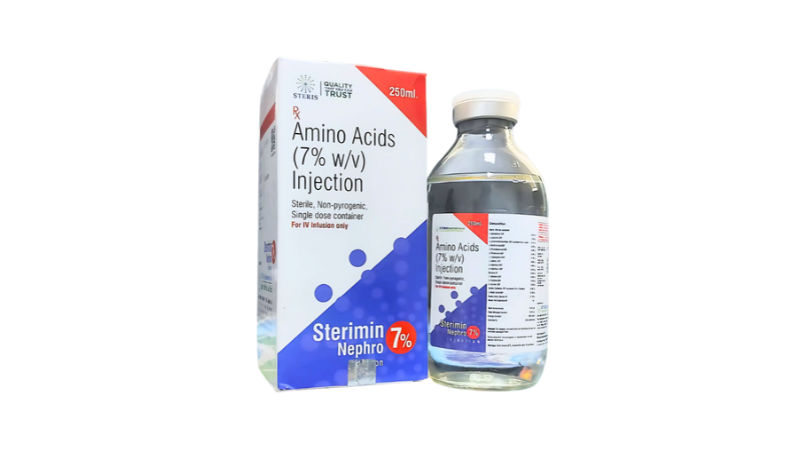


What Is Amino Acids Injection Used For?
Oct 21, 2026
Amino Acid Injection 7% by Steris Healthcare is a sterile intravenous (IV) solution that supplies amino acids, the building blocks of protein, directly into the bloodstream. It is used when a patient cannot eat, cannot eat enough, or cannot absorb nutrients through the gut, and needs protein support to maintain body tissue, heal wounds, and recover from illness or surgery.
Amino acids injection uses generally include:
- Total parenteral nutrition (TPN): as the protein component, combined with dextrose (carbohydrate), lipid emulsions, electrolytes, vitamins, and trace elements
- Peripheral parenteral nutrition: short-term support through a peripheral vein when a patient is expected to resume eating soon, where the formulation and osmolarity permit
- Before and after major surgery: to reduce muscle breakdown and support wound healing
- Severe burns and trauma: when protein needs rise sharply and oral intake is not enough
- Gastrointestinal disorders: for example, intestinal obstruction, fistulas, severe pancreatitis, or short bowel syndrome, where the gut cannot absorb nutrients
- Prolonged inability to eat: in critical illness, severe malnutrition, or swallowing failure when tube feeding is not possible
- Hypoproteinemia and negative nitrogen balance: when the body is losing more protein than it takes in
Amino Acid Injection 7% is a supportive nutritional therapy. It works alongside treatment of the underlying illness and does not replace it.
Why Are Amino Acids Important?
Amino acids are the molecules that make up proteins, and proteins do almost everything in the body. When illness, injury, or surgery strikes, the body’s demand for protein rises while the ability to eat falls. Without enough amino acids, the body begins to break down its own muscle to get them.
Amino acids matter for several reasons:
- They build and repair tissue. Muscle, skin, organs, and wounds all depend on protein.
- They support immunity. Antibodies and immune cells are made of protein, so poor nutrition can weaken defence against infection.
- They help wounds and surgical incisions heal. Collagen formation requires an adequate amino acid supply.
- They make enzymes and hormones. Many body regulators are protein-based.
- They preserve lean body mass. In critical illness, protecting muscle can influence recovery, strength, and length of hospital stay.
- They provide a nitrogen source. Maintaining nitrogen balance is a basic goal of nutritional support.
Key Benefits
What Are the Benefits of Amino Acids Injection?
1. Delivers nutrition when the gut cannot. The IV route bypasses digestion entirely, so amino acids reach the bloodstream directly.
2. Supports muscle preservation. Adequate protein supply helps limit the breakdown of lean tissue in patients who are severely ill or recovering from major surgery.
3. Promotes wound healing. Amino acids supply the raw material needed for new tissue and collagen.
4. Helps correct negative nitrogen balance. Supplying nitrogen helps shift the body from a breakdown state toward repair.
5. Part of a complete nutrition plan. It can be combined with carbohydrate, fat, electrolytes, and vitamins in a customized regimen.
6. Concentrated, efficient dosing. At 7%, the solution provides a substantial amount of protein per litre, which helps meet higher needs without excessive fluid volume.
7. Sterile, controlled delivery. Dosing is calculated by weight and clinical status and monitored by the care team, which allows precise adjustment.
Mechanism of Action:
The mechanism of action of amino acids injection is straightforward, because it supplies what the body normally gets from dietary protein.
- Direct entry into circulation. After infusion, the amino acids enter the blood and are carried to tissues throughout the body.
- Protein synthesis. Cells take up amino acids and use them to build new proteins, such as muscle, enzymes, antibodies, and structural proteins. This requires adequate energy, which is why amino acids are usually given together with dextrose or lipids. Without enough calories, the body burns amino acids for energy instead of using them to build tissue.
- Nitrogen balance. Supplying the essential amino acids, which the body cannot make, alongside the non-essential ones helps maintain or restore positive nitrogen balance.
- Metabolism in the liver. The liver processes amino acids, converting some into other compounds and breaking down excess nitrogen into urea, which the kidneys excrete.
- Energy use when needed. If calories are insufficient, amino acids can be oxidized for energy, which is why a balanced nutrition plan is important.
In simple terms, the solution replaces the dietary protein a patient is unable to take in, giving the body the materials it needs to repair itself.
Indications, Efficacy and Clinical Evidence
Indications: Source of amino acids (nitrogen) as part of parenteral nutrition in patients who cannot ingest, digest, or absorb adequate protein by mouth or enteral feeding, including those with increased protein requirements from surgery, trauma, burns, or critical illness.
What does the evidence say?
- Clinical nutrition guidelines: International guidelines from bodies such as ESPEN and ASPEN recommend parenteral nutrition, including an amino acid source, when enteral nutrition is not possible or not sufficient. They stress that the route, timing, and dose should be individualized.
- Protein dose and outcomes: Studies in critically ill and surgical patients generally support providing adequate protein to limit muscle loss, though the optimal amount and timing remain active research topics, and more is not always better, particularly in the very early phase of acute illness.
- Malnourished patients: Evidence shows that severely malnourished patients who cannot eat benefit from timely nutritional support, which can reduce complications.
- Safety: Parenteral nutrition is safe when prescribed correctly and monitored, but it carries risks such as catheter-related infection, metabolic disturbances, and liver changes with prolonged use.
Dosage Guidelines
Dosage must always be determined by a physician, clinical pharmacist, or nutrition support team. The product is administered by IV infusion under medical supervision. General principles:
- Typical adult requirement: Commonly about 0.8 to 2.0 g of amino acids per kg of body weight per day, depending on the clinical condition. Critically ill, burn, or trauma patients may need more, while patients with kidney or liver impairment may need an adjusted amount.
- Calculation: A 7% solution provides 7 g of amino acids per 100 mL. For example, a 70 kg adult prescribed 1.2 g/kg/day needs about 84 g, equal to roughly 1,200 mL of a 7% solution, delivered as part of the total regimen. Your care team will calculate the exact volume.
- Administration: By slow IV infusion, usually through a central venous catheter for concentrated solutions, or through a peripheral vein only when the product and mixture are suitable. It is often mixed with dextrose, lipids, electrolytes, and vitamins under sterile conditions in a pharmacy or ward.
- Infusion rate: Increased gradually and kept within the limit set by the prescriber. Rapid infusion may cause nausea, flushing, or metabolic disturbance.
- Children and neonates: Dosing is weight-based and specialized. Use only under pediatric nutrition guidance, with a formulation suited to children where required.
- Duration: For as long as the patient cannot meet needs by other routes, with regular review.
- Monitoring: Blood glucose, electrolytes, kidney and liver function, blood urea, triglycerides, and fluid balance are usually checked regularly.
- Overdose or too-fast infusion: May cause nausea, vomiting, high blood urea, acidosis, or confusion. The infusion should be stopped or slowed, and the medical team informed immediately.
Side Effects
Many patients tolerate it well, particularly when it is given slowly and monitored. Possible common effects include:
- Nausea or vomiting
- Flushing or a feeling of warmth
- Headache
- Pain, redness, or irritation at the infusion site
- Mild fever or chills
- Raised blood urea nitrogen
- Mild changes in blood sugar or electrolytes when combined with other nutrition components
Most of these are mild and settle when the rate is reduced. Tell your nurse or doctor if you feel unwell during an infusion.
Available Substitutes
If Amino Acid Injection 7% is unavailable, other parenteral amino acid solutions exist under various brand names, and availability differs by country and hospital. Examples include Aminoplasmal, Aminosteril, Clinisol, Travasol, Trophamine (pediatric), and Aminoven, among others. Concentrations (for example 5%, 7%, 10%, or 15%), electrolyte content, and amino acid profile differ, so a substitute should only be chosen by your doctor or pharmacist. Special formulations also exist for kidney failure, liver failure, and neonates. Multi-chamber bags that combine amino acids, glucose, and lipids are another option your care team may consider.
Amino acids injection price: The cost varies by country, pack size (for example 100 mL, 250 mL, or 500 mL), brand, and supplier or hospital pharmacy, and it changes over time. Please check with your hospital pharmacy, distributor, or Steris Healthcare for the current price and not rely on a figure published online.
Precautions and Warnings
- Medical supervision only: It should be prepared and administered by trained staff using sterile technique.
- Allergy: Do not use if you are allergic to any component of the solution.
- Severe kidney disease: Amino acid load may raise blood urea. Specialized formulations and careful dose adjustment may be required.
- Severe liver disease or hepatic coma: Standard solutions may worsen ammonia levels. Special hepatic formulations may be needed.
- Inborn errors of amino acid metabolism: Contraindicated in certain metabolic disorders unless specifically designed for use.
- Severe acidosis or hyperammonemia: Correct these before or during use, as advised by the doctor.
- Heart failure or fluid overload: Use carefully with close fluid monitoring.
- Electrolyte and glucose monitoring: Needed regularly, particularly during the first days.
- Adequate calories: Provide enough energy (carbohydrate and/or fat) so that amino acids are used for building protein, not burned for fuel.
- Infection control: Use strict aseptic technique, and monitor the catheter site for signs of infection.
- Pregnancy and breastfeeding: Use only when the doctor judges the benefit outweighs the risk.
- Children and neonates: Use only with pediatric specialist guidance.
- Visual check and storage: Do not use if the solution is cloudy, discolored, contains particles, or the container is damaged. Store in a cool, dry place below the temperature on the label, protected from light and freezing. Use immediately after opening or mixing and discard any unused portion. Keep out of reach of children.
Frequently Asked Questions (FAQs)
1. What is amino acids injection used for?
It is used to provide protein building blocks through a vein for patients who cannot eat or absorb enough nutrition by mouth or tube feeding.
2. What is Amino Acid Injection 7%?
It is a sterile IV solution by Steris Healthcare containing 7% amino acids, used as part of parenteral nutrition.
3. What are the uses of amino acids injection?
Common uses include parenteral nutrition, support after major surgery, burns, trauma, critical illness, and gut disorders that prevent normal feeding.
4. What does 7% mean in amino acids injection?
It means the solution contains 7 grams of amino acids per 100 mL, or about 70 grams per litre.
5. How is amino acids injection given?
By slow IV infusion under medical supervision, often through a central line, and usually combined with dextrose, lipids, and other nutrients.
6. What is the dose of amino acids injection?
Adult needs are commonly around 0.8 to 2.0 g per kg of body weight per day, but your doctor decides the exact amount.
7. What is the price of amino acids injection?
Price varies by brand, pack size, and country. Check with your hospital pharmacy or Steris Healthcare for the current price.
8. What are the side effects of amino acids injection?
Common ones include nausea, flushing, headache, and irritation at the infusion site. Serious reactions are less common.
9. Can amino acids injection be given at home?
Home parenteral nutrition exists for selected long-term patients, but only with specialist training, supervision, and sterile supplies.
10. Is amino acids injection safe for kidney patients?
It needs careful dosing and monitoring, and special formulations may be required for severe kidney disease.
Conclusion
Amino Acid Injection 7% by Steris Healthcare is a sterile parenteral solution that supplies amino acids when a patient cannot get enough protein through eating or tube feeding. It supports tissue repair, wound healing, immune function, and the preservation of muscle during surgery, burns, trauma, and critical illness. It works by providing the building blocks for protein synthesis and helping maintain nitrogen balance, ideally alongside adequate calories. It is generally well tolerated when dosed correctly and monitored, but it needs careful use in people with kidney disease, liver disease, metabolic disorders, or fluid overload. It should always be prescribed and supervised by a healthcare team.
For Further Information:
Mail Us: contact@sterispharma.com or info@sterispharma.com
Call Now: +91 8824175417, +91 9982524671
Recent Post
Oxymetazoline Nasal Solution: A Complete Guide to Uses and Safety
What Are Methylcobalamin Sublingual Tablets 1500 mcg Used For?
L Lysine Hydrochloride Syrup: Uses, Benefits, Dosage and Side Effects
How Do Empagliflozin, Sitagliptin, and Metformin Work Together?
Empagliflozin, Sitagliptin, and Metformin: Uses, Benefits, and Side Effects
D-Panthenol and Sodium Hyaluronate Eye Drops: Uses and Precautions
How Do Ketorolac Tromethamine Eye Drops Work?
Ofloxacin and Dexamethasone Eye Drops: Uses, Benefits, and Side Effects
How Does S-Adenosyl-L-Methionine Support Normal Body Functions?
What Is S-Adenosyl-L-Methionine (SAMe)? Uses and Benefits

