


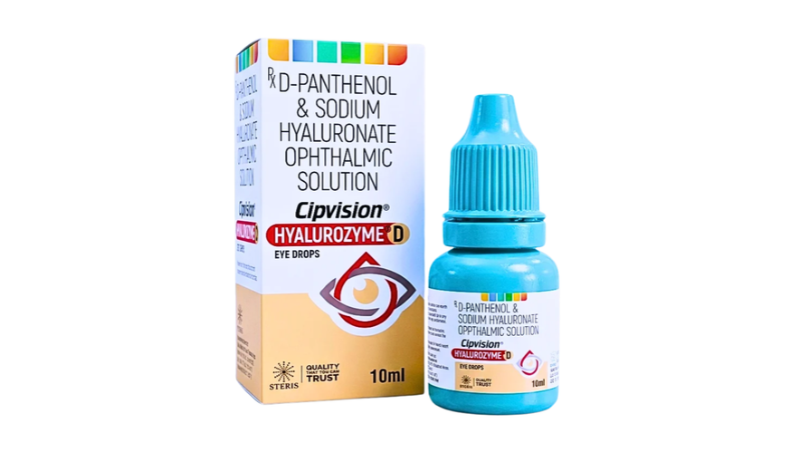


D-Panthenol and Sodium Hyaluronate Eye Drops: Uses and Precautions
Oct 21, 2026
Cipvision Hyalvrozymed by Steris Healthcare is a lubricating eye drop that combines d panthenol and sodium hyaluronate in a sterile ophthalmic solution. It is used to relieve dry, tired, gritty, or irritated eyes and to support healing of the eye’s surface. If your eyes burn after hours on a screen, feel sandy in an air-conditioned room, or are sore after contact lens wear or minor surface irritation, this is the kind of drop an eye doctor or pharmacist may suggest.
D panthenol uses in eye care, together with sodium hyaluronate, generally include:
- Dry eye symptoms: burning, stinging, grittiness, redness, and the feeling of something in the eye
- Digital eye strain: tired, dry eyes from long screen time, reading, or driving
- Contact lens discomfort: dryness and irritation during lens wear
- Environmental irritation: eye discomfort from wind, dust, smoke, air conditioning, heating, or dry air
- Minor surface irritation or damage: small corneal surface abrasions or irritation, under medical advice
- Support after eye surgery or procedures: to improve comfort and lubrication when your doctor recommends it
- Preventive lubrication: for people who are prone to dryness, such as those who work long hours at a screen or in dry, dusty places
Cipvision Hyalvrozymed manages symptoms and supports the eye surface. If dryness is caused by an underlying condition, such as an autoimmune disease, eyelid disease, or a medicine side effect, that cause also needs attention.
Why Are D Panthenol and Sodium Hyaluronate Eye Drops Important?
The front of your eye is covered by a thin tear film that keeps the surface smooth, clear, and protected. When the tear film is unstable or too thin, the surface dries out and becomes inflamed. This causes discomfort, blurry vision that comes and goes, and a cycle of irritation that can damage the surface if it continues.
These drops matter for several reasons:
- Dry eye is common and often underestimated. Modern screen habits, indoor air, ageing, hormonal changes, and contact lens use all raise the risk.
- Comfort affects daily life. Dry eyes can make reading, working, driving, and sleeping uncomfortable.
- Surface health matters for vision. A healthy tear film helps light focus clearly. A damaged surface can blur vision.
- Two ingredients support two needs. Sodium hyaluronate holds moisture on the surface, while d panthenol supports the healing of surface cells.
- They are generally gentle. Lubricant drops are a common first step before stronger treatments.
Key Benefits
What Are the Benefits of D Panthenol and Sodium Hyaluronate Eye Drops?
1. Long-lasting lubrication. Sodium hyaluronate is a natural substance that binds water, so it forms a moist, cushioning layer on the eye that stays longer than plain saline.
2. Supports healing of the eye surface. D panthenol is converted in the body to pantothenic acid (vitamin B5), which plays a role in cell repair and in the renewal of the corneal surface.
3. Relieves burning, grittiness, and tired eyes. Many people feel soothing relief within minutes of use.
4. Improves comfort with contact lenses and screens. Regular use can ease the dryness that builds up over a long day.
5. Helps protect the surface from irritation. The lubricating layer buffers the eye against dust, wind, and dry air.
6. Steroid-free and antibiotic-free. It does not carry the pressure-raising effect of steroids or the resistance concerns of antibiotics, so it suits routine, repeated use for dryness.
7. Easy to use. One or two drops, a few times a day, with no complicated routine.
8. May reduce the need for stronger treatment. For mild to moderate dryness, good lubrication can be enough to keep symptoms under control.
Mechanism of Action:
The mechanism of action of d panthenol and sodium hyaluronate eye drops relies on two complementary ingredients.
Sodium hyaluronate (lubrication and moisture retention)
- Hyaluronic acid, the parent molecule, is a long, water-loving polymer that can hold many times its weight in water.
- On the eye, it forms a viscoelastic, cushioning film that spreads evenly with each blink and stays longer than watery drops.
- It supports the stability of the tear film, reduces friction between the eyelid and the eye surface, and may support the movement of surface cells during healing.
D panthenol (surface repair and hydration)
- D panthenol (dexpanthenol) is the alcohol form of vitamin B5. After application, it is converted to pantothenic acid.
- Pantothenic acid is a component of coenzyme A, which cells need for energy and for building proteins and fats. This supports the renewal and repair of the corneal and conjunctival surface cells.
- It is also a humectant, which means it attracts and holds water, adding to the moisturizing effect.
- It has mild soothing, anti-irritant properties on the surface tissue.
In plain terms, sodium hyaluronate keeps the surface wet and comfortable, and d panthenol helps the surface cells recover. Together, they ease symptoms and support a healthier tear film.
Indications, Efficacy and Clinical Evidence
Indications: Relief of symptoms of dry eye and eye irritation, support of the corneal and conjunctival surface in mild irritation or minor damage, and lubrication for contact lens wearers and for eyes exposed to environmental stress, as approved on the product label. Approved uses differ between countries, so follow the label for Cipvision Hyalvrozymed.
What does the evidence say?
- Sodium hyaluronate: Clinical trials and systematic reviews of hyaluronate eye drops in dry eye generally report improved symptoms and signs, such as better tear film stability and surface staining, compared with no treatment or plain saline. Results are usually clearer for symptom relief than for dramatic changes in measured signs, and different concentrations perform similarly in many studies, with higher concentrations sometimes lasting longer.
- D panthenol (dexpanthenol): Studies on dexpanthenol-containing eye drops report support for corneal and conjunctival surface healing and improvement in dry eye signs and symptoms. Some small trials show benefit after procedures that disturb the corneal surface, though many studies are small, short, or use mixed formulations, so more high-quality research would strengthen the evidence.
- Combination use: Combining a hydrating polymer with a repair-supporting ingredient is a common approach in dry eye care. Evidence specific to this exact pairing is smaller than for hyaluronate alone, so benefits should be viewed as supportive and not guaranteed.
- Safety: Both ingredients have a long record of good tolerability on the eye. Most side effects are mild and temporary.
Dosage Guidelines
Always follow your eye doctor’s advice and the leaflet in your pack. General guidance for d panthenol and sodium hyaluronate eye drops:
- Adults and children (as advised): Usually 1 drop in the affected eye(s) three to four times a day, or as needed for comfort, up to the maximum stated on your label. Some people need more frequent use during severe dryness, as directed by their doctor.
- Children: Use only on medical advice, and follow the age guidance on the label.
- Duration: For short-term relief, or for ongoing use as directed. If you need the drops for more than a week or so, discuss it with your doctor, because chronic dry eye may need a fuller assessment.
How to put in eye drops:
- Wash your hands.
- Remove contact lenses unless the label says the drops are suitable for use with lenses in place.
- Tilt your head back and pull down the lower eyelid to form a small pocket.
- Hold the bottle upside down above the eye and squeeze one drop in without letting the tip touch your eye, lashes, or fingers.
- Close your eye gently for a minute and press lightly on the inner corner of the eye to keep the drop on the surface.
- Wipe away any excess and replace the cap tightly.
Other points:
- Using other drops: Wait at least 5 minutes between different eye drops. Use thicker gels or ointments last.
- Contact lenses: Wait at least 15 minutes before putting lenses back in, unless the product is labeled as lens-compatible.
- Missed dose: Simply use the next drop when needed. Do not worry about doubling up, but do not exceed the stated daily limit.
- Overdose or accidental swallowing: An extra drop is not harmful. Rinse the eye with clean water if it stings. Seek medical advice if a large amount is swallowed, especially by a child.
Side Effects
Most people tolerate these drops well. Common side effects are mild and short-lived:
- Temporary blurred vision right after instilling, because of the slightly thicker solution
- Mild stinging or burning when the drop goes in
- A sticky feeling on the eyelids or lashes
- Mild redness
- A feeling of something in the eye
- Watery eyes
These usually settle within a few minutes. Tell your doctor or pharmacist if they continue.
Available Substitutes
If Cipvision Hyalvrozymed is unavailable, other eye drops combining dexpanthenol and sodium hyaluronate are sold under various brand names, and availability differs by country. Your pharmacist can confirm a product with similar strengths and the same type of formulation (preserved or preservative-free).
Other options your doctor or pharmacist may suggest for dry or irritated eyes include:
- Sodium hyaluronate eye drops alone, in different concentrations (for example 0.1%, 0.18%, 0.3%)
- Carboxymethylcellulose (CMC) eye drops
- Hydroxypropyl methylcellulose (HPMC) or hydroxypropyl guar-based drops
- Polyethylene glycol or propylene glycol lubricants
- Carbomer-based lubricating gels, useful at night
- Preservative-free single-dose vials, which suit frequent use or sensitive eyes
- Cyclosporine or lifitegrast eye drops, which are prescription treatments for chronic dry eye disease
Do not switch to a medicated drop without advice. If you wear contact lenses, check that the replacement is compatible with them.
Precautions and Warnings
- Allergy: Do not use if you are allergic to d panthenol, panthenol-containing products, sodium hyaluronate, or any ingredient in the formulation, including preservatives.
- Do not touch the dropper tip to your eye, eyelid, fingers, or any surface. Do not share the bottle with anyone.
- Contact lenses: Preserved drops can be absorbed by soft lenses. Remove lenses before use, and wait at least 15 minutes before reinserting them, unless the label says otherwise.
- Eye infection or injury: Do not use these drops as the only treatment for an infected, injured, or chemically burned eye. Get medical care.
- Red flags needing medical attention: Severe pain, sudden vision loss, intense redness, light sensitivity, a corneal ulcer, or discharge needs prompt examination.
- Persistent symptoms: If symptoms last more than about a week, or return quickly, see an eye doctor to look for causes such as meibomian gland dysfunction, allergy, or autoimmune disease.
- Frequent use: If you need drops more than four times a day, ask about preservative-free options, since long-term exposure to preservatives can irritate the surface in some people.
- Pregnancy and breastfeeding: Generally considered low risk for lubricating drops, but use only after checking with your doctor.
- Children: Use only on medical advice.
- Other eye medicines: Tell your doctor about all drops and ointments you use. Apply the lubricant after medicated drops, leaving at least 5 minutes between them.
- Driving and machinery: Your vision may be briefly blurred after instilling. Wait until it clears before driving or operating machinery.
- Good habits help: Blink regularly during screen time, follow the 20-20-20 rule (every 20 minutes, look at something 20 feet away for 20 seconds), keep screens slightly below eye level, use a humidifier in dry rooms, and avoid direct airflow toward your face.
- Storage: Keep in a cool, dry place, away from direct sunlight, with the cap closed tightly. Discard multi-dose bottles about 28 days after first opening, or as stated on the label. Use single-dose vials once and discard them. Keep out of the reach of children.
Frequently Asked Questions (FAQs)
1. What are d panthenol and sodium hyaluronate eye drops used for?
They are used to relieve dry, irritated, tired, or gritty eyes and to support healing of the eye surface.
2. What is Cipvision Hyalvrozymed?
It is a d panthenol and sodium hyaluronate lubricating eye drop by Steris Healthcare.
3. What is d panthenol?
D panthenol (dexpanthenol) is the alcohol form of vitamin B5. In the body, it converts to pantothenic acid, which supports cell repair and moisture retention.
4. What are the uses of d panthenol eye drops?
They are used for dry eye symptoms, minor surface irritation, contact lens discomfort, and comfort after some eye procedures, as advised by a doctor.
5. What does sodium hyaluronate do in eye drops?
It is a water-binding lubricant that holds moisture on the eye surface and stabilizes the tear film.
6. What is the composition of d panthenol and sodium hyaluronate eye drops?
They usually contain d panthenol around 2% and sodium hyaluronate around 0.1% to 0.3%. Check your pack for the exact strengths.
7. How do I use d panthenol and sodium hyaluronate eye drops?
Wash your hands, tilt your head back, put one drop in the lower eyelid pocket, close your eye gently, and avoid touching the dropper tip.
8. How often can I use these eye drops?
Usually three to four times a day or as needed, within the limit on your label or as your doctor advises.
9. Can I use them with contact lenses?
Remove lenses before use and wait about 15 minutes before putting them back, unless the label says the drops are lens-compatible.
10. How long does it take for the drops to work?
Many people feel soothing relief within minutes, although the full benefit for dryness may build over a few days of regular use.
Conclusion
Cipvision Hyalvrozymed by Steris Healthcare is a d panthenol and sodium hyaluronate eye drop that lubricates the eye, relieves dryness and irritation, and supports the healing of the eye surface. Sodium hyaluronate holds moisture and steadies the tear film, while d panthenol, a form of vitamin B5, supports the repair of surface cells. It is generally well tolerated and suits screen users, contact lens wearers, and people exposed to dry or dusty environments. It manages symptoms but does not replace treatment of an underlying cause, so see an eye doctor if you have pain, vision changes, marked redness, or dryness that does not settle within a week.
For Further Information:
Mail Us: contact@sterispharma.com or info@sterispharma.com
Call Now: +91 8824175417, +91 9982524671
Recent Post
What Is Amino Acids Injection Used For?
How Do Empagliflozin, Sitagliptin, and Metformin Work Together?
Empagliflozin, Sitagliptin, and Metformin: Uses, Benefits, and Side Effects
How Do Ketorolac Tromethamine Eye Drops Work?
Ofloxacin and Dexamethasone Eye Drops: Uses, Benefits, and Side Effects
How Does S-Adenosyl-L-Methionine Support Normal Body Functions?
What Is S-Adenosyl-L-Methionine (SAMe)? Uses and Benefits
Benzydamine Mouthwash: How It Works for Mouth Pain and Inflammation
Polyethylene Glycol 3350 Powder: Uses, Dosage, Precautions, and Price
Probiotic Sachet with FOS, L-Glutamine & Colostrum – Uses and Benefits

