


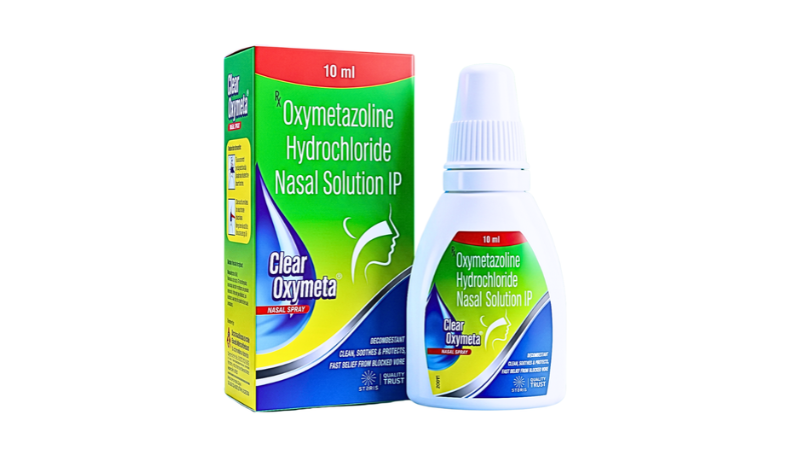


Oxymetazoline Nasal Solution: A Complete Guide to Uses and Safety
Oct 21, 2026
CLEAR OXYMETA by Steris Healthcare is an oxymetazoline hydrochloride nasal solution that relieves a blocked nose. If a cold, sinus congestion, or an allergy has left you breathing through your mouth, unable to sleep, or sounding stuffed up, a nasal decongestant like this can open your nasal passages within minutes.
Oxymetazoline hydrochloride nasal solution uses generally include:
- Nasal congestion from the common cold: the most common use, giving fast relief of a blocked nose
- Allergic rhinitis (hay fever): short-term relief of stuffiness during allergy flare-ups
- Sinusitis: easing nasal blockage and pressure as an adjunct while the sinus infection is treated
- Rhinitis from other causes: such as irritants, dust, or dry air
- Eustachian tube congestion: where a blocked nose contributes to a feeling of ear fullness or pressure, for example during air travel or a cold
- Nasal procedures and examinations: doctors sometimes use it to shrink nasal tissue and control minor bleeding, under medical direction
- Nosebleeds (epistaxis): a doctor may use it to constrict vessels in some cases
CLEAR OXYMETA is meant for short-term use. It is not a treatment for chronic nasal problems, and it does not replace antibiotics, antihistamines, or steroid nasal sprays when those are needed.
Why Is Oxymetazoline Hydrochloride Important?
A blocked nose is more than an annoyance. It disturbs sleep, causes mouth breathing and a dry throat, blunts the sense of smell and taste, reduces concentration, and can make headaches and facial pressure worse. For young children and babies, nasal blockage can interfere with feeding, though oxymetazoline 0.05% is not meant for them (see Dosage).
Oxymetazoline matters for several reasons:
- It works quickly. Relief usually begins within a few minutes of use.
- It lasts a long time. A single dose can ease congestion for up to about 12 hours, which means twice-daily dosing is enough for most people.
- It works locally. The medicine acts right where it is needed, with relatively little reaching the rest of the body when used as directed.
- It helps with sleep and comfort. Many people use it at bedtime during a cold to breathe more easily.
- It is a practical short-term option. When allergy or cold symptoms are at their worst, a decongestant can make the first few days far more bearable while other treatments take effect.
Key Benefits
What Are the Benefits of Oxymetazoline Hydrochloride Nasal Solution?
1. Fast relief of a blocked nose. Most people feel their airways open within minutes.
2. Long-lasting effect. Relief commonly lasts around 8 to 12 hours, so you do not need to dose often.
3. Reduces swelling of nasal tissue. By narrowing the dilated blood vessels in the nasal lining, it lowers swelling and mucus-related blockage.
4. Helps with sinus pressure and ear fullness. When the nasal passages open, the sinuses and eustachian tubes can drain more easily, which may ease pressure.
5. Improves breathing and sleep. Clearer breathing at night can help you rest better during a cold.
6. Local action with low general absorption. Used as directed and for short periods, it acts mainly in the nose.
7. Convenient to use. A few drops or sprays in each nostril are quick, and no preparation is needed.
8. Useful before certain nasal procedures. Under medical supervision, it helps shrink tissue and reduce bleeding.
Mechanism of Action:
The mechanism of action of oxymetazoline hydrochloride is straightforward and works through the nerves and blood vessels of the nose.
- Alpha-adrenergic agonist. Oxymetazoline is a sympathomimetic imidazoline derivative. It stimulates alpha-adrenergic receptors (mainly alpha-1 and alpha-2) on the smooth muscle of blood vessels in the nasal lining.
- Vasoconstriction. Stimulating these receptors makes the small blood vessels narrow. When congestion occurs, nasal blood vessels swell with blood, and the lining thickens and blocks the airway.
- Reduced swelling and mucus. With less blood flow and fluid leaking into the tissue, the nasal lining shrinks, the airway widens, and congestion eases.
- Duration. Oxymetazoline binds to the receptors for a relatively long time, which explains its action of up to about 12 hours.
- Why overuse backfires. With repeated use for too long, the nasal lining can become less responsive, and when the medicine wears off the blood vessels swell even more, causing “rebound congestion” (rhinitis medicamentosa). This is the main reason this medicine is limited to a few days.
In plain terms, oxymetazoline tightens the swollen blood vessels in your nose so the lining shrinks and air can flow.
Indications, Efficacy and Clinical Evidence
Indications: Temporary relief of nasal congestion due to the common cold, hay fever or other upper respiratory allergies, and sinusitis, as approved on the product label. Approved uses vary between countries, so follow the label for CLEAR OXYMETA.
What does the evidence say?
- Common cold: Trials and systematic reviews of topical nasal decongestants, including oxymetazoline, show that they reduce subjective nasal congestion and measurable nasal airway resistance in adults with colds, with effects within minutes. Reviews note the benefit is short-lived and symptom-related, and it does not shorten the cold itself.
- Allergic rhinitis: Oxymetazoline can relieve stuffiness, but it does not control sneezing, itching, or the underlying allergy. Guidelines generally prefer intranasal steroids and antihistamines for ongoing management, with decongestants used only for brief relief.
- Sinusitis: Decongestants may ease obstruction and pressure, and they are sometimes used alongside other treatment, though evidence that they improve cure rates is limited.
- Duration of effect: Studies show decongestant action lasts up to about 12 hours after a single dose.
- Rebound congestion: Prolonged use beyond the recommended period can cause rebound swelling and dependence on the spray. Some studies suggest that rebound may take longer than three days to appear in certain people, but because it varies and can be hard to reverse, the standard label advice is to limit use to about three to five days.
- Safety: When used as directed, oxymetazoline is generally well tolerated. Systemic effects are uncommon with correct use, but they can occur with overuse or in sensitive people, and accidental swallowing by young children can be dangerous.
Dosage Guidelines
Always follow your doctor’s prescription and the leaflet in your pack. General guidance for oxymetazoline hydrochloride 0.05% nasal solution:
- Adults and children over 6 years: Commonly 2 to 3 drops or 2 to 3 sprays into each nostril, twice daily (morning and evening), roughly 10 to 12 hours apart. Do not exceed two doses in 24 hours.
- Children under 6 years: The 0.05% strength is generally not recommended. A lower strength (such as 0.025%) may be used in some countries for young children, but only on a doctor’s advice. Do not use this product in infants or toddlers unless a doctor says so.
- Duration: For short-term use only, usually no more than 3 days (some labels allow up to 5 to 7 days). Do not use for longer than the label states.
- How to use the drops:
- Gently blow your nose to clear it.
- Tilt your head back slightly, or lie down with your head over the edge of the bed.
- Put the stated number of drops into each nostril without touching the dropper tip to your nose.
- Keep your head tilted for about a minute so the drops spread, then sit up.
- Wipe the dropper and close the bottle tightly.
- How to use the spray:
- Blow your nose gently.
- Keep your head upright, and insert the nozzle just inside one nostril, pointing slightly away from the middle of the nose.
- Press once, firmly and quickly, while breathing in gently through the nose.
- Repeat in the other nostril as directed.
- Avoid sniffing hard right after spraying, since that can pull the medicine into the throat.
- Wipe the nozzle and replace the cap.
- Do not share the bottle, because sharing can spread infection.
- Missed dose: Use it when you remember if you still need it, but do not use extra doses to catch up. Do not exceed the daily limit.
- Overdose or accidental swallowing: Seek medical help immediately, particularly if a child swallows it. Oxymetazoline can cause drowsiness, slow heart rate, low body temperature, and breathing problems in small children.
Side Effects
Most people tolerate the nasal solution well when it is used briefly and as directed. Common side effects are mild and local:
- Stinging, burning, or dryness inside the nose
- Sneezing right after use
- Nasal irritation or mild nosebleed
- A dry throat or mouth
- Headache
- Runny nose after the effect wears off
- Rebound congestion if used for too long
These usually settle quickly. Tell your doctor or pharmacist if they persist.
Available Substitutes
If CLEAR OXYMETA is unavailable, other oxymetazoline nasal solutions or sprays are sold under various brand names, and availability differs by country. Examples in some markets include Nasivion and Afrin. Your pharmacist can help you choose a product with the same strength (0.05%) and the same form (drops or spray).
Other options your doctor or pharmacist may suggest include:
- Xylometazoline nasal drops or spray (for example 0.1% for adults), a similar topical decongestant, with the same short-use limits
- Saline nasal drops or sprays, which are safe to use frequently, help loosen mucus, and suit infants and children
- Intranasal corticosteroid sprays (such as fluticasone, mometasone, or budesonide), better for allergic rhinitis and longer-term use, though they take days to work
- Antihistamine tablets or nasal sprays (such as cetirizine, levocetirizine, fexofenadine, or azelastine), for allergy symptoms
- Oral decongestants (such as pseudoephedrine, used with caution), which carry more whole-body effects
- Steam inhalation and warm compresses, which can ease congestion comfortably
- Sleeping with your head raised and staying well hydrated
Do not use two different decongestant nasal sprays together. Ask your pharmacist before combining it with oral cold medicines that contain decongestants.
Precautions and Warnings
- Limit use. Do not use for more than the number of days on the label (usually 3 days, up to 5 to 7 on some labels). Longer use risks rebound congestion and damage to the nasal lining.
- Rebound congestion. If your blockage returns and gets worse each time the spray wears off, stop and see your doctor. Stopping may cause a few uncomfortable days, and your doctor may suggest a steroid nasal spray or saline to help you come off the decongestant.
- Allergy: Do not use if you are allergic to oxymetazoline or any ingredient in the solution, including the preservative.
- MAO inhibitors and some antidepressants: Do not use during treatment with monoamine oxidase inhibitors, or within about two weeks of stopping one, because of the risk of a dangerous blood pressure rise. Tell your doctor about any antidepressants, including tricyclics.
- Heart disease and high blood pressure: Use only under medical advice, since oxymetazoline can affect heart rate and blood pressure.
- Thyroid disease, diabetes, enlarged prostate, and difficulty passing urine: Use with caution and ask your doctor first.
- Glaucoma: Do not use if you have narrow-angle glaucoma unless your eye doctor agrees.
- Pregnancy and breastfeeding: Use only if your doctor judges the benefit outweighs the risk, since decongestants can reduce blood flow and affect the baby. Many doctors prefer saline and non-drug measures first.
- Children: Do not use the 0.05% strength in children under 6, and keep all nasal decongestants out of children’s reach because accidental swallowing can be dangerous.
- Elderly: More sensitive to heart and blood pressure effects, so use cautiously.
- Nasal surgery or injury: Avoid unless your doctor advises it.
- Eyes: Avoid contact. If it happens, rinse with plenty of water.
- Do not swallow. It is for use in the nose only.
- Hygiene: Do not share the bottle or touch the tip to your nose, and replace the bottle after the period stated on the label once opened.
- Persistent symptoms: See a doctor if symptoms last more than a week, or if you have fever, severe facial pain, green or yellow discharge, or swelling around the eyes.
- Driving and machinery: Most people can drive normally, but if you feel dizzy or unwell, avoid it.
- Storage: Keep in a cool, dry place below 30°C, away from direct sunlight, with the cap tightly closed, and out of the reach of children.
Frequently Asked Questions (FAQs)
1. What is oxymetazoline hydrochloride nasal solution used for?
It is used for short-term relief of a blocked nose caused by the common cold, allergies, or sinus congestion.
2. What is CLEAR OXYMETA?
CLEAR OXYMETA is an oxymetazoline hydrochloride 0.05% nasal solution by Steris Healthcare for relieving nasal congestion.
3. What does “IP” mean in oxymetazoline hydrochloride nasal solution IP?
IP stands for Indian Pharmacopoeia, which means the product meets Indian quality standards.
4. What are the uses of oxymetazoline hydrochloride nasal spray?
It is used for nasal congestion from colds, hay fever, and sinusitis, and sometimes before nasal procedures under medical supervision.
5. How does oxymetazoline work?
It narrows the swollen blood vessels in the lining of the nose, which shrinks the tissue and lets air flow more freely.
6. How quickly does oxymetazoline work?
Most people feel relief within a few minutes, and it can last up to about 12 hours.
7. How do I use oxymetazoline nasal drops or spray?
Blow your nose gently, tilt your head slightly, put the stated number of drops or sprays in each nostril, and avoid touching the tip to your nose.
8. How often can I use it?
Usually twice a day, about 10 to 12 hours apart, and no more than two doses in 24 hours.
9. How many days can I use oxymetazoline?
Generally no longer than 3 days, though some labels allow up to 5 to 7 days. Follow your product label.
10. What is rebound congestion?
It is a worsening of nasal blockage caused by using a decongestant spray for too long, which makes you feel you need the spray more and more.
Conclusion
CLEAR OXYMETA by Steris Healthcare is an oxymetazoline hydrochloride nasal solution that relieves nasal congestion from colds, allergies, and sinus problems. It works by constricting swollen blood vessels in the nasal lining, which shrinks the tissue and opens the airway, with relief starting within minutes and lasting up to about 12 hours. It is effective for short-term symptom relief and is generally well tolerated, but it must not be used for more than a few days, because prolonged use can cause rebound congestion. Use it exactly as directed, keep it away from young children, avoid it if you take MAO inhibitors, and see a doctor if your symptoms last or worsen.
For Further Information:
Mail Us: contact@sterispharma.com or info@sterispharma.com
Call Now: +91 8824175417, +91 9982524671
Recent Post
How Do Linagliptin and Metformin Work Together to Manage Type 2 Diabetes?
What Are Methylcobalamin Sublingual Tablets 1500 mcg Used For?

L Lysine Hydrochloride Syrup: Uses, Benefits, Dosage and Side Effects
What Is Amino Acids Injection Used For?
How Do Empagliflozin, Sitagliptin, and Metformin Work Together?
Empagliflozin, Sitagliptin, and Metformin: Uses, Benefits, and Side Effects
D-Panthenol and Sodium Hyaluronate Eye Drops: Uses and Precautions
How Do Ketorolac Tromethamine Eye Drops Work?
Ofloxacin and Dexamethasone Eye Drops: Uses, Benefits, and Side Effects
How Does S-Adenosyl-L-Methionine Support Normal Body Functions?

