


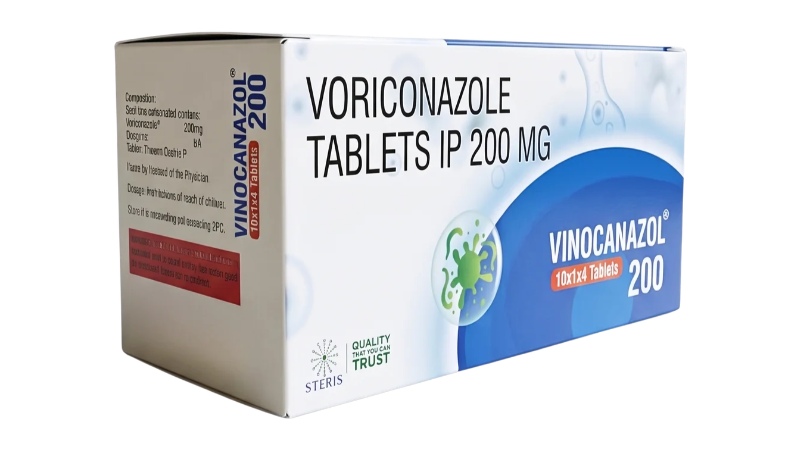


Voriconazole 200 mg : uses, Dosage, Price & Side Effects
Aug 11, 2025
VINOCANAZOL 200 contains voriconazole 200 mg per tablet. Voriconazole is a broad-spectrum triazole antifungal prescribed to treat serious and invasive fungal infections.
Voriconazole 200 mg uses
Depending on local approvals, doctors prescribe voriconazole for:
- Invasive aspergillosis, the most important use and the usual first-choice treatment
- Candidaemia (Candida infection in the bloodstream) in non-neutropenic patients
- Oesophageal candidiasis and some other serious Candida infections, including fluconazole-resistant strains
- Serious infections caused by Scedosporium and Fusarium species
- Prevention (prophylaxis) of fungal infection in some high-risk patients, such as after stem cell transplant, in certain regions
It is not intended for minor skin, nail or vaginal yeast infections, which have simpler and safer treatments.
Because treatment is started in hospitals and monitored by infectious disease specialists, haematologists, pulmonologists or other physicians, VINOCANAZOL 200 should be taken only on prescription.
Why Voriconazole Is Important in Antifungal Treatment
Invasive fungal infections are among the hardest infections to treat. They affect people with leukaemia, organ or stem cell transplants, uncontrolled diabetes, prolonged steroid use, advanced HIV, severe lung disease or intensive care stays. Without effective treatment, mortality can be high.
Voriconazole matters because:
- It is the recommended first-line treatment for invasive aspergillosis in major international guidelines.
- It covers a broad range of moulds and yeasts, including some resistant to older drugs.
- It is available in both intravenous (IV) and oral forms, so patients can step down from a drip to a voriconazole tablet once stable.
- It reaches many body tissues, including the brain and the central nervous system, at useful levels.
- Doctors can fine-tune treatment using blood level monitoring (therapeutic drug monitoring).
Mechanism of Action: How Voriconazole Works
Fungal cells need a molecule called ergosterol to build and maintain their cell membrane, just as human cells use cholesterol. Voriconazole blocks an enzyme called lanosterol 14-alpha-demethylase (a fungal cytochrome P450 enzyme, CYP51).
When this enzyme is blocked:
- Ergosterol production drops, weakening the fungal cell membrane.
- Toxic sterol intermediates build up inside the fungal cell.
- The fungus cannot grow or multiply, and many species are killed over time. Against Aspergillus, voriconazole is generally fungicidal; against Candida it is mostly fungistatic.
Because human cells depend far less on this enzyme, the drug is relatively selective, although it also affects some human liver enzymes (CYP2C19, CYP2C9 and CYP3A4), which explains its many drug interactions.
Key Benefits
What Are the Benefits of Voriconazole 200 mg?
- Proven survival advantage in invasive aspergillosis compared with older treatment.
- Broad activity against Aspergillus, many Candida species, Scedosporium and Fusarium.
- Flexible IV-to-oral switch, which supports earlier hospital discharge and continued treatment at home.
- Good tissue penetration, including the central nervous system, where infections can be especially dangerous.
- High oral bioavailability, so a voriconazole 200 mg tablet delivers levels close to the IV form when taken correctly.
- Guided dosing through blood level monitoring, which helps balance effect and safety.
Indications, Efficacy and Clinical Evidence
Here is what the strongest research shows:
- Invasive aspergillosis: In a landmark randomised trial published in the New England Journal of Medicine (2002), voriconazole was compared with amphotericin B deoxycholate. At 12 weeks, about 53% of voriconazole patients had a successful response versus roughly 32% with amphotericin B, and survival was higher with voriconazole (about 71% versus 58%), with fewer serious side effects.
- Candidaemia: A randomised trial comparing voriconazole with amphotericin B followed by fluconazole in non-neutropenic patients found similar overall success rates, supporting voriconazole as a valid option.
- Rare moulds: Open-label studies and case series show useful response rates against Scedosporium and Fusarium infections, where options are limited.
- Guidelines: Infectious disease society guidelines recommend voriconazole as the primary therapy for invasive aspergillosis, usually for a minimum of 6 to 12 weeks, depending on immune recovery and response.
- Limits of evidence: Voriconazole levels vary widely between patients because of genetics (especially CYP2C19) and interactions, so benefit and toxicity depend on proper monitoring.
In short, voriconazole is a well-established, evidence-backed antifungal for serious infection, but it needs expert supervision.
Side Effects
Side effects are common, but many are manageable. Tell your doctor about any symptom that bothers you.
Common side effects
- Visual disturbances: blurred vision, changes in colour perception, or increased brightness sensitivity (often temporary and reversible)
- Fever, chills
- Skin rash and sensitivity to sunlight
- Nausea, vomiting, diarrhoea
- Headache, dizziness
- Swelling of the legs or hands (peripheral oedema)
- Raised liver enzymes on blood tests
- Visual or auditory hallucinations in some patients
Available Substitutes
Switching antifungals is a specialist decision. Possible alternatives include:
- Other voriconazole brands with the same strength (200 mg) and form. Check the label.
- Posaconazole or isavuconazole, other mould-active triazoles. Isavuconazole may have fewer liver and eye effects and less QT prolongation.
- Liposomal amphotericin B, an IV option for severe disease or when triazoles are not suitable.
- Echinocandins (caspofungin, micafungin, anidulafungin), IV options mainly for Candida infections.
- Itraconazole for some less severe mould infections.
- Fluconazole, which covers many yeast infections but does not treat Aspergillus.
Dosage Guidelines
The dose must be decided by your doctor based on the infection, your weight, liver function and blood levels. Typical adult oral dosing described in prescribing information includes:
- Adults weighing 40 kg or more: usually 200 mg every 12 hours, which may be increased to 300 mg every 12 hours if the response is inadequate.
- Adults weighing less than 40 kg: usually 100 mg every 12 hours, which may be increased to 150 mg.
- Loading dose: Treatment for serious infection often begins with an intravenous loading dose or a higher oral dose in the first 24 hours, then continues with the maintenance dose.
- Liver impairment: In mild to moderate cirrhosis, the maintenance dose is usually halved. It is not recommended in severe liver disease unless the benefit clearly outweighs the risk.
- How to take it: Swallow the voriconazole tablet with water at least one hour before or one hour after a meal, because food reduces absorption. Take it at the same times each day.
- Duration: Often several weeks to months. Do not stop early, even when you feel better.
- Missed dose: Take it as soon as you remember, unless the next dose is near. Do not double up.
- Children: Dosing is weight-based and set by a paediatric specialist.
- Monitoring: Expect blood tests for liver function and, in many centres, drug level (trough) checks, along with ECG and electrolyte monitoring when needed.
Precautions and Warnings When Using
- Drug interactions are the biggest concern. Voriconazole must not be combined with certain medicines, including rifampicin, rifabutin, carbamazepine, long-acting barbiturates, St John's wort, ergot alkaloids, pimozide, quinidine, cisapride, sirolimus, and some HIV medicines at certain doses. It can also raise levels of ciclosporin, tacrolimus, warfarin, some statins, benzodiazepines and phenytoin, and doses often need adjusting. Share a full list of your medicines and supplements.
- Heart conditions: Tell your doctor if you have a heart rhythm disorder, low potassium or magnesium, or take other QT-prolonging drugs.
- Liver and kidney disease: Needs closer monitoring and possible dose changes.
- Sun protection: Avoid direct sunlight. Use broad-spectrum sunscreen, a hat and protective clothing. Report any new or changing skin lesions.
- Driving and machinery: Vision changes can affect night driving. Do not drive or operate machinery if your vision is affected.
- Pregnancy: Voriconazole can harm an unborn baby and is generally avoided unless the benefit clearly outweighs the risk. Women who could become pregnant should use effective contraception during treatment and ask their doctor about its duration.
- Breastfeeding: Discuss with your doctor. Breastfeeding is generally not recommended during treatment.
- Lactose content: Tablets may contain lactose. Tell your doctor if you have hereditary galactose intolerance or lactase deficiency.
- Allergy to other azole antifungals: Tell your doctor, as cross-reactivity may occur.
- Long-term use: Needs monitoring for skin changes, bone pain and fluoride-related effects.
- Storage: Store in a cool, dry place, away from light and children, and follow the instructions on the pack.
Frequently Asked Questions
1. What is voriconazole?
Voriconazole is a triazole antifungal medicine used to treat serious fungal infections such as invasive aspergillosis.
2. What is VINOCANAZOL 200?
VINOCANAZOL 200 is a Steris Healthcare brand of voriconazole 200 mg tablets, prescribed for serious fungal infections.
3. What are the uses of voriconazole 200 mg?
It is used for invasive aspergillosis, candidaemia, oesophageal candidiasis, and serious Scedosporium and Fusarium infections, and sometimes for prevention in high-risk patients.
4. How does voriconazole work?
It blocks the fungal enzyme needed to make ergosterol, which damages the fungal cell membrane and stops fungal growth.
5. How should I take a voriconazole 200 mg tablet?
Swallow it with water at least one hour before or after a meal, at the same times each day, as your doctor directs.
6. What is the usual dose of voriconazole 200 mg?
For adults weighing 40 kg or more, the usual oral maintenance dose is 200 mg every 12 hours, but your doctor sets the exact dose.
7. What are the common side effects of voriconazole?
Visual changes, fever, rash, nausea, vomiting, headache, swelling and raised liver enzymes.
8. What are the serious side effects of voriconazole?
Liver injury, heart rhythm problems, severe skin reactions, serious allergy, and long-term skin and bone problems.
9. Why does voriconazole affect vision?
It can temporarily change how the retina and optic nerve function, causing blurred vision or colour changes that usually go away.
10. Can I drink alcohol while taking voriconazole?
It is best to avoid alcohol, since both can stress the liver.
11. Can I stay in the sun while on voriconazole?
Avoid direct sun and use sunscreen and protective clothing, because the drug increases skin sensitivity.
12. Which medicines should not be taken with voriconazole?
Rifampicin, rifabutin, carbamazepine, St John's wort, ergot alkaloids, pimozide, quinidine and others. Always show your doctor your full medicine list.
13. Is voriconazole safe in pregnancy?
It can harm the unborn baby and is generally avoided unless the benefit outweighs the risk. Use effective contraception.
14. How long does voriconazole treatment last?
Often several weeks to months, depending on the infection and immune recovery. Do not stop early.
15. Is voriconazole safe for people with liver disease?
It needs dose reduction and close monitoring, and is avoided in severe liver disease unless essential.
Conclusion
VINOCANAZOL 200 (voriconazole 200 mg) from Steris Healthcare is a triazole antifungal for serious invasive fungal infections, most importantly invasive aspergillosis, as well as selected Candida, Scedosporium and Fusarium infections. It works by blocking ergosterol production in fungal cells and has strong clinical evidence, including improved survival over older therapy in aspergillosis. It also comes with important cautions: liver toxicity, QT prolongation, visual and skin effects, and many drug interactions. Take it exactly as prescribed, on an empty stomach, protect your skin from the sun, keep up with blood tests, and tell your doctor about every medicine you use.
For Further Information:
Mail Us: contact@sterispharma.com or info@sterispharma.com
Call Now: +91 8824175417, +91 9982524671
Recent Post
Mecobalamin Injection 1500 mcg/ml Uses, Benefits, Dosage & Side Effects
Methylcobalmine 1500mcg+Ala+Etc Capsules Uses, Benefits, Dosage, Side Effects
ZENCOBAL D3 Uses, Benefits & Price in India | Steris Healthcare
Zinc Acetate 50mg: Uses, Benefits, Dosage, Side Effects
Ziprasidone Capsules 40mg Uses, Benefits, Dosage, Side Effects
Zoledronic Acid 5 mg: Uses, Benefits & Dosage – Steris Healthcare
Paracetamol Diclofenac Sodium and Chlorzoxazone Tablets: Uses, Benefits, Dosage, Side Effects
Cefuroxime Axetil 500mg + Potassium Clavulanate 125mg Uses, Benefits & Side Effects
Cefuroxime Axetil 500mg Uses, Benefits, Side Effects
Cefuroxime Axetil 250mg Uses, Benefits, Side Effects

