


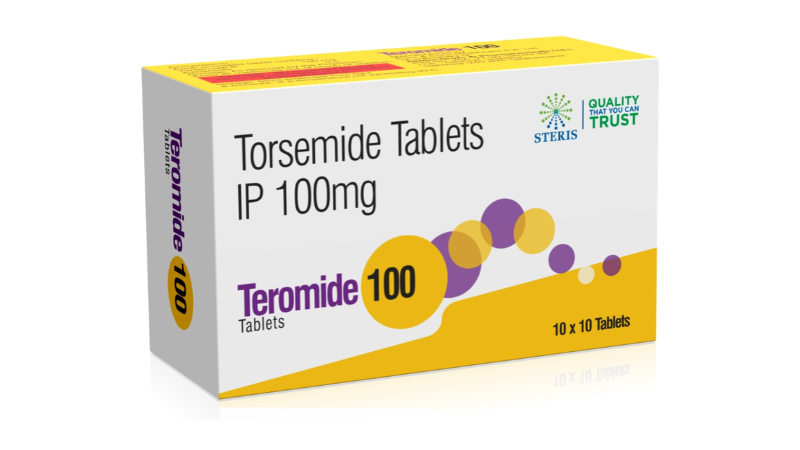


Torsemide 100 mg: Uses, Dosage, Side Effects, and Precautions
Oct 22, 2026
TEROMIDE 100, from Steris Healthcare, is a tablet containing torsemide 100 mg. Torsemide (also spelled torasemide) is a loop diuretic, a powerful class of diuretic that acts on the part of the kidney called the loop of Henle.
The torsemide uses that doctors commonly consider include:
- Oedema (fluid retention) associated with congestive heart failure
- Oedema due to chronic kidney disease, including some cases of nephrotic syndrome
- Oedema and ascites due to liver cirrhosis, usually together with a potassium-sparing diuretic such as spironolactone
- Hypertension (high blood pressure), where lower doses are used, alone or with other medicines
- Pulmonary congestion, where fluid collects in the lungs because of heart failure
- Maintenance therapy after hospital treatment with injectable diuretics, as decided by the doctor
The 100 mg strength is at the upper end of the range and is generally reserved for patients with significant fluid overload or reduced kidney function, in whom lower doses have not been enough. It is a prescription-only medicine, and the dose should always be set and adjusted by a doctor.
Why Is Torsemide Important?
Fluid overload is not just uncomfortable. In heart failure, extra fluid makes the heart work harder, causes breathlessness and is one of the leading reasons for hospital admission. In kidney disease, uncontrolled fluid raises blood pressure and strains the heart. In cirrhosis, ascites causes pain, breathlessness and a risk of infection.
Here is why torsemide holds an important place:
- It is a potent, reliable diuretic. Loop diuretics produce more urine than thiazide diuretics, and they remain effective even when kidney function is reduced.
- It has good, predictable absorption. Oral torsemide is almost completely absorbed (bioavailability of around 80 to 90 per cent) and is not much affected by food or by gut swelling. Furosemide, in comparison, is absorbed unpredictably, and this is more of a problem when the gut wall is swollen with fluid in heart failure.
- It lasts longer. Torsemide acts for roughly 6 to 8 hours, compared with 3 to 4 hours for furosemide, so a single daily dose is often enough, which supports adherence.
- It may offer additional benefits in heart failure. Some research suggests torsemide has anti-aldosterone properties and may reduce cardiac fibrosis, though the clinical meaning is still being studied.
- It treats high blood pressure in suitable patients, at lower doses.
For patients, the practical gain is less swelling, easier breathing, better exercise tolerance and, for many, fewer unplanned visits to hospital.
Mechanism of Action
What Is in TEROMIDE 100?
Each tablet contains torsemide 100 mg as the active ingredient, together with inactive excipients that form the tablet. Always read the carton for the full composition.
How Does Torsemide Work?
Your kidneys filter blood and then reclaim most of the salt and water before urine is formed. A large share of the salt is recovered in the thick ascending limb of the loop of Henle.
- Blocks the Na⁺/K⁺/2Cl⁻ co-transporter: Torsemide binds to this transporter on the inner surface of the tubule cells and blocks it.
- Salt stays in the urine: Sodium, potassium and chloride are not reabsorbed.
- Water follows the salt: Because water moves with salt, urine volume rises sharply (diuresis).
- Fluid leaves the body: Extracellular fluid and blood volume fall, which reduces swelling, lung congestion and the workload on the heart, and lowers blood pressure.
- Other effects: Loop diuretics also increase excretion of calcium, magnesium and hydrogen ions. Torsemide additionally has a mild vasodilating effect and may counteract aldosterone to a small degree.
Key Benefits
What Are the Benefits of TEROMIDE 100?
- Strong fluid removal in patients with significant oedema, including those with reduced kidney function.
- Reliable absorption, so the effect is more predictable than with some other loop diuretics.
- Longer duration of action, often allowing once-daily dosing.
- Relief of breathlessness and swelling in heart failure, as congestion falls.
- Blood pressure lowering at lower doses in selected patients.
- Possible lower risk of hospital re-admission in heart failure, based on some studies, although the largest trial did not confirm a difference (see below).
- Useful for switching from injectable to oral therapy after a hospital stay.
- Fine-tuned dosing: Lower-strength tablets can be used to titrate down once the fluid is controlled, so 100 mg is rarely a long-term starting point.
Indications, Efficacy and Clinical Evidence
A balanced summary of what the research shows:
- Heart failure with oedema: Studies comparing torsemide with furosemide have reported greater relief of symptoms and, in some smaller trials, fewer hospital admissions for heart failure with torsemide. These findings made torsemide an attractive option.
- The TRANSFORM-HF trial: This large, pragmatic, randomised trial compared torsemide with furosemide in patients discharged after a heart-failure hospitalisation. It found no significant difference in all-cause mortality between the two drugs over the follow-up period, and no significant difference in the combined outcome of death or hospitalisation. This is an important and honest result. It suggests that the choice between the two loop diuretics can reasonably rest on patient factors, such as response, tolerability, convenience and cost, rather than on a proven survival advantage.
- Renal oedema: Studies in chronic kidney disease show that torsemide produces effective diuresis, and higher doses can be needed as kidney function falls. Dose requirements are typically larger in advanced disease.
- Cirrhosis: Torsemide has been used with spironolactone for ascites and oedema, with outcomes broadly comparable to furosemide-based regimens in smaller studies.
- Hypertension: At low doses (a few milligrams daily), torsemide lowers blood pressure and has been studied in this role, though thiazide-type diuretics remain more commonly used for uncomplicated hypertension.
- Limits of the evidence: Many trials were small or open-label. Fluid removal is not the same as improving long-term outcomes. Diuretics relieve symptoms, but they do not cure the underlying heart, kidney or liver disease, which needs its own treatment.
Dosage Guidelines
Dosing must always be set by your doctor and adjusted according to your weight, fluid status, blood tests and kidney function. The following is general information only.
- Heart failure oedema: Commonly started at 10 to 20 mg once daily, increased as needed. Higher doses, up to 100 mg per day or sometimes more in specialist care, may be used in severe fluid overload or advanced kidney disease.
- Chronic kidney disease oedema: Often starts at 20 mg once daily, with a stepwise increase according to response. Higher doses, in the range of 50 to 100 mg and above, may be needed in advanced impairment.
- Hepatic cirrhosis: Commonly 5 to 10 mg once daily, together with an aldosterone antagonist, and adjusted carefully because of the risk of electrolyte disturbance.
- Hypertension: Typically a much lower dose, such as 2.5 to 5 mg once daily, which means a 100 mg tablet is not appropriate for this use.
- The 100 mg tablet is a high-strength product. It is not a starting dose for most patients, and it should not be used by anyone who has not been specifically prescribed it. Never split or share tablets.
- Timing: Take it in the morning, so the increased urination does not disturb your sleep. If a second dose is prescribed, take it early in the afternoon.
- With or without food: It can be taken either way. If it upsets your stomach, take it with food.
- Daily weights: Weigh yourself every morning after passing urine and before breakfast, and keep a record. A rapid gain (for example, more than about 1 to 2 kg in a day or 2 to 3 kg in a week) should be reported to your doctor.
- Missed dose: Take it when you remember, unless it is late in the day. Do not take a double dose, and do not take it close to bedtime.
- Do not stop suddenly or change the dose without your doctor’s advice.
- Monitoring: Regular blood tests for sodium, potassium, magnesium, creatinine, urea and uric acid are part of safe use, along with blood pressure checks.
Side Effects
Many side effects come from the drug’s intended action, the loss of fluid and salts. They may include:
- Increased urination, particularly in the first hours after the dose
- Thirst and dry mouth
- Dizziness or light-headedness, especially on standing up
- Headache
- Muscle cramps or weakness
- Fatigue
- Low potassium (hypokalaemia), which can cause weakness, cramps and palpitations
- Low sodium (hyponatraemia), low magnesium and low calcium
- Nausea, diarrhoea or constipation
- Raised uric acid, which can trigger gout in susceptible people
- Raised blood sugar in some patients
- Increased urea and creatinine in the blood
- Ringing in the ears, particularly with high doses
Many of these improve with dose adjustment, adequate fluid and salt guidance from your doctor, and potassium supplements or potassium-sparing medicines where necessary.
Available Substitutes
Several pharmaceutical companies market torsemide (torasemide) tablets in India and elsewhere in a range of strengths, such as 5 mg, 10 mg, 20 mg and 40 mg. A 100 mg tablet is less commonly stocked, so many patients are instead prescribed combinations of lower-strength tablets. Other loop diuretics include furosemide and bumetanide, while other diuretic classes include thiazides (such as hydrochlorothiazide and chlorthalidone), thiazide-like drugs (metolazone, indapamide) and potassium-sparing agents (spironolactone, eplerenone, amiloride). These are not interchangeable: they differ in potency, duration, side effects and indications. A common approximate equivalence is that torsemide 20 mg is roughly comparable to furosemide 40 mg by mouth, but exact conversion should always be made by your doctor. Never switch products yourself, and never combine tablets of different strengths to reach a dose without medical guidance.
Precautions and Warnings
Do not use if you:
- Are allergic to torsemide, other loop diuretics or any ingredient in the tablet. Tell your doctor if you are allergic to sulfonamide (“sulfa”) medicines.
- Have anuria (the kidneys produce no urine)
- Have severe dehydration or very low blood volume
- Have severe, uncorrected low sodium, low potassium or other significant electrolyte disturbances
- Have hepatic coma or a precoma state
- Have severely low blood pressure
Tell your doctor before starting if you:
- Have kidney disease or reduced urine output
- Have liver disease or cirrhosis, as rapid fluid shifts can trigger hepatic encephalopathy
- Have diabetes, since blood sugar may change
- Have gout or high uric acid
- Have an enlarged prostate or difficulty passing urine, because the increase in urine volume can cause urinary retention
- Have a heart rhythm problem, or take digoxin, since low potassium or magnesium raises the risk of arrhythmia
- Have low blood pressure or are elderly, because they are more prone to dizziness, falls and dehydration
- Have hearing problems or take other ototoxic medicines
- Are pregnant, planning pregnancy or breastfeeding. Loop diuretics are generally avoided in pregnancy unless clearly necessary, and they may reduce milk production. Your doctor will weigh the risks and benefits.
- Are a competitive athlete, since diuretics are on prohibited lists in some sports
Practical advice:
- Take the tablet in the morning, and plan your day around the increased urination.
- Rise slowly from lying or sitting to avoid dizziness and falls.
- Follow your doctor’s guidance on fluid and salt intake. Do not restrict or increase fluids on your own, and avoid very salty foods.
- Ask your doctor whether you need potassium-rich foods or a supplement. Do not start potassium supplements or salt substitutes (which often contain potassium) without advice.
- Keep a daily weight diary and report rapid changes.
- Take extra care in hot weather, during illness with vomiting or diarrhoea, or when you are not eating or drinking well. Ask your doctor whether to pause the dose on such “sick days”.
- Limit alcohol, which adds to dizziness and dehydration.
- Do not drive or operate machinery if you feel dizzy.
- Attend all blood test and clinic appointments.
- Store the tablets in a cool, dry place, away from moisture, light and children.
Frequently Asked Questions (FAQs)
1. What is torsemide 100 mg used for?
Torsemide 100 mg is a high-strength loop diuretic used to treat significant fluid retention (oedema) caused by heart failure, kidney disease or liver cirrhosis, as prescribed by a doctor.
2. What are the main torsemide uses?
Oedema in heart failure, chronic kidney disease and cirrhosis, pulmonary congestion and, at much lower doses, high blood pressure.
3. What is TEROMIDE 100?
TEROMIDE 100 is a torsemide 100 mg tablet marketed by Steris Healthcare.
4. What type of medicine is torsemide?
It is a loop diuretic, often called a water tablet.
5. How does torsemide work?
It blocks the Na⁺/K⁺/2Cl⁻ co-transporter in the loop of Henle, so more salt and water are passed in the urine, which reduces fluid in the body.
6. When should I take torsemide?
Usually once daily in the morning, so that increased urination does not disturb your sleep.
7. How quickly does torsemide work?
It begins to work within about an hour, with a peak effect in one to two hours, and the action lasts several hours.
8. Can I take torsemide with food?
Yes. It can be taken with or without food, and taking it with food may help if it upsets your stomach.
9. Is torsemide better than furosemide?
Torsemide is absorbed more reliably and lasts longer, but the large TRANSFORM-HF trial found no significant difference in mortality between the two, so the choice depends on the patient.
10. What are the common side effects of torsemide?
Frequent urination, thirst, dizziness, headache, muscle cramps, fatigue and changes in potassium, sodium and magnesium levels.
Conclusion
TEROMIDE 100 by Steris Healthcare, containing torsemide 100 mg, is a high-strength loop diuretic used to remove excess fluid in heart failure, kidney disease and liver cirrhosis. By blocking the sodium-potassium-chloride transporter in the loop of Henle, it makes the kidneys pass more salt and water, which eases swelling, lung congestion and strain on the heart. Torsemide offers reliable absorption and a longer action than furosemide, although large trials such as TRANSFORM-HF suggest that its survival benefit over furosemide is not proven, so the choice rests on the individual patient. Because the 100 mg strength is potent, it should be used only when prescribed, with regular monitoring of weight, blood pressure, kidney function and electrolytes. Take it in the morning, report dizziness, muscle weakness, palpitations, hearing changes or a sharp fall in urine output promptly, and never adjust the dose on your own.
For Further Information:
Mail Us: contact@sterispharma.com or info@sterispharma.com
Call Now: +91 8824175417, +91 9982524671
Recent Post

EUROSOFT MOSQUITO SHIELD
Olmesartan and Metoprolol: Uses, Benefits, Dosage & Side Effects | Steris Healthcare
Tofacitinib 11 mg Tablets: A Complete Guide to Uses and Side Effects
Olmesartan Medoxomil + Metoprolol Succinate: Uses, Dosage
How Streptococcus Thermophilus Supports Digestive Health
Olmesartan Medoxomil + Metoprolol Succinate: Uses, Benefits & Side Effects
Sirolimus 1 mg: Uses, Dosage, Side Effects, and Precautions
What Is Cefpodoxime Proxetil? Uses and Benefits Explained
Mirtazapine 7.5 mg: Uses, Benefits, Dosage & Side Effects

Clotrimazole Dusting Powder: Uses, Benefits, and Side Effects

