


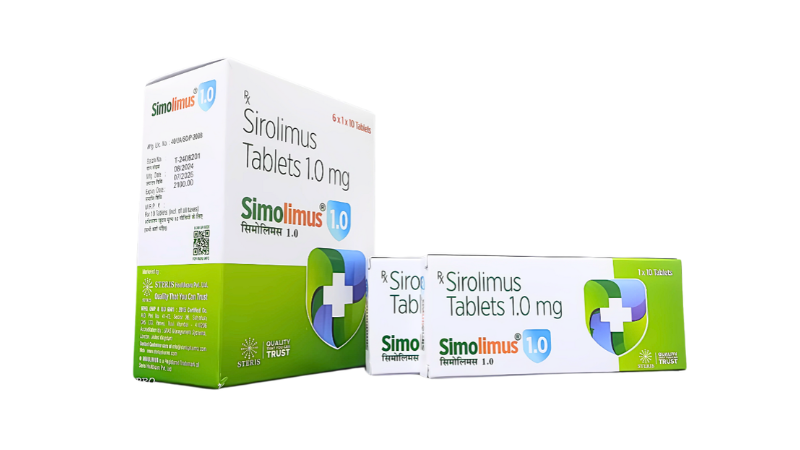


Sirolimus 1 mg: Uses, Dosage, Side Effects, and Precautions
Oct 22, 2026
SIMOLIMUS 1.0, from Steris Healthcare, is a tablet containing sirolimus 1 mg. Sirolimus (also known as rapamycin) is an mTOR inhibitor, a type of immunosuppressant that was first discovered in a soil bacterium found on Easter Island (Rapa Nui), which is where the name “rapamycin” comes from.
The sirolimus uses that doctors commonly consider include:
- Prevention of organ rejection in kidney transplant recipients, typically in patients at low to moderate immunological risk
- Use in combination with other immunosuppressants, such as ciclosporin (for a limited period) and corticosteroids, in standard regimens
- Maintenance therapy after early withdrawal of ciclosporin, in selected patients under specialist supervision
- Lymphangioleiomyomatosis (LAM), a rare progressive lung disease affecting mostly women, in which sirolimus helps stabilise lung function
- Selected rare conditions such as certain vascular anomalies and tuberous sclerosis-related manifestations, in specialist care and in some regions
Approved indications differ between countries and brands. This is a prescription-only, specialist medicine, and it must be started and monitored by a transplant physician or a relevant specialist.
Why Is Sirolimus Important?
After a transplant, the balance between preventing rejection and avoiding over-suppression of the immune system is delicate. Too little immunosuppression risks losing the organ. Too much raises the chance of serious infections and certain cancers. Long-term use of some older drugs, particularly calcineurin inhibitors like ciclosporin and tacrolimus, can also damage the very kidney that was transplanted.
Here is why sirolimus holds an important place:
- It works differently from calcineurin inhibitors. Because its mechanism is distinct, it can be used to reduce or avoid calcineurin inhibitor exposure in selected patients, which may help protect kidney function.
- It has anti-proliferative properties. Beyond suppressing immunity, sirolimus slows the growth of certain cells, which is the reason it has been explored for skin cancer risk reduction in transplant recipients.
- It offers an option when other drugs are not tolerated. Some patients develop side effects from standard regimens, and sirolimus gives the transplant team another tool.
- It treats a rare lung disease. In LAM, sirolimus is one of the few medicines shown to slow decline in lung function.
- It is available as a tablet for long-term home use, with blood-level monitoring to keep the dose precise.
For patients, the practical gain is protection of the transplanted organ with a regimen that is tailored to their risk profile.
Mechanism of Action
What Is in SIMOLIMUS 1.0?
Each tablet contains sirolimus 1 mg as the active ingredient, together with inactive excipients that form the tablet. Always read the carton for the full composition.
How Does Sirolimus Work?
Sirolimus acts on a central cellular control switch called mTOR (mammalian target of rapamycin).
- Binds to FKBP-12: Inside immune cells, sirolimus first binds a small protein called FKBP-12.
- Inhibits mTOR: The sirolimus-FKBP-12 complex blocks mTOR, a protein kinase that drives cell growth, metabolism and division.
- Stops T-cell and B-cell proliferation: When an immune cell is activated by a foreign organ, it normally receives growth signals (such as interleukin-2) and multiplies. By blocking mTOR, sirolimus prevents these cells from progressing through the cell cycle, so the immune attack on the transplant is dampened.
- Different step from calcineurin inhibitors: Ciclosporin and tacrolimus block the early activation signal in T-cells. Sirolimus acts later, on the response to growth signals, which is why the two classes can be used together or one in place of the other.
- Anti-proliferative effect beyond immunity: The same pathway controls growth in other cells, which explains both its benefits (such as in LAM and some vascular conditions) and some of its side effects (such as delayed wound healing and mouth ulcers).
Key Benefits
What Are the Benefits of SIMOLIMUS 1.0?
- Prevents rejection of kidney transplants as part of a combination regimen.
- Kidney-sparing potential: In selected patients, it allows lower or no calcineurin inhibitor exposure, which can help preserve kidney function.
- Lower skin cancer risk in some studies: Data suggest transplant patients converted to sirolimus may develop fewer new skin cancers than those staying on calcineurin inhibitors.
- Stabilises lung function in LAM, a disease with few treatment options.
- Once-daily dosing, which supports adherence.
- Flexible 1 mg strength, which allows fine adjustment based on blood levels.
- Different side-effect profile from other immunosuppressants, which can suit patients who cannot tolerate those.
- Long clinical experience since its approval for transplant use in the late 1990s.
Indications, Efficacy and Clinical Evidence
A balanced summary of what the research shows:
- Prevention of kidney transplant rejection: Pivotal randomised trials in the late 1990s showed that adding sirolimus to ciclosporin and corticosteroids significantly lowered the rate of acute rejection in the first six months compared with control regimens.
- Calcineurin inhibitor withdrawal and conversion: Studies of ciclosporin withdrawal after the early period reported better kidney function in the sirolimus group, though with a trade-off in some trials of a higher rate of acute rejection. Conversion trials in patients with declining kidney function from calcineurin inhibitor toxicity gave mixed results, and benefit seems greatest when conversion happens early and kidney damage is not advanced.
- Safety signals in some trials: Large studies, including ones comparing sirolimus with tacrolimus or with ciclosporin, found that sirolimus-based regimens could carry higher rates of certain adverse effects, including proteinuria, wound-healing problems and mouth ulcers. This is why the choice of regimen is individualised.
- Liver transplant caution: Sirolimus is not recommended in the early period after liver transplantation because of an increased risk of hepatic artery thrombosis, and an increased mortality and graft loss signal was noted in some trials.
- Lung transplant caution: Bronchial anastomotic dehiscence has been reported when sirolimus was started early after lung transplantation.
- Skin cancer: Trials in kidney transplant recipients with prior skin cancers (such as the CONVERT and TUMORAPA studies) suggested a reduced rate of new skin cancers after switching, though not all trials agree, and discontinuation due to side effects was higher.
- LAM: The MILES trial showed that sirolimus stabilised lung function over 12 months in patients with LAM, compared with decline in the placebo group, and the benefit was lost after stopping treatment. This underlines the need for continued therapy when it is working.
- Limits of the evidence: The strength of evidence differs by indication. Most data come from transplant trials in selected populations, and results cannot be generalised to everyone. This is why specialist supervision and regular blood-level monitoring are essential.
Dosage Guidelines
Sirolimus dosing is highly individualised and must be set and adjusted by a specialist using blood-level measurements. The following is general information only.
- Kidney transplant (low to moderate risk, with ciclosporin): A typical regimen involves a loading dose on the first day, followed by a once-daily maintenance dose, with the dose adjusted to achieve target blood trough levels. Ciclosporin is usually withdrawn after two to four months in selected patients, and the sirolimus target level is then raised.
- Lymphangioleiomyomatosis (LAM): Treatment often begins at a low daily dose, with adjustment to a target trough level determined by the specialist.
- Blood level monitoring: Trough levels are checked a week or more after any dose change, and regularly thereafter. Different laboratory methods can give different readings, so the same lab and method should be used where possible.
- Consistency matters: Take it at the same time every day, and consistently either with or without food, as food changes absorption.
- Swallow whole: Swallow the tablet with water. Do not crush, chew or split unless the leaflet or your specialist allows it.
- Separate from ciclosporin: When used with ciclosporin, sirolimus is usually taken about four hours after the ciclosporin dose, as advised.
- Liver impairment: The dose is usually reduced, and trough levels are monitored closely.
- Avoid grapefruit and grapefruit juice, which raise sirolimus levels.
- Missed dose: Take it as soon as you remember, if it is within a short window. Do not double up, and contact your transplant team for advice.
- Never stop abruptly. Stopping can cause rejection. Any change should be made only by your transplant team.
Side Effects
Side effects are common, and many are dose-related. They may include:
- Mouth ulcers and sores (aphthous stomatitis)
- Swelling of the hands, feet or ankles (peripheral oedema)
- Raised cholesterol and triglyceride levels
- Acne or other skin rash
- Diarrhoea, constipation, nausea or abdominal pain
- Headache
- Joint pain
- Low blood counts, including anaemia, low platelets and low white cells
- High blood pressure
- Increased urine protein (proteinuria)
- Delayed wound healing
- Fever
- Urinary tract infections
- Menstrual irregularities, and, in men, effects on sperm count and testosterone
Many of these can be managed by dose adjustment, supportive care or medication. Report them rather than stopping the drug yourself.
Available Substitutes
Several pharmaceutical companies market sirolimus tablets and oral solutions in India and elsewhere, and a well-known originator brand exists in many countries. Other mTOR inhibitors such as everolimus are used in transplantation and oncology, and other immunosuppressants include tacrolimus, ciclosporin, mycophenolate and azathioprine. These work differently, have different dosing and monitoring requirements, and are not interchangeable. Even different sirolimus products can vary in how they are absorbed, so changing between brands should be done only under your transplant team’s supervision, with extra blood-level monitoring afterwards. Never switch on your own.
Precautions and Warnings
Do not use if you:
- Are allergic to sirolimus, related compounds or any ingredient in the tablet
- Are a liver transplant recipient in the early post-transplant period, unless a specialist has expressly decided otherwise
- Are a lung transplant recipient in the early period after surgery, unless your specialist has advised otherwise
Tell your doctor before starting if you:
- Have an active infection, a history of recurrent infections, hepatitis B or C, or tuberculosis
- Have a history of cancer, particularly skin cancer
- Have kidney disease, proteinuria or a history of kidney problems
- Have liver disease
- Have high cholesterol or triglycerides, or a history of heart disease
- Have diabetes or are at risk of it
- Plan to have surgery, since wound healing can be impaired and the doctor may adjust treatment around the operation
- Are pregnant, planning pregnancy or breastfeeding. Sirolimus is generally not recommended in pregnancy, and effective contraception is advised during treatment and for a period after stopping, as specified in the leaflet. Women of childbearing age should discuss this carefully with their transplant team. Breastfeeding is generally not advised.
- Are a man planning to father a child, since sirolimus may affect fertility and sperm
- Take any other medicines, herbal products or supplements
Practical advice:
- Attend every scheduled blood test and clinic review. Dose adjustment depends on them.
- Protect your skin from the sun: use sunscreen, wear protective clothing and have regular skin checks.
- Practise good oral hygiene, and report mouth ulcers early.
- Wash hands frequently, avoid close contact with people who are visibly unwell, and follow food safety rules.
- Have cholesterol, blood sugar, kidney function and urine protein checked regularly.
- Do not stop the medicine or change the dose without your transplant team’s instructions.
- Carry a medicine card or note stating that you take an immunosuppressant.
- Store the tablets in the original pack, in a cool, dry place, away from light, moisture and children.
Frequently Asked Questions (FAQs)
1. What is sirolimus 1 mg used for?
Sirolimus 1 mg is used to prevent organ rejection in kidney transplant recipients and, under specialist care, to treat lymphangioleiomyomatosis (LAM).
2. What are the main sirolimus uses?
Prevention of kidney transplant rejection, treatment of LAM and, in some regions and specialist settings, certain rare vascular and tuberous sclerosis-related conditions.
3. What is SIMOLIMUS 1.0?
SIMOLIMUS 1.0 is a sirolimus 1 mg tablet marketed by Steris Healthcare.
4. What type of medicine is sirolimus?
It is an immunosuppressant and an mTOR inhibitor, also known as rapamycin.
5. How does sirolimus work?
It binds FKBP-12 and blocks mTOR, which stops immune cells from multiplying in response to growth signals and so reduces the immune attack on a transplanted organ.
6. How is sirolimus different from tacrolimus and ciclosporin?
Tacrolimus and ciclosporin are calcineurin inhibitors that block early T-cell activation, while sirolimus blocks a later growth-signalling step through mTOR. Their side-effect profiles also differ.
7. How should I take a sirolimus tablet?
Once daily, at the same time each day, and consistently either with or without food. Swallow it whole with water.
8. Why do I need regular blood tests on sirolimus?
Blood levels vary widely between people, so doctors measure trough levels to keep the dose effective and safe.
9. Can I take sirolimus with grapefruit juice?
No. Grapefruit can raise sirolimus levels and increase side effects.
10. What are the common side effects of sirolimus?
Mouth ulcers, swelling of the ankles, high cholesterol, acne, diarrhoea, headache, joint pain, low blood counts and delayed wound healing.
Conclusion
SIMOLIMUS 1.0 by Steris Healthcare, containing sirolimus 1 mg, is an mTOR-inhibitor immunosuppressant used to prevent rejection in kidney transplant recipients and, under specialist care, to treat lymphangioleiomyomatosis. By blocking the growth signals that immune cells need to multiply, it protects the transplanted organ and offers a kidney-sparing alternative in selected patients. Its benefits come with real responsibilities: regular blood-level monitoring, vigilance for infection, careful management of cholesterol and kidney function, sun protection, and attention to interactions. The evidence differs by indication, and the regimen must be individualised by a transplant specialist. Take it exactly as directed, never stop it abruptly, and report fever, breathing difficulty, swelling or any new symptoms promptly.
For Further Information:
Mail Us: contact@sterispharma.com or info@sterispharma.com
Call Now: +91 8824175417, +91 9982524671
Recent Post
Tofacitinib 11 mg Tablets: A Complete Guide to Uses and Side Effects
Olmesartan Medoxomil + Metoprolol Succinate: Uses, Dosage
Torsemide 100 mg: Uses, Dosage, Side Effects, and Precautions
How Streptococcus Thermophilus Supports Digestive Health
Olmesartan Medoxomil + Metoprolol Succinate: Uses, Benefits & Side Effects
What Is Cefpodoxime Proxetil? Uses and Benefits Explained
Mirtazapine 7.5 mg: Uses, Benefits, Dosage & Side Effects
Clotrimazole Dusting Powder: Uses, Benefits, and Side Effects
What Is Empagliflozin and Metformin? Uses, Benefits, and Side Effects
Hydrochlorothiazide 12.5 mg: Uses, Benefits & Side Effects

