




Tofacitinib 11 mg Tablets: A Complete Guide to Uses and Side Effects
Oct 22, 2026
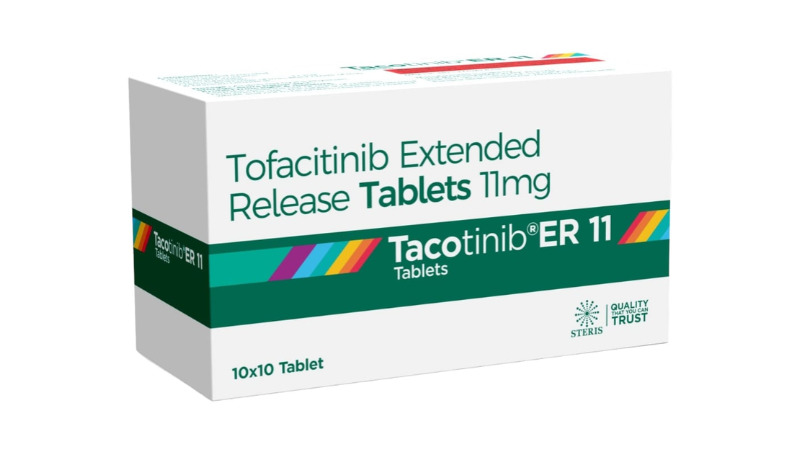
TACOTINIB ER 11, from Steris Healthcare, is an extended-release tablet containing tofacitinib 11 mg. Tofacitinib is a Janus kinase (JAK) inhibitor, a targeted synthetic disease-modifying antirheumatic drug (tsDMARD). The extended-release form is designed for once-daily use.
The tofacitinib 11 mg uses that doctors commonly consider include:
- Moderately to severely active rheumatoid arthritis (RA) in adults who have had an inadequate response or intolerance to methotrexate or other conventional treatments
- Active psoriatic arthritis (PsA) in adults who have had an inadequate response to one or more DMARDs
- Active ankylosing spondylitis (AS) in adults who have had an inadequate response to conventional therapy, in regions where it is approved (the extended-release 11 mg strength is generally used for RA and PsA, and approved uses differ by country)
- Ulcerative colitis, where a different dosing schedule is typically used under specialist guidance
Approved indications and available strengths differ between countries and brands. Tofacitinib is a prescription-only medicine, and it should be started and monitored by a rheumatologist or other relevant specialist.
Why Is Tofacitinib Important?
Inflammatory arthritis is not just a joint problem. Uncontrolled disease causes pain, loss of function, fatigue and, over time, deformity and disability. It is also linked to higher cardiovascular risk. Early and effective control of inflammation is the single most important goal of treatment.
Here is why tofacitinib holds a place in modern care:
- It is an oral targeted therapy. Many biologic drugs need injections or infusions. Tofacitinib is a tablet, which some patients find more convenient.
- It works through a different mechanism. It blocks intracellular signalling rather than neutralising a single cytokine outside the cell, so it can help patients who have not responded to other drug classes.
- It acts quickly for many patients. Improvement is often noticed within a few weeks.
- It can be used alone or with methotrexate. This flexibility helps patients who cannot tolerate methotrexate.
- Once-daily extended-release dosing supports adherence.
For patients, the practical gain is less pain and morning stiffness, better function and a chance to slow joint damage. These benefits come with serious safety considerations, which makes careful patient selection essential.
Mechanism of Action
What Is in TACOTINIB ER 11?
Each tablet contains tofacitinib 11 mg (commonly as tofacitinib citrate) in an extended-release matrix, along with inactive ingredients. The extended-release design releases the drug gradually over the day. Do not crush, split or chew the tablet. Also, you may notice an intact tablet shell in your stool. This is normal, since the tablet casing is not absorbed, and it does not mean the medicine failed.
How Does Tofacitinib Work?
Many inflammatory signals, such as interleukin-6, interferon-gamma and others, work by binding to receptors on cell surfaces. Those receptors then activate enzymes inside the cell called Janus kinases (JAK1, JAK2, JAK3 and TYK2).
- Blocks JAK enzymes: Tofacitinib inhibits JAK1 and JAK3 most strongly, with some activity on JAK2.
- Interrupts the JAK-STAT pathway: Normally, activated JAKs phosphorylate STAT proteins, which travel to the cell nucleus and switch on inflammatory genes. By blocking JAKs, tofacitinib stops this relay.
- Reduces multiple cytokine signals at once: Several cytokines involved in RA signal through JAKs, so tofacitinib dampens many inflammatory messages together.
- Calms immune cell activity: T-cell, B-cell and natural killer cell function is reduced, which helps control the autoimmune attack on the joints.
The same broad effect explains the safety concerns: reduced immune signalling can raise infection risk, and JAK2 inhibition can affect blood cell production.
Key Benefits
What Are the Benefits of TACOTINIB ER 11?
- Reduces joint pain, swelling and morning stiffness in active rheumatoid arthritis.
- Improves physical function and quality of life, as measured in clinical trials.
- Slows radiographic progression (structural joint damage) when used with methotrexate.
- Once-daily oral dosing, with no injections.
- Can be used as monotherapy in patients who cannot take methotrexate.
- Fast onset in many patients.
- Useful after other therapies have failed, including some biologics.
- Helps with psoriatic arthritis symptoms in suitable patients.
- Predictable dosing without the need for routine drug-level monitoring.
Indications, Efficacy and Clinical Evidence
A balanced look at the research:
- Rheumatoid arthritis: The ORAL clinical trial programme (including ORAL Solo, ORAL Sync, ORAL Standard, ORAL Scan and ORAL Start) enrolled thousands of patients. Compared with placebo, tofacitinib produced significantly higher ACR20, ACR50 and ACR70 response rates and larger improvements in disability scores. In ORAL Scan, tofacitinib plus methotrexate reduced the progression of joint damage. In ORAL Start, in patients not previously treated with methotrexate, tofacitinib showed greater clinical and structural benefits than methotrexate alone.
- Psoriatic arthritis: The OPAL Broaden and OPAL Beyond trials reported superior ACR20 responses to placebo, including in patients who had not responded to TNF inhibitors.
- Ankylosing spondylitis: Trials have shown improvement in disease activity scores versus placebo in patients who did not respond to NSAIDs, leading to approval in some regions.
- Ulcerative colitis: The OCTAVE trials showed higher rates of remission and mucosal healing versus placebo, with dosing different from RA schedules.
- The ORAL Surveillance safety trial: This large, post-approval, randomised trial enrolled patients with RA aged 50 or over who had at least one additional cardiovascular risk factor. It compared tofacitinib (5 mg and 10 mg twice daily) with TNF inhibitors. The study did not meet its non-inferiority criteria for major adverse cardiovascular events and malignancies, and it found higher rates of these outcomes, and of blood clots and death, with tofacitinib. These results led regulators in the United States, Europe and elsewhere to strengthen warnings and to recommend that JAK inhibitors be used in higher-risk patients, such as older adults, current or past long-term smokers and those with cardiovascular or cancer risk factors, only if no suitable alternatives exist.
- Limits of the evidence: The efficacy data are strong, but the safety data call for caution. Treatment decisions need a careful, individual benefit-risk discussion between you and your specialist.
Dosage Guidelines
Dosing must always be set by your specialist. The following is general information only.
- Rheumatoid arthritis and psoriatic arthritis (extended-release): The usual dose is one 11 mg extended-release tablet once daily. It is often used with methotrexate or other non-biologic DMARDs, and in some patients as monotherapy.
- Swallow whole with water. Do not crush, split or chew an extended-release tablet.
- With or without food: It can be taken either way, at about the same time each day.
- Do not combine formulations: Do not take immediate-release and extended-release tablets together unless your doctor specifically instructs you to.
- Switching: Patients stable on immediate-release 5 mg twice daily can switch to extended-release 11 mg once daily, as directed by the doctor.
- Kidney and liver impairment: Dose reduction or avoidance is required in moderate to severe impairment, and the 11 mg extended-release tablet is not suitable for all patients. In such cases, your doctor will often use an immediate-release product at a lower dose.
- Interacting medicines: If you take a strong CYP3A4 inhibitor (such as ketoconazole) or a medicine that inhibits both CYP3A4 and CYP2C19 (such as fluconazole), your doctor will reduce the dose.
- Blood-count thresholds: Treatment is generally not started, or is interrupted, if lymphocyte count, neutrophil count or haemoglobin fall below specified safety limits, so you will need regular blood tests.
- Interruption during infection: If you develop a serious infection, your doctor will usually pause treatment until it is controlled.
- Missed dose: Take it when you remember on the same day. If it is nearly time for the next dose, skip the missed dose. Never take two doses at once.
- Do not stop abruptly without your specialist’s advice. Disease flares may follow.
- Monitoring: Complete blood count, liver enzymes, lipid profile (usually 4 to 8 weeks after starting), kidney function and screening for tuberculosis and hepatitis B and C before and during treatment.
Side Effects
Common side effects of tofacitinib may include:
- Upper respiratory tract infections, such as colds, sore throat and sinusitis
- Headache
- Diarrhoea, nausea or stomach upset
- Raised cholesterol and triglyceride levels
- Raised liver enzymes
- Rash
- High blood pressure
- Low white blood cell counts or anaemia
- Increased creatine kinase (CK) levels on blood tests
- Herpes simplex cold sores
- Urinary tract infections
- Acne
- Fatigue
Some effects, such as lipid and liver changes, are usually found on blood tests rather than felt, which is why scheduled monitoring is important.
Available Substitutes
Several pharmaceutical companies market tofacitinib tablets in India and elsewhere, including the originator brand Xeljanz and its extended-release version, in strengths such as 5 mg (immediate-release) and 11 mg (extended-release). Other JAK inhibitors include baricitinib and upadacitinib. Other options for inflammatory arthritis include methotrexate, leflunomide, sulfasalazine, hydroxychloroquine, TNF inhibitors (adalimumab, etanercept, infliximab), IL-6 inhibitors and others. These are not interchangeable. They differ in mechanism, route, evidence and risk. Even among tofacitinib products, the immediate-release and extended-release forms are dosed differently. Never switch on your own. Your specialist will decide on the best option.
Precautions and Warnings
Do not use if you:
- Are allergic to tofacitinib or any ingredient in the tablet
- Have an active serious infection, including active tuberculosis
- Have severe liver impairment
- Are pregnant or breastfeeding. Tofacitinib is not recommended in pregnancy, and animal studies showed harm to the developing foetus. Women of childbearing age should use effective contraception during treatment and for a period afterwards, as stated in the leaflet, and should not breastfeed during treatment and for a period after the last dose.
- Are taking potent immunosuppressants such as azathioprine or ciclosporin, or biologic DMARDs, at the same time, since the risk of serious infection is increased
Tell your doctor before starting if you:
- Have a history of infections, tuberculosis exposure, hepatitis B or C, HIV or recurrent shingles
- Have had a heart attack, stroke or blood clots, or have risk factors such as smoking, high blood pressure, diabetes or high cholesterol
- Are 50 years or older, or are a current or former long-term smoker, since risks are higher in these groups
- Have a history of cancer
- Have diverticulitis or a history of bowel perforation
- Have kidney or liver problems
- Have low blood counts
- Have lung disease
- Plan to have a vaccination. Live vaccines should be avoided during treatment. Ask your doctor to update non-live vaccines, such as the shingles (recombinant), influenza and pneumococcal vaccines, before starting if possible.
- Take other medicines, herbal products or supplements
Practical advice:
- Attend every scheduled blood test and review.
- Wash hands often, avoid close contact with people who are clearly unwell, and report fever promptly.
- Do not smoke. Smoking worsens both rheumatoid arthritis and the cardiovascular risk with JAK inhibitors.
- Protect your skin from the sun and have regular skin examinations.
- Maintain a healthy diet, exercise as tolerated, and manage blood pressure, cholesterol and blood sugar.
- Do not stop the medicine or change the dose without your specialist’s advice.
- Carry a card or note stating that you take an immunosuppressant.
- Store the tablets in the original pack, in a cool, dry place, away from moisture and children.
Frequently Asked Questions (FAQs)
1. What is tofacitinib 11 mg used for?
Tofacitinib 11 mg extended-release is used to treat moderately to severely active rheumatoid arthritis and active psoriatic arthritis in adults, as prescribed by a specialist.
2. What are the main tofacitinib 11 mg uses?
Rheumatoid arthritis and psoriatic arthritis, and in some regions ankylosing spondylitis, usually after other treatments have not worked well enough.
3. What is TACOTINIB ER 11?
TACOTINIB ER 11 is a tofacitinib 11 mg extended-release tablet marketed by Steris Healthcare.
4. What type of medicine is tofacitinib?
It is a Janus kinase (JAK) inhibitor, a targeted oral immunomodulating medicine.
5. How does tofacitinib work?
It blocks JAK enzymes inside immune cells, which interrupts the JAK-STAT signalling pathway and reduces inflammatory cytokine activity.
6. How should I take tofacitinib 11 mg?
Once daily, swallowed whole with water, at about the same time each day, with or without food.
7. How long does tofacitinib take to work?
Many patients notice improvement within two to four weeks, with further gains over the following months.
8. What are the tofacitinib side effects?
Common effects include colds and upper respiratory infections, headache, diarrhoea, raised cholesterol, raised liver enzymes, rash and high blood pressure.
9. What are the serious side effects of tofacitinib?
Serious infections, shingles, blood clots, heart attack or stroke, certain cancers, gastrointestinal perforation, low blood counts and liver problems.
10. Does tofacitinib increase the risk of infection?
Yes. It lowers immune activity, so infections including tuberculosis and shingles can occur. Report fever or infection symptoms promptly.
Conclusion
TACOTINIB ER 11 by Steris Healthcare, containing tofacitinib 11 mg extended-release, is a once-daily oral JAK inhibitor used for moderately to severely active rheumatoid arthritis and psoriatic arthritis in adults who have not responded adequately to conventional treatment. By blocking the JAK-STAT signalling pathway, it reduces the inflammatory messages that drive joint pain, swelling and damage. Clinical trials show clear benefits for symptoms, function and joint protection, but safety data, especially from the ORAL Surveillance trial, show higher risks of serious infections, cardiovascular events, blood clots and cancer in higher-risk patients. That is why tofacitinib should be used only under specialist supervision, after screening for infections, with regular blood tests, and after a frank discussion of risks and alternatives. Take it exactly as prescribed, avoid smoking, protect your skin, and report fever, chest pain, leg swelling, breathlessness or any new symptoms promptly.
For Further Information:
Mail Us: contact@sterispharma.com or info@sterispharma.com
Call Now: +91 8824175417, +91 9982524671
Recent Post

EUROSOFT MOSQUITO SHIELD
Olmesartan and Metoprolol: Uses, Benefits, Dosage & Side Effects | Steris Healthcare
Olmesartan Medoxomil + Metoprolol Succinate: Uses, Dosage
Torsemide 100 mg: Uses, Dosage, Side Effects, and Precautions
How Streptococcus Thermophilus Supports Digestive Health
Olmesartan Medoxomil + Metoprolol Succinate: Uses, Benefits & Side Effects
Sirolimus 1 mg: Uses, Dosage, Side Effects, and Precautions
What Is Cefpodoxime Proxetil? Uses and Benefits Explained
Mirtazapine 7.5 mg: Uses, Benefits, Dosage & Side Effects

Clotrimazole Dusting Powder: Uses, Benefits, and Side Effects

