




Clotrimazole Dusting Powder: Uses, Benefits, and Side Effects
Oct 22, 2026
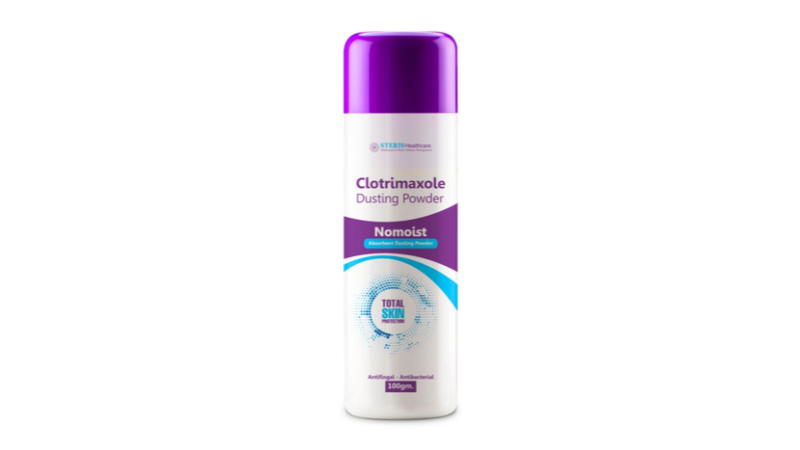
NOMOIST DUSTING POWDER 100, from Steris Healthcare, is a clotrimazole dusting powder. It combines an established antifungal medicine with a fine powder base that helps keep skin dry, so it tackles both the fungus and the moisture that feeds it.
The clotrimazole dusting powder uses that doctors commonly consider include:
- Tinea pedis (athlete’s foot), the itchy, peeling or cracked skin between the toes
- Tinea cruris (jock itch), the red, itchy rash of the groin and inner thighs
- Tinea corporis (ringworm of the body), ring-shaped, scaly patches on the trunk or limbs
- Intertrigo, a rash in skin folds such as under the breasts, the armpits or the abdominal folds, when complicated by fungal infection
- Candidal skin infections (cutaneous candidiasis) in moist areas
- Pityriasis (tinea) versicolor, in some patients, under medical advice
- Prevention of recurrence in people who sweat heavily or who are prone to repeated fungal infection, including use inside socks and shoes where advised
A dusting powder is particularly suited to moist, friction-prone areas where a cream or ointment may feel heavy or sticky. It is for external use only, and the diagnosis and treatment duration should be confirmed by a doctor, especially if the rash is widespread, recurrent or not improving.
Why Is Clotrimazole Dusting Powder Important?
Fungal skin infections are among the most common skin problems worldwide. They are rarely dangerous, but they can be intensely itchy, embarrassing and stubborn. They also spread easily: from feet to groin, from person to person through shared towels, and from the floors of gyms or bathrooms. Untreated, they can lead to skin cracking, secondary bacterial infection and repeated flare-ups.
Here is why this formulation matters:
- It treats the cause and the environment. Clotrimazole attacks the fungus, while the powder base absorbs moisture and reduces friction, which makes the skin less hospitable to fungal growth.
- It is practical for skin folds and feet. Creams can feel greasy in areas that are already damp. A powder spreads thinly, stays put and feels dry.
- It supports prevention. Because dryness is the key to keeping fungus away, a powder can also be used to reduce recurrences once the infection has cleared, as advised by a doctor.
- It is broad-spectrum. Clotrimazole is active against dermatophytes (the fungi that cause ringworm, athlete’s foot and jock itch), yeasts such as Candida and Malassezia, and some other fungi.
- It acts locally. Very little of the medicine reaches the bloodstream when applied to intact skin, which limits whole-body side effects.
For patients, the practical gain is quick relief from itching and burning, clearing of the rash and, importantly, fewer relapses.
Mechanism of Action
What Is in NOMOIST DUSTING POWDER 100?
The active ingredient is clotrimazole, an imidazole antifungal. It is mixed into a dusting powder base, which commonly includes ingredients such as talc or other fine absorbent powders and, in some products, other skin-friendly excipients. Please read your carton for the exact strength and the full ingredient list, since formulations can differ between manufacturers.
How Does Clotrimazole Work?
Clotrimazole belongs to the azole class of antifungals. Its action can be explained in simple steps:
- Blocks ergosterol production: Fungal cell membranes need a fat-like molecule called ergosterol, in the same way human cell membranes need cholesterol. Clotrimazole inhibits an enzyme (14-alpha-demethylase) that fungi use to make ergosterol.
- Damages the fungal membrane: Without enough ergosterol, the membrane becomes leaky and unstable. Essential cell contents escape and the fungus cannot grow or multiply.
- Fungistatic and, at higher concentrations, fungicidal: At usual topical concentrations, it stops fungal growth, and at higher concentrations, it can kill susceptible fungi.
- Helps relieve symptoms: As the fungal load falls, itching, redness and scaling gradually settle.
The Role of the Powder Base
The dusting powder itself contributes to the therapeutic effect. It absorbs sweat, reduces skin-on-skin friction and helps keep the area dry. This does not replace the antifungal action, but it supports it by making the skin environment less favourable for fungus.
Key Benefits
What Are the Benefits of NOMOIST DUSTING POWDER 100?
- Targeted antifungal action against the common fungi that cause foot, groin and body infections.
- Keeps the skin dry, which reduces itching, irritation and the chance of recurrence.
- Non-greasy and light: Comfortable in skin folds and in hot weather.
- Easy to apply: No rubbing is needed, which matters when the skin is sore.
- Useful in shoes and socks: A small amount dusted inside footwear can help limit reinfection, if your doctor or pharmacist advises it.
- Low absorption through the skin, so general side effects are uncommon.
- Suitable for use with other measures, such as good hygiene and breathable clothing.
- Widely used and well understood, with decades of clinical experience behind clotrimazole.
Indications, Efficacy and Clinical Evidence
A balanced summary of what the evidence shows:
- Established efficacy of topical azoles: Systematic reviews of treatments for athlete’s foot and ringworm show that topical azole antifungals, including clotrimazole, are significantly more effective than placebo at clearing the infection (mycological cure) and improving symptoms.
- Clotrimazole in dermatophyte infections: Clinical studies of 1% clotrimazole preparations in tinea pedis, tinea cruris and tinea corporis have reported high rates of clinical and mycological cure when used regularly for the recommended period, typically a few weeks.
- Candidal skin infections: Clotrimazole has demonstrated activity against Candida in skin folds and similar sites, with good symptom relief in trials and in practice.
- Comparison with other antifungals: Imidazoles such as clotrimazole, miconazole and ketoconazole are generally comparable in effectiveness for many superficial fungal infections. Some other classes, such as allylamines (for example terbinafine), may clear certain dermatophyte infections faster in some studies, but clotrimazole remains a dependable, affordable option.
- Evidence specific to powders: Much of the clinical research involves creams and solutions. Powder forms are supported by the same active ingredient, and they are valued mainly for their drying effect and suitability for moist areas. Direct trial data for powders are more limited, so many doctors use a powder as an adjunct to a cream or for prevention rather than as the only treatment in severe or widespread infection.
- Practical takeaway: Treatment must continue for the full recommended duration, usually until a week or two after the skin looks normal, to lower the chance of relapse. Nail and scalp infections do not respond to topical powders alone and need a different approach.
Dosage Guidelines
Always follow your doctor’s or pharmacist’s directions and the leaflet in your pack. The following is general information.
- Frequency: Commonly applied to the affected area two to three times a day, or as directed.
- Amount: A thin, even layer is enough. More powder does not work better and can cake in skin folds.
- Before applying: Wash the area gently with mild soap and water, then dry it thoroughly, especially between the toes and in skin folds. Applying powder on damp skin can lead to clumping.
- How to apply: Hold the container a little distance from the skin and dust lightly over the affected area and a small margin of surrounding skin. For the feet, also dust between the toes. Wash your hands afterwards unless your hands are the treated area.
- For footwear: If your doctor advises, dust a small amount inside clean, dry socks and shoes.
- Duration: Many infections need treatment for about two to four weeks, and sometimes longer. Continue for the full period advised, even if symptoms ease sooner.
- Missed application: Apply when you remember and continue as usual. Do not apply extra to compensate.
- Children: Use only on medical advice. In babies and young children, avoid dusting powder near the face because inhaling fine powder can irritate the lungs.
- For external use only: Do not swallow it, and do not apply to the eyes, mouth or inside the nose or vagina.
- Combination with a cream: Sometimes a doctor may advise a clotrimazole cream for active infection and powder for drying and prevention.
Side Effects
Clotrimazole is usually well tolerated on the skin. When side effects occur, they are generally mild and confined to the area of application. They may include:
- Mild burning or stinging
- Redness or irritation
- Itching that seems to worsen briefly
- Dryness or peeling of the skin
- Mild swelling or blistering at the site
- Tingling or a feeling of warmth
- Skin rash
Mild irritation often settles. Tell your doctor or pharmacist if it continues.
Available Substitutes
Several companies market clotrimazole dusting powders and clotrimazole creams, lotions and solutions in India and elsewhere. Other antifungal options include miconazole, ketoconazole, luliconazole, terbinafine and sertaconazole, available in creams, powders, sprays and lotions. These medicines are not automatically interchangeable: the choice depends on the type of fungus, the site, the severity and your medical history. Do not switch on your own. Ask your doctor or pharmacist to confirm the active ingredient, strength and suitability for you.
Precautions and Warnings
Do not use if you:
- Are allergic to clotrimazole, other imidazole antifungals or any ingredient in the powder
- Have a skin condition or rash that has not been diagnosed, unless a doctor advises it
Tell your doctor or pharmacist before using if you:
- Have broken, weeping or severely inflamed skin, since the powder may irritate it or cake
- Have asthma or a lung condition, since inhaling fine powder can trigger symptoms
- Are pregnant or breastfeeding. Topical clotrimazole is generally considered to have low absorption, but you should still ask your doctor first.
- Are treating a baby or toddler. Avoid applying near the face and be especially careful about inhalation.
- Have diabetes or a weakened immune system, as fungal infections may be more persistent and need closer medical supervision
- Are using other skin products on the same area
Practical advice:
- Keep skin dry. Dry thoroughly after bathing, swimming and exercise, and pay attention to between the toes and skin folds.
- Wear breathable fabrics, such as cotton, and change out of sweaty clothes promptly.
- Change socks daily and let shoes air out between wears.
- Do not share towels, combs, socks or footwear.
- Wash bedding and towels in hot water while the infection is active.
- Wear sandals in public showers, pools and gyms to avoid catching athlete’s foot.
- Avoid scratching, which spreads infection and can lead to bacterial complications.
- Treat all affected areas together, since athlete’s foot often spreads to the groin.
- Do not inhale the powder. Apply away from the face and avoid shaking the container near your nose.
- Keep away from the eyes. Rinse with water if contact occurs.
- See a doctor if there is no improvement after about two weeks, if the rash worsens or spreads, if you have fever, or if the infection keeps returning.
- Store in a cool, dry place, with the lid closed tightly, away from children and moisture.
Frequently Asked Questions (FAQs)
1. What is clotrimazole dusting powder used for?
It is used to treat and help prevent fungal skin infections such as athlete’s foot, jock itch, ringworm and candidal infections in skin folds.
2. What are the clotrimazole dusting powder uses?
Main uses include tinea pedis, tinea cruris, tinea corporis, intertrigo with fungal infection, cutaneous candidiasis and prevention of recurrence in moist, sweaty areas.
3. What is NOMOIST DUSTING POWDER 100?
It is a clotrimazole dusting powder marketed by Steris Healthcare for topical use on fungal skin infections.
4. How does clotrimazole work?
It blocks the production of ergosterol, an essential part of the fungal cell membrane, which damages the membrane and stops the fungus from growing.
5. How often should I apply clotrimazole dusting powder?
Commonly two to three times a day, or as directed by your doctor or pharmacist.
6. How long should I use it?
Often about two to four weeks, and usually for a week or two after the skin looks normal, to reduce the risk of recurrence.
7. Should I apply it on wet or dry skin?
Apply it on clean, thoroughly dry skin. Damp skin can cause the powder to clump.
8. Can I use clotrimazole dusting powder between my toes?
Yes. It is commonly used between the toes for athlete’s foot. Dry the area well before applying.
9. Can I use it for jock itch?
Yes. It is used for fungal infection of the groin, but avoid applying it to broken or very raw skin, and keep it away from mucous membranes.
10. Can I put clotrimazole powder inside my shoes and socks?
A small amount may be used if your doctor or pharmacist advises it, to help reduce reinfection.
Conclusion
NOMOIST DUSTING POWDER 100 by Steris Healthcare, a clotrimazole dusting powder, is a practical option for common fungal skin infections such as athlete’s foot, jock itch, ringworm and skin-fold candidiasis. Clotrimazole stops fungus from building its cell membrane, while the powder base keeps the skin dry and reduces friction, which means the product works on both the cause and the conditions that let the infection thrive. Results are best when the area is cleaned and dried before each application, when the powder is used for the full duration advised, and when hygiene and clothing habits support healing. Stop use and seek care for allergic symptoms, worsening skin, or an infection that does not improve.
For Further Information:
Mail Us: contact@sterispharma.com or info@sterispharma.com
Call Now: +91 8824175417, +91 9982524671
Recent Post
How Streptococcus Thermophilus Supports Digestive Health
Olmesartan Medoxomil + Metoprolol Succinate: Uses, Benefits & Side Effects
Sirolimus 1 mg: Uses, Dosage, Side Effects, and Precautions
What Is Cefpodoxime Proxetil? Uses and Benefits Explained
Mirtazapine 7.5 mg: Uses, Benefits, Dosage & Side Effects
What Is Empagliflozin and Metformin? Uses, Benefits, and Side Effects
Hydrochlorothiazide 12.5 mg: Uses, Benefits & Side Effects
Betahistine 16 mg Tablets: Uses, Benefits and Precautions
What Is Colchicine 0.5 mg Used For? A Complete Guide
Sitagliptin and Metformin Tablets for Type 2 Diabetes: Uses and Benefits

