


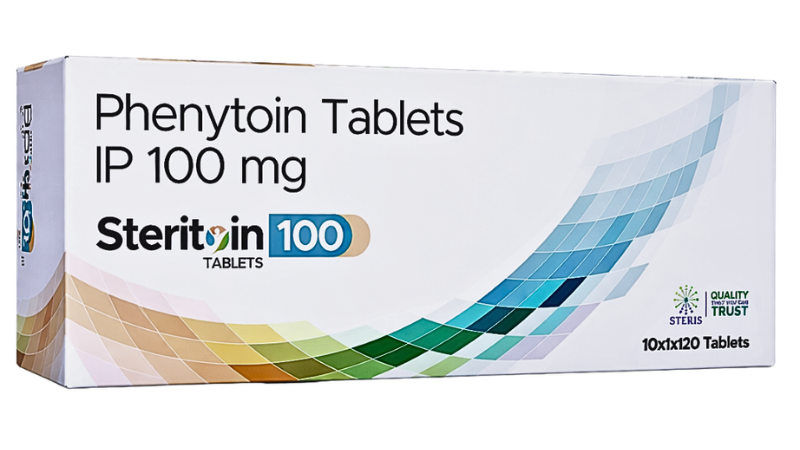



STERITOIN 100: Complete Guide to Phenytoin 100mg
Aug 03, 2024
Epilepsy affects nearly 50 million people worldwide, making it one of the most common neurological disorders on the planet (World Health Organization, 2024). Despite the arrival of newer anticonvulsants, phenytoin 100 mg remains a backbone therapy in neurology wards across India and globally — valued for its proven efficacy, established safety profile, and accessible cost.
STERITOIN 100, manufactured by Steris Healthcare, delivers precisely formulated phenytoin 100 mg per tablet to help patients and clinicians manage seizure disorders with confidence. Whether you're a patient newly diagnosed with epilepsy, a caregiver doing research, or a healthcare professional evaluating treatment options, this guide covers everything you need to know about tab phenytoin 100 mg — from mechanism of action and clinical uses to exact dosing, side effects, and pricing.
Let's get into it.
What Is Phenytoin 100 mg?
Phenytoin 100 mg is a prescription anticonvulsant (antiepileptic) medication that contains 100 milligrams of phenytoin sodium as its active pharmaceutical ingredient. It belongs to the hydantoin class of drugs and has been used clinically since 1938 — making it one of the oldest and most rigorously studied antiepileptic drugs in modern medicine.
Phenytoin 100 mg is an antiepileptic tablet that prevents seizures by stabilizing sodium channels in brain neurons. It is available under the brand name STERITOIN 100 by Steris Healthcare and is prescribed for tonic-clonic seizures, partial seizures, and seizure prevention after neurosurgery.
How Does It Work?
Phenytoin works primarily by blocking voltage-gated sodium channels in the neuronal cell membrane. During a seizure, neurons fire in rapid, uncontrolled bursts. Phenytoin stabilizes these channels in their inactivated state, slowing the rate at which neurons can fire repeatedly. The result? Seizure propagation is halted before it can spread through the brain.
Unlike benzodiazepines, phenytoin doesn't sedate the patient — which makes it suitable for long-term daily management of epilepsy rather than just emergency intervention.
What Is Phenytoin 100 mg Used For?
Phenytoin 100 mg is used to treat and prevent epileptic seizures, including tonic-clonic (grand mal) and focal seizures. It is also used for seizure prevention after head trauma or brain surgery. STERITOIN 100 by Steris Healthcare is the branded version of this medication.
Primary Uses
1. Tonic-Clonic Seizures (Grand Mal Epilepsy) The most well-established phenytoin 100 mg use is controlling generalized tonic-clonic seizures — episodes where the entire body stiffens and then jerks rhythmically. Phenytoin reduces both the frequency and severity of these events.
2. Partial (Focal) Seizures Phenytoin is highly effective in simple and complex partial seizures, where abnormal electrical activity starts in a specific brain region. Clinical studies show it achieves seizure freedom in approximately 60–70% of newly diagnosed partial epilepsy patients when optimally dosed.
3. Status Epilepticus (Intravenous Use) In emergency settings, intravenous phenytoin (or fosphenytoin) is a second-line drug for status epilepticus — a prolonged seizure emergency lasting more than 5 minutes.
4. Seizure Prophylaxis After Neurosurgery Phenytoin 100 mg is routinely prescribed to patients who have undergone brain surgery, head trauma treatment, or are at elevated risk of post-operative seizures.
Secondary Uses
- Trigeminal neuralgia — as an adjunct where carbamazepine fails
- Cardiac arrhythmias — specifically digoxin-induced arrhythmias (though this use is less common today)
- Neuropathic pain — limited evidence, typically off-label
What Is the Phenytoin 100 mg Dose?
Dosage is one of the most clinically critical aspects of phenytoin therapy. This drug has a narrow therapeutic index — meaning the gap between an effective dose and a toxic dose is small. Patients must never self-adjust their dose.
Standard Adult Dosing
| Indication | Starting Dose | Maintenance Dose | Frequency |
|---|---|---|---|
| Epilepsy (Adult) | 100 mg 3x/day | 300–400 mg/day | 1–3 times daily |
| Elderly Patients | 100 mg 1–2x/day | Adjust per blood levels | Once or twice daily |
| Status Epilepticus (IV) | 15–20 mg/kg loading | 100 mg every 6–8 hours | As directed |
| Neurosurgical Prophylaxis | 100–200 mg/day | Per blood level monitoring | Once or twice daily |
Paediatric Dosing
Children typically receive 5–8 mg/kg/day in two to three divided doses. Exact dosing must be calculated by a paediatrician based on the child's weight and seizure type.
Therapeutic Drug Monitoring (TDM)
Because phenytoin follows non-linear (Michaelis-Menten) pharmacokinetics, small dose increases can lead to disproportionately large rises in blood levels. Target serum concentrations are:
- Therapeutic range: 10–20 mcg/mL (total phenytoin)
- Toxic level: Above 20 mcg/mL
Important: Always take STERITOIN 100 exactly as your neurologist prescribes. Do not skip doses, double up, or stop suddenly — abrupt discontinuation can trigger rebound seizures.
What Is the Major Side Effect of Phenytoin?
This is one of the most searched questions about phenytoin, and it deserves a direct, honest answer.
The major and most visible side effect of phenytoin is gingival hyperplasia — an overgrowth of the gums affecting approximately 20–50% of long-term users (Journal of Clinical Periodontology, 2023). It typically appears within the first 3 months of therapy and is more common in younger patients.
Complete Side Effect Profile
Common Side Effects (>10% of patients):
- Gingival hyperplasia (gum overgrowth)
- Nystagmus (involuntary eye movements)
- Ataxia (coordination problems)
- Slurred speech
- Dizziness and drowsiness
Dose-Related Toxicity (at serum levels >20 mcg/mL):
- Confusion and cognitive impairment
- Diplopia (double vision)
- Sedation
- Nausea, vomiting
Serious / Rare but Dangerous Side Effects:
- Stevens-Johnson Syndrome (SJS) — a severe skin reaction, medical emergency
- Drug Reaction with Eosinophilia and Systemic Symptoms (DRESS)
- Drug-induced lupus erythematosus
- Hepatotoxicity (liver damage)
- Megaloblastic anaemia (due to folate interference)
- Osteoporosis with prolonged use (phenytoin induces vitamin D-metabolizing enzymes)
Long-Term Use Effects:
- Peripheral neuropathy
- Coarsening of facial features
- Hirsutism (excess hair growth)
- Cognitive dulling in some patients
Feature Snippet Answer: The major side effect of phenytoin is gingival hyperplasia — abnormal overgrowth of the gums — which affects up to 50% of long-term users. Other serious side effects include Stevens-Johnson Syndrome, liver toxicity, and megaloblastic anaemia. Regular dental hygiene and blood level monitoring can minimize these risks.
What Is Phenytoin Drug Used For — Beyond Epilepsy?
The question "what is phenytoin drug used for" often surprises people who assume it's a single-purpose medication. While seizure management is the primary indication, phenytoin has a broader pharmacological history:
Cardiac Use: Phenytoin was historically used to treat ventricular arrhythmias, particularly those caused by digitalis toxicity, because of its sodium-channel-blocking effects on cardiac muscle. While largely replaced by safer agents today, it's still occasionally used in specific cases.
Trigeminal Neuralgia: Some patients with this debilitating facial pain condition don't respond adequately to carbamazepine. Phenytoin serves as a second-line option, reducing the frequency of pain attacks by stabilizing neural firing.
Wound Healing: Emerging research (mostly observational) suggests topical phenytoin may promote wound healing in chronic ulcers, likely through its anti-inflammatory and cell proliferation effects. This application remains investigational.
Neonatal Seizures: Phenytoin IV is used in hospital settings for seizures in newborns who don't respond to phenobarbital.
Benefits of STERITOIN 100 by Steris Healthcare
Why do neurologists and patients choose STERITOIN 100 over other phenytoin brands? Here's what sets Steris Healthcare's formulation apart:
1. Consistent Pharmaceutical Quality
Steris Healthcare manufactures STERITOIN 100 under stringent GMP (Good Manufacturing Practice) guidelines, ensuring each tablet contains a precise 100 mg dose of phenytoin sodium. Batch-to-batch consistency matters enormously with a narrow therapeutic index drug like phenytoin.
2. Bioavailability Assurance
Generic phenytoin tablets can vary in bioavailability — meaning switching brands can alter how much drug actually enters your bloodstream. STERITOIN 100 is formulated to deliver reliable, predictable absorption. This is why physicians often advise patients to stick with the same brand once stable on therapy.
3. Extended Availability
STERITOIN 100 is distributed through a wide network of pharmacies across India, reducing the risk of supply interruptions — a real concern for patients who depend on continuous daily medication.
4. Affordable Pricing
Seizure management is a lifelong commitment for most patients. Steris Healthcare keeps STERITOIN 100 priced to ensure long-term affordability without compromising quality.
5. Patient-Friendly Tablet Format
The round, scored tablet can be split for dose adjustments when clinically appropriate — a practical feature that many patients appreciate.
Phenytoin 100 mg Price in India
One of the most searched queries is phenytoin 100 mg tablet price — an understandable concern for patients on long-term therapy.The price of phenytoin 100 mg tablet (STERITOIN 100 by Steris Healthcare) typically ranges from ₹15 to ₹40 per strip of 10 tablets in India, depending on the pharmacy and location. Monthly therapy cost for standard dosing (300 mg/day = 3 tablets/day) works out to approximately ₹90–₹120/month, making it one of the most affordable antiepileptic options available.
Price Comparison Overview
| Format | Approx. Price per Strip (10 tablets) |
|---|---|
| STERITOIN 100 (Steris Healthcare) | ₹15 – ₹40 |
| Other branded phenytoin 100 mg | ₹20 – ₹55 |
| Generic phenytoin 100 mg | ₹10 – ₹25 |
Prices may vary by state, pharmacy, and availability. Always check with your local pharmacist or licensed online pharmacy for current pricing.
Patients with below-poverty-line (BPL) cards or those enrolled in government health schemes like Ayushman Bharat may access phenytoin at subsidized rates through Jan Aushadhi Kendras.
How to Take STERITOIN 100 Correctly
Taking this medication correctly isn't just about swallowing a tablet — it's about protecting your seizure control and avoiding toxicity.
With or Without Food? Phenytoin should generally be taken with food or milk to reduce gastric irritation. However, avoid taking it with high-fat meals or tube feeds, as these can significantly reduce absorption.
Timing: Take your dose at the same time each day. If you're on a three-times-daily schedule, space doses evenly — typically morning, afternoon, and night.
Missed Dose: If you miss a dose and remember within a few hours, take it immediately. If it's close to the next scheduled dose, skip the missed one. Never double up.
Drug-Drug Interactions to Know: Phenytoin is notorious for interactions because it strongly induces CYP450 liver enzymes, which can accelerate the breakdown of many other drugs, including:
- Oral contraceptives (reduced efficacy — use backup contraception)
- Warfarin (altered INR — monitor closely)
- Corticosteroids (reduced effect)
- Some HIV medications
- Antifungals like fluconazole (can raise phenytoin to toxic levels)
Always show your full medication list to your prescribing doctor.
Who Should NOT Take Phenytoin 100 mg?
Absolute Contraindications:
- Known hypersensitivity to phenytoin or other hydantoins
- Sinus bradycardia or heart block (for IV formulation)
Use With Caution:
- Pregnancy — phenytoin is a known teratogen (causes fetal hydantoin syndrome). Use only when benefits outweigh risks, with folate supplementation.
- Breastfeeding — phenytoin passes into breast milk; discuss with your doctor
- Hepatic impairment — reduced metabolism increases toxicity risk
- Elderly patients — more sensitive to cognitive and balance effects
"Can phenytoin be taken lifelong?"
Yes, many patients with epilepsy take phenytoin for years or even decades. With proper monitoring — including annual blood counts, liver function tests, bone density scans after age 40, and regular dental check-ups — long-term use is manageable and clinically appropriate.
"Phenytoin 100 mg vs 300 mg extended-release — what's the difference?"
Standard 100 mg tablets require multiple daily doses. Phenytoin extended-release (ER) capsules (commonly 300 mg once daily) offer the convenience of a single daily dose for adherence. However, not all patients achieve adequate seizure control on once-daily dosing, and switching formulations requires careful blood level monitoring.
"Is phenytoin a controlled substance in India?"
No. Phenytoin is not classified as a controlled or scheduled substance under India's NDPS Act. It is, however, a Schedule H drug, meaning it requires a valid prescription and cannot be purchased over the counter.
"What food should I avoid with phenytoin 100 mg?"
Avoid high-calcium foods (like dairy taken simultaneously) and enteral tube feeds close to dose time, as calcium can impair phenytoin absorption. Alcohol should be strictly avoided — it can unpredictably alter phenytoin blood levels, either raising them (acute alcohol use) or lowering them (chronic heavy alcohol use).
"How soon does phenytoin start working?"
After starting oral phenytoin, it takes approximately 7–10 days to reach a stable therapeutic blood level (steady state). During this initial period, some patients may still experience breakthrough seizures. IV loading doses in hospital achieve therapeutic levels within hours.
Conclusion: STERITOIN 100 — Trusted Seizure Control from Steris Healthcare
Phenytoin has earned its place in neurology not by luck, but by nearly nine decades of clinical evidence. STERITOIN 100 by Steris Healthcare brings that proven molecule to patients with the quality assurance, dosage consistency, and affordability that modern epilepsy management demands.
Key points to remember:
Phenytoin 100 mg tablet is a first-line treatment for tonic-clonic and focal seizures. It works by stabilizing sodium channels, not by sedating the patient. The drug requires careful dose titration and regular blood level monitoring because of its narrow therapeutic index. Gingival hyperplasia is the most common long-term side effect — preventable with good dental hygiene. STERITOIN 100 is competitively priced, widely available, and manufactured under GMP standards by Steris Healthcare.
If you or a loved one has been prescribed phenytoin 100 mg, follow your neurologist's instructions precisely, attend all monitoring appointments, and don't hesitate to ask questions. With the right medical supervision, STERITOIN 100 can deliver years of reliable seizure control and significantly improve quality of life.
Frequently Asked Questions About STERITOIN 100 (Phenytoin 100 mg)
What is the brand name for phenytoin 100 mg?
STERITOIN 100 is the brand name for phenytoin 100 mg manufactured by Steris Healthcare. Other Indian brand names include Eptoin (Abbott) and Dilantin (Pfizer, more common internationally). Each brand may differ slightly in excipients, which can affect absorption — so it's important not to switch brands without medical guidance.
Can I stop taking STERITOIN 100 if I feel better?
No. Stopping phenytoin suddenly can trigger rebound seizures, including dangerous status epilepticus. If your neurologist believes you're seizure-free and may be a candidate for discontinuation, they'll guide you through a very gradual taper over several months — never abrupt withdrawal.
Does phenytoin 100 mg cause weight gain?
Phenytoin is not typically associated with significant weight gain — unlike some other antiepileptics such as valproate or gabapentin. However, it can cause facial coarsening and hirsutism with long-term use, which some patients find distressing.
What blood tests do I need while taking phenytoin?
Your doctor will typically monitor: serum phenytoin levels (aim 10–20 mcg/mL), complete blood count (CBC), liver function tests (LFT), and periodic folate/vitamin B12 levels. Bone density (DEXA scan) is recommended for patients on long-term therapy, especially post-menopausal women.
Is STERITOIN 100 safe during pregnancy?
Phenytoin is classified as FDA Pregnancy Category D — there is evidence of human fetal risk (fetal hydantoin syndrome: cleft palate, cardiac defects, growth restriction). It should only be used in pregnancy when seizure control cannot be achieved with safer alternatives, under close neurological and obstetric supervision.
Recent Post
Semaglutide 4mg vs Pancreatitis Risk: What Doctors Want You to Know
Semaglutide 8mg Injection: Frequently Asked Questions Answered by Experts
Mycophenolate Mofetil 500mg (Mycofortic M 500): Uses, Benefits & Precautions – Complete Guide
What is Bisogard 1.25? Bisoprolol 1.25mg Uses, Dosage & Side Effects Explained

Can Semaglutide Injection Be Used Without Diabetes?
What Are Nintedanib Soft Gelatin Capsules Used For? Complete Guide
Where to Buy Semaglutide Injection in India: Price, Pen & Prescription Guide
ERITOCOX BENZ 60/5 Dosage Guide: How to Take Etoricoxib & Cyclobenzaprine Tablets Safely
Gabapentin and Methylcobalamin Tablets Side Effects: What Patients Should Know
Thyroxine sodium tablets IP: उपयोग, फायदे और साइड इफेक्ट्स

