


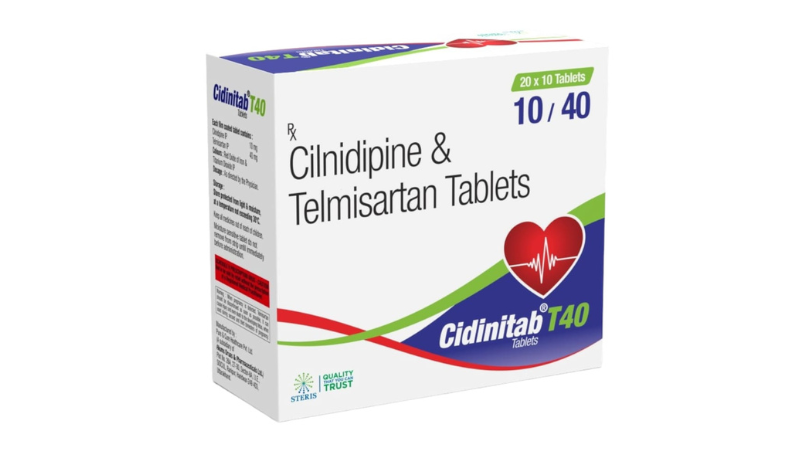



CIDNITAB T 10/40: Manage Hypertension with Telmisartan & Cilnidipine
Aug 07, 2024
CIDNITAB T 10/40, manufactured by Steris Healthcare, is a fixed-dose combination tablet containing telmisartan 40 mg and cilnidipine 10 mg. It is prescribed for the management of hypertension (high blood pressure), particularly in patients whose blood pressure is not sufficiently controlled with a single antihypertensive agent.
CIDNITAB T 10/40 is commonly prescribed for adults with essential (primary) hypertension, and is often specifically chosen for patients who experience ankle swelling with standard calcium channel blockers, since cilnidipine has a distinct mechanism that tends to cause less of this side effect.
Why It's Important
High blood pressure is frequently called a "silent" condition because it usually produces no noticeable symptoms even as it steadily damages the heart, kidneys, brain, and blood vessels over time. Left unmanaged, it significantly raises the risk of heart attack, stroke, and kidney failure.
For a meaningful proportion of patients, a single blood-pressure medicine simply isn't enough to reach target readings. This is why combination therapy — such as telmisartan 40 mg and cilnidipine 10 mg in CIDNITAB T 10/40 — has become a well-established clinical strategy. Rather than pushing one drug class to its maximum dose (which often increases side effects disproportionately to added benefit), combining two drugs with different, complementary mechanisms allows for better control at more moderate, better-tolerated doses of each.
Understanding this composition matters because it isn't a random pairing — it reflects a specific clinical rationale: an ARB to block the hormone system that raises blood pressure, and a next-generation calcium channel blocker designed to relax blood vessels while minimizing the fluid retention and ankle swelling that older calcium channel blockers are known for.
Key Benefits
What Are the Benefits of CIDNITAB T 10/40?
- Dual-mechanism blood pressure control: Telmisartan blocks angiotensin II to relax blood vessels, while cilnidipine blocks both L-type and N-type calcium channels for a broader vasodilatory and heart-rate-stabilizing effect.
- Reduced ankle swelling compared to standard calcium channel blockers: Cilnidipine's action on N-type calcium channels (found in sympathetic nerve endings) helps reduce the pooling of blood in leg veins that commonly causes edema with amlodipine-type drugs.
- Smoother, sustained blood pressure control: Telmisartan's long half-life combined with cilnidipine's gradual onset helps avoid sharp peaks and troughs in blood pressure throughout the day.
- Convenient once-daily dosing: Instead of taking a telmisartan tablet and a tab cilnidipine 10 mg separately, patients receive both active ingredients in a single tablet, supporting better adherence.
- Potential kidney-protective effect: Some evidence suggests cilnidipine's N-type calcium channel blockade may help reduce pressure within the kidney's filtering units, which can be a meaningful benefit for patients with early kidney involvement from long-standing hypertension.
- Heart-rate friendly: Unlike some calcium channel blockers, cilnidipine does not typically cause a reflex increase in heart rate, making it a favorable option for patients sensitive to heart-rate changes.
Side Effects
Like all prescription medicines, CIDNITAB T 10/40 can cause side effects, although not everyone will experience them. Commonly reported effects include:
- Dizziness or lightheadedness
- Headache
- Mild ankle or foot swelling (generally less than with standard calcium channel blockers)
- Fatigue or tiredness
- Flushing or a warm sensation in the face
- Nausea or mild stomach upset
- Palpitations (a fluttering or racing heartbeat sensation)
- Muscle cramps
Most of these effects are mild and often improve as the body adjusts to the medicine over the first few weeks of treatment.
Available Substitute
Depending on your doctor's assessment, alternative options in this therapeutic category include:
- Telmisartan alone (20 mg, 40 mg, or 80 mg strengths)
- Cilnidipine 10 mg tablet alone
- Telmisartan + Amlodipine combinations
- Telmisartan + Chlorthalidone combinations
- Telmisartan + Cilnidipine + Metoprolol (triple therapy for resistant hypertension)
Dosage Guidelines
The right dose should always be determined by a qualified physician, based on your blood pressure readings, medical history, kidney function, and response to prior treatment. General guidance for this class of combination typically includes:
- Standard starting dose: One tablet of CIDNITAB T 10/40 (telmisartan 40 mg + cilnidipine 10 mg) once daily, usually taken at the same time each day.
- Administration: Can be taken with or without food; swallow with a full glass of water.
- Missed dose: If a dose is missed, take it as soon as you remember, unless it is close to the time for your next dose — in that case, skip the missed dose. Do not double up.
- Duration: This is generally a long-term (chronic) therapy. Do not stop taking it abruptly, even if you feel well, without consulting your doctor, as sudden discontinuation may cause blood pressure to rise again.
- Monitoring: Your doctor may periodically check your blood pressure, kidney function, and electrolyte levels to ensure the medicine continues to work well for you and adjust the dose if necessary.
This information is general and educational — it does not replace an individualized prescription. Take this medicine exactly as directed by your treating doctor.
Precautions & Warnings
Before starting CIDNITAB T 10/40, inform your doctor if you have or have had:
- Kidney or liver disease
- Heart failure or other significant heart conditions
- Low blood pressure or a tendency toward fainting
- Diabetes
- Pregnancy or plans to become pregnant — telmisartan is not recommended during pregnancy, especially in the second and third trimesters, due to risk of fetal harm
- Breastfeeding
- Known allergy to telmisartan, cilnidipine, or any other ingredient in the tablet
- Electrolyte imbalances, particularly elevated potassium levels
- Recent heart attack or unstable angina
Additional precautions:
- Avoid alcohol, as it can intensify dizziness and the blood-pressure-lowering effect.
- Rise slowly from sitting or lying positions to reduce the risk of dizziness.
- Inform your doctor of all other medicines and supplements you take, including potassium supplements, NSAIDs, and other blood pressure medicines, since interactions are possible.
- Stay hydrated, but follow your doctor's specific fluid-intake advice.
- Regular blood pressure and kidney function monitoring is advisable during long-term use.
- Use caution when driving or operating machinery until you know how the medicine affects you, as dizziness or fatigue can occur.
Mechanism of Action
Understanding the mechanism of action helps explain why telmisartan 40 mg and cilnidipine 10 mg are frequently prescribed together rather than as two unrelated drugs.
Telmisartan 40 mg belongs to the Angiotensin II Receptor Blocker (ARB) class. It works by selectively blocking the AT1 receptor, preventing angiotensin II — a hormone that constricts blood vessels and encourages sodium and water retention — from exerting its effects. By blocking this receptor, telmisartan allows blood vessels to relax and widen, directly lowering blood pressure. It also has one of the longest half-lives among ARBs, providing smooth, consistent action over a full 24-hour period.
Cilnidipine 10 mg is a distinctive dual calcium channel blocker. Unlike conventional calcium channel blockers (such as amlodipine), which act only on L-type calcium channels in blood vessel walls, cilnidipine also blocks N-type calcium channels located in sympathetic nerve endings. This dual action offers two benefits:
- L-type channel blockade relaxes vascular smooth muscle, widening blood vessels and reducing blood pressure — similar to standard calcium channel blockers.
- N-type channel blockade reduces the release of norepinephrine from sympathetic nerves, which helps prevent the reflex increase in heart rate and the pooling of blood in leg veins that often causes ankle swelling with standard calcium channel blockers.
When combined, telmisartan 40 mg and cilnidipine 10 mg address blood pressure through two separate but complementary pathways:
- Telmisartan blocks the renin-angiotensin-aldosterone system (RAAS) to relax blood vessels and reduce fluid retention.
- Cilnidipine relaxes blood vessels directly while also calming the sympathetic nervous system's contribution to blood pressure and heart rate.
This combined mechanism is why CIDNITAB T 10/40 is often chosen for patients who need effective blood pressure control with a lower likelihood of the ankle swelling associated with standard calcium channel blocker therapy.
Frequently Asked Questions
1. What is CIDNITAB T 10/40 used for?
It is used to treat high blood pressure (hypertension) in adults, particularly when a single medicine doesn't adequately control it.
2. What is telmisartan tablet used for?
Telmisartan tablet is used to lower high blood pressure by relaxing blood vessels and blocking the hormone angiotensin II.
3. What is cilnidipine 10 mg used for?
Cilnidipine 10 mg is used to treat high blood pressure by relaxing blood vessels and reducing sympathetic nervous system activity, often with less ankle swelling than other calcium channel blockers.
4. Tab cilnidipine 10 mg uses in Hindi क्या हैं?
टैब सिल्निडिपिन 10 एमजी का उपयोग उच्च रक्तचाप को नियंत्रित करने के लिए किया जाता है। यह रक्त वाहिकाओं को चौड़ा करके रक्तचाप को कम करता है।
5. Can telmisartan and cilnidipine be taken together?
Yes, doctors commonly prescribe them together, as in CIDNITAB T 10/40, when a patient's blood pressure needs dual-mechanism control. Never combine them on your own without medical advice.
6. What is telmisartan 40 mg and cilnidipine 10 mg combination used for?
This combination is used to manage hypertension more comprehensively than either drug alone by relaxing blood vessels through two different, complementary mechanisms.
7. What are the common side effects of cilnidipine 10 mg?
Common side effects include dizziness, headache, mild swelling, flushing, and palpitations. Most are mild and improve over time.
8. How long does it take for CIDNITAB T 10/40 to work?
Some blood pressure reduction may be seen within one to two weeks, with the full effect generally observed after four to eight weeks of consistent use.
9. Can CIDNITAB T 10/40 be taken during pregnancy?
No. Telmisartan-containing medicines are not recommended during pregnancy, especially in the second and third trimesters, due to risk of fetal harm. Inform your doctor immediately if pregnant or planning pregnancy.
10. What happens if I miss a dose?
Take it as soon as you remember, unless it's nearly time for your next dose — in that case, skip the missed dose and continue your regular schedule without doubling up.
11. Does cilnidipine cause less ankle swelling than amlodipine?
Yes, cilnidipine's unique action on N-type calcium channels tends to cause less ankle and foot swelling compared to standard calcium channel blockers like amlodipine.
12. What is the price of cilnidipine 10 mg tablets?
Pricing varies by brand, pack size, and region. Check with your local pharmacy or Steris Healthcare's official retailer for current pricing information.
13. Is CIDNITAB T 10/40 safe for long-term use?
Yes, when prescribed and monitored by a doctor with periodic blood pressure and kidney function checks, it is generally considered safe for long-term hypertension management.
14. Can this medicine be stopped suddenly?
No, stopping abruptly without medical guidance may cause your blood pressure to rise again. Any changes to your regimen should be made gradually and under medical supervision.
15. Are there substitutes available for CIDNITAB T 10/40?
Yes, alternatives include telmisartan or cilnidipine as standalone tablets, or other combinations such as telmisartan + amlodipine. Substitution should only be done on your doctor's advice.
16. Does CIDNITAB T 10/40 interact with other medicines?
It can interact with other blood-pressure-lowering drugs, potassium supplements, and certain NSAIDs. Always share your complete medication list with your doctor.
17. Who should not take CIDNITAB T 10/40?
People with severe kidney or liver disease, known drug allergies, pregnancy, or a history of very low blood pressure should avoid this medicine unless specifically advised otherwise by a specialist.
Conclusion
CIDNITAB T 10/40, containing telmisartan 40 mg and cilnidipine 10 mg, offers a thoughtfully designed combination therapy from Steris Healthcare for patients who need more comprehensive blood pressure management than a single antihypertensive drug can provide. By pairing an ARB with a next-generation, dual-acting calcium channel blocker, this tablet targets blood pressure through two distinct pathways while helping minimize the ankle swelling commonly associated with standard calcium channel blockers.
As always, no blood pressure medicine should be started, adjusted, or stopped without medical supervision. Hypertension management is highly individualized, and only your doctor can determine whether this specific combination, its dosage, and its duration are appropriate for your health profile. If you've been prescribed CIDNITAB T 10/40, take it consistently, monitor your blood pressure as advised, attend follow-up appointments, and report any unusual symptoms to your doctor promptly.
For Further Information:
Mail Us: contact@sterispharma.com or info@sterispharma.com
Call Now: +91 8824175417, +91 9982524671
Recent Post
Semaglutide 4mg vs Pancreatitis Risk: What Doctors Want You to Know
Semaglutide 8mg Injection: Frequently Asked Questions Answered by Experts
Mycophenolate Mofetil 500mg (Mycofortic M 500): Uses, Benefits & Precautions – Complete Guide
What is Bisogard 1.25? Bisoprolol 1.25mg Uses, Dosage & Side Effects Explained

Can Semaglutide Injection Be Used Without Diabetes?

What Are Nintedanib Soft Gelatin Capsules Used For? Complete Guide
Where to Buy Semaglutide Injection in India: Price, Pen & Prescription Guide
ERITOCOX BENZ 60/5 Dosage Guide: How to Take Etoricoxib & Cyclobenzaprine Tablets Safely
Gabapentin and Methylcobalamin Tablets Side Effects: What Patients Should Know
Thyroxine sodium tablets IP: उपयोग, फायदे और साइड इफेक्ट्स