



Aceclofenac, Paracetamol and Serratiopeptidase: Uses, Dosage and Precautions
Oct 22, 2026
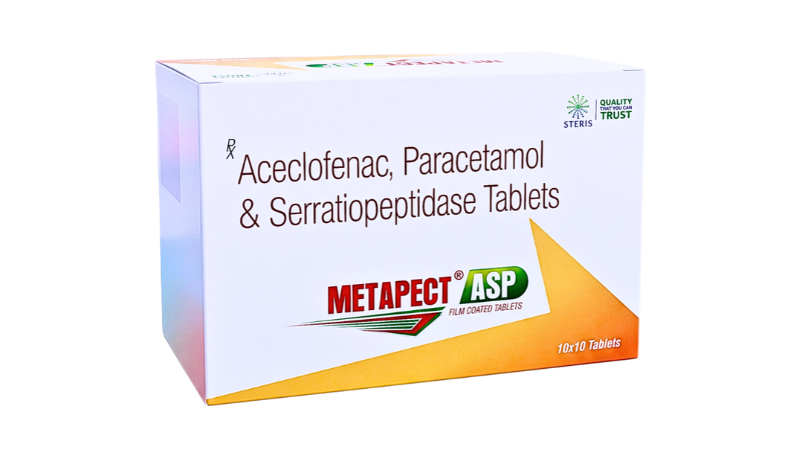
METAPECT ASP, from Steris Healthcare, is one such combination tablet. Each tablet contains Aceclofenac IP 100 mg, Paracetamol IP 325 mg and Serratiopeptidase IP 15 mg. In simple terms, it is a three-in-one aceclofenac paracetamol serratiopeptidase tablet designed to:
- Relieve mild to moderate pain
- Reduce inflammation and swelling
- Bring down fever linked to inflammatory conditions
The aceclofenac paracetamol serratiopeptidase uses that doctors commonly consider include:
- Pain and swelling after surgery, injury or dental procedures
- Osteoarthritis and rheumatoid arthritis symptoms
- Ankylosing spondylitis
- Muscle sprains, strains and soft-tissue injuries
- Back pain, neck pain and joint pain
- Toothache and post-extraction discomfort
- Pain with fever, where an anti-inflammatory is also needed
This tablet is intended for short-term use under medical supervision. It is not a long-term fix, and it is not meant for self-medication.
Why Is This Combination Important?
Pain is not one problem. It is usually a chain of events: tissue is damaged, inflammatory chemicals are released, fluid collects around the area, nerves become sensitised, and the pain signal gets louder. A single drug typically interrupts only one link of that chain.
The aceclofenac paracetamol serratiopeptidase combination works on three links at once:
- Aceclofenac reduces the chemical signals that drive inflammation and pain at the site of injury.
- Paracetamol works on the pain and temperature-control centres in the brain and spinal cord.
- Serratiopeptidase is an enzyme that helps the body clear inflammatory debris and reduce swelling.
The result is a more rounded approach than any one ingredient alone. For the patient, this often means fewer separate tablets, a simpler routine and, in many cases, faster comfort so that they can get back to walking, working or sleeping properly.
Mechanism of Action
Understanding what is inside the aceclofenac paracetamol serratiopeptidase tablets helps you use them wisely.
Aceclofenac IP (100 mg): Aceclofenac is a non-steroidal anti-inflammatory drug (NSAID). It works by blocking cyclooxygenase (COX) enzymes, which the body uses to make prostaglandins, the molecules behind pain, heat, redness and swelling. Aceclofenac is described as preferentially acting on COX-2, the form most active at inflamed sites. This is why it is often considered better tolerated by the stomach than some older NSAIDs, although it can still cause gastric problems.
Paracetamol IP (325 mg): Paracetamol (acetaminophen) acts mainly in the central nervous system. It raises the pain threshold and helps reset the body’s temperature set-point, which explains its pain-relieving and fever-lowering effect. It has little anti-inflammatory action by itself, which is why it pairs well with an NSAID. At standard doses, it has a long record of use in adults.
Serratiopeptidase IP (15 mg): Serratiopeptidase is a proteolytic enzyme originally isolated from bacteria found in the silkworm intestine. It is thought to break down fibrin and other protein debris at the injury site, improve fluid drainage, and thereby reduce swelling and thickened secretions. It is widely used in India and several other countries as an adjunct for post-operative and traumatic swelling. It is worth being honest here: clinical evidence for serratiopeptidase is encouraging in some studies but mixed overall, and larger, high-quality trials are still needed.
Key Benefits
What Are the Benefits of METAPECT ASP?
- Multi-pathway pain relief: Peripheral (aceclofenac) and central (paracetamol) pain control in the same tablet.
- Reduced swelling: Serratiopeptidase supports the clearance of swelling and inflammatory fluid, which can help in post-surgical and injury recovery.
- Fever control: Paracetamol helps when inflammation is accompanied by raised temperature.
- Convenience: One tablet replaces multiple medicines, which can improve adherence to the prescribed course.
- Practical dosing: Typically taken twice a day, fitting easily into routine.
- Useful across conditions: Dental, orthopaedic, post-operative, musculoskeletal and general inflammatory pain.
Indications, Efficacy and Clinical Evidence
Here is what is reasonably well established, and what is less certain:
- Aceclofenac has been studied in osteoarthritis, rheumatoid arthritis and ankylosing spondylitis, where trials have generally shown pain relief comparable to other commonly used NSAIDs such as diclofenac, often with a favourable gastrointestinal tolerability profile.
- Paracetamol is one of the most extensively studied analgesics and antipyretics in the world, and combining it with an NSAID is a common clinical strategy for additive pain relief.
- Serratiopeptidase has been studied for swelling after dental surgery, sprains, sinusitis and breast engorgement, with some trials reporting reduced swelling and pain. However, results are not uniform, and regulators in several regions regard the evidence as limited.
Dosage Guidelines
Dosage should always follow your doctor’s prescription. As general information:
- Adults: One tablet twice daily, usually after food, or as directed by the physician.
- Duration: Shortest possible course, commonly a few days up to about a week or two, depending on the condition and clinical review.
- How to take it: Swallow the tablet whole with a full glass of water. Do not crush or chew. Taking it after meals reduces stomach irritation.
- Missed dose: Take it when you remember, unless the next dose is near. Never double up.
- Children: This strength is generally not recommended for children unless specifically advised by a paediatrician.
- Other paracetamol sources: Many cold, flu and fever products contain paracetamol. Count all sources so that total daily paracetamol does not exceed the limit your doctor sets (commonly 3–4 g per day for healthy adults).
Side Effects
Most people tolerate this combination well for short courses. Possible common side effects include:
- Nausea, indigestion or stomach discomfort
- Heartburn or acidity
- Diarrhoea or constipation
- Headache or dizziness
- Mild skin rash or itching
- Abdominal pain or bloating
These are often mild and settle with food or after the course ends. Tell your doctor if they persist.
Available Substitutes
Other tablets containing the same aceclofenac 100 mg + paracetamol 325 mg + serratiopeptidase 15 mg composition are marketed by different pharmaceutical companies in India. Examples that pharmacists often mention include Zerodol-SP and similar brands. Availability varies by region and pharmacy. Never switch brands or compositions on your own: ask your doctor or pharmacist to confirm that the salt combination and strengths match your prescription exactly.
Precautions and Warnings
Before you start aceclofenac paracetamol serratiopeptidase tablets, tell your doctor if any of the following apply to you.
Do not use if you:
- Are allergic to aceclofenac, paracetamol, serratiopeptidase, aspirin or any other NSAID
- Have an active stomach or intestinal ulcer or bleeding
- Have severe heart, liver or kidney failure
- Have had asthma, hives or rhinitis triggered by aspirin or NSAIDs
- Are in the last three months of pregnancy
Use with caution if you:
- Have a history of gastric ulcers, acidity or gastrointestinal bleeding
- Have high blood pressure, heart disease or a previous stroke
- Have mild to moderate kidney or liver impairment
- Have a bleeding disorder or are due for surgery
- Are elderly, as they are more prone to NSAID side effects
- Are pregnant or breastfeeding. Use only if your doctor judges the benefit outweighs the risk.
Drug interactions to discuss with your doctor:
- Blood thinners (warfarin, heparin) and antiplatelets, due to a bleeding risk
- Other NSAIDs or aspirin, which increases stomach and kidney risk
- Diuretics and blood pressure medicines, which may be less effective
- Lithium, methotrexate, ciclosporin and digoxin, whose levels may rise
- Corticosteroids, which raise the risk of ulcers
Lifestyle advice:
- Avoid alcohol. It increases liver and stomach risk, especially with paracetamol.
- Stay hydrated.
- Use the lowest effective dose for the shortest time.
- If pain, swelling or fever continues beyond a few days, see your doctor rather than extending the course yourself.
Frequently Asked Questions (FAQs)
1. What are aceclofenac paracetamol serratiopeptidase tablets used for?
They are used to relieve mild to moderate pain, inflammation, swelling and fever associated with conditions such as arthritis, sprains, back pain, dental procedures and post-operative recovery.
2. What is METAPECT ASP?
METAPECT ASP is a combination tablet from Steris Healthcare containing aceclofenac 100 mg, paracetamol 325 mg and serratiopeptidase 15 mg.
3. How does aceclofenac paracetamol serratiopeptidase work?
Aceclofenac reduces inflammation by blocking COX enzymes, paracetamol lowers pain and fever through central action, and serratiopeptidase helps reduce swelling by breaking down inflammatory protein debris.
4. Is aceclofenac paracetamol serratiopeptidase a painkiller?
Yes. It combines two analgesics (aceclofenac and paracetamol) with an enzyme that supports the anti-swelling effect.
5. How many times a day can I take this tablet?
Typically one tablet twice daily after meals, but you should follow the exact dose prescribed by your doctor.
6. Should I take it before or after food?
After food. This helps reduce stomach irritation.
7. How long can I take aceclofenac paracetamol serratiopeptidase tablets?
Usually for a short course of a few days to about two weeks. Long-term use should only happen under medical supervision.
8. What are the common side effects?
Nausea, acidity, indigestion, stomach pain, diarrhoea, headache, dizziness and mild skin rash.
9. Can it cause stomach problems?
Yes. Like other NSAIDs, it can cause irritation, ulcers or bleeding in some people, especially with prolonged use, alcohol or a history of ulcers.
10. Is aceclofenac paracetamol serratiopeptidase safe in pregnancy?
It should be avoided in the last three months of pregnancy and used earlier only if a doctor decides it is necessary.
Conclusion
METAPECT ASP by Steris Healthcare brings together aceclofenac, paracetamol and serratiopeptidase to address pain, inflammation, swelling and fever in one tablet. The aceclofenac paracetamol serratiopeptidase uses span post-operative recovery, dental pain, arthritis, sprains and general musculoskeletal conditions. It can make short-term recovery more comfortable, but like all NSAID-containing medicines, it should be used at the lowest effective dose, for the shortest time, and under a doctor’s guidance.
For Further Information:
Mail Us: contact@sterispharma.com or info@sterispharma.com
Call Now: +91 8824175417, +91 9982524671
Recent Post
Doxepin Hydrochloride 25 mg Tablets: Uses, Benefits & Price in India
Understanding the Benefits of Astaxanthin and Lycopene Tablets
Donepezil Hydrochloride 10 mg Tablet – Uses, Price & Buy Online in India
What Is Tiapride 50 mg Used For? A Complete Guide
Tiapride 25 mg: Uses, Dosage and Possible Side Effects
How Do Linagliptin and Metformin Work Together to Manage Type 2 Diabetes?
Oxymetazoline Nasal Solution: A Complete Guide to Uses and Safety
What Are Methylcobalamin Sublingual Tablets 1500 mcg Used For?
L Lysine Hydrochloride Syrup: Uses, Benefits, Dosage and Side Effects
What Is Amino Acids Injection Used For?

