


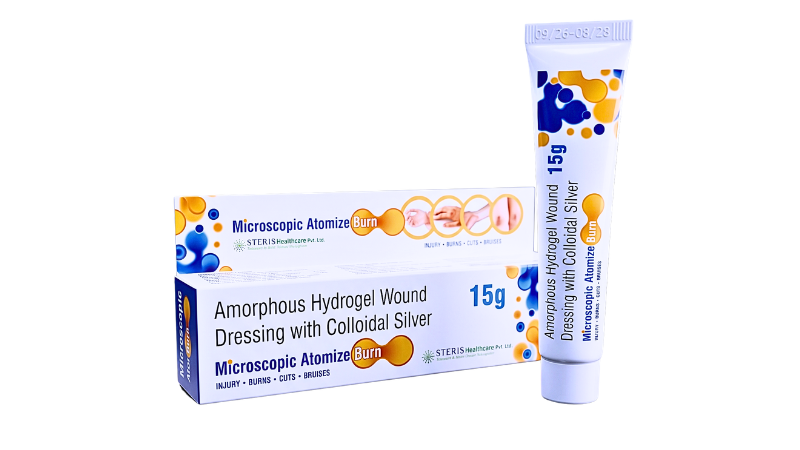



Amorphous Hydrogel with Colloidal Silver: Uses & Benefits
Oct 17, 2026
MICROSCOPIC ATOMIZE BURN by Steris Healthcare is an amorphous hydrogel wound dressing with colloidal silver. It is a soft, water-rich gel that keeps a wound moist while silver helps reduce bacteria in the wound bed. It is mainly used for minor burns, scalds, shallow cuts and abrasions, pressure sores, diabetic foot wounds, and other wounds that are dry, sloughy, or at risk of infection.
If you have searched for amorphous hydrogel, amorphous hydrogel uses, or colloidal silver cream, this guide explains what the product is, how it works, how it is applied, what to watch for, and what the evidence says.
In simple terms:
- Amorphous hydrogel is a free-flowing, shapeless gel made mostly of water, held together by polymers such as carboxymethylcellulose and glycerin. It fills the wound bed completely, unlike a flat sheet.
- Colloidal silver is made of extremely small silver particles suspended in a liquid or gel. In a wound dressing, the silver acts on the surface of the wound against bacteria and is not meant to be swallowed.
Together they give you a moist healing environment and a built-in antimicrobial barrier in one product.
Why Is an Amorphous Hydrogel Wound Dressing with Colloidal Silver Important?
Wound care has changed a great deal since the 1960s. Research by Dr. George Winter showed that wounds kept moist heal faster than wounds left to dry and form a scab. This is the basis of moist wound healing, and amorphous hydrogels are one of the clearest examples of it.
A moist environment matters because:
- Skin cells (keratinocytes) migrate more easily across a moist surface than under a dry crust.
- Dead tissue (slough) softens and separates naturally, a process called autolytic debridement.
- Dressing changes are less painful, because the dressing does not stick to the wound.
Infection is the other big concern. Burns, pressure ulcers, and diabetic wounds are especially vulnerable, since damaged skin no longer acts as a barrier. Silver has been used against bacteria for centuries, and adding colloidal silver to a hydrogel means moisture and antimicrobial protection come in one step. This is why an amorphous hydrogel with colloidal silver is common in hospital wound-care protocols, burn units, and home nursing.
Key Benefits
What Are the Benefits of Amorphous Hydrogel with Colloidal Silver?
1. Keeps the wound moist. Hydrogel is typically 70 to 90 percent water. It can donate moisture to dry wounds and protect against drying out.
2. Gentle autolytic debridement. It softens slough and non-viable tissue so the body’s own enzymes can clear it, with no need for harsh scraping in many cases.
3. Antimicrobial protection. Silver ions act against a wide range of bacteria and fungi, including organisms commonly found in burns and chronic wounds.
4. Soothing, cooling effect. Many patients with burns and scalds report that the gel feels cool and reduces the sensation of heat and discomfort.
5. Fills irregular wounds. Because it is amorphous, it molds into deep, uneven, or cavity wounds where a flat dressing cannot reach.
6. Atraumatic removal. The dressing does not adhere to the wound bed, so changing it causes less pain and less damage to new tissue.
7. Reduces the dressing burden. Fewer changes may be needed than with gauze, which helps both patients and caregivers.
8. Works with other care. It can be used under a secondary dressing, compression bandage, or offloading device, as directed.
Mechanism of Action:
The action has two parts.
The hydrogel base
- It hydrates the wound bed and keeps it at a moist, near-body-temperature environment.
- Water helps rehydrate dry necrotic tissue and slough, supporting autolysis.
- It maintains a fluid layer that supports cell migration and the formation of new tissue (granulation and epithelialization).
- It absorbs a small amount of exudate, though it is not meant for heavily weeping wounds.
The colloidal silver
- Silver is released as positively charged silver ions (Ag⁺) when it meets wound fluid.
- These ions bind to bacterial cell walls and membranes, increasing their permeability.
- Inside the cell, silver interferes with respiratory enzymes and can bind to DNA, blocking replication.
- Because it acts on several targets at once, bacteria find it harder to develop resistance than they do with a single-target antibiotic. Reduced susceptibility has still been reported in some settings, so it should be used when there is a clinical reason and not on every wound.
The result is a moist, protected wound bed where debridement and healing can proceed with fewer bacteria present.
Indications, Efficacy and Clinical Evidence
Indications (commonly used for)
- First- and second-degree (superficial and partial-thickness) burns and scalds
- Pressure ulcers (bedsores) with slough or dry wound beds
- Diabetic foot ulcers (under medical supervision)
- Venous leg ulcers with slough
- Surgical wounds healing by secondary intention
- Skin tears, abrasions, and donor sites
- Wounds at risk of infection or with signs of local colonization
What the evidence says
It is important to be honest about the evidence, because readers and search engines both value accurate information.
- Hydrogels: Evidence supports their role in moist wound healing and autolytic debridement. They are widely recommended in wound-care guidelines for dry or sloughy wounds. Large head-to-head trials against other dressings are limited.
- Silver dressings: Results are mixed. Some studies show reduced bacterial load and lower odor and wound infection signs. Systematic reviews, including those by Cochrane, have concluded that there is not enough strong evidence that silver dressings speed healing or prevent infection in all wound types. For burns, some reviews have found newer dressings to perform as well as or better than silver sulfadiazine cream in terms of healing time and pain.
- Practical takeaway: Silver is best used for wounds that are infected, at high risk of infection, or heavily colonized, and usually for a limited trial period (often around two weeks), after which the wound is reassessed. It is not meant for routine long-term use on clean, healing wounds.
No clinical study specific to this brand’s formulation is cited here. Ask Steris Healthcare for product documentation, such as regulatory status, silver content, and any available test data.
Side Effects
Most people tolerate it well. Possible effects include:
- Mild stinging or burning when first applied
- Redness, itching, or irritation of the skin around the wound
- Maceration (white, soft, wrinkled skin) if the gel spreads onto healthy skin or the dressing is left too long
- Temporary grey or dark staining of the wound bed or surrounding skin, which can be mistaken for dead tissue
- Slight discoloration of dressings or clothing
Available Substitute
Substitutes depend on the wound type and your doctor’s advice. Common alternatives include:
- Plain amorphous hydrogel (no silver) for clean wounds without infection risk
- Silver sulfadiazine 1% cream, a traditional burn cream
- Silver alginate or silver foam dressings, better for moderate to heavy exudate
- Nanocrystalline silver dressings
- Cadexomer iodine or PHMB-based gels as non-silver antimicrobial options
- Medical-grade honey dressings
Do not swap between products without medical advice. A pharmacist or wound-care nurse can help match the product to the wound.
Dosage Guidelines
This is a topical dressing, so it is applied as a layer, not taken as a measured dose. The label of your product and your clinician’s instructions take priority. As a general guide:
- Wash hands thoroughly, or wear sterile gloves.
- Clean the wound gently with saline or the cleanser your clinician advises. Pat the surrounding skin dry.
- Apply a layer of gel to the wound bed. A thickness of about 3 to 5 mm is typical. Fill cavities loosely and do not pack them tightly.
- Keep it on the wound. Avoid spreading it widely on healthy skin.
- Cover with a suitable secondary dressing (non-adherent pad, gauze, or film) and secure it.
- Change as directed. This is typically every 1 to 3 days, or sooner if the dressing becomes saturated or soiled.
- Review the wound regularly. If there is no improvement in about two weeks, ask the clinician whether to continue, change, or stop silver.
For large or deep burns, do not self-treat. These need medical care.
Precautions & Warnings:
- Known silver allergy: do not use.
- Deep, third-degree, or large burns: seek medical care first.
- Heavily exuding wounds: hydrogel is not designed to absorb large amounts of fluid. A different dressing may be better.
- Dry, stable eschar on an ischemic limb (poor blood supply): hydrogel may not be appropriate, since moisture can raise infection risk. Follow your vascular or wound specialist’s advice.
- Pregnancy and breastfeeding: ask a doctor before use, especially on large areas.
- Infants and neonates: use only under medical supervision because of the risk of silver absorption.
- Thyroid, kidney, or liver conditions with large wound areas: discuss with a doctor.
- MRI or radiotherapy: some silver dressings need to be removed before these procedures. Check the label and tell your care team.
- Do not swallow it. This is a topical dressing. Oral “colloidal silver” products are not approved for treating any disease and carry a risk of argyria and drug interactions.
- Signs of infection (spreading redness, pus, fever, increasing pain) need prompt medical review. A dressing does not replace antibiotics when they are needed.
- Storage: keep in a cool, dry place and close the cap or tube after each use. Do not use if expired or if the seal is broken. Keep out of reach of children.
Frequently Asked Questions
1. What is amorphous hydrogel wound dressing with colloidal silver?
It is a soft, water-based gel that keeps wounds moist and contains tiny silver particles that act against bacteria on the wound surface.
2. What is amorphous hydrogel used for?
It is used on dry or sloughy wounds, minor burns, pressure ulcers, diabetic foot ulcers, and skin tears. It hydrates the wound and helps soften dead tissue so it can clear naturally.
3. What are the uses of amorphous hydrogel with colloidal silver?
It is used for burns, scalds, shallow wounds, and wounds at risk of infection, where both moisture and antimicrobial protection are needed.
4. Is colloidal silver safe to apply on wounds?
Topical silver in a dressing is generally considered safe for short-term use under guidance. Long-term or heavy use, or use on large areas, needs medical supervision.
5. Can I swallow colloidal silver?
No. Swallowing colloidal silver is not recommended, as it can cause argyria (permanent blue-grey skin) and has no proven medical benefit. This product is for external use only.
6. How does colloidal silver kill bacteria?
Silver ions bind to bacterial cell walls and membranes, disrupt key enzymes, and interfere with DNA, which stops the bacteria from surviving and multiplying.
7. Is amorphous hydrogel good for burns?
Yes, for minor, superficial to partial-thickness burns. It cools and moisturizes the area. Deep or large burns need medical care.
8. How often should the dressing be changed?
Usually every 1 to 3 days, or sooner if it is saturated or soiled. Follow the label and your clinician’s instructions.
9. How long can silver hydrogel be used on a wound?
Silver dressings are usually used for a limited time, often around two weeks, after which the wound is reassessed.
10. What is the difference between amorphous hydrogel and colloidal silver cream?
Hydrogel is a water-rich gel that hydrates wounds. Silver cream is an emulsion used mainly on burns and typically needs more frequent application.
Conclusion
MICROSCOPIC ATOMIZE BURN, an amorphous hydrogel wound dressing with colloidal silver from Steris Healthcare, combines two well-established ideas in wound care: a moist healing environment and antimicrobial silver. It suits minor burns, sloughy or dry wounds, pressure ulcers, and wounds at risk of infection. It fills irregular wound beds, supports gentle debridement, and reduces bacteria at the wound surface.
It works best when used for the right wound, for a limited and reviewed period, and alongside good wound care: cleaning, offloading, nutrition, and blood sugar control where relevant. Evidence for silver is mixed, so it should not be used on every wound. Always follow the label and your clinician’s advice, and seek medical care promptly for large burns or signs of infection.
For Further Information:
Mail Us: contact@sterispharma.com or info@sterispharma.com
Call Now: +91 8824175417, +91 9982524671
Recent Post
What Is Minocycline Hydrochloride Used For? A Complete Guide
Voglibose and Repaglinide Tablets – Uses, Price & Buy Online in India
Donepezil Hydrochloride with Memantine Hydrochloride Uses, Benefits & Price in India
Amino Acid with Vitamin and Mineral Tablets Nutritional Support Explained
Fluticasone Furoate, Umeclidinium Bromide & Vilanterol Inhalation Powder
Semaglutide 4mg vs Pancreatitis Risk: What Doctors Want You to Know
Semaglutide 8mg Injection: Frequently Asked Questions Answered by Experts
Mycophenolate Mofetil 500mg (Mycofortic M 500): Uses, Benefits & Precautions – Complete Guide
What is Bisogard 1.25? Bisoprolol 1.25mg Uses, Dosage & Side Effects Explained
Can Semaglutide Injection Be Used Without Diabetes?