


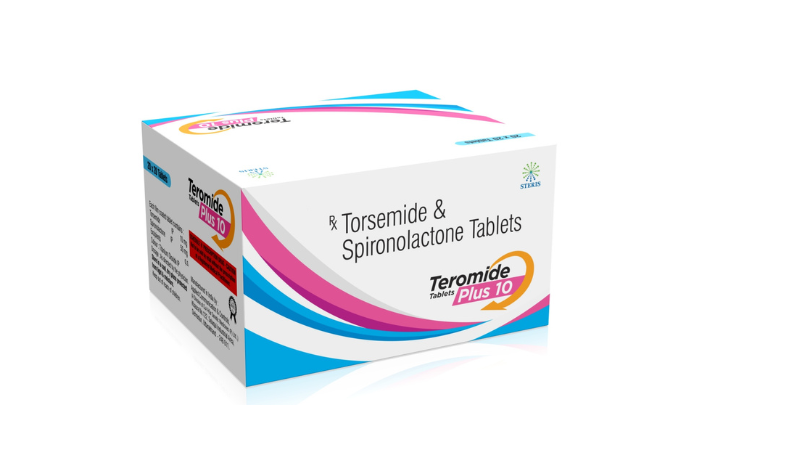



TORSEMIDE AND SPIRONOLACTONE - Uses, Side Effects, Interactions, Dosage and Call to Action.
Jul 12, 2024
What Is Torsemide and Spironolactone Tablet?
Torsemide and Spironolactone tablets are a combination medication that brings together two diuretics working through different mechanisms in the kidney. Torsemide belongs to the loop diuretic class and acts on the thick ascending limb of the loop of Henle, blocking sodium and chloride reabsorption, which leads to increased urine output and removal of excess fluid from the body. Spironolactone is a potassium-sparing diuretic and aldosterone receptor antagonist that acts on the distal renal tubule, reducing sodium reabsorption without causing potassium loss.
This combination is prescribed because loop diuretics like torsemide, while effective at reducing fluid overload, tend to cause potassium depletion (hypokalemia) with prolonged use. Adding spironolactone offsets this effect, offering more balanced electrolyte control while maintaining strong diuretic action. This dual mechanism makes the combination particularly useful in chronic, fluid-retentive conditions where long-term diuretic therapy is required.
Uses of Torsemide and Spironolactone Tablets
- Management of edema (fluid retention/swelling) associated with congestive heart failure
- Treatment of fluid accumulation due to liver cirrhosis and ascites
- Management of edema linked to chronic kidney disease and nephrotic syndrome
- Adjunct therapy in resistant or difficult-to-control hypertension
- Reducing pulmonary congestion and breathlessness in heart failure patients
- Long-term diuretic maintenance therapy where potassium balance is a concern
Key Benefits of Torsemide and Spironolactone Tablets
- Dual-action diuresis: Combines a potent loop diuretic with a potassium-sparing agent for comprehensive fluid control
- Reduced risk of hypokalemia: Spironolactone offsets potassium loss commonly seen with torsemide alone
- Better patient compliance: Single fixed-dose tablet reduces pill burden compared to taking two separate medicines
- Improved cardiac outcomes: Aldosterone antagonism from spironolactone offers additional cardioprotective benefit in heart failure patients
- Effective in resistant edema: Useful when single-agent diuretic therapy fails to control fluid overload
- Longer duration of action: Torsemide has a longer half-life than furosemide, offering more consistent diuretic effect
Dosage and Administration
| Parameter | Recommendation |
|---|---|
| Usual starting dose | As prescribed by physician; typically once daily in the morning |
| Administration | Taken orally, with or without food, preferably at the same time each day |
| Dose adjustment | Based on response, renal function, and electrolyte monitoring |
| Missed dose | Take as soon as remembered; skip if next dose is near — do not double dose |
| Duration | As advised by treating physician; not for self-discontinuation |
Note: Exact dosage strength and titration must be determined by a qualified physician based on the patient's clinical condition, kidney function, and electrolyte status.
Side Effects of Torsemide and Spironolactone Tablets
- Dizziness or lightheadedness (especially on standing)
- Dehydration or excessive thirst
- Increased urination frequency
- Muscle cramps or weakness
- Nausea or gastrointestinal upset
- Headache
- Hyperkalemia (elevated potassium levels) — requires monitoring
- Gynecomastia (breast tenderness/enlargement in men) — associated with spironolactone
- Menstrual irregularities in women
- Low blood pressure (hypotension)
- Electrolyte imbalances (sodium, magnesium)
Seek immediate medical attention if you experience irregular heartbeat, severe muscle weakness, confusion, or signs of severe allergic reaction.
Drug Interactions
| Drug/Class | Interaction Effect |
|---|---|
| ACE inhibitors / ARBs | Increased risk of hyperkalemia and hypotension |
| NSAIDs | May reduce diuretic effectiveness and increase kidney strain |
| Potassium supplements | Risk of dangerous potassium elevation |
| Lithium | Reduced lithium clearance, increased toxicity risk |
| Digoxin | Altered digoxin levels; requires monitoring |
| Other antihypertensives | Additive blood-pressure-lowering effect |
| Corticosteroids | May counteract potassium-sparing effect |
Conclusion
Torsemide and Spironolactone tablets offer a clinically balanced approach to managing fluid retention across cardiac, hepatic, and renal conditions. By combining a fast-acting loop diuretic with a potassium-sparing agent, this fixed-dose combination minimizes the electrolyte imbalance risks commonly associated with diuretic monotherapy while delivering effective symptom control for edema and hypertension. As with any prescription diuretic combination, regular monitoring of kidney function, blood pressure, and electrolyte levels is essential, and the medicine should only be used under medical supervision.
Frequently Asked Questions
1. What is Torsemide and Spironolactone tablet used for?
It is used to treat fluid retention (edema) caused by heart failure, liver cirrhosis, and kidney disease, and to help manage high blood pressure.
2. How does Torsemide and Spironolactone combination work?
Torsemide removes excess fluid through increased urination while Spironolactone blocks aldosterone and prevents potassium loss, giving balanced diuretic action.
3. Is Torsemide and Spironolactone safe for long-term use?
It can be used long-term under medical supervision with regular monitoring of kidney function and electrolyte levels.
4. What are the common side effects of Torsemide and Spironolactone tablets?
Common side effects include dizziness, increased urination, muscle cramps, nausea, and headache.
5. Can Torsemide and Spironolactone cause high potassium levels?
Yes, hyperkalemia is a known risk, especially when combined with potassium supplements or ACE inhibitors/ARBs.
6. What is the difference between Torsemide and Spironolactone individually?
Torsemide is a loop diuretic that causes potassium loss, while Spironolactone is a potassium-sparing diuretic that retains potassium — together they balance each other.
7. Can I take Torsemide and Spironolactone with food?
Yes, it can be taken with or without food, though consistency in timing is recommended.
8. Who should avoid Torsemide and Spironolactone tablets?
Patients with severe kidney failure, hyperkalemia, Addison's disease, or known allergy to the components should avoid it unless directed by a doctor.
9. Does Torsemide and Spironolactone help with heart failure?
Yes, it helps reduce fluid overload and congestion associated with congestive heart failure and offers additional cardioprotective benefit.
10. Can Torsemide and Spironolactone tablets cause gynecomastia?
Yes, spironolactone component may cause breast tenderness or enlargement in men with prolonged use.
11. How quickly does Torsemide and Spironolactone start working?
Diuretic effects from torsemide typically begin within 1 hour of oral administration, while spironolactone's full effect may take a few days.
12. Is monitoring required while taking this medicine?
Yes, regular blood tests for kidney function, sodium, and potassium levels are recommended during treatment.
13. Can pregnant or breastfeeding women take Torsemide and Spironolactone?
This combination should only be used in pregnancy or breastfeeding if specifically advised by a physician, as safety data is limited.
14. What should I do if I miss a dose?
Take it as soon as remembered; if it's close to the next dose, skip the missed one — do not double the dose.
15. Can Torsemide and Spironolactone be used for hypertension alone?
Yes, it may be used as an adjunct in resistant hypertension cases not controlled by first-line antihypertensives.
16. Does this medicine interact with NSAIDs like ibuprofen?
Yes, NSAIDs can reduce the diuretic effect and increase strain on the kidneys.
17. What lifestyle precautions should be followed while on this medicine?
Avoid excess potassium-rich foods without medical advice, stay hydrated appropriately, monitor blood pressure, and avoid alcohol.
18. Can you take spironolactone and torsemide together?
Yes, they can be taken together, but only as prescribed, with monitoring of potassium, kidney function, and blood pressure.
Recent Post
Itopride Hydrochloride Uses: What It Treats and How It Works

Glimepiride 0.5 mg + Voglibose 0.2 mg + Metformin SR 500 mg | Steris Healthcare
Trimetazidine Hydrochloride Modified Release Tablets 35 mg Uses, Benefits

EUROSOFT MOSQUITO SHIELD

Olmesartan and Metoprolol: Uses, Benefits, Dosage & Side Effects | Steris Healthcare
Tofacitinib 11 mg Tablets: A Complete Guide to Uses and Side Effects

Olmesartan Medoxomil + Metoprolol Succinate: Uses, Dosage
Torsemide 100 mg: Uses, Dosage, Side Effects, and Precautions

How Streptococcus Thermophilus Supports Digestive Health
Olmesartan Medoxomil + Metoprolol Succinate: Uses, Benefits & Side Effects