


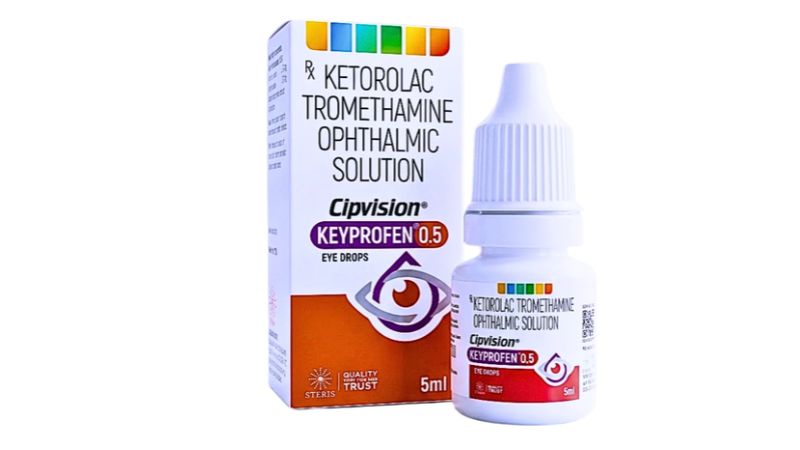


Ketorolac Tromethamine Ophthalmic Solution: Uses, Benefits, Side Effects & Dosage
Oct 28, 2026
What Is Cipvision Keyprofen 0.5?
Cipvision Keyprofen 0.5 is an ophthalmic (eye) solution from the CIPVISION range by Steris Healthcare Pvt. Ltd., a WHO-GMP and ISO-certified pharmaceutical manufacturer in India. A topical nonsteroidal anti-inflammatory drug (NSAID) used to relieve eye pain and inflammation after procedures such as cataract or corneal refractive surgery, and to reduce itching associated with seasonal allergic conjunctivitis.
Ketorolac tromethamine belongs to the pyrrolo-pyrrole group of NSAIDs. Prescribing information for ketorolac ophthalmic solution describes it as a sterile, isotonic, aqueous 0.5% solution with a pH of about 7.4. Because it is applied directly to the eye, the drug acts locally on the surface and front part of the eye, and the amount that reaches the bloodstream is far lower than with oral ketorolac tablets or injections.
What Is Cipvision Keyprofen 0.5 Used For?
Ketorolac tromethamine ophthalmic solution 0.5% is indicated for two main situations:
| Indication | What it means | Who benefits |
|---|---|---|
| Inflammation after cataract surgery | Reduces redness, swelling and discomfort in the operated eye during the early recovery period | Patients recovering from cataract extraction (with or without lens implant) |
| Ocular itching due to seasonal allergic conjunctivitis | Provides temporary relief from itchy, irritated eyes during allergy season | Adults and children (labelled age limits apply) with seasonal eye allergies |
Doctors may also use NSAID eye drops in other post-operative or inflammatory settings at their discretion. Always follow your ophthalmologist's instructions rather than self-prescribing.
Post-cataract inflammation
After cataract surgery, the eye releases prostaglandins, which are chemical messengers that drive inflammation and discomfort. By blocking the cyclooxygenase enzyme, ketorolac reduces prostaglandin production and helps calm the eye. Many surgeons prescribe an NSAID drop alongside, or instead of, a steroid drop, depending on the patient's risk profile.
Seasonal allergic conjunctivitis
During pollen season or dust exposure, the eye's surface can become red, watery and intensely itchy. Ketorolac helps relieve the itching component. It is not an antihistamine, so doctors sometimes combine it with other allergy eye drops where appropriate.
How Does Ketorolac Eye Drop Work?
Ketorolac tromethamine is a cyclooxygenase (COX) inhibitor. Here is the simple version:
- Injury, surgery or allergens trigger the release of arachidonic acid in eye tissue.
- The COX enzymes convert arachidonic acid into prostaglandins.
- Prostaglandins cause swelling, redness, pain and itching.
- Ketorolac blocks COX, so fewer prostaglandins are produced.
- Inflammation and discomfort settle.
Key Benefits of Cipvision Keyprofen 0.5
- Targets inflammation at the source: Works on the prostaglandin pathway in the eye, helping reduce post-operative redness and swelling.
- Relief from itching: Helps ease the itch of seasonal allergic conjunctivitis.
- Non-steroidal option: A useful choice when your doctor wants to limit steroid exposure. Steroid drops can raise intraocular pressure in some people, whereas NSAID drops are not steroid-based.
- Local action, low systemic exposure: Applied as drops, so the medicine mainly stays in the eye.
- Fits into combined regimens: Prescribing information notes that ketorolac ophthalmic solution has been given safely alongside other eye medications such as antibiotics, alpha-agonists, beta blockers, carbonic anhydrase inhibitors, cycloplegics and mydriatics, when your doctor directs it.
- Simple schedule: Typically a short, structured course, which supports adherence.
- Quality-backed manufacturing: Produced by Steris Healthcare Pvt. Ltd. under WHO-GMP and ISO-certified quality systems. [Reviewer: confirm certification wording and licence numbers before publishing.]
Dosage and How to Use Cipvision Keyprofen 0.5
Condition Typical schedule Post-cataract-surgery inflammation 1 drop in the operated eye four times a day, starting about 24 hours after surgery and continuing through the first 2 weeks after surgery Seasonal allergic conjunctivitis (itching) 1 drop in the affected eye(s) four times a day, or as your doctor directs
Step-by-step instillation
- Wash your hands thoroughly.
- Remove contact lenses (ketorolac drops are not to be used while wearing contact lenses).
- Tilt your head back and gently pull down the lower eyelid to form a small pocket.
- Hold the bottle upside down and place one drop into the pocket without touching the tip to your eye, lashes or fingers.
- Close your eye for a minute or two; lightly press the inner corner of the eye to reduce drainage.
- If you use other eye drops, wait at least 5 minutes between them.
- Recap the bottle immediately and store as directed.
Storage and handling
- Store at room temperature and protect from light, as stated on standard ketorolac ophthalmic labelling.
- Keep the cap tightly closed and never share the bottle.
- Follow the discard-after-opening instruction on your pack.
Side Effects of Ketorolac Eye Drops
Most people tolerate ketorolac eye drops well, but side effects can happen.
Common side effects
- Temporary stinging or burning when the drop goes in. This is the most frequently reported effect in labelling.
- Mild eye irritation or redness
- Brief blurred vision
Less common effects
Prescribing information lists reactions seen in roughly 1 to 10 percent of patients, including allergic reactions, corneal swelling (edema), iritis, ocular inflammation, superficial keratitis and superficial eye infections.
Rare but serious effects, so call your eye doctor promptly
- Corneal infiltrates or corneal ulcer
- Corneal thinning or persistent corneal damage
- Delayed wound healing
- Severe eye pain, worsening redness, light sensitivity or sudden drop in vision
- Wheezing or breathing difficulty (reported in people with aspirin or NSAID sensitivity or asthma)
- Signs of a severe allergic reaction: swelling of the face or lips, rash, trouble breathing
Precautions and Warnings
| Precaution | Why it matters |
|---|---|
| Delayed healing | Topical NSAIDs can slow or delay healing of the cornea. |
| Corneal effects | Prolonged or frequent use has been linked with corneal problems such as keratitis, erosion, thinning or ulceration; people with corneal disease, diabetes, rheumatoid arthritis or repeated eye surgery may be at higher risk. |
| Bleeding tendencies | NSAIDs can increase bleeding time. Use with caution if you have a bleeding disorder or take blood-thinning medicines. |
| Aspirin/NSAID sensitivity and asthma | Cross-sensitivity can occur; bronchospasm has been reported. Tell your doctor if you are allergic to aspirin or other NSAIDs. |
| Contact lenses | Do not wear contact lenses while using this medicine. |
| Pregnancy | Prostaglandin-inhibiting drugs may affect the fetal circulation; use in late pregnancy should be avoided unless your doctor advises otherwise. |
| Breastfeeding | Talk to your doctor first, since many drugs pass into breast milk. |
| Children | Safety and effectiveness have not been established in children under 2 years. |
| Driving | Temporary blurred vision may occur. Wait until your vision clears before driving or operating machinery. |
Who Should Not Use Cipvision Keyprofen 0.5?
Avoid this medicine, or speak with your doctor first, if you:
- Are allergic to ketorolac or any ingredient in the formulation
- Have had asthma, hives or a severe allergic reaction after aspirin or another NSAID
- Have a bleeding disorder or take medicines that prolong bleeding
- Are in the late stage of pregnancy
- Have an active corneal ulcer or significant corneal disease
- Plan to wear contact lenses during treatment
Ketorolac vs Steroid vs Antibiotic Eye Drops
| Feature | Ketorolac (Cipvision Keyprofen 0.5) | Steroid eye drops | Antibiotic eye drops |
|---|---|---|---|
| Drug type | NSAID | Corticosteroid | Anti-bacterial |
| Treats | Inflammation, itching | Stronger inflammation and allergy | Bacterial infection |
| Lowers eye pressure? | No | No (may raise it in some people) | No |
| Kills germs? | No | No | Yes |
| Typical use | Post-cataract, allergic itching | Post-surgery, uveitis, severe allergy | Bacterial conjunctivitis, post-op infection prevention |
Buying Guide: Price, Availability and Prescription
If you are ready to purchase, keep these points in mind:
- Prescription needed: Cipvision Keyprofen 0.5 is a Schedule H drug. A valid prescription from a registered doctor is required.
- Check Price: Pricing varies by pack size and channel. Use the Check Price option on the Steris Healthcare product page or contact the team for the current rate.
- Genuine supply: Buy from licensed pharmacies, hospital suppliers or authorised distributors. Check that the seal is intact and the batch number and expiry date are printed.
- Bulk and institutional orders: Hospitals, eye clinics and pharmacy chains can enquire with Steris Healthcare about trade supply and franchise opportunities.
Tips for Safe and Effective Use
- Finish the course your doctor prescribed, but never extend it on your own.
- Do not use leftover drops from a previous surgery or episode.
- Never touch the bottle tip to your eye or any surface.
- Keep a short diary of drops if you use several eye medicines after surgery.
- Attend every follow-up visit so your doctor can check corneal healing.
- Report burning that does not settle, worsening redness or any change in vision.
Conclusion
Cipvision Keyprofen 0.5, which contains ketorolac tromethamine ophthalmic solution 0.5% w/v, is a targeted, steroid-free NSAID eye drop for controlling inflammation after cataract surgery and easing the itch of seasonal allergic conjunctivitis. It works by blocking prostaglandin production in the eye, is generally well tolerated, and most commonly causes only brief stinging. Its limits matter as much as its benefits: it is not an antibiotic, not a steroid, and not a treatment for high eye pressure, and it should be used for the shortest time your doctor considers appropriate because of the risk to corneal healing with prolonged use.
Frequently Asked Questions
1. Does ketorolac reduce eye pressure?
No. Ketorolac eye drops are not used to lower intraocular pressure and are not a glaucoma treatment. Their role is to reduce inflammation and itching. If you have glaucoma, keep using your pressure-lowering drops as prescribed and tell your doctor that you have been given ketorolac.
2. Is ketorolac eye drops a steroid?
No. Ketorolac is a non-steroidal anti-inflammatory drug (NSAID). It reduces inflammation by blocking prostaglandin production rather than acting as a corticosteroid.
3. How long is it safe to use ketorolac eye drops?
Use it only for as long as your doctor prescribes. After cataract surgery, the standard course runs through the first 2 weeks after the operation. For allergic itching, your doctor sets the duration. Prolonged or very frequent use of topical NSAIDs has been associated with corneal problems, so do not extend treatment on your own.
4. Is ketorolac an antibiotic eye drop?
No. Ketorolac does not kill bacteria. If you have an eye infection, your doctor may prescribe a separate antibiotic drop, which can be used alongside ketorolac when directed.
5. How fast do ketorolac eye drops work?
Because it is a locally acting drop, many people begin to notice more comfort within the first days of regular use, but response varies by person and condition. [Reviewer placeholder: add label-based onset data only if supported by approved documentation.] If symptoms do not improve or worsen, contact your doctor.
6. Who should not use ketorolac eye drops?
People who are allergic to ketorolac or its ingredients, those with aspirin or NSAID-triggered asthma or allergy, patients with bleeding disorders or on blood thinners (without medical advice), those in late pregnancy, and anyone who will wear contact lenses during treatment should avoid it unless a doctor says otherwise.
7. Does ketorolac eye drops have side effects?
Yes. The most common is brief stinging or burning when the drop goes in. Others include eye irritation, redness, temporary blurred vision and, less often, corneal swelling or inflammation. Rarely, corneal ulcers or delayed healing can occur.
8. Is it safe to use ketorolac?
Used as prescribed, ketorolac eye drops are generally considered safe and well tolerated for short courses. Safety depends on correct dosing, duration and your health history, which is why a prescription and follow-up are needed. Oral and injectable ketorolac have much stricter safety limits than the eye-drop form.
9. What are the side effects of ketorolac?
For eye drops: stinging, burning, irritation, redness and blurred vision are most typical, with rare corneal complications. For oral or injectable ketorolac (a different, systemic use), risks include stomach and intestinal bleeding, kidney problems and cardiovascular events, which is why those forms are limited to short courses.
10. What organ does ketorolac affect?
Taken by mouth or injection, ketorolac can affect the stomach and gut, kidneys, and blood clotting. Eye drops deliver far lower systemic exposure, so the organ they mainly act on is the eye, particularly the cornea and front of the eye.
11. What is Cipvision Keyprofen 0.5 used for?
It is used for inflammation after cataract surgery and for temporary relief of itchy eyes due to seasonal allergic conjunctivitis.
12. What is the dose of Cipvision Keyprofen 0.5?
Standard ketorolac 0.5% labelling advises one drop four times a day in the affected eye. After cataract surgery, treatment starts about 24 hours post-operatively and continues through the first two weeks. Follow your doctor's prescription and pack leaflet.
13. Can I wear contact lenses with ketorolac eye drops?
No. Remove contact lenses before using the drops and follow your doctor's advice on when to resume wearing them.
14. Can I use ketorolac eye drops with other eye drops?
Yes, when your doctor directs it. Wait at least 5 minutes between different eye drops so the first one is not washed out.
15. Is Cipvision Keyprofen 0.5 available without a prescription?
No. It is a Schedule H prescription medicine in India. Buy it only from licensed pharmacies against a valid prescription.
17. Can I use ketorolac eye drops during pregnancy or breastfeeding?
Late-pregnancy use should be avoided because prostaglandin-inhibiting drugs may affect the baby's circulation. Speak to your doctor before using the drops if you are pregnant or breastfeeding.
18. Will ketorolac eye drops blur my vision?
Temporary blurred vision can occur right after instillation. Wait until your vision is clear before driving or using machinery.
19. How should I store Cipvision Keyprofen 0.5?
Keep it at room temperature, away from light, tightly closed and out of children's reach. Never share the bottle and follow the discard-after-opening guidance on the pack.
20. Where can I buy Cipvision Keyprofen 0.5 online?
Check availability through sterisonline.com or contact Steris Healthcare at contact@sterispharma.com. A valid prescription is required, so choose a licensed, verified supplier.
Recent Post
Ofloxacin Dexamethasone Eye/Ear Drops: What Doctors Prescribe
Dapagliflozin and Bisoprolol: Uses, Benefits, Side Effects and Precautions
How Do Dapagliflozin and Metformin Work Together to Manage Type 2 Diabetes?
Voglibose and Repaglinide Tablets: Uses & Side Effects
Dapagliflozin for Type 2 Diabetes: Uses and Important Precautions
Dapagliflozin and Metformin Tablets: Uses, Benefits, Side Effects and Precautions
Itopride Hydrochloride Uses: What It Treats and How It Works
Glimepiride 0.5 mg + Voglibose 0.2 mg + Metformin SR 500 mg | Steris Healthcare
Trimetazidine Hydrochloride Modified Release Tablets 35 mg Uses, Benefits
EUROSOFT MOSQUITO SHIELD

