


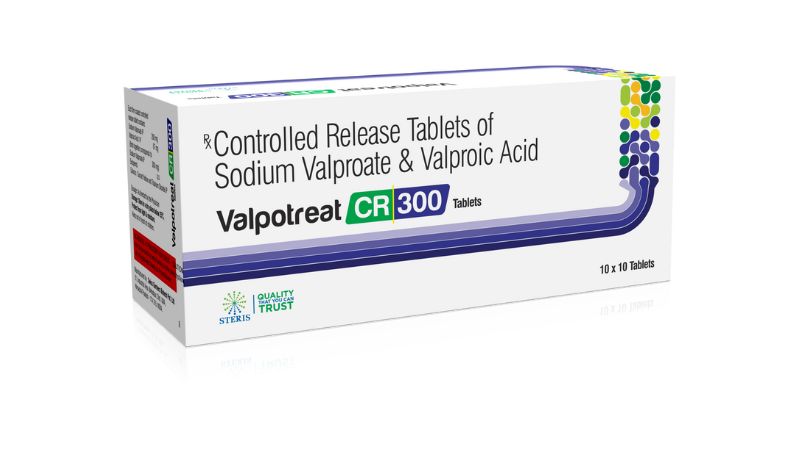



VALPOTREAT CR 300: Comprehensive Guide to Sodium Valproate CR 300 mg....
Jul 13, 2024
VALPOTREAT CR 300
Sodium Valproate CR 300 mg
What is sodium valproate for?
VALPOTREAT CR 300, manufactured by Steris Healthcare, is a broad-spectrum neuro-therapeutic formulation containing Sodium Valproate (300 mg) A prescription medicine commonly prescribed to manage epilepsy, bipolar disorder, and help prevent migraine headaches.
+-----------------------------------------------------------------------+
|                         VALPOTREAT CR 300                             |
|               (Controlled Release Sodium Valproate 300mg)             |
+-----------------------------------------------------------------------+
                                    |
                                    v
     +------------------------------+------------------------------+
     |                              |                              |
     v                              v                              v
+------------------+      +-------------------+      +-------------------+
| Anti-Epileptic   |      | Mood Stabilizer   |      | Prophylactic      |
| Prevents Seizures|      | Bipolar Mania     |      | Migraine Relief   |
+------------------+      +-------------------+      +-------------------+
Primary Clinical Indications
-
Epilepsy & Seizure Disorders: Used as monotherapy or adjunctive therapy for generalized tonic-clonic seizures, absence seizures, focal (partial) seizures, and myoclonic jerks.
-
Bipolar Disorder (Manic Episodes): Functions as a mood stabilizer to treat acute manic or mixed episodes associated with Bipolar I Disorder.
-
Migraine Prophylaxis: Reduces the frequency, intensity, and duration of severe recurrent migraine headaches.
Why Its Important to Choose VALPOTREAT CR 300
Managing chronic neurological and psychiatric conditions requires maintaining steady serum drug concentrations. Conventional immediate-release formulations cause rapid absorption spikes, leading to side effects like dizziness or nausea, followed by steep concentration troughs that expose patients to breakthrough seizures or mood swings.
Plasma Concentration
  ^
  |    /---\      /---\      /---\   (Immediate Release: Peak/Trough spikes)
  |   /     \    /     \    /     \
  |  /-------\--/-------\--/-------\ (VALPOTREAT CR 300: Smooth Therapeutic Window)
  | /         \/         \/         \
  +--------------------------------------------------> Time
VALPOTREAT CR 300 solves this with a controlled-release (CR) matrix technology:
-
Steady Plasma Levels: Slowly releases active sodium valproate into the gastrointestinal tract, preventing sharp blood peak concentrations.
-
Enhanced Tolerability: Smooth absorption reduces peak-related gastrointestinal and neurological adverse effects.
-
Improved Compliance: Once- or twice-daily dosing schedules prevent missed doses and maintain stable symptom control.
-
Pharmaceutical Quality: Manufactured under strict quality parameters by Steris Healthcare, ensuring batch-to-batch bioequivalence and clinical reliability.
Key Benefits of Sodium Valproate
What are the benefits of VALPOTREAT CR 300?
-
Broad-Spectrum Efficacy: Effective across generalized, partial, and unclassified seizure patterns.
-
Bipolar Mood Stabilization: Rapidly controls acute manic symptoms and prevents relapse into depressive or manic cycles.
-
Reduced Pill Burden: The extended delivery system reduces dosing frequency.
-
Migraine Frequency Reduction: Calms hyperexcitable cortical pathways to lower monthly migraine attacks.
-
Neuroprotective Support: Upregulates inhibitory signaling pathways while suppressing excitotoxic triggers.
Mechanism of Action of Sodium Valproate
Sodium valproate stabilizes central electrical activity through three primary mechanisms:
                  [ SODIUM VALPROATE ]
                           |
      +--------------------+--------------------+
      |                    |                    |
      v                    v                    v
+------------------+ +------------------+ +------------------+
| GABA Enhancement | | Sodium Channel   | | Calcium Channel  |
|  (Inhibition)    | |    Blockade      | |    Blockade      |
+------------------+ +------------------+ +------------------+
-
Enhancement of GABAergic Transmission:
-
Inhibits GABA transaminase (the enzyme responsible for GABA degradation).
-
Stimulates glutamic acid decarboxylase (GAD) to increase GABA synthesis.
-
Increases overall gamma-aminobutyric acid (GABA) concentrations, enhancing baseline inhibitory signaling in the brain.
-
-
Blockade of Voltage-Gated Sodium Channels:
-
Binds to voltage-gated sodium ($\text{Na}^+$) channels in their inactivated state during high-frequency neuronal firing.
-
Suppresses rapid, repetitive action potentials without affecting normal, low-frequency signaling.
-
-
Modulation of Low-Threshold T-Type Calcium Channels:
-
Inhibits $\text{T-type Ca}^{2+}$ channels in thalamic neurons.
-
Interrupts the 3-Hz spike-and-wave discharges characteristic of absence seizures.
-
Side Effects of Sodium Valproate
While VALPOTREAT CR 300 is generally well tolerated, side effects can occur as the body adjusts to the medication.
| Body System | Mild / Transient Side Effects |
| Gastrointestinal | Nausea, mild abdominal pain, dyspepsia, transient diarrhea |
| Neurological | Somnolence, mild tremor (fine postural hand tremor), dizziness |
| Dermatological | Temporary hair thinning or hair loss (alopecia) |
| Metabolic | Increased appetite and dose-dependent weight gain |
Serious Side Effects Of Sodium Valproate
Seek immediate medical attention if any of the following severe adverse reactions occur:
-
Hepatotoxicity (Severe Liver Damage): Marked by dark urine, facial swelling, persistent fatigue, severe nausea, or jaundice (yellowing of skin/eyes). Highest risk in the first 6 months of therapy.
-
Acute Pancreatitis: Severe, sudden abdominal pain radiating to the back, accompanied by nausea and vomiting. Can progress rapidly if untreated.
-
Teratogenicity & Fetal Toxicity: Causes major congenital malformations (neural tube defects like spina bifida) and neurodevelopmental disorders if taken during pregnancy.
-
Thrombocytopenia & Coagulopathies: Low platelet counts leading to unexplained bruising, nosebleeds, or prolonged bleeding times.
-
Hyperammonemic Encephalopathy: Elevated blood ammonia levels causing sudden lethargy, confusion, or changes in mental state, even with normal liver function tests.
Available Substitutes For Sodium Valproate
If a physician needs to alter therapy due to intolerance, several bioequivalent or therapeutic alternatives exist under medical supervision:
-
Valproate Chrono / Extended Release Formulations: Alternative controlled-release sodium valproate and valproic acid combinations.
-
Divalproex Sodium: A stable compound of sodium valproate and valproic acid designed to reduce upper GI irritation.
-
Alternative Anticonvulsants / Mood Stabilizers:
-
Levetiracetam (Broad-spectrum anti-epileptic)
-
Lamotrigine (Bipolar depression and focal/generalized seizures)
-
Carbamazepine / Oxcarbazepine (Focal seizure management)
-
Topiramate (Migraine prophylaxis and seizure control)
-
Dosage Guidelines For VALPOTREAT CR 300
-
Administration: Swallow tablets whole with water. Do not crush, split, or chew the tablet, as breaking the CR matrix destroys the extended-release mechanism and risks dose-dumping.
-
Epilepsy (Adults & Children > 17 kg):
-
Starting Dose: Typically 10 to 15 mg/kg/day, titrated upwards in weekly intervals by 5 to 10 mg/kg/day.
-
Maintenance Dosage: 20 to 30 mg/kg/day divided into 1 or 2 doses (e.g., 1 tablet of VALPOTREAT CR 300 twice daily).
-
-
Bipolar Disorder (Acute Mania):
-
Initial Target Dose: 750 mg to 1000 mg daily divided across CR doses, titrated to achieve clinical stabilization and therapeutic plasma concentrations ($50\text{--}125\ \mu\text{g/mL}$).
-
-
Migraine Prophylaxis:
-
Starting Dose: Usually 300 mg once daily at bedtime, increasing to 300 mg twice daily if clinically indicated.
-
Precautions & Warnings
1. Pregnancy & Teratogenic Risk (Black Box Warning)
Sodium valproate is strictly contraindicated in pregnant women and women of childbearing potential unless a formal Pregnancy Prevention Programme (PPP) is fulfilled and alternative treatments are ineffective. It carries a high risk of congenital malformations (approx. 10%) and neurodevelopmental disorders (up to 30-40%).
2. Routine Laboratory Monitoring
Before starting therapy and periodically during treatment, physicians should order:
-
Liver Function Tests (LFTs): To monitor baseline transaminases and bilirubin.
-
Complete Blood Count (CBC): To monitor platelet counts and coagulation profiles.
-
Serum Amylase/Lipase: If the patient develops acute abdominal symptoms.
-
Therapeutic Drug Monitoring (TDM): Target trough valproate plasma concentrations generally range from $50\text{ to }100\ \mu\text{g/mL}$ for epilepsy and up to $125\ \mu\text{g/mL}$ for bipolar mania.
3. Abrupt Discontinuation Risk
Never stop taking VALPOTREAT CR 300 suddenly. Abrupt withdrawal can trigger status epilepticus (continuous, life-threatening seizures) or severe rebound bipolar mania. Tapering must occur gradually under medical guidance.
Indications, Efficacy, and Clinical Evidence
Clinical Indications
VALPOTREAT CR 300 is indicated for:
-
Idiopathic Generalized Epilepsy (Absence, Myoclonic, Tonic-Clonic).
-
Secondary Generalized Seizures and Focal (Partial) Seizures with or without secondary generalization.
-
Manic Episodes associated with Bipolar I Disorder.
-
Prophylaxis of Episodic and Chronic Migraine in adult patients.
Clinical Efficacy & Evidence
Monotherapy and adjunctive trials consistently demonstrate sodium valproate's position as a first-line agent:
-
Epileptic Control: Clinical evidence shows over 70-80% seizure reduction or complete freedom in newly diagnosed generalized epilepsy patients when maintaining therapeutic serum levels.
-
Bipolar Mania: Randomized double-blind studies confirm that valproate provides rapid antimanic response within 3 to 5 days of reaching target therapeutic doses, outperforming placebo and matching lithium in acute antimanic efficacy.
-
Migraine Reduction: Clinical trials indicate a $\ge 50\%$ reduction in monthly migraine frequency in over 50% of treated patients compared to baseline.
Conclusion
VALPOTREAT CR 300 by Steris Healthcare combines sodium valproate with a controlled-release delivery system. By maintaining steady therapeutic blood levels, it helps control seizures, stabilize mood in bipolar disorder, and prevent recurrent migraines while minimizing peak-related side effects. Proper use requires strict medical supervision, routine blood monitoring, and adherence to dosage guidelines to ensure long-term treatment success.
Frequently Asked Questions
1. What are sodium valproate tablets used for?
Sodium valproate tablets are prescribed to treat epilepsy (seizures), manage manic episodes in bipolar disorder, and prevent recurrent migraine headaches. They calm hyperactive nerve signals in the brain.
2. Is valproate 500 a mood stabilizer?
Yes. Sodium valproate (including 200mg, 300mg, and 500mg strengths) acts as a mood stabilizer. It controls high energy, racing thoughts, and impulsivity during manic phases of bipolar disorder.
3. Is valproate high risk?
Sodium valproate is a potent prescription drug classified as high-risk in specific populations—particularly during pregnancy due to birth defects and developmental risks. It also requires periodic liver and blood test monitoring to prevent rare liver or pancreatic issues.
4. What happens if a normal person takes sodium valproate?
If someone without epilepsy or bipolar disorder takes sodium valproate, they do not gain any cognitive benefit. Instead, they may experience adverse side effects like severe drowsiness, dizziness, confusion, nausea, low blood pressure, or unsteadiness.
5. What is the difference between sodium valproate and valproic acid?
Both compounds deliver the active valproate ion to the body. Sodium valproate is the sodium salt of valproic acid. Combining both (or using controlled-release forms like VALPOTREAT CR 300) improves stomach GI tolerance and extends drug absorption time.
6. How does tab sodium valproate work in the brain?
It increases the levels of GABA (an inhibitory chemical messenger) and blocks overactive sodium channels in nerve cells. This prevents uncontrolled electrical bursts that cause seizures or rapid mood changes.
7. Can I take VALPOTREAT CR 300 during pregnancy?
No. VALPOTREAT CR 300 should be avoided during pregnancy due to high risks of physical birth defects and neurodevelopmental delays. Female patients must discuss safe contraceptive plans with their physician.
8. Why is VALPOTREAT CR 300 taken as a whole tablet?
VALPOTREAT CR 300 uses a controlled-release delivery system. Crushing or chewing the tablet breaks this mechanism, releasing the entire dose at once, which increases side effect risks and shortens the drug's duration of action.
9. How long does it take for sodium valproate 500mg or 300mg to work?
For epilepsy, seizure control often begins within days to weeks as blood levels stabilize. For bipolar mania, mood stabilization usually improves within 3 to 7 days of reaching the target dose.
10. Does sodium valproate cause weight gain?
Weight gain is a recognized side effect of long-term valproate therapy. Regular exercise, a balanced diet, and monitoring weight changes with your doctor can help manage this effect.
11. What blood tests are needed while taking VALPOTREAT CR 300?
Doctors regularly request Liver Function Tests (LFTs), Complete Blood Counts (CBC/platelets), and therapeutic drug level checks to ensure safe and effective dosing.
12. What should I do if I miss a dose of VALPOTREAT CR 300?
Take the missed tablet as soon as you remember. However, if it is almost time for your next scheduled dose, skip the missed dose. Never double up on tablets to catch up.
13. Can sodium valproate cause hair loss?
Temporary hair thinning or loss can occur in some patients. Hair growth typically resumes once the body adjusts or if the dosage is modified under medical guidance.
14. Can I drink alcohol while taking sodium valproate tablets?
Alcohol should be avoided. Combining alcohol with sodium valproate increases central nervous system depression, leading to severe drowsiness, impaired coordination, and a higher risk of seizures.
15. Why is VALPOTREAT CR 300 prescribed for migraines?
It helps calm hyper-excitable cortical neurons and vascular pathways in the brain, reducing the frequency and severity of recurring migraine attacks
For further information
Email: info@sterispharma.com / contact@sterispharma.com
Call/WhatsApp: 7877551268, 7849827488
Recent Post
Rifaximin 200mg Uses in Hindi: जानें RIFAXIKEM 200 कब, कैसे और क्यों ली जाती है?
Amlodipine 5 mg : उपयोग, फायदे, सही खुराक और कीमत
Rosuvastatin 10mg Uses in Hindi: जानें ROUSTRIN 10 कब, कैसे और क्यों ली जाती है?
Gliclazide 60 mg : जानें खुराक, फायदे, साइड इफेक्ट्स और सावधानियां
Glimepiride 2mg + Metformin 500mg + Voglibose 0.2mg Uses in Hindi: संपूर्ण जानकारी

Best Hyaluronic Acid Moisturizer for Skin: Eurosoft Advance D Matt Moisture

Best Sugar Scrub for Body: Benefits & Usage of Eurosoft Sugar Scrub
Teneligliptin 20 mg: टेनेलिग्लिप्टिन और पायोग्लिटाज़ोन टैबलेट के फायदे, उपयोग और खुराक

Semaglutide Injection: Uses, Benefits, Dosage, Side Effects & Precautions
Empagliflozin 25 mg Uses in Hindi: उपयोग, फायदे, सही खुराक और साइड इफेक्ट्स

