


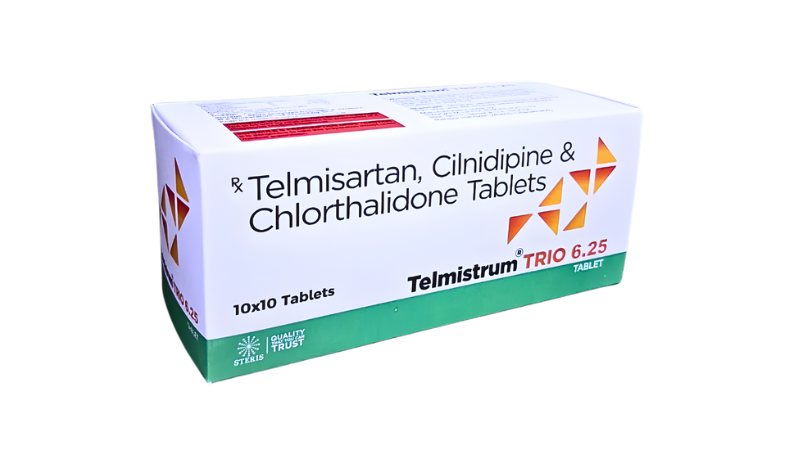



TELMISTRUM TRIO 6.25: Telmisartan, Cilnidipine & Chlorthalidone Uses & Side Effects
Sep 14, 2026
TELMISTRUM TRIO 6.25, manufactured by Steris Healthcare, is a triple fixed-dose combination tablet containing telmisartan 40 mg, cilnidipine 10 mg, and chlorthalidone 6.25 mg. It is built around the well-established telmisartan 40 mg and cilnidipine 10 mg combination, with a low dose of chlorthalidone added to provide an extra layer of blood pressure control through a completely different mechanism.
In simple terms, TELMISTRUM TRIO 6.25 works on three separate fronts at once: telmisartan relaxes blood vessels by blocking a hormone called angiotensin II, cilnidipine relaxes blood vessels directly through a dual calcium-channel-blocking action, and chlorthalidone helps the kidneys eliminate excess sodium and water. This three-pronged approach is generally reserved for patients with moderate-to-resistant hypertension who need more than two-drug therapy to reach a safe blood pressure target.
Why It's Important
High blood pressure is often described as a "silent" condition, since most people feel no symptoms even as it quietly damages the heart, kidneys, brain, and blood vessels over time. Left unmanaged, it substantially raises the risk of heart attack, stroke, and kidney failure.
For many patients, even a two-drug combination like telmisartan 40 mg and cilnidipine 10 mg doesn't fully bring blood pressure into the target range. This is where triple therapy becomes clinically important. Rather than continuing to increase the dose of one or two drugs — which often adds side effects without proportionally improving control — adding a third medicine with a distinct mechanism, such as a low-dose diuretic, frequently achieves better results at lower, better-tolerated doses of each individual component.
This is exactly the rationale behind TELMISTRUM TRIO 6.25: it takes the proven telmisartan 40 mg and cilnidipine 10 mg foundation and adds a carefully chosen low dose of chlorthalidone (6.25 mg) to address the fluid-retention component of blood pressure that ARB and calcium channel blocker therapy alone may not fully resolve — all while keeping the daily pill count to a single tablet.
Key Benefits
What Are the Benefits of TELMISTRUM TRIO 6.25?
- Triple-mechanism blood pressure control: Telmisartan blocks angiotensin II, cilnidipine blocks both L-type and N-type calcium channels, and chlorthalidone reduces fluid volume — three distinct pathways working together.
- Suited for harder-to-control hypertension: Particularly useful for patients whose blood pressure remains elevated despite telmisartan and cilnidipine dual therapy.
- Low-dose diuretic component: The 6.25 mg chlorthalidone dose is intentionally low, aiming to add meaningful blood-pressure benefit while minimizing electrolyte disturbances often associated with higher diuretic doses.
- Reduced ankle swelling: Cilnidipine's action on N-type calcium channels helps reduce the leg-vein pooling that causes ankle swelling with standard calcium channel blockers, an advantage retained even in this triple combination.
- Simplified once-daily dosing: Combines what would otherwise be three separate tablets into one, reducing pill burden and improving treatment adherence.
- Long-acting, smooth 24-hour coverage: Telmisartan's long half-life, cilnidipine's steady vasodilatory action, and chlorthalidone's prolonged diuretic effect together support consistent blood pressure control throughout the day.
- Comprehensive approach for resistant hypertension: Combining an ARB, a next-generation calcium channel blocker, and a long-acting diuretic reflects an evidence-informed strategy often used for patients who need more than dual therapy.
Side Effects
As with any prescription combination medicine, TELMISTRUM TRIO 6.25 can cause side effects. Commonly reported, generally mild effects include:
- Dizziness or lightheadedness
- Headache
- Mild ankle or foot swelling (often less than with standard calcium channel blockers)
- Increased urination (related to the diuretic component)
- Fatigue or tiredness
- Flushing or a warm sensation in the face
- Muscle cramps
- Nausea or mild stomach upset
- Dry mouth
Most of these effects are mild and tend to settle within the first few weeks as the body adjusts to the medicine.
Available Substitute
Depending on your doctor's clinical judgment, alternative options in this therapeutic category include:
- Telmisartan 40 mg and cilnidipine 10 mg (dual combination, without chlorthalidone)
- Telmisartan alone (20 mg, 40 mg, or 80 mg strengths)
- Cilnidipine 10 mg tablet alone
- Chlorthalidone tablet alone
- Telmisartan + Amlodipine or Telmisartan + HCTZ combinations
Dosage Guidelines
Your physician will determine the appropriate dose based on your blood pressure readings, response to prior therapy, kidney function, electrolyte levels, and overall health profile. General guidance for this class of triple combination typically includes:
- Standard dose: One tablet of TELMISTRUM TRIO 6.25 (telmisartan 40 mg + cilnidipine 10 mg + chlorthalidone 6.25 mg) once daily, generally taken at the same time each day, commonly in the morning.
- Administration: Can be taken with or without food, with a full glass of water.
- Missed dose: If you miss a dose, take it as soon as you remember unless it is nearly time for the next scheduled dose — in that case, skip the missed dose rather than doubling up.
- Duration: This is typically a long-term maintenance therapy for chronic hypertension management. Do not stop taking it abruptly, even if your blood pressure readings improve, without consulting your doctor.
- Monitoring: Regular blood pressure checks, kidney function tests, and electrolyte panels (particularly sodium and potassium) are recommended during ongoing treatment, since the diuretic component can affect these levels over time.
This is general educational guidance and does not replace an individualized prescription. Take this medicine strictly as directed by your treating physician.
Precautions & Warnings
Before starting TELMISTRUM TRIO 6.25, inform your doctor if you have or have had any of the following conditions or circumstances:
- Kidney disease, especially significant renal impairment
- Liver disease
- Diabetes (thiazide-type diuretics can affect blood sugar levels)
- Gout or a history of high uric acid levels
- Known drug allergies, particularly to sulfonamide-derived medicines (chlorthalidone is a sulfonamide derivative)
- Heart failure or a history of heart attack
- Pregnancy or plans to become pregnant — telmisartan is not recommended during pregnancy, especially in the second and third trimesters
- Breastfeeding
- Electrolyte imbalances or a history of low sodium/potassium levels
- Severe low blood pressure or a tendency toward fainting spells
Additional precautions:
- Avoid alcohol, which can worsen dizziness and low blood pressure effects.
- Rise slowly from sitting or lying positions to reduce the risk of dizziness.
- Stay adequately hydrated, but follow your doctor's guidance on fluid intake, especially in hot weather, since the diuretic component increases fluid loss.
- Inform your doctor about all other medications, including over-the-counter painkillers (NSAIDs), potassium supplements, lithium, or other blood pressure medicines, as interactions are possible.
- Routine blood tests to monitor kidney function and electrolytes are advisable during long-term therapy.
- Use caution when driving or operating machinery until you know how the medicine affects you.
Mechanism of Action
Understanding how each component works helps explain why this triple combination — built on the proven telmisartan 40 mg and cilnidipine 10 mg foundation, with chlorthalidone added — is reserved for harder-to-control hypertension.
Telmisartan 40 mg is an Angiotensin II Receptor Blocker (ARB). It works by selectively blocking the AT1 receptor, preventing angiotensin II — a hormone that constricts blood vessels and promotes sodium retention — from exerting its effects. This leads to relaxation and widening of blood vessels and reduced fluid retention. Telmisartan's long half-life provides steady, round-the-clock blood pressure control.
Cilnidipine 10 mg is a distinctive dual calcium channel blocker. Unlike conventional calcium channel blockers, which act only on L-type calcium channels in blood vessel walls, cilnidipine also blocks N-type calcium channels located in sympathetic nerve endings. L-type blockade relaxes vascular smooth muscle to widen blood vessels, while N-type blockade reduces norepinephrine release from sympathetic nerves, helping prevent the reflex increase in heart rate and the leg-vein pooling that commonly causes ankle swelling with standard calcium channel blockers.
Chlorthalidone 6.25 mg is a thiazide-like diuretic. It acts on the distal convoluted tubule of the kidney, reducing the reabsorption of sodium and chloride, which leads to increased excretion of sodium and water in the urine. This reduces overall blood volume, directly lowering blood pressure. Chlorthalidone has a notably longer duration of action than other thiazide-type diuretics, and even at this low 6.25 mg dose, it contributes meaningfully to blood pressure reduction while aiming to minimize electrolyte disturbances.
When combined, these three mechanisms address blood pressure from three separate physiological angles:
- Telmisartan — blocks the renin-angiotensin-aldosterone system to relax vessels and limit fluid retention at the hormonal level.
- Cilnidipine — relaxes blood vessels directly through dual calcium channel blockade while calming sympathetic nervous system activity.
- Chlorthalidone — reduces circulating blood volume by promoting sodium and water excretion through the kidneys.
This is why telmisartan 40 mg and cilnidipine 10 mg, further enhanced with a low dose of chlorthalidone, is often chosen for patients whose hypertension needs a more comprehensive, three-pathway approach than dual therapy alone can achieve.
Frequently Asked Questions
1. What is TELMISTRUM TRIO 6.25 used for? It is used to manage high blood pressure (hypertension), particularly in patients who need more than two-drug therapy to reach their target blood pressure.
2. What is telmisartan 40 mg used for? Telmisartan 40 mg is used to lower high blood pressure by relaxing blood vessels and blocking the hormone angiotensin II.
3. What is cilnidipine 10 mg used for? Cilnidipine 10 mg is used to treat high blood pressure by relaxing blood vessels and reducing sympathetic nervous system activity, often with less ankle swelling than other calcium channel blockers.
4. Tab cilnidipine 10 mg uses in Hindi क्या हैं? टैब सिल्निडिपिन 10 एमजी का उपयोग उच्च रक्तचाप को नियंत्रित करने के लिए किया जाता है। यह रक्त वाहिकाओं को चौड़ा करके रक्तचाप को कम करता है।
5. What is telmisartan 40 mg and cilnidipine 10 mg combination used for? This combination is used to manage hypertension more comprehensively than either drug alone by relaxing blood vessels through two different, complementary mechanisms.
6. What is chlorthalidone tablet used for? Chlorthalidone tablet is a diuretic used to treat high blood pressure by helping the kidneys remove excess sodium and water.
7. What are telmisartan and chlorthalidone tablets uses when combined? This combination is used to control high blood pressure by combining vessel relaxation with fluid volume reduction, especially when ARB therapy alone isn't sufficient.
8. What are the common side effects of cilnidipine 10 mg? Common side effects include dizziness, headache, mild swelling, flushing, and palpitations. Most are mild and improve over time.
9. What is the price of cilnidipine 10 mg tablets? Pricing varies by brand, pack size, and region. Check with your local pharmacy or Steris Healthcare's official retailer for current pricing information.
10. How long does it take for TELMISTRUM TRIO 6.25 to work? Some blood pressure reduction may be seen within one to two weeks, with the full effect typically observed after four to eight weeks of consistent use.
11. Can TELMISTRUM TRIO 6.25 be taken during pregnancy? No. Telmisartan-containing medicines are not recommended during pregnancy, especially in the second and third trimesters, due to risk of fetal harm. Inform your doctor immediately if pregnant or planning pregnancy.
12. What happens if I miss a dose? Take it as soon as you remember, unless it's nearly time for your next dose — in that case, skip the missed dose and continue your regular schedule without doubling up.
13. Why is chlorthalidone 6.25 mg used instead of a higher dose? The low 6.25 mg dose is chosen to provide meaningful additional blood pressure control while minimizing the electrolyte disturbances that can occur with higher diuretic doses.
14. Does cilnidipine cause less ankle swelling than amlodipine? Yes, cilnidipine's unique action on N-type calcium channels tends to cause less ankle and foot swelling compared to standard calcium channel blockers like amlodipine.
15. Is TELMISTRUM TRIO 6.25 safe for long-term use? Yes, when prescribed and monitored by a doctor with periodic blood pressure, kidney function, and electrolyte checks, it is generally considered safe for long-term hypertension management.
16. Can this medicine be stopped suddenly? No, stopping abruptly without medical guidance may cause your blood pressure to rise again. Any changes to your regimen should be gradual and doctor-supervised.
17. Are there substitutes available for TELMISTRUM TRIO 6.25? Yes, alternatives include telmisartan 40 mg + cilnidipine 10 mg without chlorthalidone, telmisartan or cilnidipine as standalone tablets, or other combinations such as telmisartan + amlodipine. Substitution should only be done on your doctor's advice.
18. Who should not take TELMISTRUM TRIO 6.25? People with severe kidney or liver disease, known sulfonamide allergy, pregnancy, or significant electrolyte imbalances should avoid this medicine unless specifically advised otherwise by a specialist.
Conclusion
TELMISTRUM TRIO 6.25, built around the well-established combination of telmisartan 40 mg and cilnidipine 10 mg and enhanced with a low dose of chlorthalidone (6.25 mg), offers a comprehensive, triple-mechanism approach to blood pressure management from Steris Healthcare. For patients whose hypertension isn't adequately controlled by ARB and calcium-channel-blocker dual therapy, this combination addresses blood pressure through three complementary pathways — hormonal vessel relaxation, direct vascular and sympathetic modulation, and fluid volume reduction — all in one convenient, once-daily tablet.
As with any triple antihypertensive therapy, the decision to start, adjust, or stop this medicine should always rest with your treating physician, who will consider your individual blood pressure trends, kidney function, electrolyte status, and overall cardiovascular risk profile. If TELMISTRUM TRIO 6.25 has been prescribed for you, take it consistently, attend your follow-up appointments, monitor your blood pressure as advised, and report any new or worsening symptoms promptly.
For Further Information:
Mail Us: contact@sterispharma.com or info@sterispharma.com
Call Now: +91 8824175417, +91 9982524671
Recent Post

What Is Telmisartan and Metoprolol Succinate Combination Used For?

TELMISTRUM AZ 16: Telmisartan 40mg & Azelnidipine 16mg Uses, Dosage & Side Effects
What Is Telmisartan and Chlorthalidone Combination Used For?
Telmisartan 40mg + Amlodipine 5mg Tablets: Uses, Dosage & Side Effects

Clarithromycin, Esomeprazole & Amoxicillin Combo Kit: View Uses, Side Effects and Medicines
What Is Amoxicillin Clavulanate with Lactic Acid Bacillus Used For?

Semaglutide Injection 2mg/3ml (SAMIGLUTIDE) – Uses, Benefits, Dosage & Side Effects

L-Glutathione, Vitamin C & Alpha Lipoic Acid Tablets: Uses, Benefits & Side Effects

Vitamin A, D & Calcium Chloride: Uses, Benefits & Safety Information

How Does Vitamin C Face Serum Benefit Your Skin?