


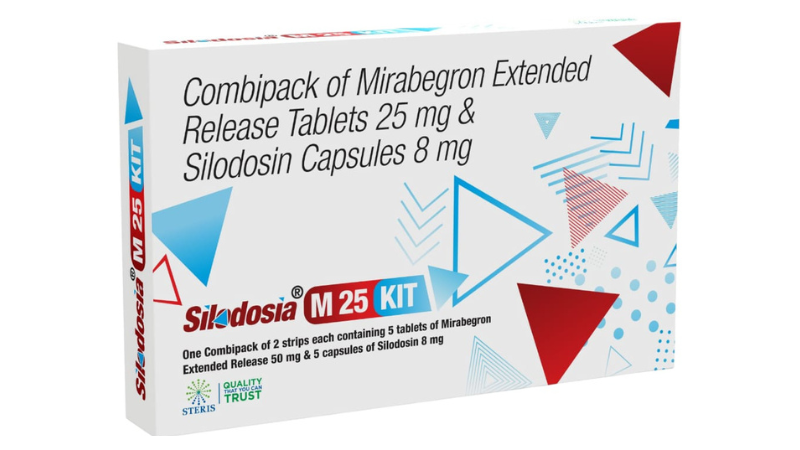



Understanding Silodosin M 25: Side Effects, Price, and Composition.
Mar 29, 2024
What Are Mirabegron and Silodosin Tablets?
Mirabegron and silodosin tablets combine two medicines with complementary actions on urinary symptoms.
Mirabegron
Mirabegron is a beta-3 adrenergic receptor agonist. It relaxes the detrusor muscle of the bladder, helping the bladder store urine more effectively. It is used for symptoms of overactive bladder, including urgency, urinary frequency and urge urinary incontinence.
Silodosin
Silodosin is an alpha-1 adrenergic receptor antagonist used to improve urinary symptoms associated with BPH. By relaxing smooth muscle around the prostate and bladder outlet, it can help make urination easier.
Why Are They Combined?
Men with BPH may experience both:
- Difficulty starting or maintaining urine flow
- Weak urinary stream
- Incomplete bladder emptying
- Frequent urination
- Sudden urinary urgency
- Urge-related urine leakage
Silodosin primarily addresses the outlet/voiding component, while mirabegron targets bladder-storage and overactive-bladder symptoms.
Clinical research has evaluated mirabegron as add-on therapy to silodosin in men who continued to have OAB symptoms despite silodosin treatment. In a randomized study, both groups receiving add-on treatment showed improvement in urinary symptoms, although fesoterodine produced greater improvement than mirabegron for some measured OAB outcomes.
Mirabegron and Silodosin Tablets Uses
The main mirabegron and silodosin tablets uses are associated with urinary symptoms in men with BPH, particularly when BPH is accompanied by overactive-bladder symptoms.
1. Benign Prostatic Hyperplasia
BPH is a non-cancerous enlargement of the prostate that can interfere with normal urine flow.
Common symptoms include:
- Difficulty starting urination
- Weak urine stream
- Frequent urination
- Urgency
- Getting up frequently at night to urinate
- Dribbling after urination
- Feeling that the bladder has not completely emptied
The combination may help relieve these symptoms but does not shrink the prostate itself. Current Indian product listings specifically describe mirabegron + silodosin combinations as symptomatic treatment for BPH rather than a medicine that reduces prostate size.
2. Overactive Bladder Symptoms Associated With BPH
Some men with BPH also have bladder-storage symptoms such as:
- Urinary urgency
- Increased frequency
- Urge urinary incontinence
Mirabegron is specifically indicated for overactive-bladder symptoms, while silodosin addresses the urinary obstruction component associated with BPH.
3. Difficulty Passing Urine
Silodosin relaxes smooth muscle in the prostate and bladder outlet, which can improve the ease of urination in men with BPH.
The combination is therefore particularly relevant when a patient has both voiding symptoms and bothersome storage symptoms.
How Do Mirabegron and Silodosin Tablets Work?
The two ingredients work through different mechanisms.
How Mirabegron Works
Mirabegron activates beta-3 adrenergic receptors in the bladder. This promotes relaxation of the bladder's detrusor muscle during the storage phase.
This can help:
Relax bladder muscle → increase urine-storage capacity → reduce urgency/frequency → improve bladder-control symptoms.
How Silodosin Works
Silodosin selectively blocks alpha-1 receptors involved in smooth-muscle contraction around the prostate and bladder outlet.
This can help:
Relax prostate/bladder-outlet muscle → reduce resistance to urine flow → make urination easier.
Therefore, the combination can address two different components of lower urinary tract symptoms.
Key Benefits of Mirabegron and Silodosin Tablets
Potential benefits, when prescribed appropriately, include:
- Helps relieve urinary symptoms associated with BPH.
- May improve difficulty passing urine.
- Helps relax prostate and bladder-outlet muscles.
- Can help manage urinary urgency.
- Can reduce bothersome urinary frequency.
- May help with urge urinary incontinence associated with overactive bladder.
- Addresses both bladder-storage and urinary-flow symptoms.
- Convenient combination therapy when both medicines are clinically appropriate.
However, individual response varies, and the combination is not suitable for every man with urinary symptoms.
Mirabegron and Silodosin Tablet Strengths
Combination products available in India can contain different mirabegron strengths with silodosin 8 mg. Current listings include examples such as:
- Mirabegron 25 mg + Silodosin 8 mg
- Mirabegron 50 mg + Silodosin 8 mg
These are examples of marketed combinations, not a recommendation for a particular patient.
The prescribed strength depends on the patient's urinary symptoms, response to treatment, kidney function, other medicines and clinical assessment.
Mirabegron and Silodosin Tablets Dosage
The appropriate dosage should be determined by the prescribing doctor.
Mirabegron extended-release tablets used for OAB are available in 25 mg and 50 mg strengths, with the official labeling recommending a 25 mg starting dose for adult OAB patients and possible increase to 50 mg after 4–8 weeks depending on response and tolerability.
Silodosin has its own dosing considerations. Official prescribing information states that the dose should be reduced to 4 mg once daily in moderate renal impairment, while severe renal impairment is a contraindication.
Because combination products have their own formulations, do not change from 25 mg to 50 mg or alter the frequency without medical advice.
How to Take Mirabegron and Silodosin Tablets
Follow the instructions provided by your doctor and the specific product label.
Important administration points include:
- Take the tablet exactly as prescribed.
- Swallow extended-release mirabegron tablets whole.
- Do not crush, chew or divide an extended-release tablet unless the product information specifically permits it.
- Silodosin is generally taken with a meal according to its prescribing information.
- Take the medicine consistently according to the prescribed schedule.
- Do not take an extra dose if you miss one unless instructed by your healthcare professional.
Mirabegron and Silodosin Tablets Side Effects
Like other prescription medicines, this combination can cause side effects.
Because the two ingredients have different safety profiles, patients should understand the possible effects of both medicines.
Common Silodosin-Related Side Effects
Silodosin prescribing information identifies the following commonly reported adverse reactions:
- Retrograde ejaculation
- Dizziness
- Orthostatic hypotension
- Diarrhea
- Headache
- Nasal congestion
- Nasopharyngitis
Mirabegron-Related Side Effects
Commonly reported adverse reactions with mirabegron include:
- Increased blood pressure
- Headache
- Nasopharyngitis
- Urinary tract infection
The exact adverse-effect profile can vary depending on the patient and combination used.
Important Warning: Blood Pressure
Mirabegron can increase blood pressure. Official prescribing information recommends periodic blood-pressure monitoring, particularly in patients who already have hypertension. Mirabegron is not recommended in patients with severe uncontrolled hypertension.
Silodosin, on the other hand, can cause postural hypotension, meaning blood pressure may fall when standing up. This can result in dizziness or, in some cases, fainting.
Therefore, patients taking the combination should report:
- Significant dizziness
- Fainting
- Unusual weakness
- Repeated blood-pressure abnormalities
Mirabegron and Silodosin: Kidney Safety
Kidney function is important when considering silodosin.
According to current prescribing information:
- Moderate renal impairment requires silodosin dose adjustment.
- Severe renal impairment is a contraindication.
- Patients with kidney impairment may have higher silodosin exposure and require monitoring.
If you have kidney disease, tell your doctor before starting this combination.
Who Should Avoid or Use This Combination With Caution?
Mirabegron and silodosin may require special consideration in people with:
- Severe uncontrolled hypertension
- Moderate or severe kidney impairment
- Severe liver impairment
- Significant urinary obstruction
- Previous drug allergy
- Multiple blood-pressure-lowering medicines
- Other alpha-blockers
- Certain CYP3A4-interacting medicines
Silodosin is contraindicated with strong CYP3A4 inhibitors such as ketoconazole, clarithromycin, itraconazole and ritonavir, according to its current prescribing information.
Silodosin should also not be combined with other alpha-blockers because of potential pharmacodynamic interactions.
Mirabegron and Silodosin Drug Interactions
Tell your doctor about all medicines you take.
Mirabegron can inhibit CYP2D6, potentially increasing exposure to medicines metabolized by this enzyme. Official labeling highlights the need for appropriate monitoring and possible dose adjustment for certain CYP2D6 substrates.
Silodosin also has important interactions involving CYP3A4 and P-glycoprotein pathways. Strong CYP3A4 inhibitors are contraindicated with silodosin, while some P-glycoprotein inhibitors are not recommended.
Patients should therefore provide their doctor or pharmacist with a complete list of prescription medicines, OTC medicines and supplements.
Silodosin and Cataract Surgery
An important point for patients taking silodosin is intraoperative floppy iris syndrome (IFIS).
Patients planning cataract surgery should inform their ophthalmologist that they are taking or have previously taken silodosin. This warning is included in current silodosin prescribing information.
Do not stop the medicine on your own; discuss the situation with the prescribing doctor and ophthalmologist.
Does Mirabegron and Silodosin Combination Shrink the Prostate?
No. The combination is primarily intended to improve urinary symptoms.
Silodosin relaxes the muscles around the prostate and bladder outlet, while mirabegron helps control bladder-storage symptoms. Current Indian medicine listings explicitly state that the combination can relieve BPH-related urinary symptoms but does not reduce prostate size.
Patients with significant prostate enlargement may require a different or additional treatment strategy based on clinical assessment.
Mirabegron and Silodosin for Frequent Urination at Night
Frequent nighttime urination, or nocturia, can occur with BPH and overactive bladder, but it can also have other causes.
Mirabegron may help when nighttime frequency is related to overactive-bladder symptoms, while silodosin may improve the urinary-flow component of BPH.
However, nocturia can also be associated with:
- Excessive evening fluid intake
- Diabetes
- Sleep disorders
- Certain medicines
- Urinary infections
- Heart or kidney conditions
Therefore, persistent nighttime urination should be properly evaluated rather than automatically attributed to prostate enlargement.
Buyer’s Guide: Buying Mirabegron and Silodosin Tablets Online
Before purchasing, check:
Composition
Confirm the exact mirabegron and silodosin strengths.
Prescription Status
This is a prescription combination, so purchase through a legitimate pharmacy and use it only as prescribed.
Manufacturer
Check the manufacturer/marketer information on the packaging.
Batch and Expiry
Verify the batch number and expiry date.
Packaging
Do not accept damaged, opened or suspicious packaging.
Storage
Follow the manufacturer's storage instructions.
Seller Authenticity
Choose a reputable, licensed pharmacy or authorized seller.
Current Indian online pharmacy listings show that several strengths and brands of mirabegron + silodosin are marketed, including 25 mg/8 mg and 50 mg/8 mg combinations. Availability and pricing can change, so buyers should verify the current product details before ordering.
When Should You Contact a Doctor?
Seek medical evaluation if you develop:
- Inability to urinate
- Blood in the urine
- Severe urinary pain
- Recurrent urinary infections
- Severe dizziness or fainting
- Significant increase in blood pressure
- Facial, lip or tongue swelling
- Difficulty breathing
- Severe or persistent urinary symptoms
Mirabegron labeling reports angioedema involving the face, lips, tongue or larynx as a rare but important adverse reaction requiring attention.
Frequently Asked Questions About Mirabegron and Silodosin Tablets
1. What are mirabegron and silodosin tablets used for?
Mirabegron and silodosin tablets are used in men with BPH who have bothersome urinary symptoms, particularly when BPH is accompanied by overactive-bladder symptoms such as urgency, frequency or urge urinary incontinence.
2. Can mirabegron and silodosin be taken together?
Yes, the two medicines are available as combination products and have also been studied as add-on therapy in men with BPH and persistent OAB symptoms. The combination should be taken only when prescribed by a healthcare professional.
3. Does mirabegron and silodosin reduce prostate size?
No. The combination primarily improves urinary symptoms. It does not directly shrink the prostate.
4. What are the common side effects of mirabegron and silodosin tablets?
Possible side effects include dizziness, orthostatic hypotension, headache, diarrhea, nasal congestion and retrograde ejaculation. Mirabegron can also increase blood pressure.
5. Can mirabegron increase blood pressure?
Yes. Mirabegron can increase blood pressure, so periodic monitoring is recommended, particularly in patients with hypertension. It is not recommended for people with severe uncontrolled hypertension.
6. Does silodosin cause ejaculation problems?
Yes. Retrograde ejaculation is one of the commonly reported adverse effects of silodosin. Patients concerned about sexual side effects should discuss them with their doctor rather than stopping treatment independently.
7. Can mirabegron and silodosin be used in kidney disease?
Kidney function matters, particularly for silodosin. The silodosin dose requires adjustment in moderate renal impairment and is contraindicated in severe renal impairment according to current prescribing information.
8. How long does mirabegron and silodosin take to work?
The response varies between individuals. Silodosin may improve urinary-flow symptoms relatively early, while improvement in bladder-storage symptoms with mirabegron may require continued treatment. Your doctor should assess your response and determine whether the prescribed dose remains appropriate.
9. Can I take these tablets without a prescription?
No. Mirabegron and silodosin combination products are prescription medicines. A doctor should assess the cause of urinary symptoms and determine whether this combination is appropriate.
10. Should I tell my eye doctor if I take silodosin?
Yes. Tell your ophthalmologist before cataract surgery because silodosin has been associated with intraoperative floppy iris syndrome (IFIS).
11. How long does silodosin take to work?
Silodosin may start improving urinary symptoms within a few days, while full benefit can take several weeks.
Conclusion: Mirabegron and Silodosin Tablets
Mirabegron and silodosin tablets provide complementary treatment for men with BPH and associated urinary symptoms. Silodosin relaxes the prostate and bladder outlet to improve urine flow, while mirabegron targets bladder-storage symptoms such as urgency and frequency. The combination can therefore be useful when both voiding and overactive-bladder symptoms are present.
Recent Post
Empagliflozin 25 mg Uses in Hindi: उपयोग, फायदे, सही खुराक और साइड इफेक्ट्स
Etoricoxib 90 Mg Uses in Hindi: उपयोग, फायदे, सही खुराक और साइड इफेक्ट्स
Aceclofenac Paracetamol Tablet Uses in Hindi: सर्दी-जुकाम, बुखार और दर्द का 5-इन-1 असरदार इलाज
Montelukast and Doxofylline Tablet Uses in Hindi: उपयोग, फायदे, खुराक और साइड इफेक्ट्स
Montelukast and Levocetirizine Tablet Uses in Hindi: एलर्जी और अस्थमा से तुरंत राहत का अचूक उपाय
Aceclofenac + Cyclobenzaprine: उपयोग, फायदे और सावधानियां
Silymarin क्या है? फायदे, उपयोग और नुकसान पूरी जानकारी
Aceclofenac Tablet Uses: Aceclofenac SR 200 mg + Cyclobenzaprine HCl SR 15 mg
Azithromycin 500 mg Uses in Hindi: जानें गले और सीने के इंफेक्शन का सबसे असरदार इलाज
Amoxicillin and Clavulanic Acid in Hindi: जानें बच्चों में इन्फेक्शन का सबसे असरदार इलाज