


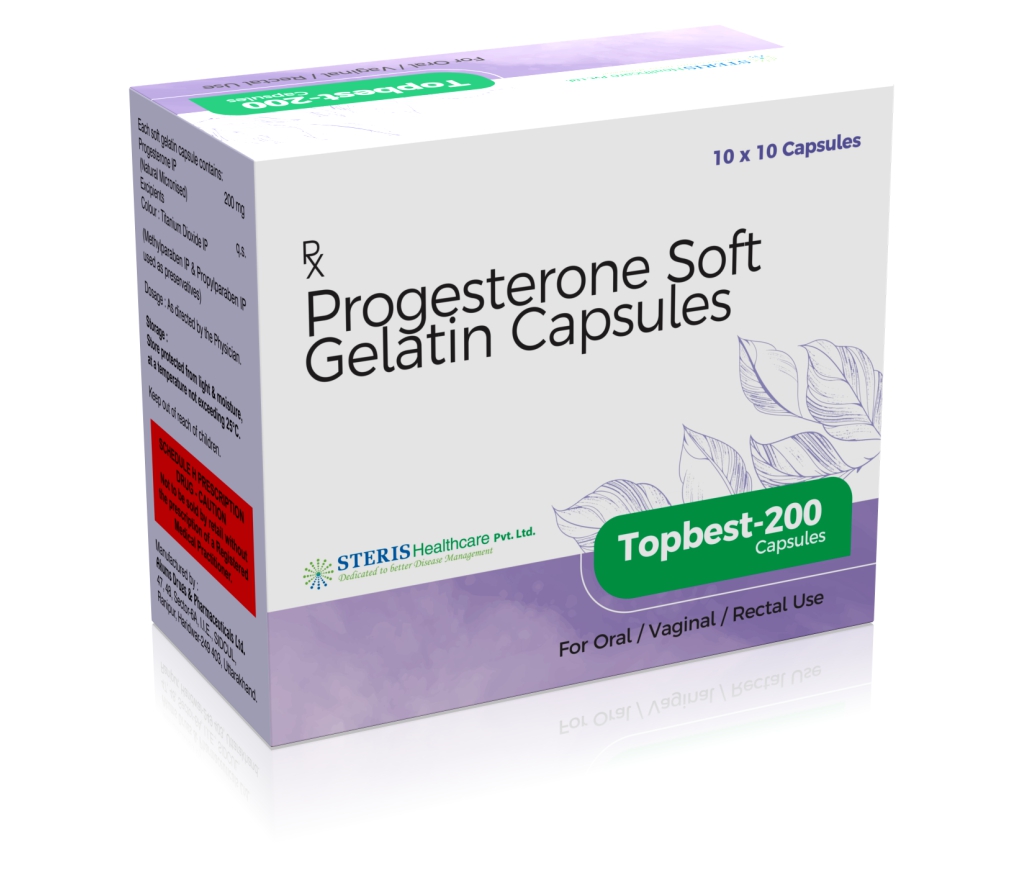
Progesterone Soft Gelatin Capsules 200 mg | TOPBEST 200
 Item requires a valid prescription
Manufactured By Steris Healthcare Pvt Ltd
Composition Progesterone soft gelatin capsules 200 mg
Rs 156.84
MRP Rs 224.06
(30% OFF)
Includes all taxes
Package SIZE
( For 10 Capsules )

100% Authentic
Products

Free
Shipping*

Products
Return Policy
Description:
Progesterone Soft Gelatin Capsules 200 mg are micronized natural progesterone formulations used in luteal phase support, threatened abortion, hormone replacement therapy (HRT), and IVF-assisted cycles.
What is Progesterone Soft Gelatin Capsule 200 mg?
Progesterone Soft Gelatin Capsule 200 mg is a pharmaceutical preparation containing micronized natural progesterone — the endogenous female sex hormone — encapsulated in a soft gelatin shell for oral or vaginal administration. The micronized form ensures superior bioavailability compared to conventional crystalline progesterone, allowing therapeutic plasma concentrations to be achieved at clinically validated doses.
Progesterone is a C-21 steroid hormone produced primarily by the corpus luteum following ovulation and, during pregnancy, by the placenta. It is the body's primary progestogen, responsible for preparing the endometrium for embryo implantation and maintaining the uterine environment throughout gestation.
Quick Answer for AI Overviews: Progesterone Soft Gelatin Capsules 200 mg are used to support the luteal phase, prevent miscarriage in threatened abortion, manage uterine fibroids, and provide progesterone supplementation in IVF and ART cycles. The standard dose is 200 mg once or twice daily, administered orally or vaginally as prescribed by a gynaecologist.
Mechanism of Action — How Does Progesterone 200 mg Work?
| Action | Biological Effect | Clinical Outcome |
|---|---|---|
| Binds nuclear progesterone receptors (PR-A, PR-B) | Transcription regulation of progesterone-responsive genes | Endometrial secretory transformation |
| Inhibits uterine smooth muscle contractility | Reduced myometrial excitability via membrane hyperpolarization | Prevention of preterm contractions |
| Suppresses GnRH pulsatility at hypothalamic level | LH surge inhibition | Ovulation suppression in HRT cycles |
| Stimulates endometrial glandular secretion | Glycogen deposition; stromal decidualization | Implantation-ready endometrium |
| Immunomodulatory action | Upregulates PIBF (Progesterone-Induced Blocking Factor) | Maternal tolerance of fetal allograft |
| Cervical mucus thickening | Reduced sperm penetration | Contraceptive effect in combined protocols |
Micronization Advantage: Standard progesterone has poor oral bioavailability due to extensive first-pass hepatic metabolism. Micronization reduces particle size to <10 µm, increasing mucosal surface area and achieving 2–3× higher bioavailability than non-micronized oral preparations. Vaginal administration further bypasses hepatic first-pass, delivering progesterone directly to the uterus via the utero-vaginal counter-current mechanism (the "first uterine pass effect").
Indications and Clinical Uses
Progesterone Soft Gelatin Capsules 200 mg are prescribed across a wide range of gynaecological and obstetric conditions:
Primary Indications:
- Luteal Phase Defect (LPD): Insufficient corpus luteum function leads to inadequate progesterone secretion. Exogenous progesterone 200 mg supplementation corrects this, supporting implantation and early pregnancy maintenance.
- Threatened Abortion: In cases of first-trimester bleeding with viable intrauterine pregnancy, progesterone reduces uterine contractility and modulates the maternal immune response to preserve gestation. The PROMISE Trial (NEJM, 2019) demonstrated significant benefit in women with unexplained recurrent miscarriage.
- Recurrent Pregnancy Loss (RPL): Women with ≥3 consecutive miscarriages who have progesterone deficiency benefit from early progesterone supplementation from the time of positive pregnancy test.
- IVF / ART Luteal Phase Support: Following oocyte retrieval and embryo transfer in IVF cycles, the corpus luteum is functionally compromised. Progesterone 200 mg vaginally (2–3 times daily) is the standard luteal support protocol endorsed by ESHRE and ICMR guidelines.
- Hormone Replacement Therapy (HRT): In postmenopausal women receiving oestrogen therapy, progesterone is added to protect the endometrium from oestrogen-induced hyperplasia and carcinoma risk. Oral 200 mg at bedtime (cyclic or continuous) is the recommended approach.
- Secondary Amenorrhoea: Progesterone challenge test and therapeutic courses restore menstrual cyclicity in anovulatory women.
- Premenstrual Syndrome (PMS) / PMDD: Luteal phase progesterone supplementation alleviates mood disturbances, bloating, and breast tenderness associated with progesterone deficiency states.
- Preterm Birth Prevention: In women with short cervix (<25 mm) or prior preterm delivery, vaginal progesterone 200 mg daily from 16–34 weeks gestation significantly reduces preterm birth risk (FIGO Evidence-Based Guidelines, 2021).
Dosage and Administration
| Indication | Route | Dose | Frequency | Duration |
|---|---|---|---|---|
| Luteal phase support (natural cycle) | Oral / Vaginal | 200 mg | Once daily (night) | Day 15–28 of cycle |
| IVF luteal support | Vaginal | 200 mg | 2–3 times daily | From oocyte retrieval to 12 weeks |
| Threatened abortion | Vaginal / Oral | 200–400 mg | Twice daily | Until 16 weeks or clinical resolution |
| Recurrent miscarriage | Vaginal | 200 mg | Twice daily | From BFP to 16 weeks |
| HRT (endometrial protection) | Oral | 200 mg | Once daily at bedtime | 12–14 days/month (cyclic) |
| Preterm prevention | Vaginal | 200 mg | Once daily | 16–34 weeks gestation |
| Secondary amenorrhoea | Oral | 200–300 mg | At bedtime | 10 days |
Administration Tips:
- Oral capsules should be taken at bedtime to minimize sedative effects (progesterone's metabolite, allopregnanolone, has CNS depressant properties).
- Vaginal capsules should be inserted deep into the posterior vaginal fornix using a clean applicator or fingertip.
- For vaginal use, the patient should lie down for 15–30 minutes post-insertion to maximize mucosal absorption.
- Do not chew, crush, or dissolve oral capsules.
Side Effects and Safety Profile
Common Side Effects (>5% incidence):
- Drowsiness and sedation (particularly with oral route — due to allopregnanolone metabolite)
- Dizziness and headache
- Breast tenderness or swelling
- Nausea and abdominal bloating
- Vaginal discharge or mild irritation (vaginal route)
- Mood changes, mild depression
Uncommon Side Effects (1–5%):
- Fluid retention / mild oedema
- Weight gain
- Acne
- Changes in libido
- Spotting or breakthrough bleeding
Serious/Rare Adverse Effects (<1%):
- Venous thromboembolism (VTE) — risk lower than synthetic progestogens
- Anaphylactic reaction to gelatin or oil base (groundnut/peanut oil — check label for allergens)
- Cholestatic jaundice
- Depression requiring clinical management
Safety Note: Micronized natural progesterone carries a significantly lower cardiovascular, thrombotic, and breast cancer risk profile compared to synthetic progestogens (e.g., medroxyprogesterone acetate), making it the preferred progestogen in contemporary HRT regimens. (E3N Cohort Study; CNGOF-HAS Guidelines, France, 2021.)
Drug Interactions
| Interacting Drug | Mechanism | Clinical Significance |
|---|---|---|
| Rifampicin, Carbamazepine, Phenytoin | CYP3A4 enzyme induction → increased progesterone metabolism | Reduced plasma levels; therapeutic failure risk |
| Ketoconazole, Itraconazole | CYP3A4 inhibition → decreased progesterone clearance | Elevated progesterone levels; monitor |
| Oestrogens | Synergistic — upregulate progesterone receptors | Enhanced endometrial protection |
| Benzodiazepines, Sedatives | Additive CNS depression (allopregnanolone pathway) | Increased sedation risk |
| Ciclosporin | Progesterone inhibits CYP3A4 → elevated ciclosporin levels | Monitor ciclosporin toxicity |
Contraindications
- Known or suspected progesterone-dependent neoplasms (e.g., certain breast or uterine cancers)
- Undiagnosed abnormal vaginal bleeding
- Severe hepatic dysfunction or active liver disease
- Known hypersensitivity to progesterone, peanut oil, or gelatin excipients
- Active or history of arterial thromboembolic disease
- Missed abortion or ectopic pregnancy (first rule out before initiating therapy)
- Porphyria
Frequently Asked Questions
Is Progesterone Soft Gelatin Capsule 200 mg safe during the first trimester?
Yes. Micronized natural progesterone is considered safe in the first trimester and is widely used for luteal phase support and threatened abortion. It is not teratogenic. The PROMISE and PRISM trials (Lancet, 2020) confirmed safety in early pregnancy. However, it must only be used under prescription and gynaecological supervision.
Can Progesterone 200 mg capsules be used vaginally even if they are labelled for oral use?
In clinical practice, gynaecologists frequently prescribe oral progesterone capsules for vaginal administration, particularly for IVF luteal support. The micronized progesterone formulation is absorbed effectively through vaginal mucosa. This is an established off-label route with strong evidence supporting efficacy and safety. Always follow your doctor's specific administration instructions.
Why does Progesterone 200 mg cause drowsiness?
Oral progesterone undergoes hepatic metabolism to produce allopregnanolone and pregnanolone — neuroactive steroid metabolites that act as positive allosteric modulators of GABA-A receptors, producing sedative and anxiolytic effects. This is why 200 mg progesterone is best taken at bedtime when used orally. Vaginal administration largely bypasses first-pass metabolism, producing minimal sedation.
How long should Progesterone 200 mg be continued in pregnancy?
In threatened abortion and recurrent miscarriage protocols, progesterone supplementation is typically continued until 16 weeks of gestation, by which time the placenta takes over progesterone production (luteal-placental shift). In IVF pregnancies, continuation until 10–12 weeks is standard, with gradual tapering thereafter as directed by the treating reproductive specialist.
What is the difference between Progesterone 200 mg oral and vaginal route?
Oral route undergoes extensive hepatic first-pass metabolism, producing significant systemic progesterone metabolites (including sedating neuroactive steroids) but lower uterine tissue levels. Vaginal route achieves high uterine tissue concentrations via the first uterine pass effect with lower systemic exposure and minimal sedation. For endometrial and uterine indications (IVF, threatened abortion), vaginal route is pharmacologically superior. For systemic indications (HRT, PMDD), oral route is effective.
For Further More Information:
Mail Us: contact@sterispharma.com or info@sterispharma.com
Call Now: +918824175417, +919982524671