




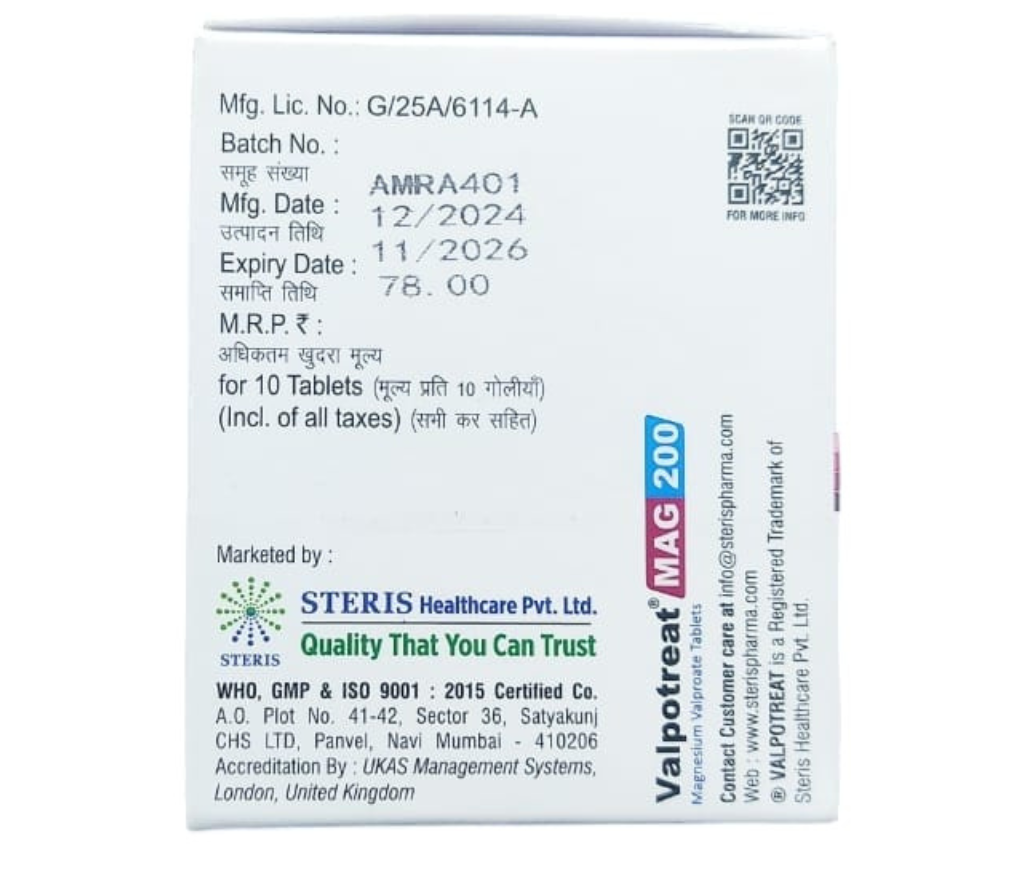
VALPOTREAT MAG 200
 Item requires a valid prescription
Manufactured By Steris Healthcare Pvt Ltd
Composition Magnesium Valproate 200mg
Rs 54.60
MRP Rs 78.00
(30% OFF)
Includes all taxes
Package SIZE
( for 10 tablets )

100% Authentic
Products

Free
Shipping*

Products
Return Policy
Description:
Magnesium Valproate is a Schedule H prescription anticonvulsant (antiepileptic) and mood-stabilizing medicine used primarily to treat epilepsy (all seizure types), bipolar disorder manic episodes, and migraine prophylaxis. It works by increasing GABA activity in the brain, which calms overactive nerve signals responsible for seizures and mood instability. It is available in multiple strengths, including Magnesium Valproate 200 mg and Magnesium Valproate 500 mg, and must only be taken under medical supervision due to its narrow therapeutic index and pregnancy-related risks.
| Attribute | Detail |
|---|---|
| Drug Class | Anticonvulsant / Antiepileptic, Mood Stabilizer |
| Primary Use | Epilepsy (generalized & partial seizures), Bipolar mania, Migraine prevention |
| Available Strengths | Magnesium Valproate 200 mg, Magnesium Valproate 500 mg |
| Mechanism | Increases GABA (inhibitory neurotransmitter) activity, stabilizes neuronal firing |
| Prescription Status | Schedule H — Prescription only |
| Common Side Effects | Nausea, weight gain, tremor, hair thinning, drowsiness |
| Serious Risk Flag | High-risk in pregnancy (neural tube defects) and hepatic impairment |
| Who Should Avoid It | Pregnant women, patients with liver disease, known valproate hypersensitivity |
Clinical Indications Table
| Condition | How Magnesium Valproate Helps |
|---|---|
| Epilepsy (Generalized & Partial Seizures) | Reduces abnormal electrical activity in the brain, lowering seizure frequency and severity |
| Bipolar Disorder (Manic Episodes) | Stabilizes mood swings and reduces the intensity of manic phases |
| Migraine Prophylaxis | Used as a preventive (not acute) therapy to reduce frequency of recurrent migraines |
| Absence Seizures & Myoclonic Seizures | Considered a broad-spectrum antiepileptic effective across multiple seizure subtypes |
What Is Magnesium Valproate?
Magnesium Valproate belongs to the valproate family of anticonvulsants, combining valproic acid with a magnesium salt base for improved tolerability in some formulations. Its core action is on the central nervous system, where it is believed to:
- Boost GABA levels — GABA (gamma-aminobutyric acid) is the brain's primary calming neurotransmitter; higher GABA activity reduces neuronal over-excitability.
- Block voltage-gated sodium channels — This limits the rapid, repetitive nerve firing that triggers seizures.
- Modulate calcium channels, contributing to its effect on absence seizures.
Key Benefits of Magnesium Valproate
- Broad-Spectrum Seizure Control — Effective across generalized, partial, absence, and myoclonic seizure types, making it a first-line option for many epilepsy patients.
- Mood Stabilization — Reduces frequency and intensity of manic episodes in bipolar disorder, supporting long-term psychiatric stability.
- Migraine Prevention — A recognized preventive therapy for patients with frequent or disabling migraine episodes.
- Once- or Twice-Daily Dosing Flexibility — Available in multiple strengths (200 mg, 500 mg) allowing individualized titration.
- Established Long-Term Safety Profile — Decades of clinical use provide doctors with well-understood monitoring parameters (liver function, platelet counts).
- Magnesium Co-Formulation — May offer better gastric tolerability compared to sodium valproate in some patients, reducing acidity-related discomfort.
Dosage & Administration
- Magnesium Valproate 200 mg—Typically used for lower-intensity maintenance dosing or in patients being titrated up from a starting dose, and in some pediatric or elderly protocols under strict supervision.
- Magnesium Valproate 500 mg—Commonly prescribed for adults requiring higher maintenance doses for seizure control or bipolar mania management.
- Usually taken with food to minimize gastrointestinal irritation.
- Extended-release formulations may allow once-daily dosing; immediate-release forms are often split into two doses.
- Abrupt discontinuation must be avoided—stopping suddenly can trigger rebound seizures. Dose tapering should always be physician-guided.
- Regular blood tests (liver enzymes, platelet count, and sometimes valproate serum levels) are recommended during long-term therapy.
Side Effects of Magnesium Valproate
Common Side Effects
- Nausea or stomach upset
- Weight gain
- Fine hand tremor
- Drowsiness or fatigue
- Hair thinning or hair loss (usually temporary)
- Mild dizziness
Serious Side Effects (Seek Medical Attention)
- Signs of liver problems: yellowing of skin/eyes, dark urine, persistent vomiting
- Unusual bruising or bleeding (low platelet count)
- Severe drowsiness, confusion, or unsteady movements
- Signs of pancreatitis: severe abdominal pain
- Allergic reactions: rash, swelling, difficulty breathing
High-Risk Population Warning
Magnesium Valproate carries a boxed-warning-level risk in pregnancy, associated with neural tube defects and developmental concerns in the fetus. It is generally classified among high-risk anticonvulsant drugs for women of childbearing age and requires strict contraception counseling and specialist supervision if prescribed in this group. Patients with pre-existing liver disease, mitochondrial disorders, or urea cycle disorders should also be evaluated carefully before starting therapy.
Magnesium Valproate vs Other Anticonvulsants
| Feature | Magnesium Valproate | Sodium Valproate | Oxcarbazepine |
|---|---|---|---|
| Primary Use | Epilepsy, Bipolar mania, Migraine | Epilepsy, Bipolar mania, Migraine | Partial-onset seizures, nerve pain |
| GI Tolerability | Generally better (magnesium buffering) | Can cause more gastric irritation | Generally well tolerated |
| Pregnancy Risk | High risk | High risk | Lower relative risk, still caution advised |
| Dosing Forms | 200 mg, 500 mg | Multiple strengths, syrup available | 150 mg, 300 mg, 600 mg |
| Prescription Status | Schedule H | Schedule H | Schedule H |
Precautions & Warnings
- Inform your doctor about all current medications, especially blood thinners, other antiepileptics, and antidepressants, due to interaction potential.
- Avoid alcohol, which can intensify drowsiness and liver strain.
- Routine liver function and blood count monitoring is essential during long-term use.
- Not recommended for patients with a personal or family history of severe hepatic disorders unless specifically advised by a specialist.
- Women of reproductive age must discuss contraception and pregnancy planning before starting therapy.
- Keep out of reach of children; overdose can be life-threatening.
Conclusion
Magnesium Valproate remains one of the most widely prescribed broad-spectrum anticonvulsants for epilepsy, bipolar disorder, and migraine prevention, valued for its established efficacy and flexible dosing across 200 mg and 500 mg strengths. However, its therapeutic benefits come with a well-documented risk profile — particularly around liver function, blood counts, and pregnancy safety — which makes it a strictly prescription-only (Schedule H) medicine. Patients should never start, stop, or adjust their dose without direct medical guidance, and regular monitoring is key to using this medication safely and effectively over the long term. If you or a loved one has been prescribed Magnesium Valproate, understanding its uses, benefits, and side effects — as outlined above — can help you have a more informed conversation with your treating doctor.
Frequently Asked Questions
1. What is magnesium valproate used for?
Magnesium Valproate is used to treat epilepsy (multiple seizure types), manic episodes in bipolar disorder, and for preventing recurrent migraines. It works by calming overactive electrical activity in the brain.
2. What is magnesium valproate 500 mg used for?
The 500 mg strength is commonly prescribed for adults needing a higher maintenance dose to control seizures or stabilize mood in bipolar disorder, as determined by a treating physician.
3. What is magnesium valproate 200 mg used for?
The 200 mg strength is typically used during dose titration, for maintenance in patients who need a lower dose, or in specific pediatric/elderly protocols under close medical supervision.
4. Which magnesium is good for epilepsy?
In the context of epilepsy management, Magnesium Valproate (a valproate-class anticonvulsant) is the relevant medical formulation — it is not a nutritional magnesium supplement but a prescription antiepileptic that uses a magnesium salt base to potentially improve tolerability.
5. What are the common side effects of taking magnesium valproate?
Common side effects include nausea, weight gain, mild hand tremor, drowsiness, temporary hair thinning, and occasional dizziness. Most are manageable and should be reported to your doctor if persistent.
6. Is valproate a high-risk drug? Yes. Valproate-class medicines, including Magnesium Valproate, are considered high-risk, particularly for women who are pregnant or planning pregnancy, due to the risk of neural tube defects and developmental effects on the fetus. It also requires monitoring for liver and blood-count effects.
7. What is magnesium valproate 200 used for?
Magnesium Valproate 200 mg is used for seizure control and mood stabilization, generally as part of a titrated or lower-maintenance dosing plan decided by a neurologist or psychiatrist.
8. Can magnesium valproate be taken during pregnancy?
It is generally avoided during pregnancy due to a well-documented risk of birth defects. Any pregnant patient currently on this medicine should consult her doctor immediately rather than stopping it abruptly on her own.
9. How long does it take for magnesium valproate to work for seizures?
Some effects on mood or seizure threshold may be noticed within days to weeks, but full therapeutic benefit for seizure control often takes several weeks of consistent, correctly dosed use, along with dose adjustments guided by your doctor.
10. Can I stop taking magnesium valproate suddenly?
No. Sudden discontinuation can trigger rebound seizures or mood destabilization. Any dose changes or stopping the medicine must be tapered gradually under medical supervision.
11. Does magnesium valproate cause weight gain?
Weight gain is a recognized and relatively common side effect for some patients on long-term valproate therapy. Diet and activity monitoring alongside regular doctor check-ins can help manage this.
12. Is magnesium valproate safe for children?
It may be prescribed for pediatric epilepsy in specific cases, but pediatric use requires specialist evaluation, careful dose calculation based on body weight, and close monitoring, particularly of liver function.
13. What monitoring tests are needed while on magnesium valproate?
Doctors typically recommend periodic liver function tests, complete blood counts (to monitor platelets), and sometimes valproate serum drug-level testing to ensure the dose remains safe and effective.
14. Can magnesium valproate be used for migraine prevention?
Yes, it is an established preventive (prophylactic) treatment for recurrent migraines, though it is used for prevention rather than treating an acute migraine attack in progress.
15. What should I avoid while taking magnesium valproate?
Avoid alcohol, unsupervised use of other central-nervous-system depressants, and abrupt dose changes. Always inform any other treating doctor or dentist that you are on this medicine before starting new treatments.
16. Is magnesium valproate the same as sodium valproate?
They belong to the same valproate drug class and share a similar mechanism of action, but differ in their salt formulation, which can affect gastrointestinal tolerability. Your doctor will choose the formulation best suited to you.
17. Where can I check the price of magnesium valproate tablets?
As this is a Schedule H prescription medicine, pricing should be checked through your prescribing doctor or a licensed pharmacy — click "Check Price" above for current listing details.
If You Need More Information About VALPOTREAT MAG 200 Click here

