


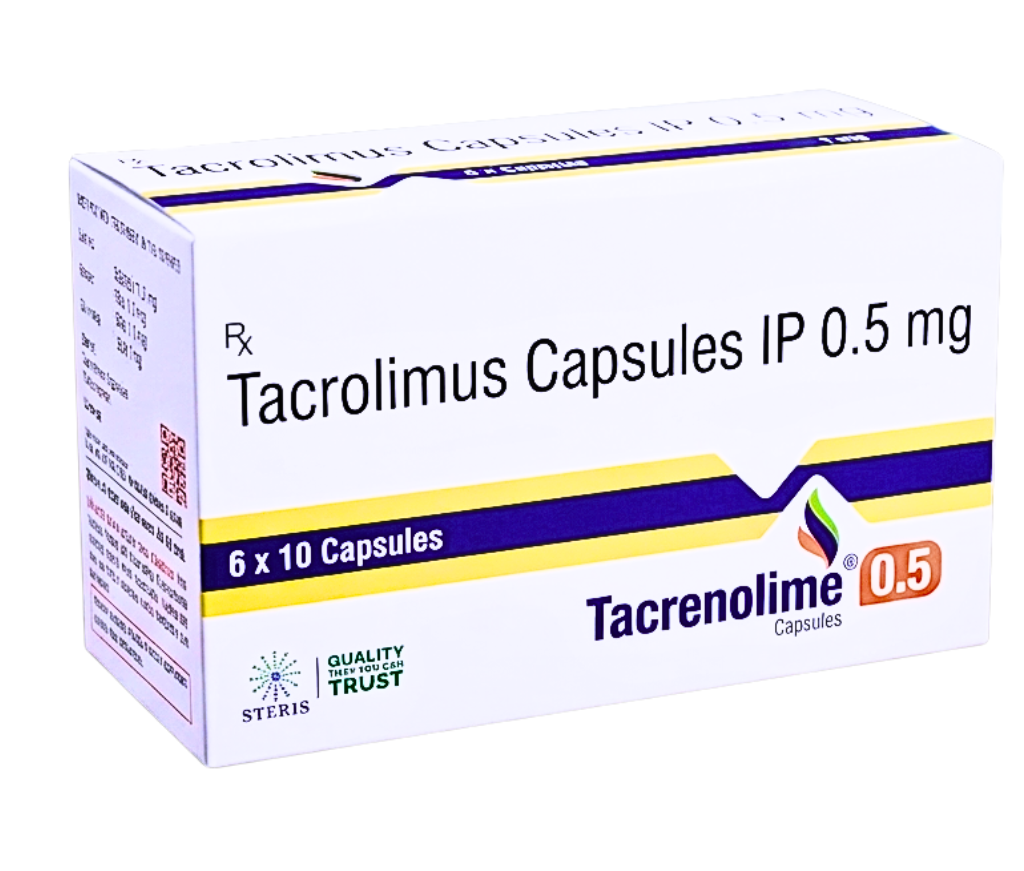
TACRENOLIME 0.5
 Item requires a valid prescription
Manufactured By Steris Healthcare Pvt Ltd
Composition Tacrolimus Capsules (0.5mg)
Rs 147.00
MRP Rs 210.00
(30% OFF)
Includes all taxes
Package SIZE
( For 10 Capsules )

100% Authentic
Products

Free
Shipping*

Products
Return Policy
Description:
Tacrolimus capsules at 0.5 mg are prescription immunosuppressant medicines primarily used to help prevent organ rejection following transplantation. Tacrolimus works by reducing specific immune-system activity so that the body's immune system is less likely to attack a transplanted organ.
In India, tacrolimus 0.5 mg capsules are available under several brands and are generally supplied on prescription. Current online pharmacy listings include products such as Takfa 0.5, Tacrolim 0.5 mg, Tacromus 0.5, Tacrograf 0.5, and Pangraf 0.5. Prices vary according to the manufacturer, pack size, pharmacy, and current offers.
If you are looking for tacrolimus capsule IP 0.5 mg uses, benefits, side effects, dosage, precautions, price, or how to buy tacrolimus 0.5 mg online, this guide provides the key information to understand before purchasing or using the medicine.
What Are Tacrolimus Capsules IP 0.5 mg?
Tacrolimus capsules IP 0.5 mg contain tacrolimus 0.5 mg, an immunosuppressive medicine belonging to the calcineurin-inhibitor class.
The term "IP" refers to the Indian Pharmacopoeia, which establishes standards for the identity, quality, and purity of medicines in India.
Tacrolimus is primarily prescribed after organ transplantation because the immune system can identify a transplanted organ as foreign. Without adequate immunosuppression, immune cells may attack the transplanted organ, resulting in rejection.
Tacrolimus reduces this immune response by inhibiting calcineurin-dependent T-cell activation. This makes it an important component of many post-transplant immunosuppressive regimens.
FDA-approved oral tacrolimus products are used to prevent organ rejection in appropriate transplant recipients, including kidney, liver, and heart transplant patients. U.S. Food and Drug Administration
Tacrolimus Capsules IP 0.5 mg Uses
The primary use of the primary tacrolimus capsules IP 0.5 mg is prevention of organ rejection after transplantation.
Depending on the individual treatment plan, tacrolimus may be prescribed to:
- Help prevent kidney transplant rejection.
- Help prevent liver transplant rejection.
- Help prevent heart transplant rejection.
- Support long-term immunosuppressive treatment following transplantation.
- Form part of a combination regimen with other immunosuppressive medicines.
The exact indication depends on the patient's transplant type and the formulation prescribed.
Tacrolimus should not be considered a general “immunity booster” or a medicine for routine kidney problems. Its immunosuppressive action is specifically intended to control inappropriate immune activity in conditions where this is medically required.
How Does Tacrolimus 0.5 mg Work?
Tacrolimus works by inhibiting calcineurin, an enzyme required for activation of T lymphocytes, commonly known as T cells.
T cells play an important role in immune defense. After transplantation, however, they can contribute to an immune response against the transplanted organ. By reducing T-cell activation, tacrolimus helps decrease the immune response responsible for organ rejection.
The same immune suppression that protects the transplanted organ can also make the patient more vulnerable to infections. Therefore, tacrolimus treatment requires careful medical supervision and regular monitoring.
Key Benefits of Tacrolimus Capsules IP 0.5 mg
1. Helps prevent organ rejection
The most important benefit of tacrolimus is its ability to suppress immune activity that could attack a transplanted organ.
2. Supports transplant maintenance
Tacrolimus can form an important part of long-term immunosuppressive therapy following transplantation.
3. Provides controlled immune suppression
Rather than broadly suppressing every aspect of immunity, tacrolimus primarily affects the calcineurin pathway involved in T-cell activation.
4. 0.5 mg strength allows dose flexibility.
The 0.5 mg strength can help physicians individualize treatment. Tacrolimus dosing is not identical for every patient and can depend on factors such as transplant type, body weight, other medicines, and blood tacrolimus concentrations.
5. Can be used as part of combination therapy
Transplant patients commonly receive tacrolimus together with other immunosuppressive medicines. The precise combination is determined by the transplant team.
Tacrolimus Capsules IP 0.5 mg Dosage
There is no universal tacrolimus 0.5 mg dosage suitable for every patient.
Your doctor determines the appropriate dose according to factors such as:
- Type of transplant
- Body weight
- Time since transplantation
- Tacrolimus blood concentration
- Kidney and liver function
- Other medicines being taken
- Individual response and adverse effects
Current Indian product information similarly states that the amount and frequency of tacrolimus depend on the type of transplant, body weight, and other medicines.
Take the medicine exactly as prescribed and maintain a consistent dosing schedule.
Do not increase or decrease the dose yourself. Do not discontinue tacrolimus simply because you feel well. Stopping treatment without medical supervision can increase the risk of organ rejection.
How to Take Tacrolimus Capsules IP 0.5 mg
Follow your prescription carefully. Depending on the specific formulation, tacrolimus capsules may be taken with or without food, but consistency in relation to meals is important.
Swallow the capsule as directed. Do not alter the formulation unless specifically instructed by your healthcare professional.
One particularly important point is formulation consistency. Immediate-release tacrolimus and extended-release tacrolimus products are not automatically interchangeable. FDA prescribing information warns about medication errors involving unintended substitution between different tacrolimus formulations. FDA Access Data
If your pharmacy offers a different brand or formulation, confirm the change with your transplant team before taking it.
Tacrolimus Capsules IP 0.5 mg Side Effects
Like other immunosuppressants, tacrolimus can cause side effects.
Potential side effects include:
- Tremor or shaking
- Headache
- High blood pressure
- Increased blood glucose
- Diabetes
- Kidney-function problems
- Increased susceptibility to infections
- Sleep problems or insomnia
- Gastrointestinal symptoms
- Changes in electrolyte levels
Current Indian product information for tacrolimus 0.5 mg products specifically identifies tremor, infections, high blood pressure, headache, and insomnia among potential adverse effects and warns about kidney problems and diabetes.
The severity of side effects varies from person to person. Regular medical monitoring is important because some clinically important changes may not cause obvious symptoms initially.
Serious Precautions With Tacrolimus 0.5 mg
Tacrolimus requires particular care because excessive exposure can increase toxicity, while inadequate exposure may increase the risk of rejection.
Doctors may monitor:
- Tacrolimus blood levels
- Kidney function
- Liver function
- Blood pressure
- Blood glucose
- Electrolytes
- Signs of infection
FDA prescribing information highlights risks including nephrotoxicity, neurotoxicity, high potassium, and new-onset diabetes after transplantation. FDA Access Data
Tacrolimus-associated immunosuppression can also increase the risk of certain infections and malignancies. FDA labeling recommends limiting excessive exposure to sunlight and UV radiation and taking appropriate skin-protection measures. FDA Access Data
Tacrolimus 0.5 mg Drug Interactions
Tacrolimus has numerous potential drug interactions. Some medicines can increase or decrease tacrolimus concentrations, potentially affecting effectiveness or toxicity.
Before starting any new medicine, tell your doctor or pharmacist about:
- Antibiotics
- Antifungal medicines
- Antiviral medicines
- Blood-pressure medicines
- Pain medicines
- Other immunosuppressants
- Herbal products
- Vitamins and supplements
Do not assume that an OTC medicine or herbal supplement is automatically safe with tacrolimus.
Who Should Take Precautions?
Tell your doctor if you have kidney disease, liver disease, heart problems, diabetes, high blood pressure, or a history of serious infections.
Pregnancy and breastfeeding should also be discussed with your healthcare professional before treatment.
Because tacrolimus suppresses the immune system, report symptoms such as persistent fever, severe weakness, unusual infections, significant changes in urination, severe headache, confusion, or other unusual symptoms promptly.
Buying Tacrolimus Capsules IP 0.5 mg Online
If you have a valid prescription and intend to buy tacrolimus capsules IP 0.5 mg online, choose a reputable, licensed pharmacy and verify the medicine carefully.
Before purchasing, check:
- Active ingredient: Tacrolimus 0.5 mg.
- Dosage form: Confirm that the product matches your prescription.
- Manufacturer: Check the manufacturer and marketer printed on the package.
- Prescription requirement: Current Indian pharmacy listings identify tacrolimus 0.5 mg products as prescription medicines.
- Batch and expiry: Check both before using the medicine.
- Packaging: Avoid products with damaged or suspicious packaging.
- Price and pack size: Compare equivalent pack sizes because different pack quantities can make direct price comparisons misleading.
Tacrolimus 0.5 mg Price in India
The tacrolimus 0.5 mg price is not fixed across all brands. Current September 2026 Indian listings show examples such as Takfa 0.5 at ₹199 MRP for 10 capsules, Tacromus 0.5 at approximately ₹200 for 10 capsules, and Pangraf 0.5 at approximately ₹190 MRP for 10 capsules. Prices, discounts, availability, and delivery charges can change.
Therefore, buyers should compare the same strength, formulation, manufacturer/brand, and pack size rather than selecting solely on the displayed price.
Frequently Asked Questions
1. What are tacrolimus capsules IP 0.5 mg used for?
Tacrolimus capsules at 0.5 mg are primarily used to help prevent organ rejection after transplantation. They may be used in kidney, liver, and heart transplant patients as part of an immunosuppressive treatment regimen. U.S. Food and Drug Administration +1
2. What are the benefits of tacrolimus 0.5 mg?
The principal benefit is reducing the immune response against a transplanted organ, helping lower the risk of rejection when used correctly as part of a prescribed transplant regimen.
3. What are the common side effects of tacrolimus 0.5 mg?
Commonly reported or listed effects include tremor, headache, high blood pressure, infections, insomnia, increased blood sugar, and kidney-related problems.
4. Can tacrolimus 0.5 mg affect the kidneys?
Yes. Tacrolimus can cause or worsen kidney-function problems in some patients. This is why kidney function and tacrolimus exposure are monitored during treatment. However, patients should never stop tacrolimus themselves, because doing so can increase the risk of transplant rejection. FDA Access Data
5. Can I buy tacrolimus capsules IP 0.5 mg online?
Yes, tacrolimus 0.5 mg capsules are listed by Indian online pharmacies, but they are prescription medicines. A purchase should be made through a legitimate pharmacy using a valid prescription. Current listings show availability and pricing can differ by brand and seller.
6. What happens if I stop taking tacrolimus 0.5 mg?
Stopping tacrolimus without medical advice can increase the risk of rejectio
7. Can tacrolimus 0.5 mg be taken with other medicines?
Yes, tacrolimus is frequently used alongside other immunosuppressive medicines. However, it has many potential drug interactions. Your doctor should review all prescription medicines, OTC medicines, and supplements before you start or change treatment.
8. Is tacrolimus 0.5 mg a steroid?
No. Tacrolimus is not a steroid. It is an immunosuppressant that works primarily by inhibiting the calcineurin pathway and reducing T-cell activation.
9. Can I switch between different tacrolimus brands?
Do not switch brands or formulations without consulting your transplant specialist. Tacrolimus requires careful dosing and monitoring, and different formulations should not be treated as automatically interchangeable. F FDA Access Data
10. How long do I need to take tacrolimus after a transplant?
The duration varies according to the transplant type, individual risk of rejection, and the treatment plan established by the transplant team. Many transplant recipients require long-term immunosuppression. Never discontinue tacrolimus based solely on how well you feel.
Conclusion
Tacrolimus capsules at 0.5 mg are prescription immunosuppressants primarily used to help prevent rejection following organ transplantation. Their key benefit is controlling the immune response that can attack a transplanted organ. Because tacrolimus has a narrow therapeutic range and can affect kidney function, blood pressure, blood glucose, electrolytes, and infection risk, treatment requires careful medical supervision and regular monitoring.
For people looking to buy tacrolimus capsules (IP 0.5 mg) online, the most important considerations are the correct strength and formulation, a valid prescription, product authenticity, appropriate storage, expiry date, and a trustworthy pharmacy. Current Indian listings demonstrate that prices differ between brands and pack sizes, so buyers should compare equivalent products rather than choosing solely by price.