


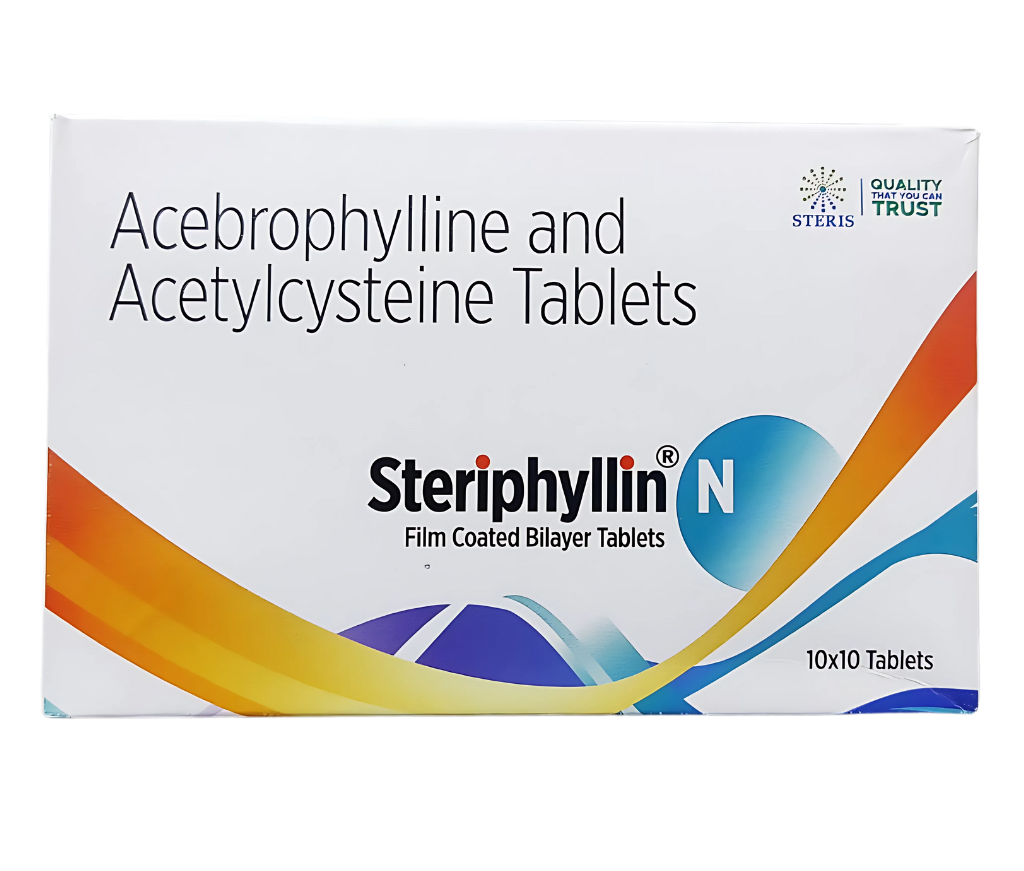

Acebrophylline and Acetylcysteine Tablets | Steriphyllin N
 Item requires a valid prescription
Manufactured By Steris Healthcare Pvt Ltd
Composition Acebrophylline 100mg , Acetylcysteine BP 600mg
Rs 127.97
MRP Rs 182.81
(30% OFF)
Includes all taxes
Package SIZE
( FOR 10 TABLET )

100% Authentic
Products

Free
Shipping*

Products
Return Policy
Description:
What are acebrophylline and acetylcysteine tablets?
Acebrophylline and acetylcysteine tablets are combination respiratory medicines used in some patients with obstructive airway conditions, particularly when excessive or thick mucus accompanies breathing problems.
The combination brings together two medicines with different but complementary actions:
- Acebrophylline is a bronchodilator with mucoregulatory/mucolytic properties that may help improve airflow and mucus clearance.
- Acetylcysteine (N-acetylcysteine or NAC) is a mucolytic that helps reduce the thickness of mucus, making secretions easier to clear.
A commonly marketed fixed-dose combination in India contains acebrophylline 100 mg + acetylcysteine 600 mg, although strengths and brands can differ. The exact product prescribed should always be checked on the medicine strip or prescription.
How do acebrophylline and acetylcysteine tablets work?
The two ingredients address different aspects of airway disease.
Acebrophylline
Acebrophylline is used to help improve airway function and is described as having bronchodilatory and mucus-regulating effects. By helping relax the airway and influencing mucus production and clearance, it may help some patients breathe more comfortably.
Acetylcysteine
Acetylcysteine is a mucolytic. Its principal respiratory role is to make thick mucus less sticky and easier to cough out. This can be particularly relevant when excessive or difficult-to-clear secretions contribute to cough and airway obstruction.
In simple terms: acebrophylline primarily supports airway function, while acetylcysteine helps loosen thick mucus.
Acebrophylline and acetylcysteine tablets uses
Doctors may prescribe this combination when a patient's respiratory condition includes symptoms such as excessive mucus, productive cough, or difficulty clearing airway secretions.
Depending on the individual diagnosis and product labeling, it may be considered as part of treatment for conditions such as:
- Chronic obstructive pulmonary disease (COPD)
- Chronic bronchitis
- Asthma in selected patients
- Other obstructive respiratory disorders associated with excessive mucus
It is important not to equate these potential uses with a recommendation for self-treatment. COPD and asthma require proper diagnosis and an individualized treatment plan.
Current international COPD guidance emphasizes comprehensive disease management rather than relying on a single oral medicine. The GOLD 2026 materials cover diagnosis, pharmacological treatment, inhaled therapy, vaccination, risk-factor reduction and follow-up management.
What are the benefits of this combination?
Potential benefits depend on the patient's diagnosis, symptoms and response to treatment.
The combination may help by:
- Supporting easier mucus clearance
- Reducing the thickness of respiratory secretions
- Supporting airway opening and airflow
- Reducing the burden of mucus-associated cough in appropriate patients
- Potentially improving lung-function measurements in selected patients
A 2025 study of 102 enrolled patients, of whom 97 completed treatment, found that mean FEV1 increased from 1.287 L to 1.484 L after 90 days. In the COPD subgroup, CAT scores also improved significantly. No severe adverse events were reported in that study.
However, this evidence should be interpreted carefully. The study did not compare the combination against placebo or another active treatment, and its results do not mean that every person with asthma, COPD or cough will experience the same benefit.
Acebrophylline and acetylcysteine tablets dosage
The correct dosage depends on the specific product, strength, diagnosis, age, kidney and liver function, other medicines and the prescribing doctor's assessment.
Some Indian product information for a 100 mg acebrophylline + 600 mg acetylcysteine formulation lists adult dosing as one tablet twice daily, preferably after meals, but this should not be treated as a universal dose for every product or patient.
Do not increase the dose because symptoms are not improving, and do not take an extra tablet to compensate for a missed dose unless your healthcare professional specifically advises you to do so.
How should acebrophylline and acetylcysteine tablets be taken?
Follow the instructions printed on your prescription and medicine packaging.
General administration points may include:
- Take the tablet exactly as prescribed.
- Some formulations are recommended after food to reduce gastrointestinal discomfort.
- Swallow the tablet as directed rather than altering the dosage form without professional advice.
- Take doses at consistent times when possible.
- Tell your doctor about all prescription medicines, OTC products, supplements and herbal products you use.
- Do not share your medicine with another person who has similar symptoms.
If you miss a dose, follow the instructions supplied with your particular product or ask your pharmacist/doctor. Avoid automatically doubling the next dose.
Side effects of acebrophylline and acetylcysteine tablets
Like all medicines, this combination can cause unwanted effects.
Reported or possible effects may include:
- Nausea
- Vomiting or stomach discomfort
- Headache
- Dizziness
- Gastrointestinal upset
Product-specific information should always be checked because the side-effect profile can vary with formulation and patient characteristics. One 2025 study reported only mild headache and weakness in an individual participant and no severe adverse events during the observation period.
Seek prompt medical attention for severe or unusual symptoms, especially significant breathing difficulty, severe allergic symptoms, fainting, chest pain or other symptoms that appear serious.
Who should use acebrophylline and acetylcysteine tablets with caution?
Before treatment, tell your doctor if you have:
- Liver disease
- Kidney disease
- A history of peptic ulcer disease
- Asthma or recurrent wheezing
- Significant heart problems
- A known allergy to either ingredient
- Pregnancy or plans to become pregnant
- Breastfeeding
Some product information lists hypersensitivity, severe hepatic or renal impairment and active peptic ulcer disease among important contraindications or precautions for particular formulations. Because products differ, the prescribing information for the exact medicine should be followed.
Drug interactions
Acebrophylline may interact with several medicines, and the interaction profile can depend on the patient's other drugs and medical conditions.
Examples reported in medicine-information resources include certain antibiotics, antifungals, cimetidine, allopurinol, corticosteroids, diuretics and some cardiovascular medicines.
This does not mean that these medicines can never be taken together. It means your doctor or pharmacist should know about your complete medication list before treatment.
Frequently Asked Questions About Acebrophylline and Acetylcysteine Tablets
1. What are acebrophylline and acetylcysteine tablets used for?
They may be prescribed for selected respiratory conditions involving airway obstruction and excessive or thick mucus, including some cases of COPD and chronic bronchitis.
2. Is acebrophylline and acetylcysteine good for cough?
It may help when cough is associated with thick or excessive respiratory mucus. It is not appropriate for every type of cough, so the underlying cause should be identified.
3. Can acebrophylline and acetylcysteine tablets treat COPD?
They may be used as part of treatment for selected COPD patients, particularly when mucus-related symptoms are present. They should not be considered a complete COPD treatment by themselves.
4. Does acetylcysteine reduce mucus?
Yes. Acetylcysteine is a mucolytic that helps make thick mucus less viscous and easier to clear.
5. Does acebrophylline help with breathing?
Acebrophylline has bronchodilatory properties and may help improve airway function in appropriately selected patients.
6. What is the usual strength of acebrophylline and acetylcysteine tablets?
A commonly marketed combination contains acebrophylline 100 mg + acetylcysteine 600 mg, but formulations can vary. Always verify the strength on your prescription and medicine packaging.
7. What is the dosage of acebrophylline and acetylcysteine tablets?
The dose should be determined by the prescribing doctor. Some product information lists one 100 mg/600 mg tablet twice daily for adults, preferably after meals, but this is not a universal instruction for every patient or product.
8. Can I take acebrophylline and acetylcysteine after food?
Some formulations are recommended after meals to reduce gastrointestinal discomfort. Follow the instructions for your specific product.
9. What are the side effects of acebrophylline and acetylcysteine tablets?
Possible side effects include nausea, gastrointestinal discomfort, headache and dizziness. Contact a healthcare professional if symptoms are severe or persistent.
10. Can I take these tablets without a prescription?
You should not self-start this combination simply because you have cough, phlegm or breathlessness. A clinician should determine whether the medicine is appropriate for your condition.
11. Can acebrophylline and acetylcysteine replace an inhaler?
No. An oral combination should not automatically replace prescribed inhaled treatment. Your doctor should determine whether both are required.
12. Can these tablets be taken for asthma?
They may be prescribed for selected asthma patients, but asthma treatment should be individualized. Do not use this combination as a substitute for prescribed controller or rescue therapy.
13. Can acebrophylline and acetylcysteine be taken for chronic bronchitis?
They may be prescribed in selected patients with chronic bronchitis, particularly when excessive mucus is an important symptom.
14. Is acetylcysteine the same as NAC?
Yes. NAC commonly refers to N-acetylcysteine, another name for acetylcysteine.
15. Can acebrophylline and acetylcysteine cause acidity or stomach upset?
Gastrointestinal discomfort can occur. Taking the medicine according to the product's instructions, including any recommendation regarding meals, may help reduce discomfort.
16. Can these tablets cause dizziness?
Dizziness can occur in some patients. If you feel dizzy or lightheaded, avoid driving or operating machinery until you know how the medicine affects you.
17. What should I tell my doctor before taking these tablets?
Tell your doctor about liver or kidney problems, ulcer history, asthma, allergies, pregnancy or breastfeeding, and every medicine, supplement or herbal product you currently use.
18. Can I take acebrophylline and acetylcysteine with other medicines?
Potential interactions are possible, particularly with some antibiotics, antifungals, cardiovascular medicines and other drugs. Give your doctor or pharmacist your complete medication list before starting treatment.
19. How long does acebrophylline and acetylcysteine take to work?
The response varies according to the underlying condition and individual patient. Do not increase the dose or continue treatment longer than prescribed simply because improvement is not immediate.
20. Can I buy acebrophylline and acetylcysteine tablets online?
Where legally permitted, purchase only from a reputable, licensed pharmacy and verify the exact active ingredients and strength against your prescription. Avoid unverified sellers or products with damaged packaging or unclear labeling.
21. Are acebrophylline and acetylcysteine tablets safe?
They can be appropriate for selected patients when prescribed and monitored correctly, but they are not risk-free. Individual medical history, other medicines and the specific formulation matter.
22. Can I stop these tablets when my cough improves?
Do not change or stop a prescribed treatment without consulting your doctor. The appropriate duration depends on the diagnosis and treatment plan.
23. Are acebrophylline and acetylcysteine antibiotics?
No. They are not antibiotics and should not be used as a substitute for antibiotic treatment when a bacterial infection requires antibiotics.
24. Is acebrophylline and acetylcysteine suitable for children?
Do not give this combination to a child unless a pediatrician specifically prescribes the appropriate product and dose. Product age restrictions can differ.
25. What is the most important thing to check before buying these tablets?
Check the exact active ingredients, strength, prescription instructions, manufacturer, expiry date and authenticity of the pharmacy or seller. When in doubt, ask a pharmacist to verify the product before purchase.
26. Acebrophylline and acetylcysteine tablets is antibiotic?
No. Acebrophylline and acetylcysteine are respiratory medicines, not antibiotics, and they do not kill bacteria.

