

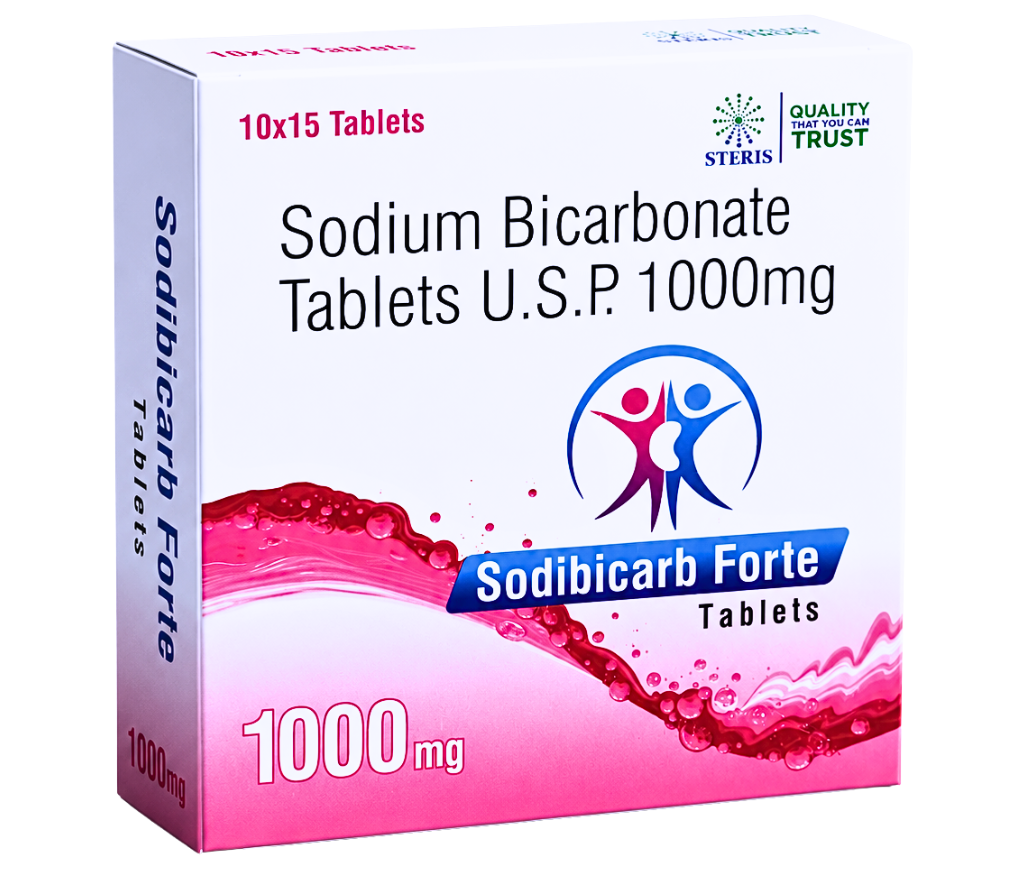
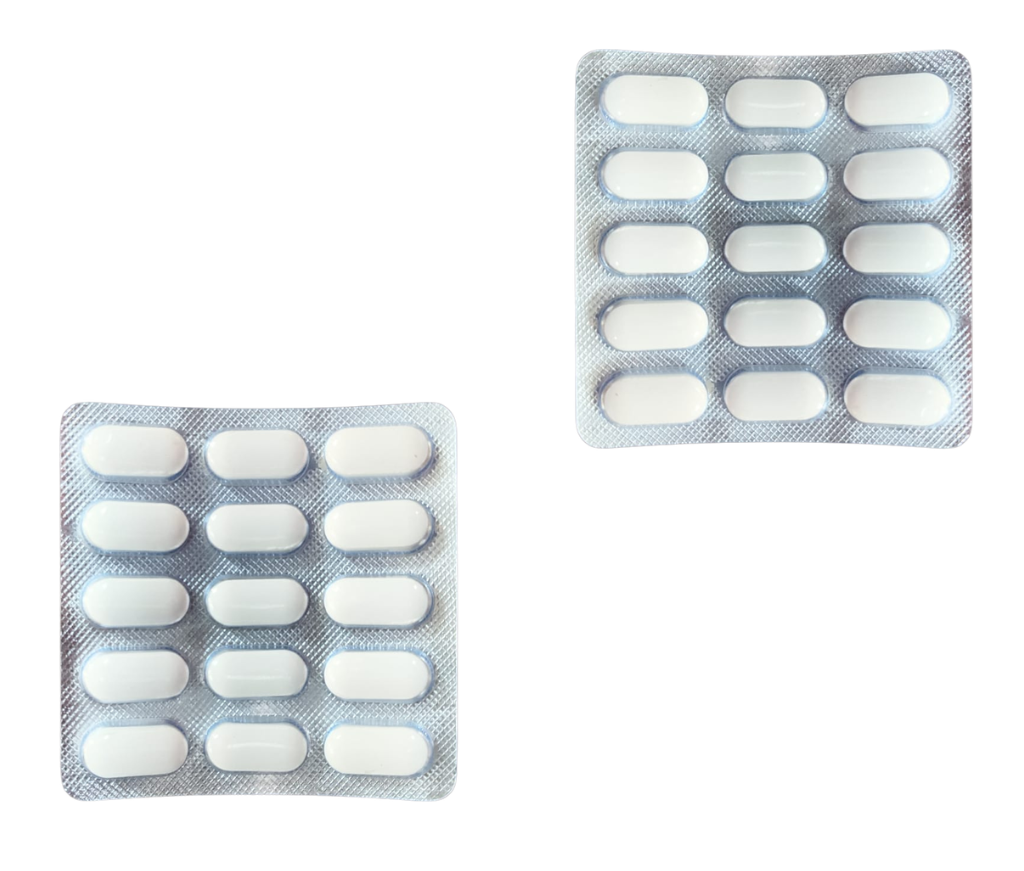
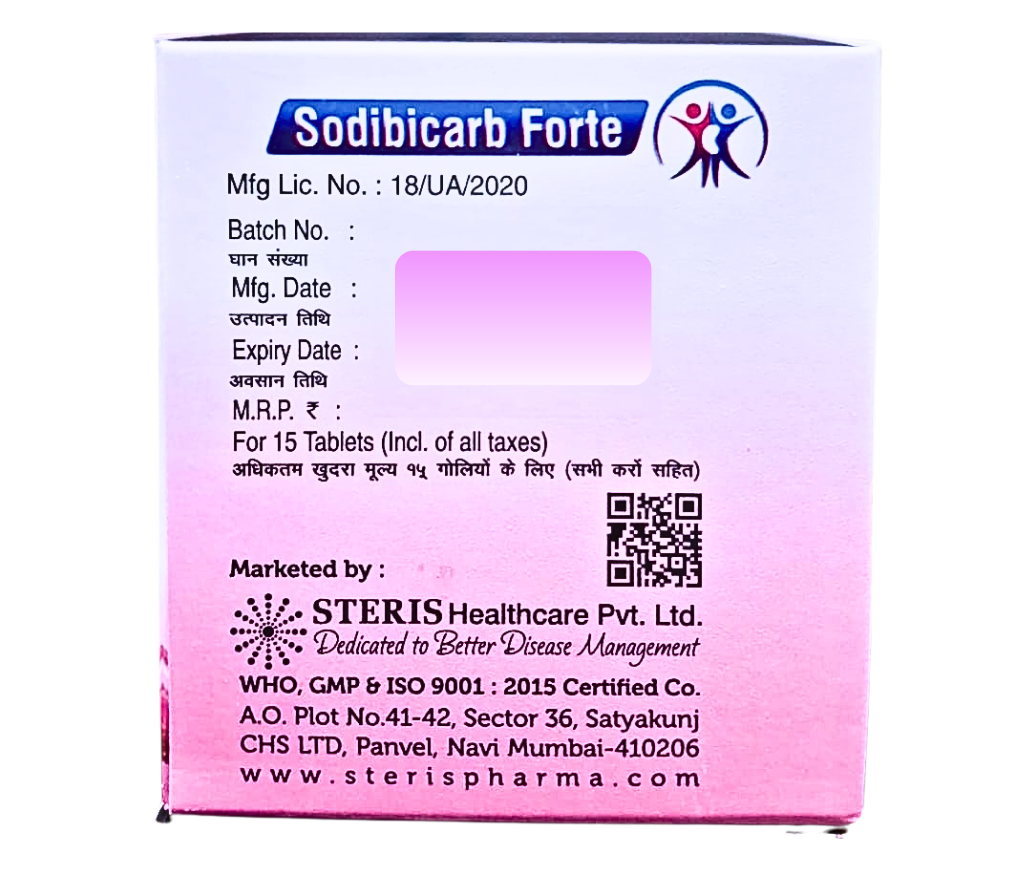
SODIBICARB FORTE
 Item requires a valid prescription
Manufactured By Steris Healthcare Pvt Ltd
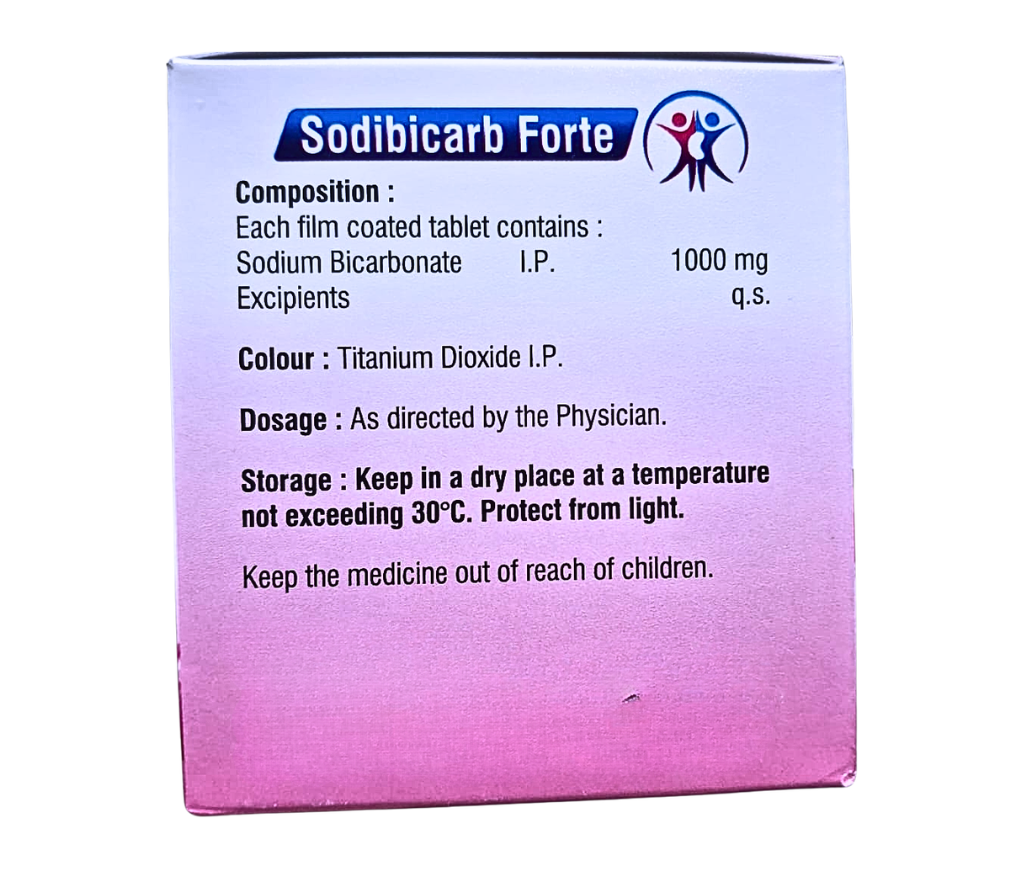
Composition Sodium Bicarbonate (1000mg)
Rs 57.75
MRP Rs 82.50
(30% OFF)
Includes all taxes
Package SIZE
( FOR 15 TABS )

100% Authentic
Products

Free
Shipping*

Products
Return Policy
Description:
Sodium bicarbonate 1000 mg is a concentrated sodium bicarbonate formulation used in different healthcare settings, depending on the product and the reason it has been prescribed or purchased. Sodium bicarbonate, also known as sodium hydrogen carbonate or baking soda, is an alkalinizing compound that can neutralize acid.
It may be used as an antacid for occasional heartburn and acid indigestion, while certain prescription 1000 mg formulations are used under medical supervision for conditions involving excess acidity, including metabolic acidosis associated with kidney problems. The appropriate use therefore depends on the formulation, route, strength, and medical indication.
If you are considering sodium bicarbonate 1000 mg tablets, the most important point is not simply the strength. You should confirm whether your product is intended as an antacid, a prescription alkalinizing medicine, or another formulation, and follow the specific label or healthcare professional's instructions.
What Is Sodium Bicarbonate 1000 mg?
Sodium bicarbonate 1000 mg contains 1,000 mg of sodium bicarbonate (NaHCO₃) per stated dose or tablet when the product label specifies that amount.
Sodium bicarbonate works by reacting with acids and increasing alkalinity. As an antacid, it can neutralize stomach acid and provide temporary relief from symptoms such as heartburn and acid indigestion. MedlinePlus identifies oral sodium bicarbonate as an antacid and notes that it may also be prescribed for certain conditions where the blood or urine needs to be made less acidic.
However, not every sodium bicarbonate 1000 mg product should be treated as an ordinary over-the-counter heartburn medicine. For example, a current Indian pharmaceutical product containing sodium bicarbonate 1000 mg is marketed as a prescription medicine for metabolic acidosis, with dosing determined by a physician.
Quick answer: Sodium bicarbonate 1000 mg is an alkalinizing medicine whose use depends on the specific product and medical indication. It may help neutralize acid, but it should not be self-dosed for kidney disease or metabolic acidosis.
Sodium Bicarbonate 1000 mg: Uses
The uses of 1000 mg of sodium bicarbonate can vary considerably by formulation.
1. Relief of Heartburn and Acid Indigestion
Sodium bicarbonate can act as a fast-acting antacid by neutralizing excess stomach acid. Oral sodium bicarbonate products are labeled for temporary relief of heartburn, acid indigestion, sour stomach, and related upset-stomach symptoms.
This makes sodium bicarbonate useful when occasional acid-related symptoms occur. It is not, however, a substitute for diagnosing frequent or persistent reflux symptoms.
2. Acid Neutralization
The alkalinizing action of sodium bicarbonate can raise pH by neutralizing acid. This is the fundamental mechanism behind its antacid activity and its medical use as an alkalinizing agent.
3. Metabolic Acidosis Under Medical Supervision
Some prescription sodium bicarbonate 1000 mg tablets are used to help manage metabolic acidosis, including acidosis associated with kidney disease or acute kidney injury. A current 1000 mg prescription formulation lists metabolic acidosis in renal failure and acute kidney injury among its therapeutic indications.
This is substantially different from taking sodium bicarbonate for occasional heartburn. The appropriate dose depends on clinical findings and should be determined by a healthcare professional.
4. Other Medical Uses
Sodium bicarbonate has additional clinical applications in specific circumstances, including medically supervised alkalinization. Injectable sodium bicarbonate, for example, has specific hospital indications and dosing requirements that are completely different from oral tablets.
Do not substitute an oral 1000 mg tablet for injectable sodium bicarbonate or another formulation.
Key Benefits of Sodium Bicarbonate 1000 mg
The potential benefits depend on why the medicine is being used.
Fast acid neutralization: Sodium bicarbonate can neutralize stomach acid and may provide temporary relief from heartburn and acid indigestion.
Alkalinizing effect: Sodium bicarbonate increases alkalinity, which is why it can be prescribed for certain acid-base disorders.
Convenient oral formulation: Where an appropriate 1000 mg tablet has been prescribed, the tablet provides a measured amount of sodium bicarbonate rather than requiring the user to measure baking soda.
Established medical ingredient: Sodium bicarbonate has recognized uses in both OTC antacid products and prescription medical treatment, although the dosage and indication differ by formulation.
It is important not to interpret these benefits as a reason to take sodium bicarbonate routinely without medical advice.
Sodium Bicarbonate 1000 mg Dosage: How Much Should You Take?
There is no single universal sodium bicarbonate 1000 mg dosage that is appropriate for everyone.
The correct amount depends on:
-
Why the medicine is being used
-
Whether it is an OTC or prescription product
-
Age
-
Kidney function
-
Blood pressure and cardiovascular status
-
Sodium intake restrictions
-
Other medicines being taken
-
The specific formulation and product label
For example, current U.S. OTC sodium bicarbonate tablet labeling commonly describes 650 mg per tablet, not 1000 mg, and provides separate age-related maximum-use instructions.
Meanwhile, prescription 1000 mg sodium bicarbonate products may have completely different dosing schedules. One current Indian prescription product specifies that dosage should be determined by a physician.
Therefore, do not automatically take one 1000 mg tablet, multiple tablets, or a 1000 mg dose several times daily unless your product label or healthcare professional specifically tells you to do so.
For OTC antacid use, MedlinePlus advises taking sodium bicarbonate exactly as directed and generally not using it for longer than two weeks unless a doctor recommends otherwise.
How to Take Sodium Bicarbonate Safely
For oral sodium bicarbonate, follow the directions on the specific package or prescription.
For antacid use, MedlinePlus states that oral sodium bicarbonate is generally taken 1 to 2 hours after meals with a full glass of water. It also advises against taking it on an overly full stomach.
Some sodium bicarbonate products have an important formulation-specific warning requiring the tablet to be completely dissolved before use. Current DailyMed labeling also warns against taking the product when overly full from food or drink.
Always read the package directions because instructions can differ between products.
Sodium Bicarbonate 1000 mg Side Effects
Like other medicines, sodium bicarbonate can cause side effects.
Common or relatively mild effects may include:
-
Increased thirst
-
Gas
-
Stomach cramps
-
Abdominal discomfort
These effects are listed by MedlinePlus for oral sodium bicarbonate.
More serious problems can occur when sodium bicarbonate is taken inappropriately or in people who are particularly sensitive to sodium or changes in electrolyte and acid-base balance.
Seek prompt medical attention for concerning symptoms such as severe weakness, persistent vomiting, severe headache, swelling, unusual breathing changes, blood in the urine, or black/tarry stools. MedlinePlus lists these among symptoms requiring immediate medical attention.
Prescription formulations can also cause problems related to excessive sodium or alkalinization. A current 1000 mg prescription product lists increased blood sodium, metabolic alkalosis, nausea or vomiting, headache, muscle symptoms, restlessness, and increased urination among possible adverse effects.
Who Should Avoid or Use Sodium Bicarbonate Carefully?
Sodium bicarbonate deserves particular caution in people who have conditions affected by sodium or fluid balance.
Talk to a healthcare professional before using it if you have:
-
High blood pressure
-
Heart failure
-
Kidney disease
-
A sodium-restricted diet
-
Significant swelling or fluid retention
-
A history of electrolyte problems
MedlinePlus specifically advises people with high blood pressure, congestive heart failure, kidney disease, or sodium-restricted diets to discuss sodium bicarbonate with a healthcare professional.
Pregnant or breastfeeding individuals should also consult a healthcare professional before using sodium bicarbonate.
Sodium Bicarbonate 1000 mg and Drug Interactions
Sodium bicarbonate can affect how some medicines are absorbed or how they work.
MedlinePlus recommends telling your doctor or pharmacist about all prescription medicines, nonprescription medicines, vitamins, supplements, and herbal products you take. It also advises separating sodium bicarbonate from other medicines by at least 2 hours.
Current OTC labeling likewise warns that antacids may interact with prescription medicines.
If you regularly take prescription medication, ask a pharmacist whether sodium bicarbonate is appropriate before starting it.
Is Sodium Bicarbonate 1000 mg the same as baking soda?
Chemically, sodium bicarbonate is the compound commonly known as baking soda. However, a pharmaceutical sodium bicarbonate product should not automatically be treated as interchangeable with household baking soda.
Medicinal products are formulated, labeled, and dosed for specific purposes. The dose, purity, route, and instructions matter.
For medical treatment, use the product specifically supplied or recommended for that purpose rather than estimating doses from kitchen measurements.
Sodium Bicarbonate 1000 mg: Important Safety Considerations
The biggest mistake is assuming that “1000 mg” automatically means a stronger version of an ordinary antacid.
A 1000 mg tablet may be intended for a different clinical purpose, particularly in prescription formulations. The product label is therefore essential.
Also remember that sodium bicarbonate contributes sodium. This matters for people who have been advised to restrict sodium or who have conditions where sodium and fluid retention are important.
If heartburn occurs frequently, lasts for more than two weeks, becomes severe, or is accompanied by alarming symptoms, do not simply continue increasing antacid use. Current OTC labeling advises stopping and consulting a doctor when symptoms persist beyond two weeks.
Frequently Asked Questions
1. What is sodium bicarbonate 1000 mg used for?
Sodium bicarbonate, 1000 mg, may be used as an alkalizing medicine or, depending on the product, for acid-related symptoms. Prescription 1000 mg formulations may be used for metabolic acidosis, while OTC sodium bicarbonate is commonly used as an antacid.
2. Can sodium bicarbonate 1000 mg relieve heartburn?
Yes, sodium bicarbonate can neutralize stomach acid and is used in some antacid products for temporary relief of heartburn and acid indigestion.
3. How often can I take sodium bicarbonate 1000 mg?
There is no universal schedule. Follow the directions for your specific product or your doctor's prescription. A prescription 1000 mg formulation may have a different dosing schedule from an OTC antacid.
4. Is 1000 mg of sodium bicarbonate safe every day?
Daily use should not be assumed to be safe for everyone. Long-term or unnecessary use can increase sodium exposure and may affect electrolyte and acid-base balance. Discuss regular use with a healthcare professional.
5. What are the main sodium bicarbonate 1000 mg side effects?
Possible effects include gas, stomach cramps, increased thirst, nausea, vomiting, and other symptoms related to excessive sodium or alkalinization. Serious symptoms require medical evaluation.
6. Can 1000 mg of sodium bicarbonate cause high sodium?
It can contribute to increased sodium levels, particularly when used excessively or in susceptible individuals. Prescription product information specifically identifies increased blood sodium as a possible adverse effect.
7. Can people with kidney disease take sodium bicarbonate 1000 mg?
Sodium bicarbonate may actually be prescribed for certain patients with metabolic acidosis associated with kidney disease, but the dose must be medically determined. People with kidney disease should not self-treat with high-dose sodium bicarbonate.
8. Is sodium bicarbonate 1000 mg good for acidity?
It can temporarily neutralize stomach acid and relieve occasional acid indigestion or heartburn when used as an appropriate antacid product.
9. Can sodium bicarbonate 1000 mg be taken with other medicines?
Potential interactions exist. MedlinePlus recommends informing a doctor or pharmacist about all medicines and generally separating sodium bicarbonate from other medicines by at least two hours.
10. Can I take sodium bicarbonate 1000 mg during pregnancy?
Speak with your doctor or pharmacist before taking it during pregnancy. The appropriate decision depends on the product, dose, reason for use, and individual circumstances.
11. Can sodium bicarbonate 1000 mg be used for indigestion?
Yes, appropriate sodium bicarbonate antacid products are labeled for acid indigestion and related symptoms.
12. Is sodium bicarbonate 1000 mg the same as a 650 mg tablet?
No. A 1000 mg formulation contains more sodium bicarbonate than a 650 mg tablet. More importantly, products with different strengths may have different directions and indications.
13. Can I use baking soda instead of sodium bicarbonate tablets?
Baking soda is sodium bicarbonate chemically, but medicinal dosing should not be improvised using household measurements. Use the product and directions recommended for the intended medical purpose.
14. How long can I take sodium bicarbonate for heartburn?
For OTC antacid use, MedlinePlus advises not using sodium bicarbonate for longer than two weeks unless directed by a doctor.
15. Does sodium bicarbonate 1000 mg help metabolic acidosis?
Certain prescription sodium bicarbonate 1000 mg products are specifically used for metabolic acidosis. Treatment should be based on medical assessment and laboratory findings rather than self-treatment.
16. Does sodium bicarbonate 1000 mg have sodium?
Yes. Sodium bicarbonate contains sodium as part of its chemical composition, which is why sodium intake is an important consideration for people on sodium-restricted diets.
17. Can sodium bicarbonate cause bloating or gas?
Yes. Gas and stomach cramps are recognized side effects of oral sodium bicarbonate.
18. When should I stop taking sodium bicarbonate?
Stop and seek medical advice if you develop serious or unusual symptoms or if heartburn symptoms persist beyond the period specified on the product label. Current OTC labeling advises medical evaluation when symptoms last more than two weeks.
19. Can children take sodium bicarbonate 1000 mg?
Do not give a 1000 mg sodium bicarbonate product to a child unless a healthcare professional specifically recommends it. Age restrictions differ between products, and current OTC labeling includes specific pediatric warnings.
20. Should I take sodium bicarbonate 1000 mg before or after food?
For antacid use, MedlinePlus states that oral sodium bicarbonate is generally taken 1–2 hours after meals with a full glass of water. However, follow the directions on your specific product because prescription formulations can differ.