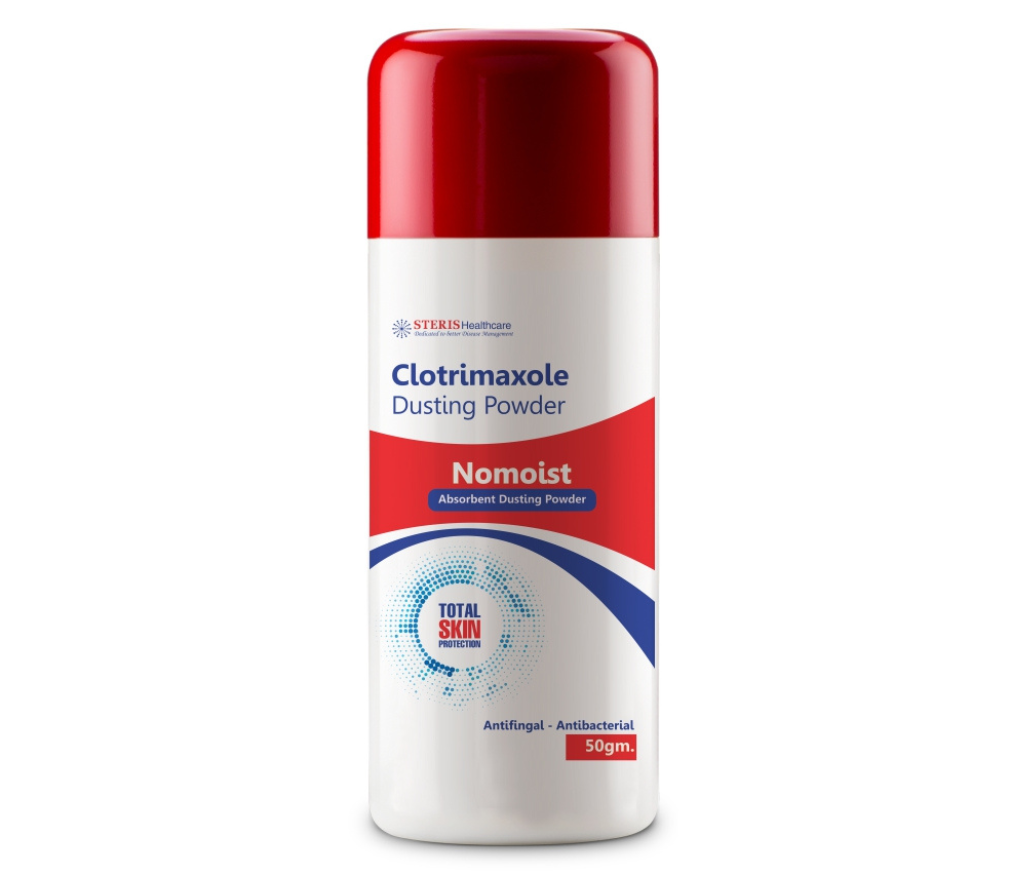


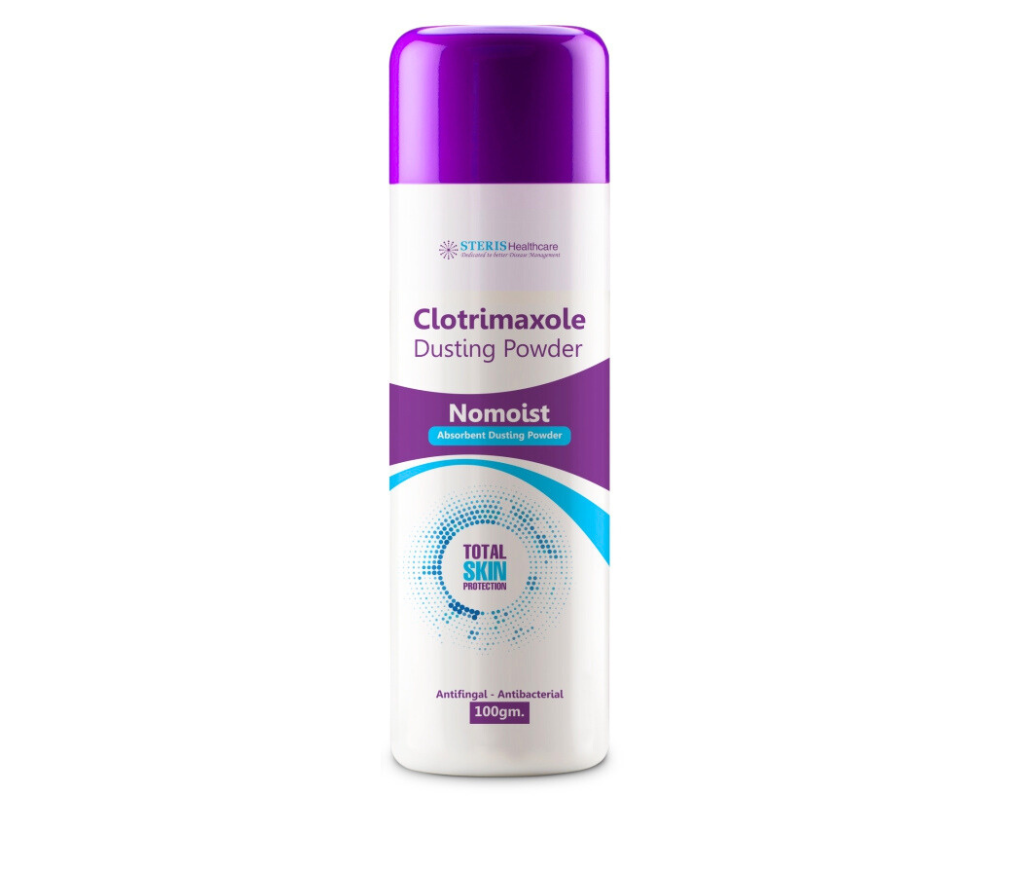
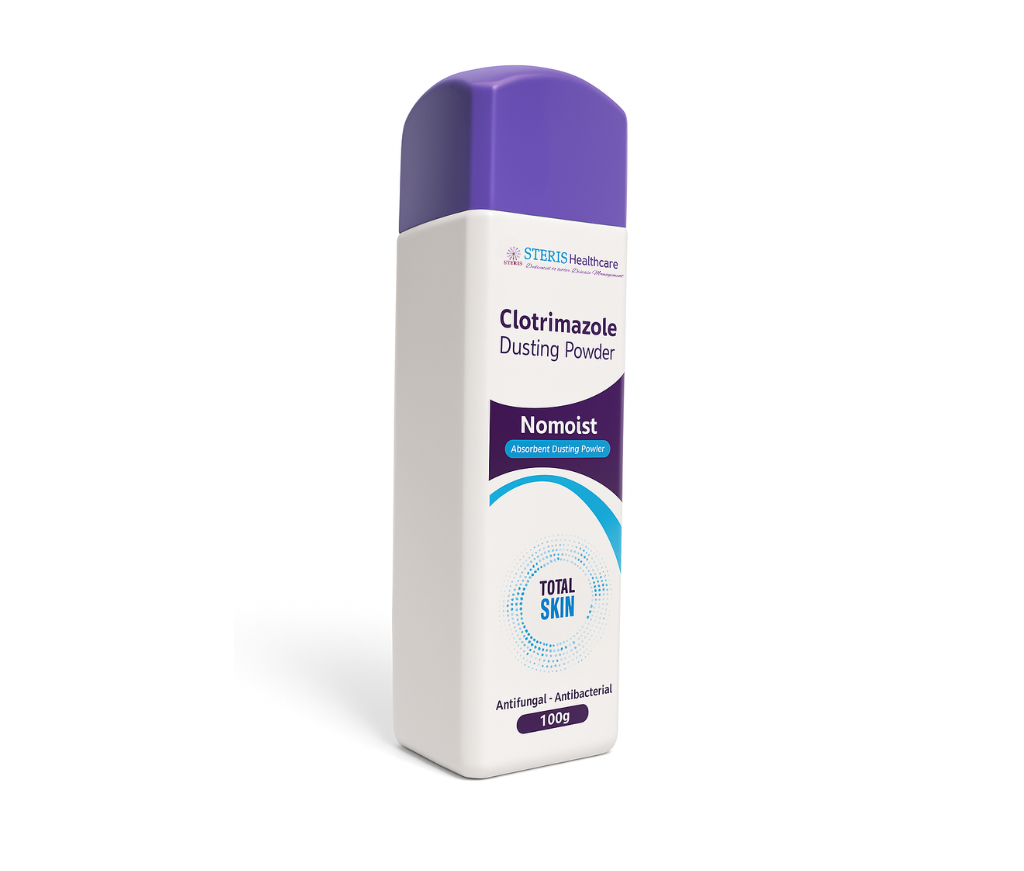
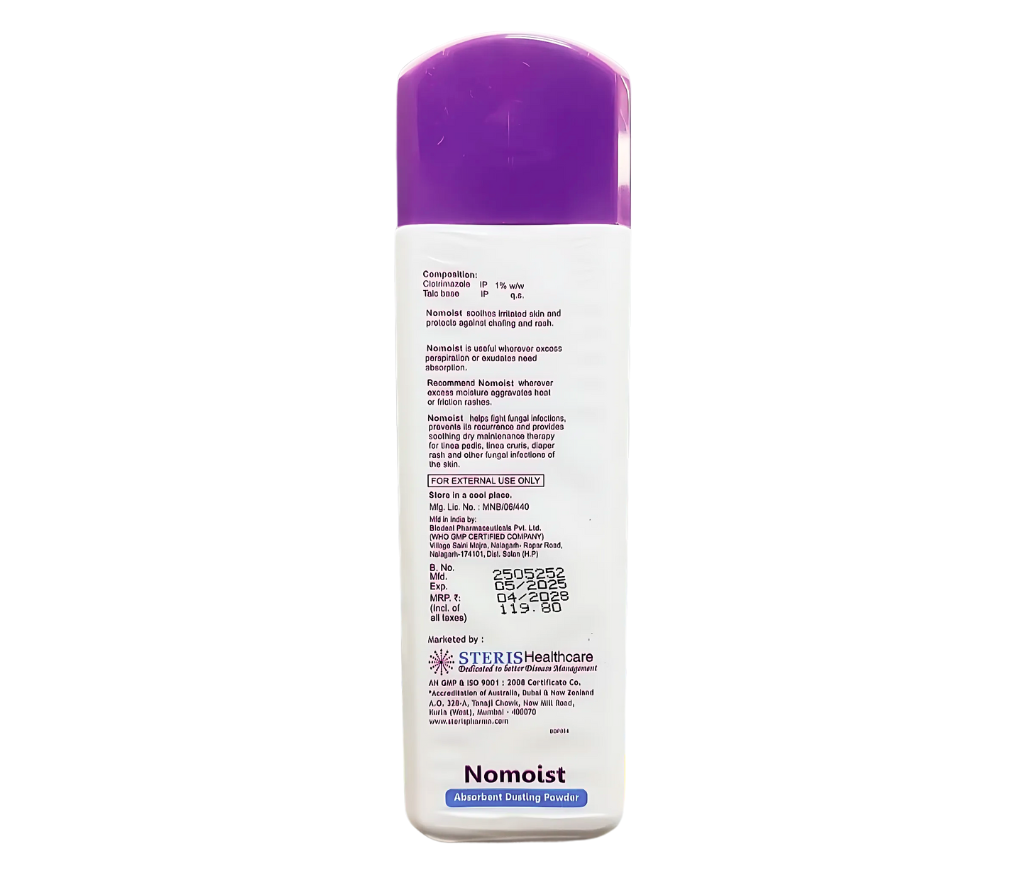
NOMOIST DUSTING POWDER
 Item requires a valid prescription
Manufactured By Steris Healthcare Pvt Ltd
Composition Clotrimazole Dusting Powder
Rs 78.62
MRP Rs 112.31
(30% OFF)
Includes all taxes
Package SIZE
( 100 GM )

100% Authentic
Products

Free
Shipping*

Products
Return Policy
Description:
Clotrimazole dusting powder is a topical antifungal product used to help treat or prevent fungal problems affecting the skin, particularly in areas where heat, moisture, and friction can encourage fungal growth. Clotrimazole belongs to the imidazole class of antifungal medicines and works by interfering with the growth of fungi.
Depending on the specific product, clotrimazole may be available as a dusting powder, cream, spray, or solution. The formulation is important because a powder can be particularly useful for keeping susceptible skin areas dry, while creams and solutions may be preferred for actively infected areas depending on the condition and product instructions.
Clotrimazole is commonly associated with fungal skin infections such as athlete's foot (tinea pedis), jock itch (tinea cruris), and ringworm (tinea corporis). Official clotrimazole labeling identifies these conditions as key uses for topical clotrimazole products.
Quick answer: What is clotrimazole dusting powder used for?
Clotrimazole dusting powder is used as a topical antifungal product for fungal-prone skin and, depending on the formulation, for conditions such as athlete's foot, jock itch, and ringworm. It can also help keep skin dry and reduce moisture and friction in areas vulnerable to fungal growth.
Clotrimazole Dusting Powder Uses
The main clotrimazole dusting powder uses relate to managing fungal skin conditions and maintaining a dry skin environment.
1. Athlete's foot
Athlete's foot is a fungal infection commonly affecting the feet and spaces between the toes. Symptoms may include itching, burning, scaling, cracking, redness, and discomfort.
Topical clotrimazole is specifically indicated for athlete's foot in numerous official product labels.
A powder formulation may be useful around the feet because moisture and sweating can contribute to an environment in which fungi thrive.
2. Jock itch
Jock itch, medically known as tinea cruris, is a fungal infection affecting the groin or nearby skin.
Topical clotrimazole products are used to treat jock itch and can relieve symptoms such as itching, burning, scaling, and discomfort.
Because the groin can become warm and sweaty, keeping the area clean and dry can be an important part of managing fungal infections.
3. Ringworm
Despite its name, ringworm is not caused by a worm. It is a fungal skin infection that can produce a characteristic ring-shaped or scaly rash.
Topical clotrimazole is used for tinea corporis, commonly called ringworm.
4. Moisture-prone skin areas
A dusting powder can be particularly convenient for areas prone to sweating and friction. However, a powder should not automatically replace an antifungal cream or another treatment if an active infection requires a different formulation.
The exact product label should determine whether the powder is intended to treat an existing fungal infection, help prevent recurrence, absorb moisture, or perform a combination of these functions.
Key Benefits of Clotrimazole Dusting Powder
1. Antifungal action
The primary therapeutic benefit of clotrimazole is its antifungal activity. It interferes with fungal growth and is used against several common superficial fungal infections.
2. Helps manage fungal-skin symptoms
When used appropriately for a susceptible fungal infection, clotrimazole can help improve symptoms associated with the infection, including itching, burning, scaling, cracking, redness, and discomfort.
3. Convenient powder format
A dusting powder is easy to apply to suitable external areas and may be convenient for people who experience sweating around the feet, footwear, skin folds, or other moisture-prone areas.
4. Helps reduce excess moisture
Keeping skin dry can be helpful when dealing with fungal-prone areas. For athlete's foot, official product directions also emphasize drying the affected area carefully and using ventilated footwear and clean socks.
5. Useful for foot-care routines
People who frequently wear closed footwear or experience sweaty feet may find an appropriate antifungal powder convenient as part of a broader foot-hygiene routine.
However, powder should not be considered a substitute for appropriate diagnosis and treatment when there is a persistent or severe infection.
How Does Clotrimazole Work?
Clotrimazole is an azole antifungal. It works by interfering with fungal growth, helping eliminate the organisms responsible for susceptible superficial fungal infections.
This is different from simply covering up itching or absorbing moisture.
For an active fungal infection, successful treatment requires using an appropriate antifungal consistently for the recommended duration. Stopping too early simply because symptoms improve can allow the infection to persist or return.
How to Use Clotrimazole Dusting Powder
The exact directions depend on the product. Always read the package instructions before use.
A typical topical antifungal routine includes:
- Clean the affected area gently.
- Dry the skin thoroughly, especially between the toes and within skin folds.
- Apply the product according to its label directions.
- Wash your hands after application unless the hands themselves are the treatment area.
- Keep clothing, socks, towels, and footwear clean and dry.
- Avoid sharing towels, socks, footwear, or other personal items that may spread fungal infection.
For topical clotrimazole formulations, official directions commonly emphasize cleaning and thoroughly drying the affected area before application.
How often should clotrimazole be used?
Do not assume that every clotrimazole dusting powder should be applied at the same frequency.
For example, official directions for some clotrimazole creams specify application twice daily, while NHS guidance for certain clotrimazole topical products describes two- or three-times-daily use.
Therefore, use the instructions supplied with your exact product.
How Long Does Clotrimazole Take to Work?
The time required for improvement varies according to the infection, its severity, treatment adherence, and the formulation used.
Some people notice symptom improvement within several days, but that does not necessarily mean the fungal infection has been completely eliminated.
Official clotrimazole labeling states that patients should seek medical advice if athlete's foot or ringworm has not improved after 4 weeks, or if jock itch has not improved after 2 weeks.
NHS information similarly notes that topical clotrimazole may take around a week before fungal symptoms begin improving and advises completing the recommended course.
Clotrimazole Dusting Powder Side Effects
Most people tolerate topical clotrimazole well, but clotrimazole dusting powder side effects or skin reactions can occur.
Possible local reactions include:
- Mild burning
- Stinging
- Itching
- Redness
- Irritation
- Peeling
- Rash
- Skin discomfort
MedlinePlus reports that topical clotrimazole can cause redness, swelling, itching, burning, stinging, peeling, hives, blistering, and skin cracks.
When should you stop using clotrimazole?
Stop using the product and seek medical advice if you develop significant irritation, worsening symptoms, a severe rash, swelling, blistering, or another unexpected reaction.
Official labeling specifically advises stopping use and asking a doctor if irritation develops or if the infection does not improve within the recommended timeframe.
Clotrimazole Dusting Powder Precautions
Clotrimazole powder is intended for external use unless the specific product label states otherwise.
Avoid the eyes
Do not allow clotrimazole to enter the eyes. If accidental eye exposure occurs, rinse thoroughly with clean water and seek medical advice if irritation persists. Official clotrimazole labels specifically instruct users to avoid eye contact.
Do not swallow
Topical clotrimazole should not be swallowed. If the product is accidentally ingested, seek medical assistance or contact an appropriate poison-control service.
Children
Some OTC clotrimazole labels advise against use in children under 2 years unless directed by a doctor. Age restrictions can vary by product and country, so check your package.
Pregnancy and breastfeeding
If you are pregnant, planning pregnancy, or breastfeeding, ask a doctor or pharmacist before using a medicinal clotrimazole product. MedlinePlus specifically recommends discussing pregnancy and breastfeeding with a healthcare professional.
Can Clotrimazole Dusting Powder Be Used on All Skin Problems?
No.
Not every itchy, red, or scaly rash is caused by fungus. Eczema, psoriasis, bacterial infections, allergic reactions, contact dermatitis, and other conditions can produce similar symptoms.
Using an antifungal product on a non-fungal rash may delay the correct diagnosis.
Also, topical clotrimazole products are not necessarily effective on the scalp or nails. Official labeling for common topical clotrimazole products states that these products are not effective for scalp or nail infections.
For nail or scalp problems, professional diagnosis is particularly important.
Clotrimazole Powder vs. Clotrimazole Cream
Both contain the same antifungal ingredient when the labeled active ingredient is clotrimazole, but they serve different practical purposes.
| Feature | Clotrimazole Dusting Powder | Clotrimazole Cream |
|---|---|---|
| Form | Dry powder | Cream |
| Moisture management | Particularly useful in moisture-prone areas | Less focused on moisture absorption |
| Active fungal infection | Depends on product label | Commonly used for superficial fungal infections |
| Feet | Convenient for sweaty feet | Useful for treating affected skin |
| Skin folds | Can help keep areas dry | Can deliver antifungal medication to affected skin |
| Best choice | Depends on condition and product | Depends on condition and product |
The important point is that formulation matters. A dusting powder marketed for moisture control should not automatically be treated as equivalent to a medicinal antifungal cream.
Clotrimazole Dusting Powder for Athlete's Foot
Athlete's foot can thrive in warm, damp environments.
For better results:
- Wash feet regularly.
- Dry carefully between the toes.
- Change socks regularly.
- Choose breathable footwear.
- Avoid wearing damp shoes.
- Do not share towels or footwear.
- Use the antifungal product exactly as directed.
Official clotrimazole directions specifically recommend paying attention to the spaces between the toes and using well-fitting, ventilated shoes with regular sock changes when treating athlete's foot.
Can You Buy Clotrimazole Dusting Powder Online?
Clotrimazole dusting powder may be available through pharmacies and online medicine retailers, depending on your location and the specific formulation.
If you are searching for “buy clotrimazole dusting powder online,” compare the following before purchasing:
- Active ingredient
- Clotrimazole concentration
- Product type
- Intended use
- Manufacturer
- Batch/lot information
- Expiry date
- Packaging condition
- Storage instructions
- Seller or pharmacy credentials
Avoid purchasing from an unidentified seller simply because the price is lower.
For a medicinal product, verify that the packaging clearly identifies clotrimazole and provides appropriate directions for use.
How to Store Clotrimazole Dusting Powder
Storage instructions vary by manufacturer.
Keep the product:
- In its original container.
- Tightly closed when not in use.
- Away from excessive heat and moisture.
- Out of children's reach.
- Within the temperature range printed on the package.
For example, one current clotrimazole topical label recommends storage at 15–30°C, while other formulations can specify different storage ranges.
Always follow the exact storage instructions on your product.
When Should You See a Doctor?
Seek professional medical advice if:
- The rash is spreading quickly.
- There is significant swelling or pain.
- The skin is producing pus or has signs of bacterial infection.
- You develop fever.
- The condition repeatedly returns.
- Symptoms become worse after starting treatment.
- There is no improvement within the timeframe stated on the product label.
- The infection involves the scalp or nails.
- You have diabetes or a weakened immune system.
- You are unsure whether the rash is fungal.
A persistent rash should not be treated indefinitely with an over-the-counter antifungal without determining the underlying cause.
Important Buying & Safety Takeaway
When searching for clotrimazole dusting powder, focus on more than price or product claims.
Check the active ingredient, concentration, intended indication, manufacturer, expiry date, and directions. If you need treatment for an active fungal infection, confirm that the particular powder is actually labeled for that purpose.
Also remember that clotrimazole is available in several formulations. A clotrimazole cream, solution, spray, and powder are not necessarily interchangeable in how they should be used. Official sources confirm that topical clotrimazole is used for common fungal infections such as athlete's foot, jock itch, and ringworm, while the exact instructions depend on the formulation.
Frequently Asked Questions
1. What is clotrimazole dusting powder used for?
Clotrimazole dusting powder is a topical antifungal product used for fungal-prone skin and, depending on its formulation, conditions such as athlete's foot, jock itch, and ringworm.
2. Does clotrimazole dusting powder kill fungus?
Clotrimazole is an antifungal medicine that works by interfering with the growth of susceptible fungi.
3. Can clotrimazole dusting powder treat athlete's foot?
Yes, when the particular product is labeled for athlete's foot. Topical clotrimazole is commonly used for tinea pedis.
4. Can I use clotrimazole powder for jock itch?
Clotrimazole is used for jock itch, but check that your specific dusting-powder product is intended for this use.
5. Is clotrimazole powder good for ringworm?
Clotrimazole is an established topical treatment for ringworm, but the exact powder formulation should be checked for its labeled indications.
6. How often should I use clotrimazole dusting powder?
Follow the directions on your exact product. Different clotrimazole formulations have different application instructions, so do not assume that all products should be used at the same frequency.
7. How long does clotrimazole take to work?
Some symptoms may begin improving within several days, but treatment often needs to continue for the full recommended course. If athlete's foot or ringworm has not improved after four weeks, or jock itch after two weeks, official labeling recommends seeking medical advice.
8. What are the side effects of clotrimazole dusting powder?
Possible side effects include local irritation, burning, stinging, itching, redness, peeling, rash, or swelling.
9. Can clotrimazole powder cause skin irritation?
Yes. Skin irritation is one of the recognized topical reactions associated with clotrimazole. Stop use and seek medical advice if significant irritation occurs.
10. Can I use clotrimazole dusting powder every day?
Use it according to the specific product label or your healthcare professional's instructions. Daily use may be appropriate for some formulations and conditions, but the frequency varies between products.
11. Can clotrimazole powder be used on the feet?
Yes, when the product is intended for foot use. Keeping the feet clean and thoroughly dry, especially between the toes, is also important when managing athlete's foot.
12. Can I use clotrimazole powder between my toes?
A product labeled for athlete's foot may be used around the toes as directed. Keep the spaces between the toes clean and dry.
13. Is clotrimazole powder safe for children?
Age restrictions depend on the product. Some OTC clotrimazole labels state that children under two should not use the product unless directed by a doctor.
14. Can I use clotrimazole powder during pregnancy?
Ask a healthcare professional before using a medicinal clotrimazole product during pregnancy. MedlinePlus recommends discussing pregnancy with a doctor before using topical clotrimazole.
15. Can I use clotrimazole powder while breastfeeding?
Discuss its use with your doctor or pharmacist, particularly if the product could come into contact with the breast or the infant.
16. Can I use clotrimazole powder on my face?
Do not assume it is appropriate for facial use. Facial rashes can have many causes, and some areas of the face are particularly sensitive. Follow the exact product directions or obtain medical advice.
17. Can clotrimazole powder be used on nails?
Common topical clotrimazole products are not effective for nail infections according to official labeling. Nail fungal infections may require a different treatment approach.
18. Can clotrimazole powder be used on the scalp?
Common topical clotrimazole formulations are not effective for scalp infections. A scalp fungal infection should be evaluated by a healthcare professional because oral treatment may be required.
19. Can I use clotrimazole powder for an itchy rash?
Only if the rash is suspected or diagnosed to be a fungal infection and the product is appropriate for that condition. Many non-fungal skin conditions can also cause itching.
20. Can I buy clotrimazole dusting powder online?
Availability depends on your country and the product. When purchasing online, use a reputable pharmacy or retailer and verify the active ingredient, concentration, manufacturer, expiry date, packaging, and intended use.
21. Is clotrimazole dusting powder better than clotrimazole cream?
Neither is universally better. A powder can be convenient for moisture-prone areas, while cream may be more appropriate for treating certain active skin infections. The best formulation depends on the condition and product directions.
22. Does clotrimazole powder stop itching?
It can help relieve itching associated with susceptible fungal infections by treating the underlying fungal cause. Official clotrimazole labels specifically describe relief of itching and related symptoms.
23. Can I use clotrimazole powder to prevent fungal infection?
Some dusting powders are marketed for moisture control or prevention, but prevention claims depend on the individual product. Read the label rather than assuming every clotrimazole product is approved for preventive use.
24. What should I do if clotrimazole powder makes my rash worse?
Stop using the product and seek medical advice if significant irritation or worsening occurs. The rash may be caused by something other than fungus or you may be experiencing a reaction to the product.
25. How should I store clotrimazole dusting powder?
Store it according to the manufacturer's instructions, generally away from excessive heat and moisture and out of children's reach. Check the package for the specific storage temperature.
Available Substitutes