


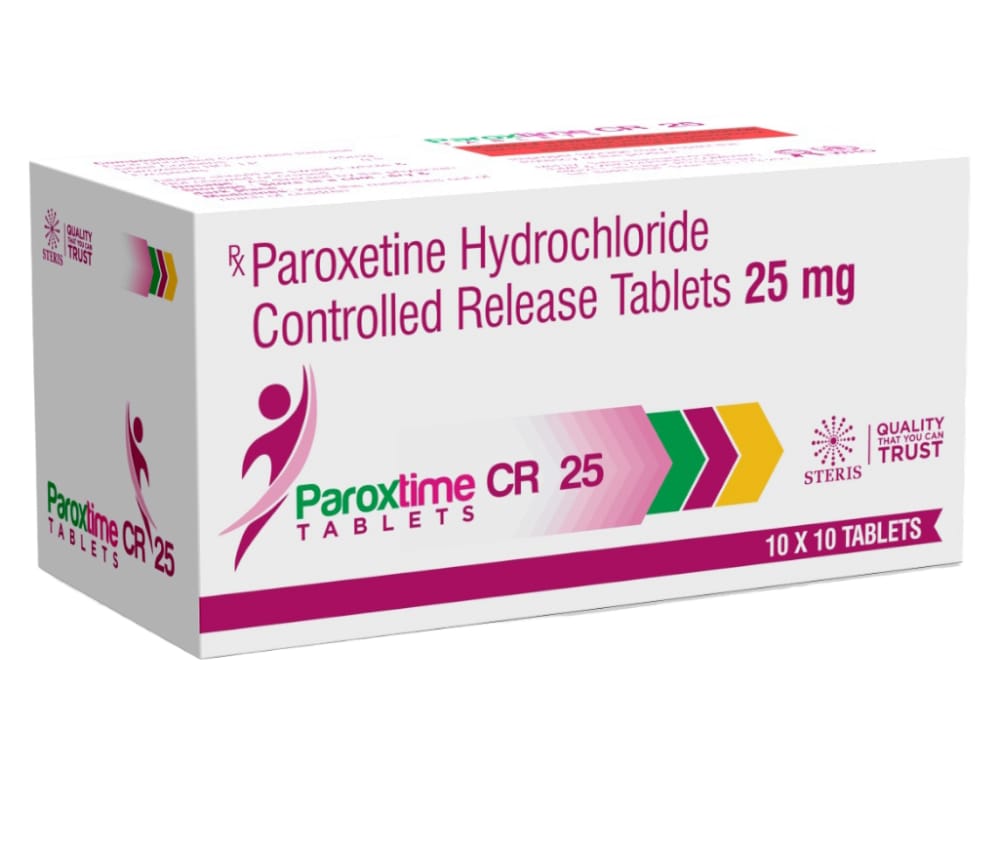
PAROXTIME CR 25
 Item requires a valid prescription
Manufactured By Steris Healthcare Pvt Ltd
Composition Paroxetine Hydrochloride Controlled Release Tablets 25 mg
Rs 127.97
MRP Rs 182.81
(30% OFF)
Includes all taxes
Package SIZE
( For 10 Tablets )

100% Authentic
Products

Free
Shipping*

Products
Return Policy
Description:
Paroxetine hydrochloride controlled release tablets 25 mg are prescription extended-release tablets containing paroxetine, a selective serotonin reuptake inhibitor (SSRI). They are used in adults for certain depressive and anxiety-related conditions, including major depressive disorder, panic disorder, social anxiety disorder, and premenstrual dysphoric disorder, depending on the prescribed formulation and indication.
Because paroxetine is a prescription antidepressant, it should be taken only according to a healthcare professional's instructions. The 25 mg strength is particularly relevant to treatment plans for some adults with major depressive disorder, while other conditions may require a different starting strength.
Product Information
| Product Detail | Information |
|---|---|
| Brand Name | PAROXTIME CR 25 |
| Composition | Paroxetine Hydrochloride Controlled Release Tablets 25 mg |
| Manufacturer/Marketer | Steris Healthcare Pvt. Ltd. |
| Target Location | India |
| Product Form | Tablet |
| Pack Size | 10 × 15 Tablets |
| Active Ingredient | Paroxetine Hydrochloride |
| Strength | 25 mg |
| Dosage Form | Controlled-Release Tablet |
| Route of Administration | Oral |
| Therapeutic Category | Antidepressant / SSRI |
| Prescription Status | Prescription medicine |
What Is Paroxetine Hydrochloride Controlled Release Tablets 25 mg?
Paroxetine hydrochloride controlled release tablets 25 mg contain paroxetine in an extended-release formulation designed for once-daily administration. The medicine belongs to the SSRI class and works by affecting serotonin signaling in the brain.
Current prescribing information lists paroxetine extended-release tablets for adults with:
-
Major depressive disorder (MDD)
-
Panic disorder (PD)
-
Social anxiety disorder (SAD)
-
Premenstrual dysphoric disorder (PMDD)
The controlled-release formulation should be swallowed whole. It should not be chewed or crushed because doing so can interfere with the intended extended-release properties of the tablet.
Paroxetine Hydrochloride 25 mg Uses
The most important paroxetine hydrochloride 25 mg uses depend on the patient's diagnosis and medical history.
Major Depressive Disorder: For adults with major depressive disorder, paroxetine extended-release tablets may help reduce symptoms associated with depression. The current U.S. prescribing information lists 25 mg once daily as the recommended starting dose for MDD, with dose adjustments made by a clinician when appropriate.
Panic Disorder: Paroxetine extended-release tablets are also indicated for panic disorder in adults. The recommended starting dose for this indication is generally lower than 25 mg, so patients should not assume that the 25 mg tablet is the correct starting dose without medical guidance.
Social Anxiety Disorder: Paroxetine extended-release tablets are indicated for adults with social anxiety disorder. Again, the recommended starting dose is generally 12.5 mg/day, with adjustments determined according to response and tolerability.
Premenstrual Dysphoric Disorder: Paroxetine extended-release tablets may also be prescribed for PMDD in adults. Depending on the treatment plan, dosing can be continuous or limited to the luteal phase.
How Does Paroxetine 25 mg Work?
Paroxetine is an SSRI. SSRIs increase the availability of serotonin signaling in the central nervous system by inhibiting serotonin reuptake.
The clinical response is not necessarily immediate. A healthcare professional may assess symptom improvement, tolerability, and treatment response over time before deciding whether the prescribed dose should be changed.
Patients should not increase, decrease, or stop paroxetine on their own. Abrupt discontinuation can cause withdrawal-like discontinuation symptoms, so the prescribing information recommends gradually reducing the dose when treatment is stopped.
Key Benefits of Paroxetine Hydrochloride Controlled Release Tablets 25 mg
When appropriately prescribed, potential treatment benefits include management of symptoms associated with certain adult psychiatric conditions.
Key features include:
-
SSRI treatment: Paroxetine works through serotonin reuptake inhibition.
-
Extended-release formulation: The controlled-release tablet is designed for once-daily administration.
-
Multiple adult indications: Extended-release paroxetine is indicated for MDD, panic disorder, social anxiety disorder, and PMDD.
-
Flexible clinical dosing: Depending on the indication and patient factors, clinicians can use different strengths and adjust the dose gradually.
-
Established prescription treatment: Paroxetine has been used clinically as an SSRI for many years.
These benefits do not mean the medicine is appropriate for everyone. Treatment decisions should consider medical history, current medicines, age, pregnancy or breastfeeding status, and individual risk factors.
Common Paroxetine 25 mg Side Effects
Like other prescription medicines, paroxetine can cause side effects. Commonly reported effects include:
-
Nausea
-
Diarrhea or constipation
-
Dizziness
-
Weakness
-
Dry mouth
-
Sweating
-
Sleep difficulties
-
Nervousness
-
Decreased appetite
-
Sexual side effects
Side effects can vary between individuals. If a symptom is persistent, severe, or concerning, contact the prescribing clinician or pharmacist.
Serious Warnings and Safety Information
Paroxetine carries an important boxed warning concerning increased risk of suicidal thoughts and behaviors in children, adolescents, and young adults taking antidepressants. Paroxetine extended-release formulations are not approved for pediatric patients. Patients receiving antidepressant therapy should be monitored for clinical worsening and new or worsening suicidal thoughts or behaviors.
Paroxetine also has important drug-interaction considerations. It should not be used with MAO inhibitors or within the specified period after stopping an MAOI. Certain other medicines, including pimozide and thioridazine, are also contraindicated with paroxetine according to prescribing information.
Tell your healthcare professional about all prescription medicines, over-the-counter medicines, vitamins, and supplements you use before starting paroxetine.
Frequently Asked Questions
1. What is paroxetine hydrochloride controlled release tablets 25 mg used for?
It is an extended-release SSRI formulation used in adults for conditions including major depressive disorder, panic disorder, social anxiety disorder, and PMDD, according to the applicable prescribing information.
2. Is paroxetine 25 mg an antidepressant?
Yes. Paroxetine is an SSRI antidepressant that is used to treat major depressive disorder and certain anxiety-related conditions.
3. What is the usual paroxetine 25 mg dose for depression?
For adults with major depressive disorder, the recommended starting dose of the extended-release formulation is 25 mg once daily. Dose changes should be made by the prescribing clinician.
4. Can paroxetine 25 mg be used for anxiety?
Paroxetine extended-release tablets are indicated for certain anxiety-related disorders in adults, including panic disorder and social anxiety disorder.
5. Should paroxetine 25 mg be taken with food?
The extended-release formulation can be administered with or without food. Follow the directions provided by your prescriber.
6. Can paroxetine controlled release tablets be crushed?
No. Extended-release paroxetine tablets should be swallowed whole and should not be chewed or crushed.
7. What are the common side effects of paroxetine 25 mg?
Common effects may include nausea, dizziness, sleep problems, sweating, dry mouth, gastrointestinal changes, decreased appetite, and sexual side effects.
8. Can paroxetine cause sexual side effects?
Yes. Sexual side effects, including reduced libido and difficulty with sexual function, have been reported with paroxetine. Discuss persistent problems with your healthcare professional.
9. Can I stop paroxetine 25 mg suddenly?
You should not stop it suddenly unless specifically instructed by a healthcare professional. The prescribing information recommends gradually reducing the dose when discontinuing treatment.
10. How long does paroxetine take to work?
The response varies by person and condition. Antidepressant benefits may take time to develop, so treatment should be evaluated by the prescribing clinician rather than judged after only a few doses.
11. What should I do if I miss paroxetine 25 mg?
Take the missed dose when remembered unless it is almost time for the next dose. Do not double the next dose to make up for a missed tablet.
12. Can paroxetine 25 mg interact with other medicines?
Yes. Paroxetine has clinically important interactions, including contraindications involving MAO inhibitors and certain other medicines. Always provide your complete medication list to your doctor or pharmacist.
13. Is paroxetine 25 mg suitable for everyone?
No. The appropriate medicine and dose depend on the individual's diagnosis, medical history, other medicines, and risk factors. Paroxetine extended-release tablets are not approved for pediatric patients.
14. Can older adults take paroxetine 25 mg?
Older adults may require a different starting dose. Current prescribing information recommends a lower starting dose for elderly patients and specific dose limits depending on the condition being treated.
15. What are serious side effects of paroxetine?
Serious reactions can occur and require medical attention. The medicine also carries an important warning regarding suicidal thoughts and behaviors, particularly in younger patients taking antidepressants.