


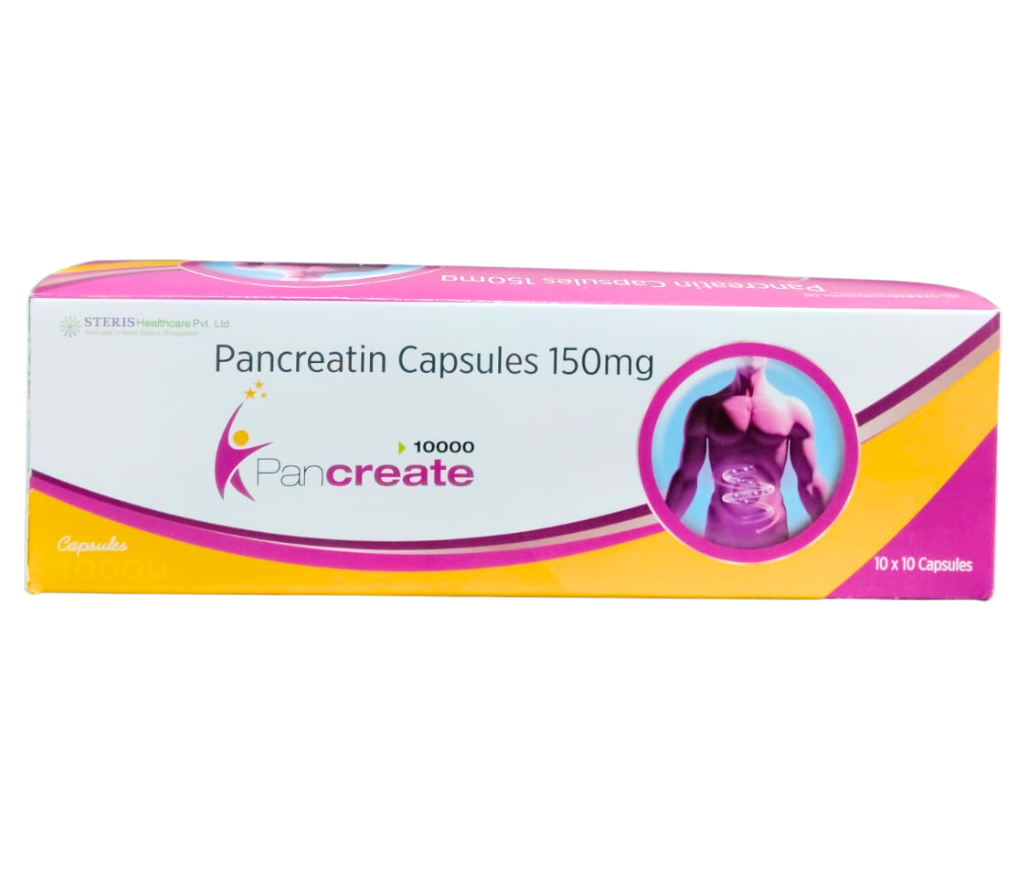
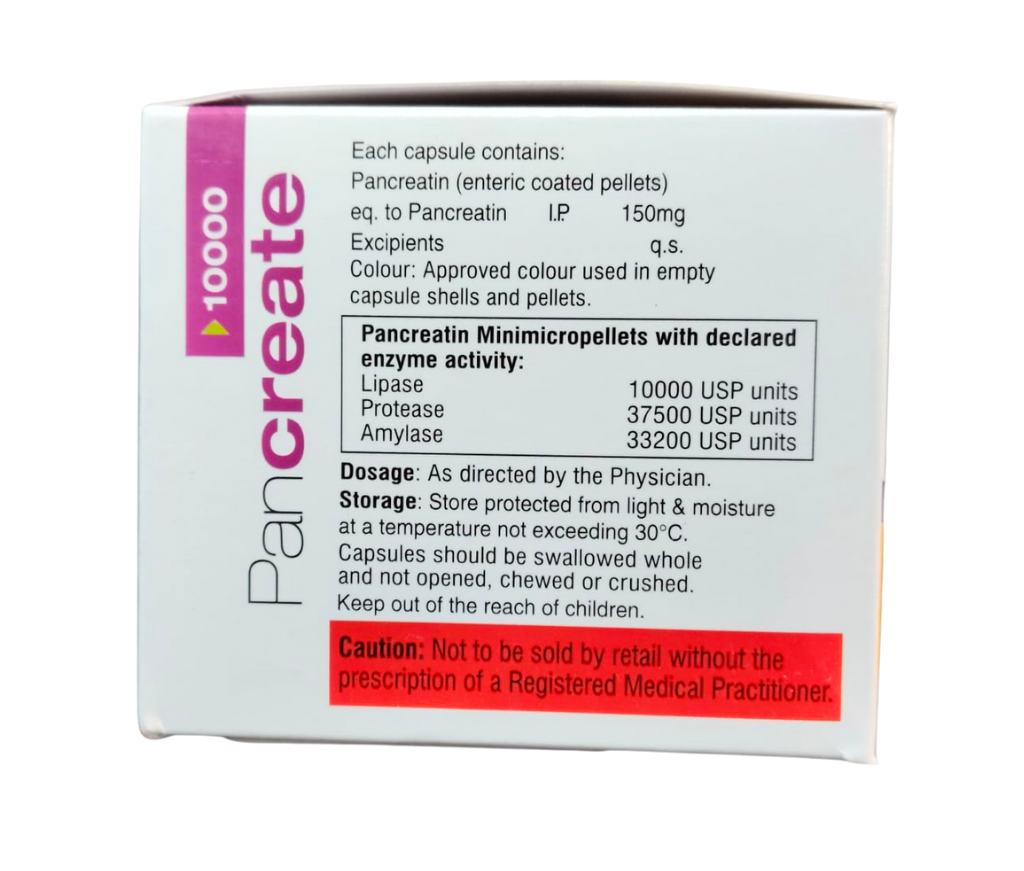
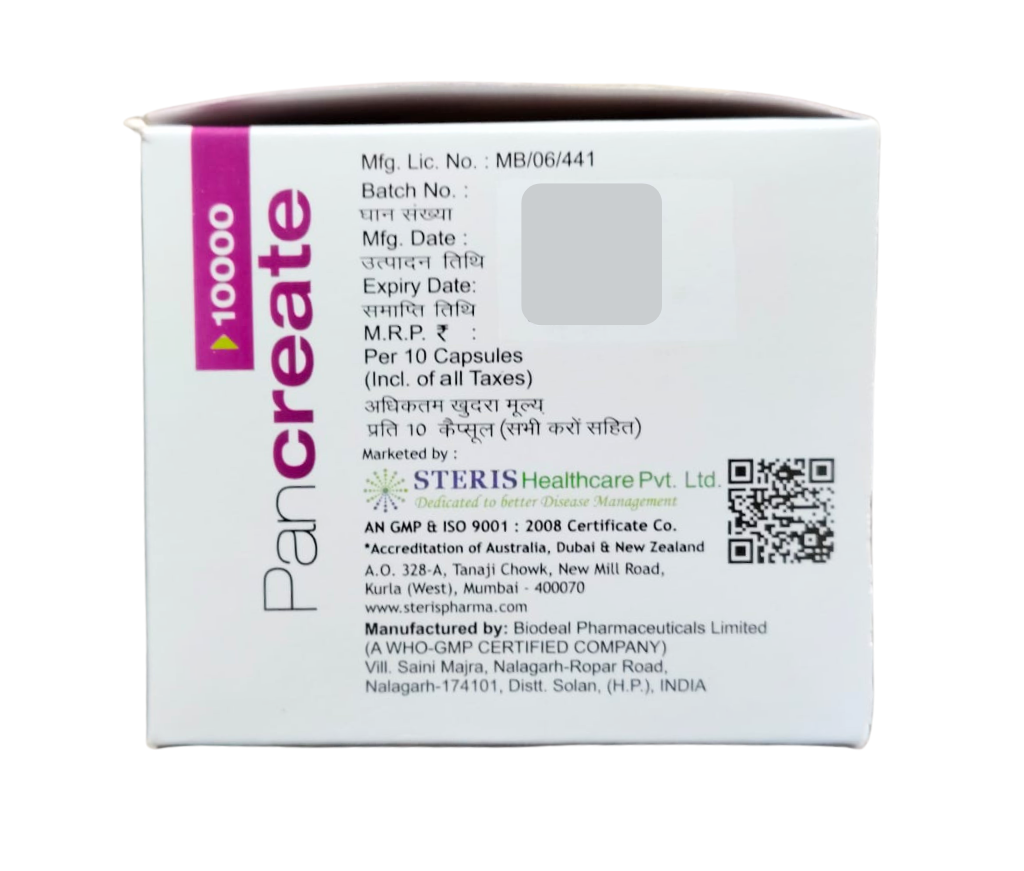
PANCREATE 10000
 Item requires a valid prescription
Manufactured By Steris Healthcare Pvt Ltd
Composition Pancreatin (150mg)
Rs 196.22
MRP Rs 280.31
(30% OFF)
Includes all taxes
Package SIZE
( For 10 Capsule )

100% Authentic
Products

Free
Shipping*

Products
Return Policy
Description:
Pancreatin 150 mg is a preparation containing pancreatic digestive enzymes. Pancreatin products generally contain a combination of lipase, amylase, and protease, enzymes that help break down dietary fat, carbohydrates, and protein respectively. These enzymes are normally produced by the pancreas and released into the intestine during digestion.
Pancreatin 150 mg products are used when the body does not have enough pancreatic digestive enzymes to properly digest food. Current Indian medicine listings describe products containing pancreatin 150 mg as being used for pancreatic enzyme deficiency and digestive symptoms associated with inadequate enzyme activity.
Importantly, 150 mg of pancreatin does not automatically tell you the enzyme activity of a product. Pancreatic enzyme products can have their potency expressed using enzyme activity units, such as lipase units, rather than simply the milligram weight of pancreatin. Therefore, two products that both say “pancreatin 150 mg” should not automatically be assumed to be therapeutically identical.
Pancreatin 150 mg Uses
The main reason pancreatin is prescribed is to provide digestive enzymes when pancreatic enzyme production or delivery to the intestine is insufficient.
1. Pancreatic enzyme deficiency
Pancreatic insufficiency can prevent adequate digestion and absorption of nutrients. Symptoms can include oily or fatty stools, bloating, abdominal discomfort, excessive gas, difficulty maintaining weight, and nutritional deficiencies. Pancreatic enzyme replacement therapy (PERT) provides enzymes with meals to help digest food.
2. Digestive problems caused by pancreatic insufficiency
When insufficient pancreatic enzymes reach the intestine, fats, proteins, and carbohydrates may not be broken down efficiently. Pancreatin can help replace some of the missing digestive activity when prescribed for an appropriate condition.
3. Chronic pancreatitis and other pancreatic disorders
Pancreatic enzyme replacement may be required in people with conditions such as chronic pancreatitis when pancreatic enzyme secretion becomes inadequate. The need for treatment, enzyme strength, and duration should be determined by a healthcare professional.
4. After pancreatic surgery
Some people develop pancreatic exocrine insufficiency after pancreatic surgery. In these circumstances, a clinician may prescribe pancreatic enzymes to support digestion and nutrient absorption.
5. Certain conditions associated with malabsorption
Pancreatic enzyme replacement can be part of treatment when poor pancreatic enzyme production contributes to malabsorption. The underlying cause should be identified rather than treating persistent digestive symptoms with enzymes without medical evaluation.
How Does Pancreatin 150 mg Work?
Pancreatin supplies digestive enzymes that perform different jobs:
-
Lipase: helps digest dietary fats.
-
Amylase: helps break down carbohydrates and starches.
-
Protease: helps digest proteins.
Normally, the pancreas releases these enzymes into the small intestine. There, they help convert food into smaller components that the body can absorb and use. When pancreatic enzyme secretion is inadequate, pancreatic enzyme replacement therapy can improve digestion.
This explains why timing matters. Pancreatic enzymes need to be present with food to work effectively. Taking them at an unrelated time may reduce their usefulness.
Key Benefits of Pancreatin 150 mg
When appropriately prescribed, the potential benefits of pancreatin include:
Supports digestion
Pancreatin supplies enzymes needed to digest major dietary nutrients, particularly fat, protein, and carbohydrates.
Helps improve nutrient absorption
Better digestion can support the absorption of nutrients when pancreatic enzyme deficiency is the cause of malabsorption. Untreated pancreatic insufficiency can contribute to vitamin and mineral deficiencies and difficulty maintaining healthy weight.
May reduce symptoms associated with enzyme deficiency
Effective pancreatic enzyme replacement can help address symptoms associated with inadequate digestion, such as fatty stools, bloating, gas, abdominal discomfort, and difficulty maintaining weight.
Helps replace missing pancreatic enzymes
Rather than simply masking digestive symptoms, pancreatic enzyme replacement addresses an underlying deficiency when pancreatic enzyme production is inadequate.
However, the benefits depend on the diagnosis, formulation, enzyme activity, dose, and correct timing with meals. Pancreatin should not be viewed as a universal treatment for ordinary indigestion.
How to Take Pancreatin 150 mg
Follow the exact instructions provided by your doctor, pharmacist, or product labeling.
For pancreatic enzyme replacement, the enzymes are generally taken with meals and snacks, because they need to mix with food in the digestive tract. Clinical guidance specifically emphasizes that pancreatic enzymes are not useful when taken without a meal, snack, or appropriate drink.
If your product is an enteric-coated capsule or contains coated enzyme particles, do not crush or chew it unless the product instructions specifically allow this. Damaging the protective coating can affect how the enzymes reach the intestine and may irritate the mouth.
Do not independently increase your dose because you continue to experience bloating or fatty stools. Those symptoms can have several causes, including an inadequate enzyme dose, incorrect timing, another digestive disorder, or a problem requiring medical assessment.
Pancreatin 150 mg Dosage: What You Need to Know
There is no single pancreatin 150 mg dosage that is appropriate for everyone.
Pancreatic enzyme therapy is commonly individualized according to factors such as the underlying pancreatic condition, the amount of fat and other nutrients in meals, symptoms, nutritional status, and the enzyme activity of the particular formulation. Some pancreatic enzyme products are prescribed according to lipase activity rather than the total milligrams of pancreatin.
For this reason, do not assume that “150 mg” means the same enzyme potency as another pancreatin product labeled 150 mg.
If your doctor changes your brand or formulation, ask the pharmacist whether the enzyme activity and formulation are equivalent, rather than comparing only the milligram number.
Pancreatin 150 mg Side Effects
Pancreatin is generally used under medical supervision, but side effects can occur.
Commonly reported problems with pancreatic enzyme therapy include:
-
Nausea
-
Bloating
-
Abdominal discomfort
-
Diarrhea
-
Constipation in some people
-
Irritation around the anus, particularly when enzyme exposure is excessive
Importantly, some symptoms such as bloating, abdominal discomfort, or diarrhea can also occur when pancreatic enzyme replacement is insufficient, meaning the presence of these symptoms does not automatically prove that the medicine is causing them.
When should you seek medical advice?
Contact your healthcare professional if digestive symptoms persist, worsen, or significantly interfere with eating and daily activities.
Seek urgent medical attention for severe or unusual symptoms, including signs of a serious allergic reaction or severe abdominal symptoms.
Long-term pancreatic enzyme therapy should be monitored when clinically indicated, particularly in people with significant pancreatic disease or nutritional problems.
Important Precautions Before Using Pancreatin 150 mg
Tell your doctor if you:
-
Have chronic pancreatitis or another pancreatic condition.
-
Have a history of intestinal problems or bowel obstruction.
-
Have gout or elevated uric acid.
-
Have difficulty swallowing capsules or tablets.
-
Have allergies to pancreatic enzyme products or their ingredients.
-
Are pregnant, planning pregnancy, or breastfeeding.
-
Take multiple medicines or dietary supplements.
Some pancreatic enzyme preparations are derived from porcine pancreatic tissue. NHS patient guidance specifically notes this for pancreatic enzyme replacement products. If the source of the enzymes conflicts with your religious, dietary, or personal requirements, discuss available options with your healthcare professional before switching products.
Pancreatin 150 mg and Gout Risk
People receiving pancreatic enzymes may have a slightly increased risk of gout because pancreatic enzyme preparations can contain purines. Patients who develop a sudden, painful attack affecting a joint should inform their doctor.
This does not mean everyone taking pancreatin will develop gout, but it is an important consideration for people who already have hyperuricemia or a history of gout.
Can Pancreatin 150 mg Be Used for Ordinary Indigestion?
Not necessarily.
Pancreatin is primarily useful when inadequate pancreatic enzyme activity contributes to digestive problems. Ordinary indigestion, heartburn, gastritis, irritable bowel symptoms, gallbladder disorders, food intolerance, and other gastrointestinal conditions can cause similar symptoms but may require completely different treatment.
If you frequently experience bloating, abdominal pain, diarrhea, fatty stools, unexplained weight loss, or nutritional deficiencies, seek medical evaluation rather than repeatedly self-treating with digestive enzymes.
Buying Pancreatin 150 mg Safely
If you are searching for buy pancreatin 150 mg, use a legitimate pharmacy and verify the exact product prescribed or recommended by your healthcare professional.
Current Indian listings show multiple products containing pancreatin 150 mg, including capsules and tablets, and some are marked as prescription medicines. Prices, availability, pack sizes, manufacturers, and delivery options can change.
Before purchasing:
-
Verify that the product contains the exact prescribed ingredient and strength.
-
Check the manufacturer and packaging.
-
Check the expiry date and packaging integrity.
-
Compare enzyme activity units, not only milligrams, when considering an alternative.
-
Purchase from a legitimate pharmacy.
-
Ask a pharmacist before substituting one pancreatic enzyme product for another.
A recent Indian listing for Pancreate 150 mg, for example, identifies pancreatin 150 mg as its composition and provides manufacturer and storage information.
Storage of Pancreatin 150 mg
Follow the storage instructions printed on your specific medicine package. Some currently listed Indian pancreatin products specify storage below 30°C.
Keep the medicine away from excessive heat and moisture and out of the reach of children.
Frequently Asked Questions
1. What is pancreatin 150 mg used for?
Pancreatin 150 mg is used as a digestive enzyme preparation when pancreatic enzyme production is insufficient. It helps provide enzymes needed to digest fats, proteins, and carbohydrates.
2. What are the main benefits of pancreatin 150 mg?
The main potential benefits are improved digestion, better breakdown of dietary nutrients, and improved nutrient absorption when pancreatic enzyme deficiency is responsible for digestive problems.
3. Is pancreatin 150 mg a digestive enzyme?
Yes. Pancreatin is a mixture of digestive enzymes, commonly including lipase, amylase, and protease.
4. Does pancreatin 150 mg help with digestion?
Yes, when inadequate pancreatic enzymes are contributing to poor digestion. It provides enzymes that help digest fats, proteins, and carbohydrates.
5. When should I take pancreatin 150 mg?
Pancreatic enzymes are generally taken with meals and snacks so they can mix with food during digestion. Follow your product-specific instructions and your doctor's directions.
6. Can I take pancreatin 150 mg after eating?
The correct timing depends on the formulation and your prescription. Pancreatic enzymes generally work best when taken with food rather than well before or after a meal. Ask your pharmacist if you are uncertain about the timing.
7. What are the side effects of pancreatin 150 mg?
Possible side effects include nausea, bloating, abdominal discomfort, diarrhea, and irritation around the anus. Persistent or severe symptoms should be discussed with a healthcare professional.
8. Can pancreatin 150 mg cause diarrhea?
Diarrhea can occur during pancreatic enzyme therapy, but diarrhea can also indicate that pancreatic insufficiency is not adequately controlled or that another digestive condition is present. Discuss persistent diarrhea with your healthcare professional.
9. Does pancreatin 150 mg help with bloating?
It may help bloating when pancreatic enzyme deficiency is the underlying cause. However, bloating has many possible causes, so pancreatin should not be used as a general-purpose bloating treatment without appropriate medical advice.
10. Does pancreatin 150 mg help with weight gain?
If pancreatic insufficiency is causing poor digestion and nutrient absorption, effective enzyme replacement may help improve nutritional status and make it easier to maintain weight.
11. Is pancreatin 150 mg safe for long-term use?
Pancreatic enzyme replacement can be used long term when medically indicated. Long-term treatment should be monitored by a healthcare professional, particularly when pancreatic disease or nutritional deficiencies are present.
12. Can I take pancreatin 150 mg without food?
Pancreatic enzymes are intended to work with food. Taking them without a meal or snack generally does not provide the intended digestive benefit.
13. Can pancreatin 150 mg be used for pancreatitis?
Pancreatic enzyme replacement may be prescribed for people with pancreatic insufficiency associated with chronic pancreatitis. It is not a treatment that should be started solely because someone has abdominal pain or suspected pancreatitis.
14. Is pancreatin 150 mg the same as pancreatic enzymes?
Pancreatin is a pancreatic enzyme preparation. However, different products can contain different enzyme activities, formulations, and delivery systems, so products should not be considered identical based solely on the “150 mg” label.
15. Can I replace my pancreatin 150 mg brand with another brand?
Do not assume that different pancreatin products are interchangeable. Ask your doctor or pharmacist to compare the enzyme activities, formulation, and prescribed dose before switching.
16. Is pancreatin 150 mg available in India?
Yes. Current Indian medicine listings show multiple products containing pancreatin 150 mg, including tablet and capsule formulations. Availability and pricing can change by pharmacy and location.
17. Can I buy pancreatin 150 mg online?
Some Indian online pharmacy listings currently show pancreatin 150 mg products, with certain products requiring a prescription. Use a legitimate pharmacy and follow local prescription requirements.
18. Is pancreatin 150 mg vegetarian?
You should check the specific product. Many pancreatic enzyme replacement preparations are derived from porcine pancreatic tissue, while formulations and ingredients can vary. Ask the manufacturer or pharmacist if the source is important to you.
19. Can pancreatin 150 mg cause gout?
Pancreatic enzyme therapy may slightly increase the risk of gout. People with a history of gout or elevated uric acid should discuss this risk with their healthcare professional.
20. What should I do if pancreatin 150 mg does not improve my symptoms?
Do not automatically increase the dose. Contact your doctor or dietitian. Persistent symptoms may indicate an inadequate dose, incorrect timing, an unsuitable formulation, or another gastrointestinal condition requiring evaluation.

