


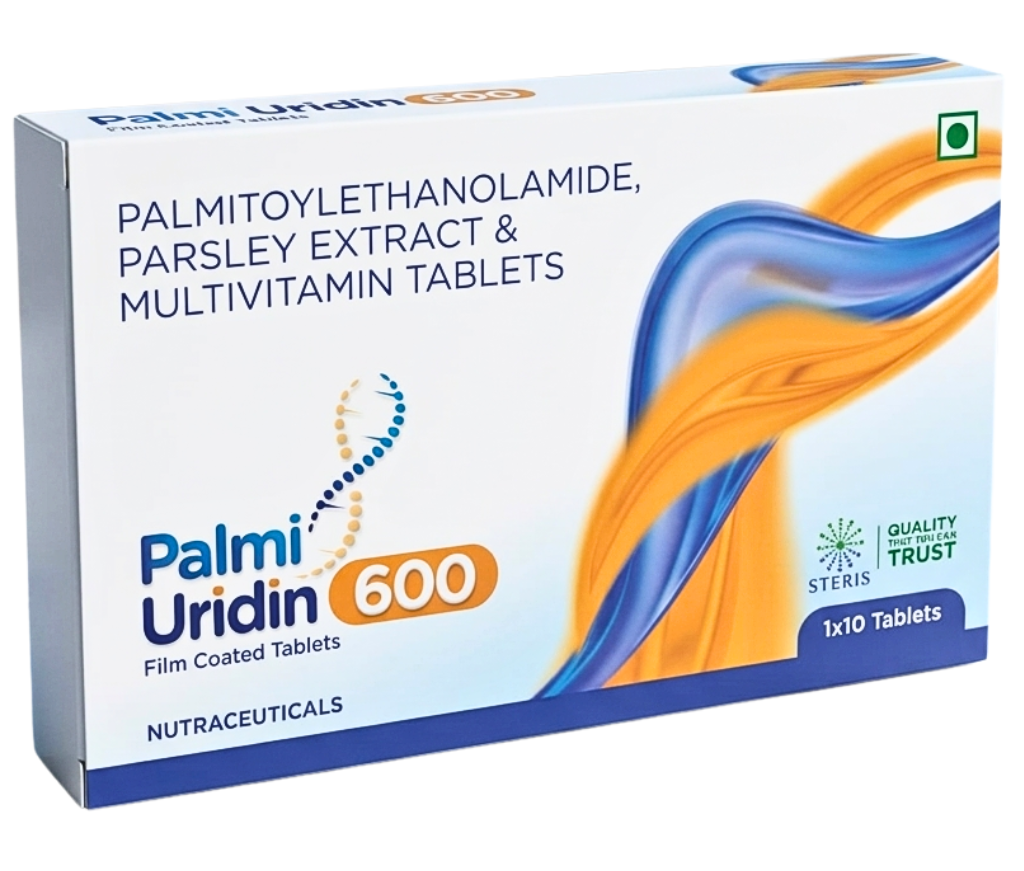
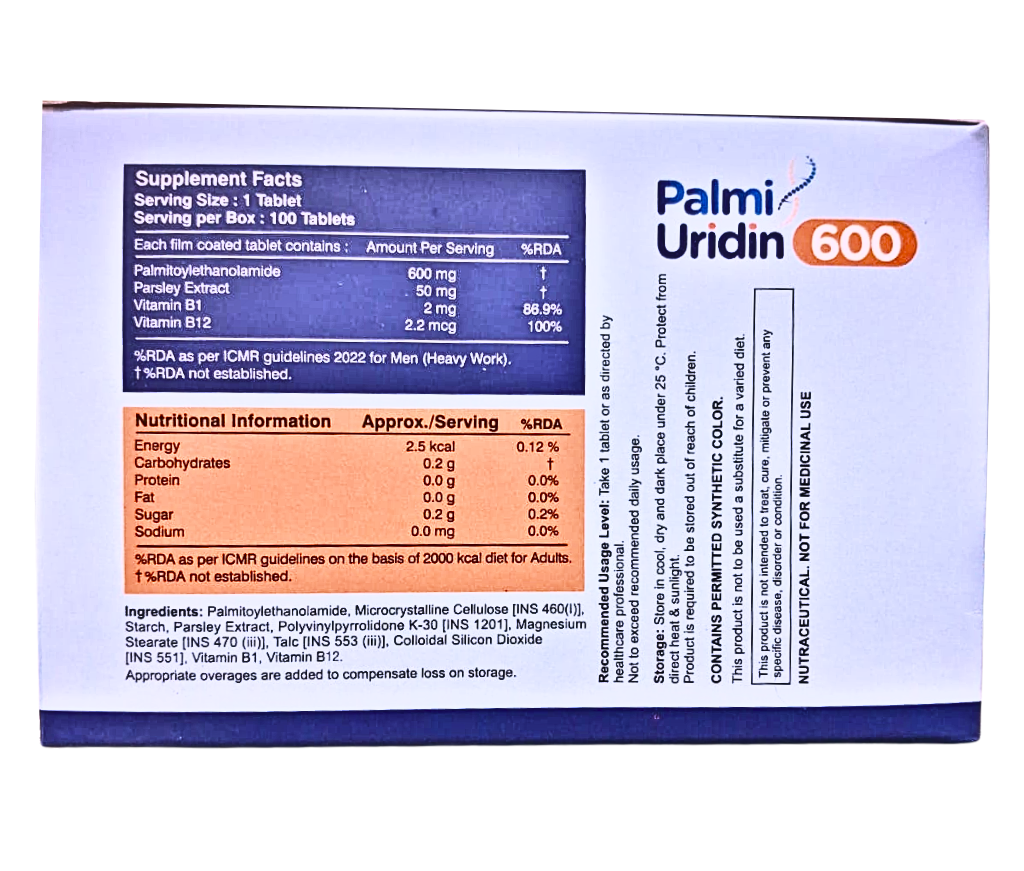
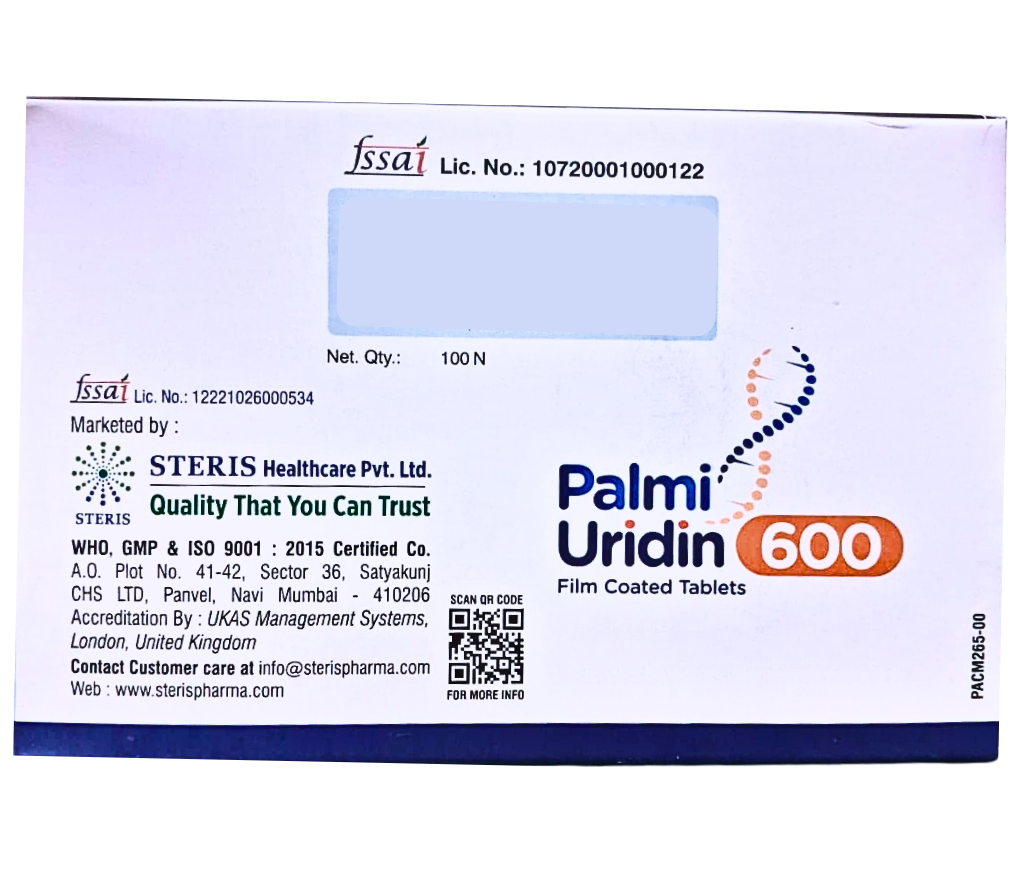
PALMI URIDIN 600
 Item requires a valid prescription
Manufactured By Steris Healthcare Pvt. Ltd.
Composition Palmitoylethanolamide,Parsley Extract & Multivitamin Tablets
Rs 405.30
MRP Rs 579.00
(30% OFF)
Includes all taxes
Package SIZE
( 10 Tablets )

100% Authentic
Products

Free
Shipping*

Products
Return Policy
Description:
What Are Palmitoylethanolamide, Parsley Extract & Multivitamin Tablets?
Palmitoylethanolamide, Parsley Extract & Multivitamin Tablets are combination nutritional supplements designed to bring together palmitoylethanolamide (PEA), parsley extract, vitamins and minerals in a single tablet formulation. The exact composition, dosage and intended use can vary considerably between manufacturers, so buyers should always check the product label rather than assuming every tablet contains the same quantities.
The combination is particularly interesting because its ingredients have different roles. PEA is a naturally occurring bioactive lipid that has been investigated for its potential role in pain, inflammation and nervous-system-related processes. A recent systematic review of randomized controlled trials found the strongest evidence for PEA in pain-management and general-wellbeing outcomes, particularly with micronized, ultramicronized or water-dispersible formulations, with generally good tolerability in the reviewed studies.
Parsley (Petroselinum crispum) contributes naturally occurring flavonoids and phenolic compounds. Research has identified compounds such as apigenin and apiin in parsley and demonstrated antioxidant activity in experimental studies. Human research is more limited, meaning antioxidant findings should not automatically be interpreted as proof that a parsley-containing tablet prevents or treats disease.
The multivitamin component can help provide selected vitamins and minerals when dietary intake is inadequate. However, multivitamins are not replacements for a varied diet, and the health effects depend heavily on the specific nutrients and doses included.
Product Information
| Product Detail | Information |
|---|---|
| Brand Name | PALMI URIDIN 600 |
| Composition | Palmitoylethanolamide, Parsley Extract & Multivitamin Tablets |
| Manufacturer/Marketer | Steris Healthcare Pvt. Ltd. |
| Product Form | Tablet |
| Pack Size | 10 Tablets |
| Target Location | India |
| Route of Administration | Oral |
| Category | Nutritional / Supportive Supplement |
How Do Palmitoylethanolamide, Parsley Extract & Multivitamin Tablets Work?
The three major components serve different purposes:
1. Palmitoylethanolamide
PEA is an endogenous fatty-acid amide studied for its analgesic, anti-inflammatory and neuroprotective properties. Clinical research has particularly examined PEA in people experiencing pain and neurological or inflammatory conditions. The latest broad systematic review identified 47 randomized controlled trials and concluded that the most convincing evidence was in pain-related outcomes, while also noting that formulations differ and results should not simply be generalized to every PEA product.
2. Parsley Extract
Parsley contains bioactive plant compounds, including flavonoids and phenolic constituents. Laboratory and nutritional research has demonstrated antioxidant potential, while a small human crossover trial found that parsley intake influenced urinary apigenin excretion and certain antioxidant enzyme measures.
This makes parsley extract a potentially useful complementary ingredient in a nutritional formulation, but stronger human clinical evidence is needed before making disease-treatment claims.
3. Vitamins and Minerals
The multivitamin portion is intended to support nutritional adequacy. According to the NIH Office of Dietary Supplements, multivitamin/mineral supplements can increase nutrient intake and may be useful for people who do not obtain adequate amounts from food. However, there is no single standardized multivitamin formula, and products can differ substantially in nutrient selection and dose.
Potential Benefits of Palmitoylethanolamide, Parsley Extract & Multivitamin Tablets
The potential benefits depend on the formulation and the individual's nutritional needs. Commonly researched or intended benefits include:
Support for pain-management strategies
PEA is the ingredient with the most relevant clinical evidence in this combination. Research has investigated it as a nutritional adjunct in different pain conditions, with the strongest evidence emerging in pain-related outcomes.
Importantly, this does not mean that every PEA-containing supplement is a proven treatment for chronic pain or neuropathy. People with persistent, severe or unexplained pain should receive an appropriate medical evaluation.
Nutritional support
A multivitamin can help fill specific dietary gaps. This can be particularly relevant when someone has a restricted diet, low appetite, inadequate food intake or an increased nutritional requirement. NIH guidance emphasizes that supplements can increase nutrient intake but should not replace a varied diet.
Antioxidant nutritional support
Parsley contains flavonoids and phenolic compounds with antioxidant activity demonstrated in laboratory and experimental research.
The practical takeaway is that parsley extract may complement a broader nutritional formulation, but consumers should avoid interpreting antioxidant activity as evidence of a guaranteed clinical benefit.
Convenient combination formula
For consumers already looking for PEA and nutritional support, a combination tablet may be more convenient than purchasing several separate products. The key purchasing consideration is transparency: check the exact quantity of PEA, parsley extract, vitamins and minerals per serving.
Palmitoylethanolamide, Parsley Extract & Multivitamin Tablets Uses
Depending on the specific formulation and its labeling, these tablets may be used as a nutritional supplement for:
-
Supporting nutritional intake
-
Providing selected vitamins and minerals
-
Complementing a pain-management or wellness plan where PEA is appropriate
-
Providing botanical compounds from parsley extract
-
Supporting general nutritional and antioxidant intake
However, a supplement should not be presented as a substitute for prescription treatment or as a guaranteed cure for neuropathy, arthritis, inflammation, nerve damage or other medical conditions.
How to Choose the Right Product
1. Check the PEA dose.
Look for the actual amount of PEA per tablet or daily serving.
2. Identify the PEA formulation.
Clinical studies have used different forms of PEA. The systematic-review evidence suggests particularly promising results with micronized, ultramicronized and water-dispersible formulations.
3. Review the complete vitamin and mineral panel.
Do not assume that every multivitamin contains the same nutrients or doses.
4. Avoid unnecessary duplication.
If you already take a multivitamin, vitamin A, zinc, iron or other supplements, compare labels to avoid excessive total intake.
5. Check manufacturing and quality information.
Look for clear labeling, batch information, manufacturer details and appropriate quality-control information.
6. Buy according to your actual need.
A higher dose or a longer ingredient list does not automatically mean a better product.
Possible Side Effects and Safety
Most healthy adults can tolerate appropriately formulated basic multivitamins, but dietary supplements can still cause adverse effects or interact with medicines. NIH guidance notes that excessive intake of certain vitamins and minerals can create safety concerns, particularly when people combine several supplements or consume fortified foods and beverages.
Possible issues can include:
-
Stomach discomfort
-
Nausea
-
Changes in bowel habits
-
Headache or other nonspecific symptoms
-
Allergic or sensitivity reactions to an ingredient
-
Excess intake of certain vitamins or minerals when multiple products are combined
The exact side-effect profile cannot be determined from the product name alone because the dose and complete ingredient list matter.
People taking prescription medicines, preparing for surgery, pregnant or breastfeeding individuals, and people with significant medical conditions should discuss supplementation with an appropriate healthcare professional. NCCIH also emphasizes that dietary supplements can interact with medicines and that the evidence and safety profile varies substantially between products.
Who Should Be More Careful?
Extra caution is appropriate if you:
-
Take several vitamin or mineral supplements
-
Use prescription medicines regularly
-
Have a chronic medical condition
-
Are pregnant or breastfeeding
-
Have a known allergy to any ingredient
-
Are preparing for surgery
-
Are considering the product for persistent or unexplained pain
A multivitamin should also not be viewed as a way to compensate for a consistently poor-quality diet. Evidence summarized by NIH indicates that multivitamins can improve nutrient intake, but they generally have not shown broad effects on preventing chronic disease or extending life in healthy populations.
Frequently Asked Questions
1. What are Palmitoylethanolamide, Parsley Extract & Multivitamin Tablets used for?
They are dietary supplements combining PEA, parsley extract and vitamins/minerals. Depending on the formulation, they may be used for nutritional support and as a complementary source of PEA. PEA has been studied particularly for pain-related outcomes, while parsley contributes plant-derived bioactive compounds and the multivitamin component helps provide selected nutrients.
2. What are the main benefits of Palmitoylethanolamide, Parsley Extract & Multivitamin Tablets?
Potential benefits depend on the formulation. PEA has clinical research supporting its potential role in pain management, parsley provides flavonoids and other phytochemicals with antioxidant activity, and multivitamins can help increase vitamin and mineral intake when dietary intake is inadequate.
3. Can Palmitoylethanolamide tablets help with nerve pain?
PEA has been investigated in several pain and neurological conditions, and a recent systematic review found its strongest evidence in pain-related outcomes. However, PEA should not be considered a guaranteed treatment for neuropathy, and the evidence for one formulation cannot automatically be applied to every PEA product.
4. Are Palmitoylethanolamide, Parsley Extract & Multivitamin Tablets safe?
Safety depends on the complete formulation, dose, individual health status and medicines being used. Basic multivitamins are generally well tolerated in healthy people when used appropriately, but excessive vitamin/mineral intake and supplement-drug interactions are possible.
5. What are the side effects of Palmitoylethanolamide, Parsley Extract & Multivitamin Tablets?
Possible adverse effects may include gastrointestinal discomfort, nausea or sensitivity to an ingredient. However, there is no universal side-effect profile because products differ in their PEA, parsley, vitamin, mineral and excipient composition. Check the label and seek professional advice if you develop concerning symptoms.
6. Can I take these tablets with other multivitamins?
Do not automatically combine them with another multivitamin. Adding multiple supplements can increase total intake of nutrients such as vitamin A, zinc, iron or other ingredients and may push intake above recommended upper limits. Compare the labels first and ask a healthcare professional when in doubt.
7. How should I choose the best Palmitoylethanolamide, Parsley Extract & Multivitamin Tablets?
Look for transparent labeling, a clearly stated PEA dose and formulation, quantified parsley extract, complete vitamin/mineral amounts, appropriate serving instructions and reliable manufacturer information. For PEA specifically, formulation matters because clinical studies have used different preparations.
8. Are these tablets a replacement for pain medicines or medical treatment?
No. A supplement should not automatically replace prescribed medicines or medical evaluation. If pain is severe, persistent, worsening or associated with weakness, numbness or other concerning symptoms, professional medical assessment is important.
9. Do multivitamins provide proven long-term health benefits?
Multivitamins can increase nutrient intake when dietary intake is insufficient, but evidence does not show that routine multivitamin use broadly prevents chronic disease or lowers mortality in healthy adults. NIH research involving more than 390,000 adults found no association between regular multivitamin use and lower overall mortality.
10. Should I take Palmitoylethanolamide, Parsley Extract & Multivitamin Tablets every day?
Follow the serving instructions on the specific product unless your healthcare professional recommends otherwise. Do not assume that taking more tablets provides greater benefits; with vitamins and minerals, excessive intake can create avoidable risks.