


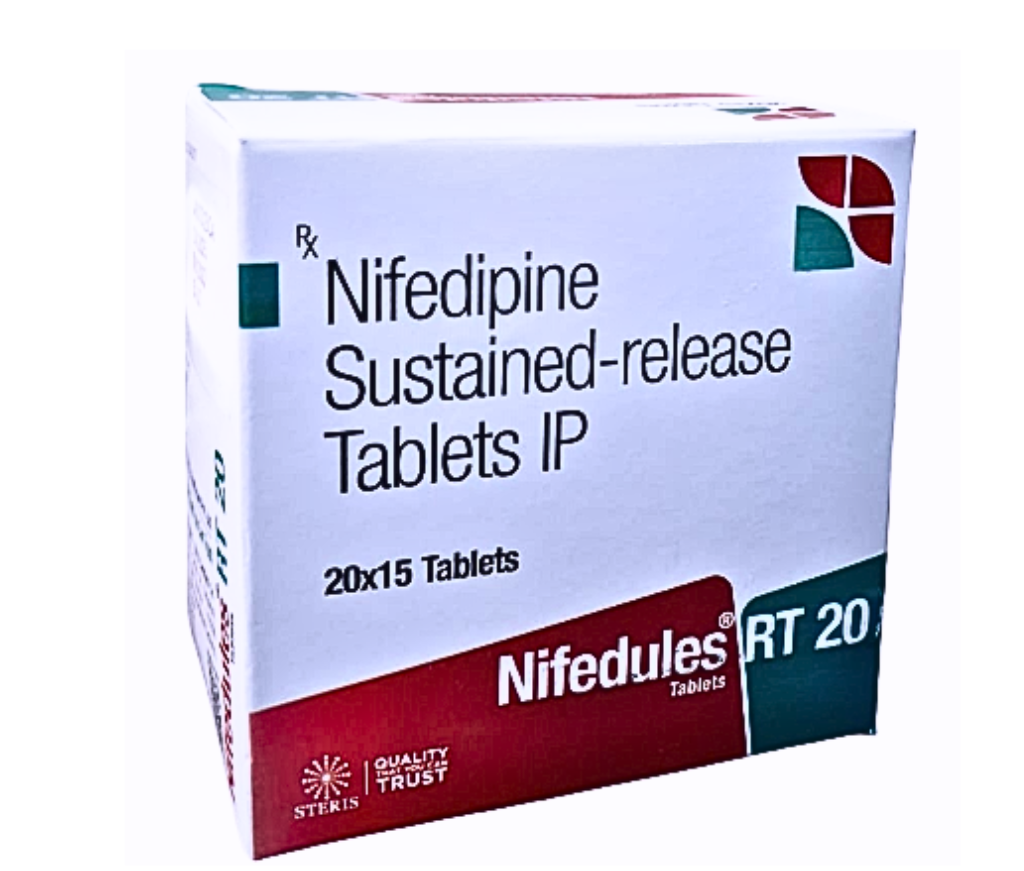
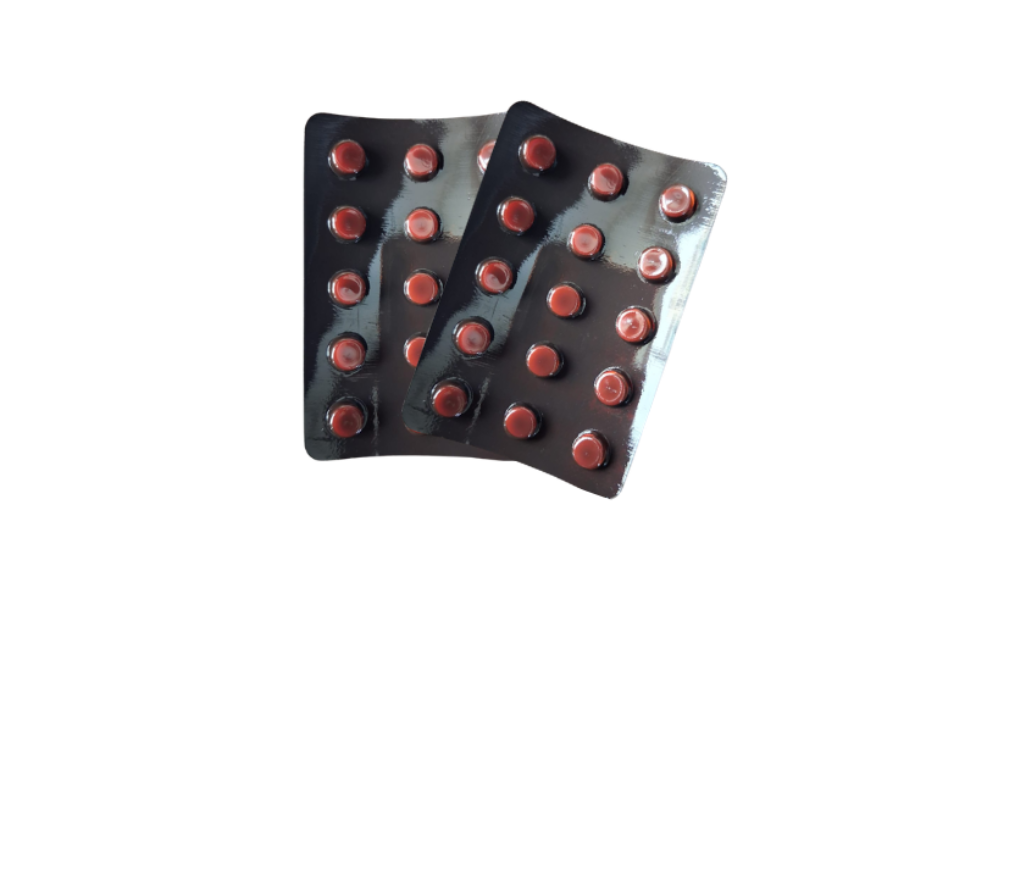
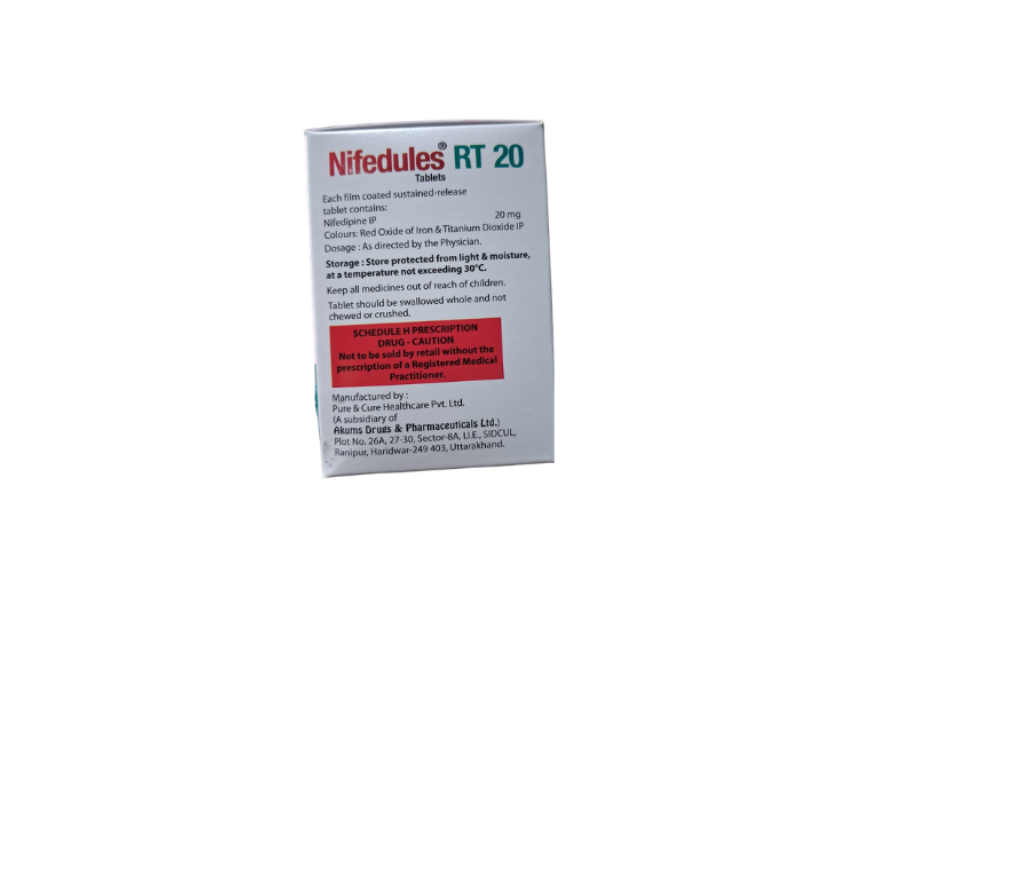
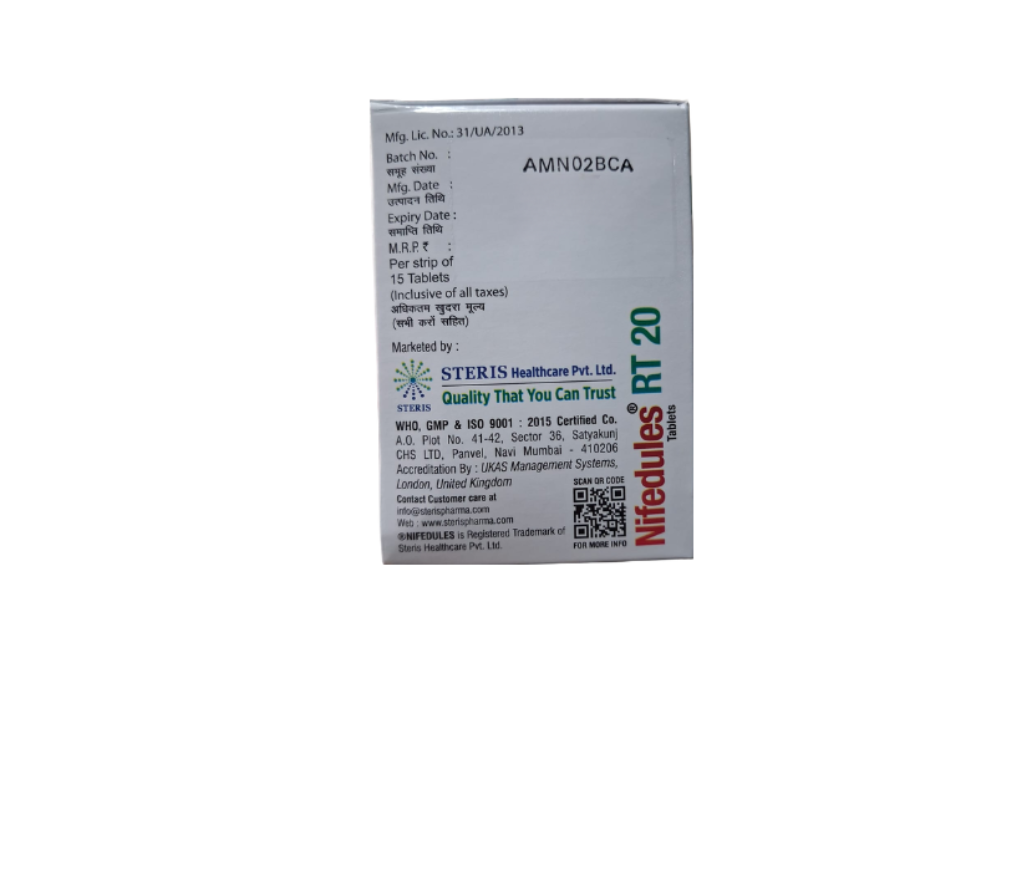
NIFEDULES RT 20
 Item requires a valid prescription
Manufactured By Steris Healthcare Pvt Ltd
Composition Nifedipine 20 mg
Rs 38.40
MRP Rs 54.87
(30% OFF)
Includes all taxes
Package SIZE
( For 15 Tablet )

100% Authentic
Products

Free
Shipping*

Products
Return Policy
Description:
Nifedipine 20 mg is a dihydropyridine calcium channel blocker (CCB) primarily prescribed to manage hypertension (high blood pressure) and chronic stable angina (chest pain). It works by relaxing and widening blood vessels, which lowers blood pressure, reduces the heart's workload, and improves blood and oxygen flow to the heart muscle. Nifedipine 20 mg is commonly available in extended-release (ER/SR) tablet formulations for once- or twice-daily dosing. Common side effects include headache, facial flushing, ankle swelling (peripheral edema), and dizziness. Nifedipine 20 mg is a prescription-only medicine (Schedule H) — it should be taken strictly under medical supervision, and the tablet should not be crushed, chewed, or split unless directed by a physician.
What Is Nifedipine 20 mg?
Nifedipine 20 mg belongs to a class of medications known as calcium channel blockers (CCBs), specifically the dihydropyridine subclass. It is one of the most widely prescribed antihypertensive and anti-anginal medicines globally and in India, used both as monotherapy and in combination with other cardiovascular drugs.
Nifedipine works by blocking the entry of calcium ions into the smooth muscle cells of blood vessel walls and the heart. This action causes vasodilation (widening of blood vessels), which reduces peripheral vascular resistance, lowers blood pressure, and decreases the oxygen demand of the heart muscle — making it effective for both blood pressure control and angina management.
Nifedipine 20 mg is generally formulated as an extended-release (ER) or sustained-release (SR) tablet, designed to release the medication gradually over several hours. This helps maintain steady blood levels and avoid the sharp blood-pressure fluctuations associated with older immediate-release formulations.
Clinical Indications of Nifedipine 20 mg
| Condition | How Nifedipine 20 mg Helps |
|---|---|
| Essential Hypertension | Relaxes arterial smooth muscle, lowering systemic blood pressure |
| Chronic Stable Angina (Angina Pectoris) | Reduces cardiac workload and improves coronary blood flow, easing chest pain episodes |
| Prinzmetal's (Vasospastic) Angina | Prevents coronary artery spasm by inhibiting calcium influx |
| Raynaud's Phenomenon (off-label, physician discretion) | Improves peripheral blood flow by relaxing constricted small vessels |
| Hypertensive Urgency Management (in specific clinical settings, under supervision) | Rapidly lowers dangerously elevated blood pressure when prescribed by a physician |
Mechanism of Action
Nifedipine selectively inhibits the influx of calcium ions through L-type calcium channels located in vascular smooth muscle and, to a lesser extent, cardiac muscle. By blocking this calcium entry:
- Vascular smooth muscle relaxes, causing arterial and arteriolar vasodilation.
- Peripheral vascular resistance decreases, resulting in lower blood pressure.
- Coronary arteries dilate, increasing oxygen delivery to the heart muscle.
- Myocardial oxygen demand decreases, relieving anginal chest pain.
Because nifedipine acts more selectively on vascular smooth muscle than on cardiac conduction tissue, it has minimal direct effect on heart rate or cardiac contractility compared to non-dihydropyridine CCBs like verapamil or diltiazem — though reflex tachycardia can occur, especially with immediate-release formulations.
Key Benefits of Nifedipine 20 mg
- Effective Blood Pressure Control: Helps achieve consistent, smooth blood pressure reduction over 24 hours with extended-release dosing.
- Angina Relief: Reduces frequency and severity of chest pain episodes in patients with chronic stable or vasospastic angina.
- Convenient Dosing: Extended-release formulations allow once- or twice-daily dosing, improving treatment adherence.
- Combination Therapy Compatible: Can be used alongside beta-blockers, ACE inhibitors, ARBs, or diuretics for patients needing multi-drug blood pressure management.
- Improved Peripheral Circulation: Beneficial in select circulatory conditions such as Raynaud's phenomenon when prescribed off-label.
- Well-Studied Safety Profile: Decades of clinical use with an established, predictable side-effect profile when taken as directed.
[Reviewer placeholder: insert verified clinical efficacy statistics/trial data with citation before publishing.]
Dosage Guidelines
- Nifedipine 20 mg is typically administered as an extended-release tablet, taken once or twice daily, depending on the formulation and the physician's assessment.
- Tablets should be swallowed whole with water — do not crush, chew, or break extended-release tablets, as this can cause rapid drug release and dangerous blood pressure drops.
- Can generally be taken with or without food, though your doctor may advise consistency in timing relative to meals.
- Grapefruit and grapefruit juice should be avoided, as they can significantly increase nifedipine blood levels and the risk of side effects.
- Dose adjustments are made gradually by the physician based on blood pressure response and tolerability.
- Missed doses should not be doubled up — consult your doctor or pharmacist for guidance.
Side Effects of Nifedipine 20 mg
Common Side Effects
- Headache
- Facial flushing (redness/warmth)
- Peripheral edema (swelling of ankles/feet)
- Dizziness or lightheadedness
- Palpitations or reflex tachycardia
- Fatigue
Less Common Side Effects
- Gingival hyperplasia (gum swelling) with long-term use
- Nausea
- Muscle cramps
- Constipation
Serious Side Effects (Seek Immediate Medical Attention)
- Severe hypotension (very low blood pressure) — dizziness, fainting
- Worsening chest pain or new-onset angina after starting therapy
- Signs of allergic reaction — rash, swelling of face/throat, difficulty breathing
- Irregular heartbeat
Nifedipine 20 mg vs. Other Calcium Channel Blockers
| Parameter | Nifedipine 20 mg | Amlodipine 5 mg | Diltiazem 90 mg |
|---|---|---|---|
| Class | Dihydropyridine CCB | Dihydropyridine CCB | Non-dihydropyridine CCB |
| Primary Use | Hypertension, Angina | Hypertension, Angina | Hypertension, Angina, Arrhythmia |
| Dosing Frequency | Once/twice daily (ER) | Once daily | Twice/thrice daily |
| Effect on Heart Rate | Minimal (reflex tachycardia possible) | Minimal | Lowers heart rate |
| Common Side Effect | Flushing, ankle edema | Ankle edema | Constipation, bradycardia |
Precautions & Warnings
- Inform your doctor if you have a history of severe aortic stenosis, congestive heart failure, or liver impairment before starting nifedipine.
- Use with caution in patients with unstable angina — immediate-release nifedipine is generally avoided in this setting.
- Pregnant or breastfeeding women should use nifedipine only under strict specialist supervision.
- Elderly patients may be more sensitive to blood-pressure-lowering effects and require closer monitoring.
- Regular blood pressure monitoring is recommended throughout treatment.
- Inform your doctor of all other medications, including beta-blockers, other antihypertensives, and CYP3A4-interacting drugs, to avoid interactions.
- Avoid alcohol, which can intensify dizziness and blood-pressure-lowering effects.
Conclusion
Nifedipine 20 mg remains a trusted and widely prescribed calcium channel blocker for managing hypertension and angina, valued for its vasodilatory action, convenient extended-release dosing, and well-established clinical track record. While generally well tolerated, it works best as part of a comprehensive treatment plan that includes regular medical follow-up, lifestyle modification, and adherence to the prescribed dosage. Because it is a Schedule H prescription medicine, nifedipine 20 mg should only be started, adjusted, or stopped under the guidance of a qualified physician. Patients experiencing uncontrolled blood pressure, chest pain, or side effects should consult their doctor promptly rather than self-adjusting treatment.
Prescription only – consult your doctor.
Frequently Asked Questions
1. What is Nifedipine 20 mg used for?
Nifedipine 20 mg is used to treat high blood pressure (hypertension) and chest pain caused by angina, including chronic stable and vasospastic angina.
2. How does Nifedipine 20 mg work in the body?
It blocks calcium from entering blood vessel muscle cells, causing the vessels to relax and widen, which lowers blood pressure and improves blood flow to the heart.
3. Is Nifedipine 20 mg safe to take every day?
When prescribed by a doctor for long-term blood pressure or angina management, nifedipine is generally safe for daily use under medical supervision and periodic monitoring.
4. Can I take Nifedipine 20 mg on an empty stomach?
It can usually be taken with or without food, but your doctor may recommend taking it consistently at the same time relative to meals each day.
5. What are the most common side effects of Nifedipine 20 mg?
The most common side effects include headache, facial flushing, ankle swelling, dizziness, and palpitations.
6. Can Nifedipine 20 mg cause swelling in the legs or feet?
Yes, peripheral edema (ankle or foot swelling) is a recognized side effect of nifedipine and should be reported to your doctor if persistent or severe.
7. Is it safe to drink grapefruit juice while taking Nifedipine 20 mg?
No, grapefruit juice can increase nifedipine levels in the blood and raise the risk of side effects; it should be avoided during treatment.
8. Can Nifedipine 20 mg be taken with other blood pressure medicines?
Yes, it is often combined with beta-blockers, ACE inhibitors, ARBs, or diuretics, but combinations should only be prescribed and monitored by a doctor.
9. What happens if I miss a dose of Nifedipine 20 mg? T
ake the missed dose as soon as you remember, but skip it if it's close to the next scheduled dose. Never double the dose without consulting your doctor.
10. Can Nifedipine 20 mg be stopped suddenly?
No, abrupt discontinuation is not recommended, as it may worsen angina symptoms in some patients. Any changes should be made gradually under medical guidance.
11. Is Nifedipine 20 mg safe during pregnancy?
Nifedipine may be used in certain pregnancy-related conditions, but only under the direct supervision of an obstetrician or specialist physician.
12. How long does it take for Nifedipine 20 mg to start working?
Extended-release formulations typically begin lowering blood pressure within a few hours, with full therapeutic effect often seen after several days of consistent use.
13. Can Nifedipine 20 mg cause a fast heartbeat?
Yes, some patients experience reflex tachycardia (a faster heartbeat) as the body responds to blood vessel relaxation, particularly with immediate-release forms.
14. What should I avoid while taking Nifedipine 20 mg?
Avoid grapefruit products, excessive alcohol, and abrupt dose changes. Always inform your doctor about other medications you are taking.
15. Can Nifedipine 20 mg tablets be crushed or split?
No, extended-release nifedipine tablets should be swallowed whole. Crushing or splitting can cause rapid drug release and dangerously low blood pressure.
16. Who should not take Nifedipine 20 mg?
Patients with severe aortic stenosis, unstable angina (for immediate-release forms), or known hypersensitivity to nifedipine should avoid it unless specifically advised by a specialist.
17. Is Nifedipine 20 mg a beta-blocker?
No, nifedipine is a calcium channel blocker, not a beta-blocker. They work through different mechanisms, though they are sometimes prescribed together.
18. Can Nifedipine 20 mg interact with other medications?
Yes, it can interact with other antihypertensives, certain antibiotics, antifungals, and CYP3A4-affecting drugs. Share your full medication list with your doctor.

