


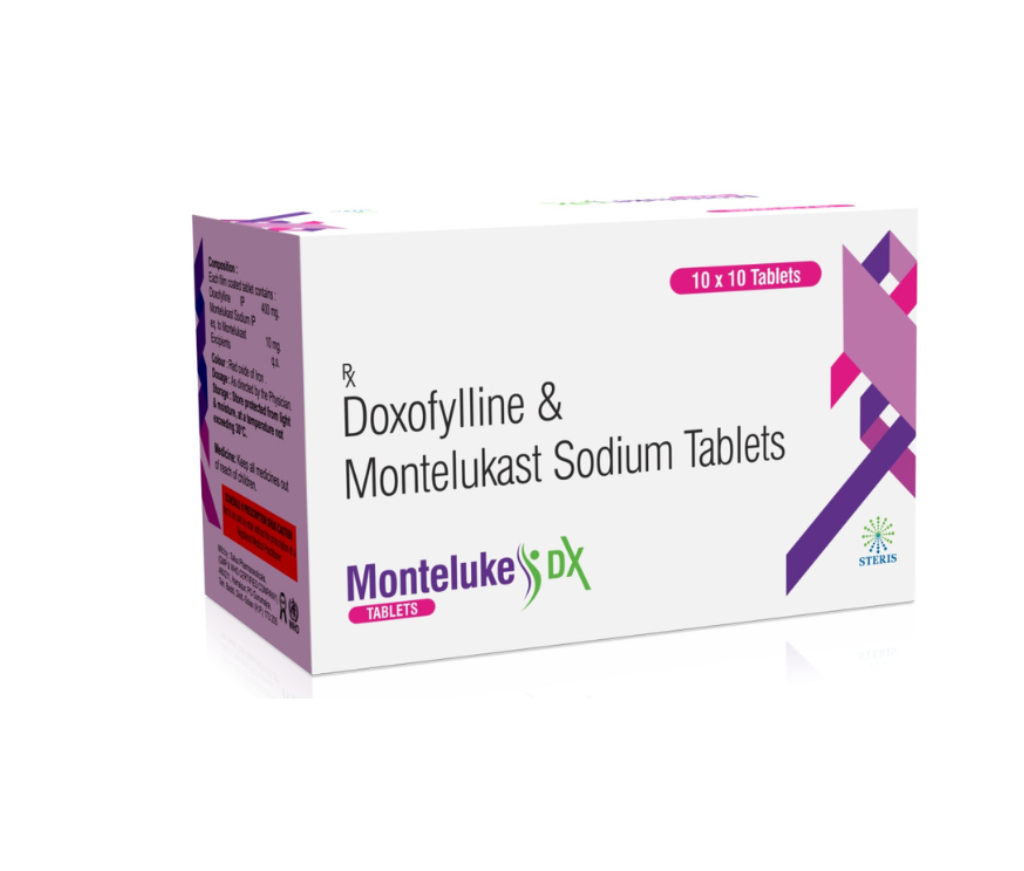
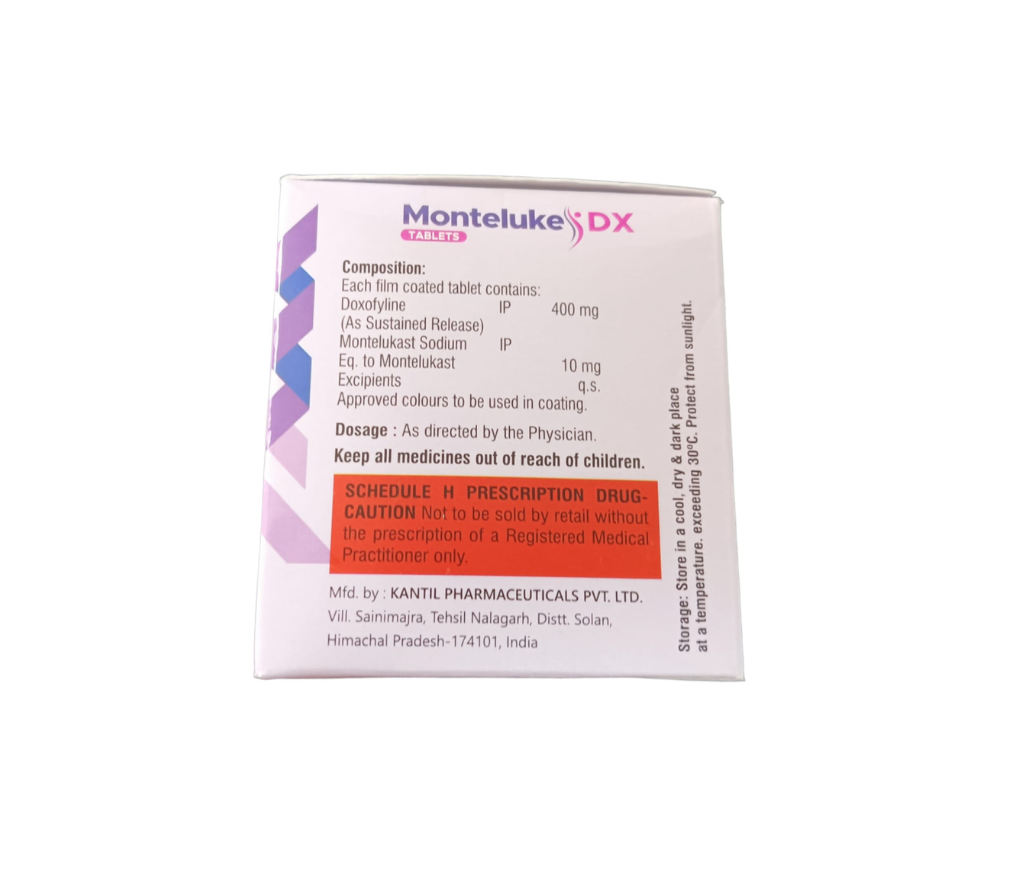
MONTELUKE DX
 Item requires a valid prescription
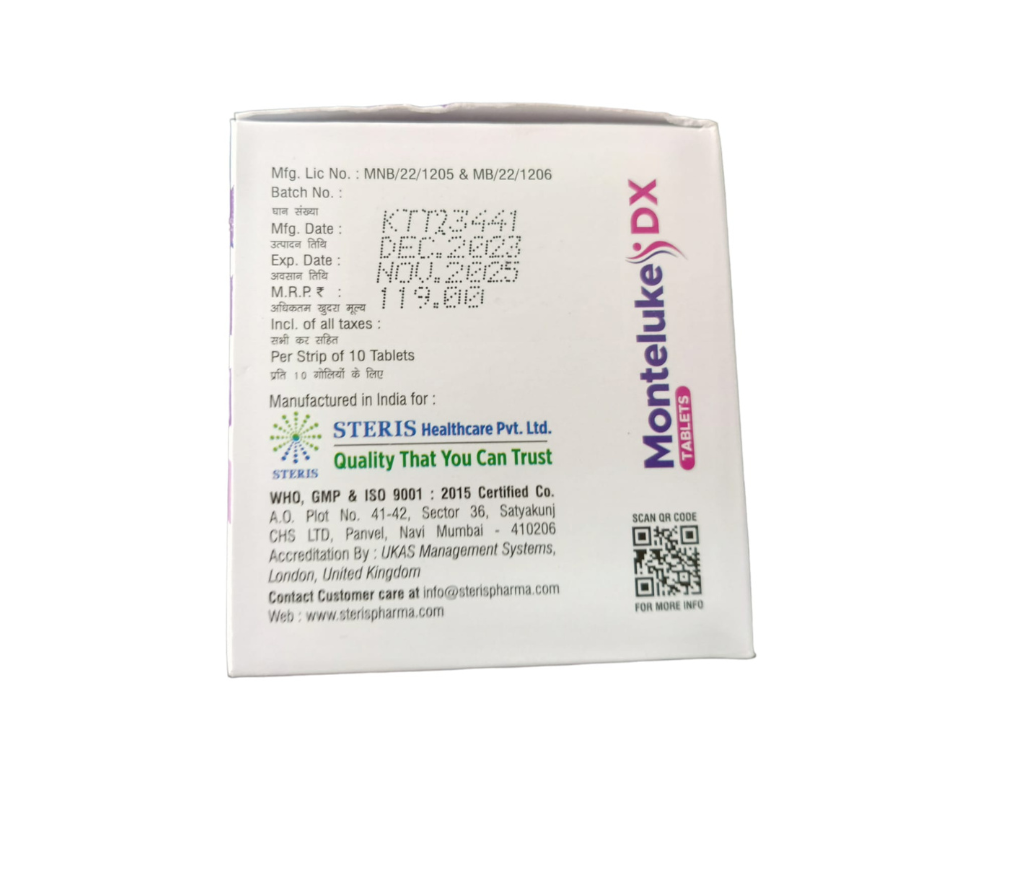
Manufactured By Steris Healthcare Pvt Ltd
Composition montelukast and doxofylline
Rs 78.09
MRP Rs 111.56
(30% OFF)
Includes all taxes
Package SIZE
( For 10 Tablets )

100% Authentic
Products

Free
Shipping*

Products
Return Policy
Description:
Montelukast is a prescription medicine taken by mouth daily to treat asthma long term, prevent exercise-induced bronchoconstriction, and relieve allergy symptoms. This medicine carries an FDA boxed warning for rare but serious neuropsychiatric side effects including mood changes, sleep disturbances and suicidal thoughts, and patients and caregivers should be counseled on this before starting therapy. Montelukast is contrasted with antihistamines like cetirizine, but they work in different ways and can be prescribed together.
What Is Montelukast Tablet Used For?
Montelukast is in a class of medications called leukotriene receptor antagonists (LTRAs). Montelukast does not work by blocking histamines as antihistamines do, but by blocking cysteinyl leukotrienes. These are signaling molecules released during allergic and asthmatic inflammation that cause airway constriction, swelling and excess mucus.
Clinical Indications
| Indication | How Montelukast Helps |
|---|---|
| Chronic asthma (maintenance) | Reduces frequency of asthma symptoms and exacerbations when taken regularly |
| Exercise-induced bronchoconstriction | May help prevent airway narrowing triggered by exertion, per physician guidance |
| Seasonal allergic rhinitis | Reduces nasal congestion, sneezing, and itching linked to seasonal allergens |
| Perennial (year-round) allergic rhinitis | Manages persistent nasal allergy symptoms not tied to a specific season |
<cite index="21-1">Health care professionals should consider the risks and benefits of montelukast when deciding to prescribe or continue patients on the medicine</cite>, and current safety guidance recommends <cite index="21-1">montelukast should only be used for allergic rhinitis in patients who have an inadequate response or intolerance to alternative therapies</cite>. This makes montelukast for allergy symptoms typically a second-line option rather than a first choice, reserved for cases where antihistamines and nasal steroids haven't worked well enough.
How Montelukast Works
Montelukast selectively blocks the cysteinyl leukotriene receptor (CysLT1) found in airway smooth muscle and immune cells. When allergens or asthma triggers cause the body to release leukotrienes, these chemicals normally bind to CysLT1 receptors and trigger:
- Bronchoconstriction (airway narrowing)
- Increased vascular permeability, causing swelling
- Excess mucus secretion
- Eosinophil recruitment (a type of inflammatory cell involved in allergic responses)
Key Benefits of Montelukast
- Once-daily oral dosing — more convenient than multiple-times-daily inhaled or nasal treatments for many patients
- Dual-purpose coverage — one of the few oral medicines that can address both asthma symptoms and allergic rhinitis in appropriate patients
- Non-sedating—unlike some older antihistamines, montelukast does not typically cause drowsiness
- Useful add-on therapy — often prescribed alongside inhaled corticosteroids for patients with asthma not fully controlled on inhaler therapy alone
- Helps reduce exacerbation frequency with regular, consistent use as directed by a physician
- Suitable long-term option for chronic, ongoing allergy or asthma symptom management under medical supervision
Dosage Guidelines
- Timing: Montelukast is typically taken once daily in the evening, as consistent evening dosing aligns with clinical trial data and helps maintain steady drug levels overnight when airway symptoms often worsen
- Administration: Can be taken with or without food, as directed by the prescribing doctor
- Formulations: Available as tablets, chewable tablets, and oral granules depending on age group and patient need—exact strength and form should follow the doctor's prescription
- Missed dose: If a dose is missed, take it as soon as remembered unless close to the next scheduled dose; do not double up
- Duration: Often prescribed for ongoing, seasonal, or as-needed preventive use depending on the condition being treated—follow your doctor's specific instructions
- Not a rescue medicine: Montelukast does not relieve a sudden asthma attack or acute allergic reaction; a fast-acting reliever inhaler or antihistamine should be used for acute symptoms as separately prescribed
Side Effects of Montelukast
Common Side Effects
- Headache
- Stomach pain or upset
- Fatigue
- Fever (more commonly reported in children)
- Cough
Boxed Warning: Serious Neuropsychiatric Events
This is the most important safety point for montelukast and should be readily disclosed to every patient who begins the medicine. The FDA is requiring a boxed warning on the label that serious neuropsychiatric events that may include suicidal thoughts or actions have been reported in patients taking montelukast The events reported were of very variable types and included, but were not limited to, agitation, aggression, depression, sleep disturbances, suicidal ideation and behavior.
Regulatory guidance specifically advises: <cite index="21-1">Ask patients about any history of psychiatric illness prior to initiating treatment</cite>, and <cite index="21-1">counsel all patients receiving montelukast about mental health side effects, and advise them to stop the medicine and contact a health care professional immediately if they develop any symptoms</cite>. Notably, <cite index="21-1">some patients have reported neuropsychiatric events after discontinuation of montelukast</cite> as well, so monitoring shouldn't stop the moment the medicine is stopped.
It's worth noting that the evidence isn't entirely one-sided — some large observational studies have found weaker associations. <cite index="22-1">In this large study of children and adolescents based on data from routine clinical practice, there was no association between use of montelukast and the risk of neuropsychiatric adverse events</cite>. The overall clinical consensus, however, is to remain cautious: the FDA's boxed warning stands, and patients/caregivers should always be counselled on the risk regardless of how individual studies read.
Watch for and report immediately:
- Sudden mood changes, agitation, or aggression
- New depression or anxiety
- Sleep disturbances, nightmares, or vivid dreams (particularly noted in children)
- Any thoughts of self-harm or suicide
Substitutes & Comparable Options
| Drug Class | Example | How It Compares to Montelukast |
|---|---|---|
| Leukotriene receptor antagonist (this class) | Montelukast | Oral, once-daily; addresses both asthma and rhinitis; carries neuropsychiatric boxed warning |
| Second-generation antihistamine | Cetirizine, Levocetirizine | Blocks histamine, not leukotrienes; faster onset for sneezing/itching; different side-effect profile |
| Second-generation antihistamine | Fexofenadine (Allegra) | Similar antihistamine action to cetirizine; often preferred for being non-sedating |
| Inhaled corticosteroid | Fluticasone, Budesonide | First-line for persistent asthma; works directly in the lungs with lower systemic exposure |
| Intranasal corticosteroid | Fluticasone nasal spray | First-line for allergic rhinitis per most guidelines; localized action |
Precautions & Contraindications
- Boxed warning for neuropsychiatric events applies to all patients — discuss any personal or family history of mental health conditions with your doctor before starting
- Not a substitute for a rescue inhaler during an acute asthma attack
- Use caution in patients with known hypersensitivity to montelukast or any of its components
- Phenylketonuria (PKU) patients should check formulation-specific excipients (some chewable forms may contain phenylalanine)
- Should not be abruptly discontinued in asthma patients without medical guidance, even if symptoms improve
- Limited data in pregnancy and breastfeeding — <cite index="26-1">available evidence does not establish a drug-associated risk of major birth defects</cite>, but this should still be discussed with an obstetrician before use
- Regular follow-up recommended to monitor both symptom control and mental health status, especially in children and adolescents
Conclusion
The Montelukast tablet is a convenient once-daily oral option for the management of chronic asthma symptoms and allergic rhinitis that works by blocking the leukotriene pathway that drives airway inflammation rather than masking symptoms as an antihistamine does. It is easy to use and covers two conditions, and it is a valuable option for many patients, especially as an add-on to inhaled therapy for asthma or a second-line choice for allergic rhinitis. That said, montelukast should never be started casually in light of the FDA's boxed warning for serious neuropsychiatric side effects including mood changes, sleep disturbances, and suicidal thoughts. 'Patients and caregivers should be fully counseled on these risks, monitored throughout treatment and advised to seek immediate medical help if any behavioral or mood changes occur. Montelukast is a prescription therapy and should be initiated and adjusted only under the supervision of a physician.
Frequently Asked Questions
1. Is montelukast an anti-allergy?
Yes. Montelukast is used to treat allergic rhinitis (seasonal and year-round nasal allergies) as well as asthma. It works by blocking leukotrienes, inflammatory chemicals involved in allergic reactions, rather than blocking histamine like traditional antihistamines.
2. Is montelukast good for sleeping?
No, montelukast is not a sleep aid and should not be used for that purpose. In fact, it carries a boxed warning for sleep disturbances, including insomnia and vivid dreams or nightmares, as a potential side effect. If you're having sleep issues while taking it, tell your doctor.
3. What should I avoid while taking montelukast?
Avoid stopping the medicine abruptly if you have asthma, and don't use it as a substitute for your fast-acting rescue inhaler during an asthma attack. It's also important to closely monitor for any mood, behavior, or sleep changes and to inform your doctor about any history of mental health conditions before starting treatment.
4. Are montelukast and cetirizine the same?
No. They belong to different drug classes. Montelukast is a leukotriene receptor antagonist, while cetirizine is an antihistamine. They work through different mechanisms and are sometimes prescribed together for more complete allergy symptom control, under a doctor's guidance.
5. Why must montelukast be taken at night?
Montelukast is commonly recommended for evening dosing because this timing was used in clinical trials and helps maintain steady drug levels through the night, when asthma and allergy symptoms can often be more pronounced. Always follow your doctor's specific timing instructions.
6. What's better, cetirizine or montelukast?
Neither is universally "better"—they treat allergies differently. Cetirizine often provides faster relief for sneezing, itching, and runny nose, while montelukast works on the underlying inflammatory pathway and may help with both asthma and allergy symptoms. Your doctor can advise on which fits your specific symptoms.
7. Who should avoid montelukast?
Patients with a known hypersensitivity to montelukast, and those with a personal or family history of significant mental health conditions, should discuss the risks carefully with their doctor before starting, given the boxed warning for neuropsychiatric side effects. It should also not be relied upon as a rescue medicine during an acute asthma attack.
8. Can I take cetirizine in the morning and montelukast at night?
This combination is sometimes prescribed by doctors for patients needing more complete allergy symptom control, since the two medicines work through different mechanisms. However, this should only be done under medical guidance and not self-directed.
9. Which is better, montelukast or Allegra (fexofenadine)? They aren't directly comparable, as fexofenadine is a fast-acting antihistamine for allergy symptoms like sneezing and itching, while montelukast targets the leukotriene pathway and is often used for both asthma and allergic rhinitis. The right choice depends on your specific symptoms and diagnosis, as advised by your doctor.
10. What is montelukast tablet used for in asthma?
It's used as a maintenance therapy to reduce the frequency and severity of asthma symptoms and exacerbations over time. It is not used to treat a sudden asthma attack.
11. Can children take montelukast?
Montelukast is available in chewable tablet and granule forms for pediatric use, but any use in children should be carefully guided by a pediatrician, with particular attention to monitoring for neuropsychiatric side effects such as changes in mood, behavior, or sleep.
12. Does montelukast cause weight gain?
Weight gain is not among the most commonly reported side effects of montelukast in official safety data. If you notice unexpected weight changes while on this medicine, discuss them with your doctor to rule out other causes.
13. How long does it take for montelukast to start working?
Montelukast is a preventive, maintenance medicine rather than a fast-acting treatment. Noticeable improvement in asthma or allergy symptom control is typically assessed over days of consistent, regular use, as guided by your doctor.
14. Is montelukast safe for long-term use?
It can be used long-term under medical supervision, with regular monitoring for neuropsychiatric side effects being an important part of ongoing care, particularly given the FDA's boxed warning.
15. Can montelukast be taken with food?
Yes, montelukast can generally be taken with or without food, but you should follow your doctor's or pharmacist's specific instructions for your prescribed formulation.
16. What happens if I stop taking montelukast suddenly?
For asthma patients, symptoms may return or worsen if montelukast is stopped abruptly without medical guidance. Additionally, some neuropsychiatric symptoms have been reported even after discontinuation, so any changes in mood or behavior should be reported to your doctor even after stopping the medicine.
If You Need More Information About MONTELUKE DX Click here