


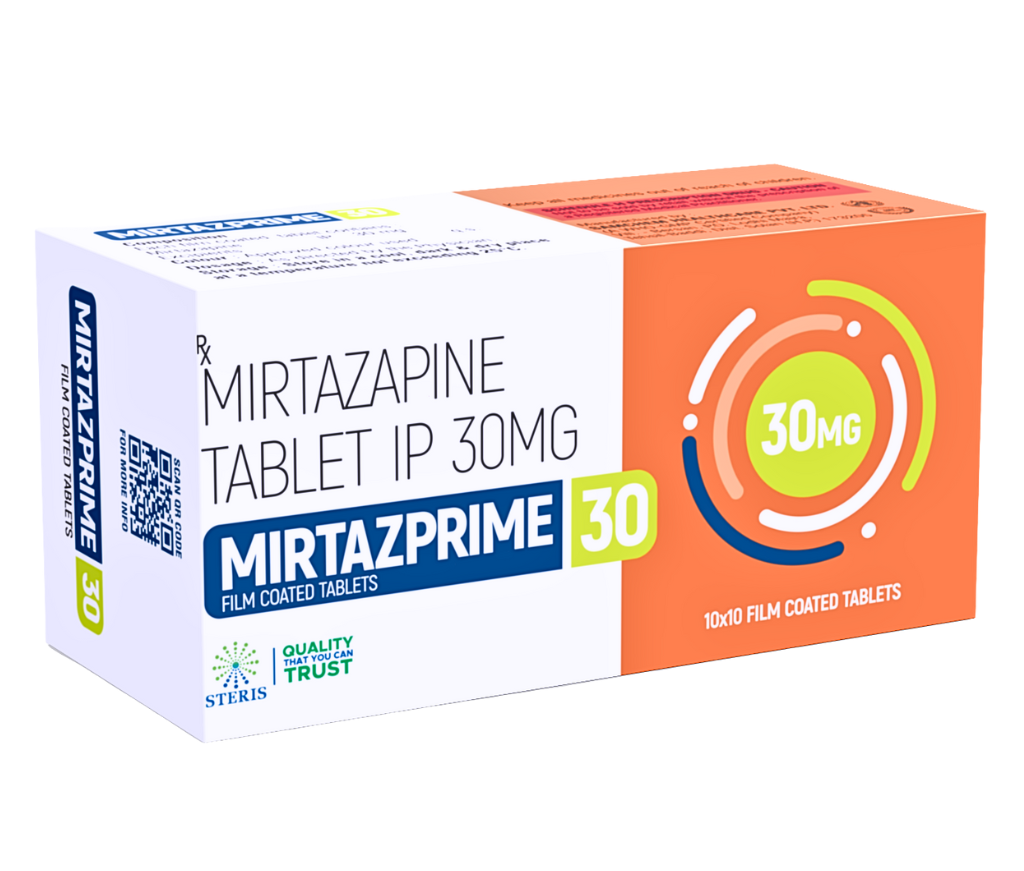
MIRTAZPRIME 30
 Item requires a valid prescription
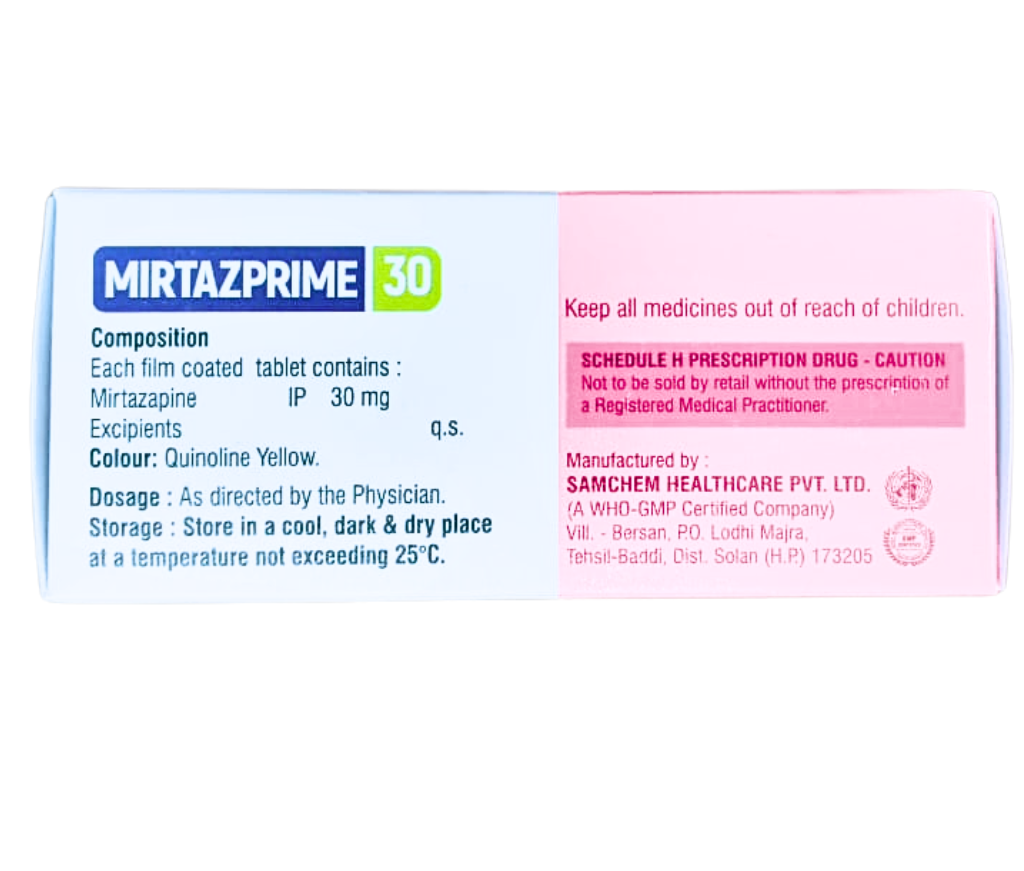
Manufactured By Steris Healthcare Pvt Ltd
Composition Mirtazapine Tablet IP 30mg
Rs 183.75
MRP Rs 262.50
(30% OFF)
Includes all taxes
Package SIZE
( For 10 Tablet )

100% Authentic
Products

Free
Shipping*

Products
Return Policy
Description:
Mirtazapine tablet 30 mg is a prescription antidepressant used primarily for the treatment of major depressive disorder (MDD) in adults. It belongs to the noradrenergic and specific serotonergic antidepressant (NaSSA) class and has a pharmacological profile that differs from selective serotonin reuptake inhibitors (SSRIs).
For healthcare professionals, mirtazapine 30 mg is particularly relevant when antidepressant treatment needs to be considered alongside symptoms such as insomnia, reduced appetite, or weight loss, although the choice of antidepressant should always be individualized. Mirtazapine can cause somnolence, increased appetite, and weight gain, which may be clinically relevant when selecting treatment.
This guide covers mirtazapine tablet 30 mg uses, key therapeutic benefits, dosage considerations, common and serious side effects, contraindications, interactions, monitoring, discontinuation, and frequently searched clinical questions.
Product Information
| Product Detail | Information |
|---|---|
| Brand Name | MIRTAZPRIME 30 |
| Composition | Mirtazapine IP 30 mg |
| Product Form | Tablet |
| Pack Size | 10 Tablets |
| Manufacturer/Marketer | Steris Healthcare Pvt. Ltd. |
| Target Market | India |
| Therapeutic Category | Antidepressant |
| Active Ingredient | Mirtazapine |
| Strength | 30 mg |
| Route of Administration | Oral |
| Prescription Status | Prescription medicine |
| Primary Use | Treatment of depression as prescribed by a healthcare professional |
| Storage | Store according to the product label, away from excessive heat and moisture |
What Is Mirtazapine Tablet 30 mg?
Mirtazapine is an oral antidepressant indicated in U.S. prescribing information for the treatment of major depressive disorder in adults. A 30 mg tablet is one of the available strengths and is generally a prescription-only medicine. Current U.S. labeling lists 7.5 mg, 15 mg, 30 mg, and 45 mg tablet strengths for certain products.
Mirtazapine has effects on central noradrenergic and serotonergic neurotransmission. Unlike SSRIs, it does not primarily work by directly inhibiting serotonin reuptake. Its receptor activity also contributes to clinically relevant effects such as sedation and increased appetite.
The 30 mg strength should not automatically be interpreted as the appropriate starting dose for every patient. Current U.S. labeling recommends a starting dose of 15 mg once daily, with dosage increases based on clinical response and tolerability, up to a maximum recommended dose of 45 mg once daily.
Mirtazapine Tablet 30 mg Uses
The primary approved indication for mirtazapine tablets in current U.S. labeling is:
Major depressive disorder in adults
Mirtazapine is used for the treatment of major depressive disorder (MDD) in adults. Depression treatment should be individualized according to symptom severity, previous treatment response, comorbidities, patient preferences, suicide risk, and potential adverse effects.
NICE's current depression guideline covers first-episode and recurrent depression, further-line treatment, relapse prevention, chronic depression, and treatment-resistant depression. The guideline was last reviewed on January 30, 2026.
Mirtazapine may be clinically considered when its overall pharmacological profile is appropriate for the patient. For example, its sedative and appetite-stimulating effects may be relevant when depression is accompanied by sleep disturbance or reduced appetite. However, these effects can also represent disadvantages in patients vulnerable to daytime sedation or weight gain.
Important distinction regarding off-label use
Mirtazapine is sometimes discussed or prescribed for conditions other than its principal approved indication in particular clinical settings. Healthcare professionals should distinguish approved indications from off-label use and verify the applicable regulatory product information before recommending or prescribing it for a specific condition.
Key Benefits of Mirtazapine Tablet 30 mg
1. Established antidepressant option
Mirtazapine is an established pharmacological treatment for major depressive disorder in adults. Its mechanism and adverse-effect profile make it clinically distinct from many conventional antidepressants.
2. Once-daily administration
Mirtazapine tablets are generally administered once daily, preferably in the evening before sleep according to current U.S. prescribing information. This dosing schedule can be convenient for adherence and may align with its sedative properties.
3. May be useful when insomnia accompanies depression
Mirtazapine can cause sleepiness, and NHS information notes that this effect may sometimes be helpful in patients with depression who have difficulty sleeping.
This does not mean mirtazapine should be routinely selected solely as a hypnotic. The underlying depressive disorder and the complete benefit-risk profile should remain the focus of treatment.
4. Appetite stimulation can be clinically relevant
Increased appetite and weight gain are recognized effects of mirtazapine.
Consequently, this characteristic may be considered when depression is accompanied by clinically significant appetite loss or unintended weight reduction. Conversely, it may be an important disadvantage for patients with obesity, metabolic risk factors, or concerns about weight.
5. Alternative mechanism to SSRIs
Mirtazapine provides an antidepressant mechanism that differs from conventional SSRIs. This can make its pharmacological profile relevant when clinicians are considering alternative antidepressant strategies.
Treatment selection should nevertheless be based on evidence, patient-specific factors, previous treatment history, and shared decision-making rather than mechanism alone.
Mirtazapine Tablet 30 mg Dosage
A 30 mg mirtazapine tablet is not necessarily the starting dose.
Current U.S. prescribing information recommends:
-
Initial dose: 15 mg once daily
-
Administration: preferably in the evening before sleep
-
Maximum recommended dose: 45 mg once daily
-
Dose changes should be based on clinical response and tolerability
-
Treatment should be reduced gradually when discontinuing rather than stopped abruptly.
The appropriate dose can differ according to individual patient characteristics and local prescribing information.
Patients with hepatic or renal impairment may require additional clinical consideration. Healthcare professionals should consult the applicable product information before determining the dosing strategy.
How Should Mirtazapine 30 mg Be Taken?
Mirtazapine tablets are taken orally. They may generally be taken with or without food, depending on the product instructions.
When a conventional 30 mg tablet is prescribed, the tablet should be taken exactly as directed. Some products are scored, but whether a tablet can appropriately be split should be confirmed from the specific product information rather than assumed.
Because mirtazapine can cause drowsiness, evening administration is commonly recommended. Patients should be counselled about activities requiring alertness, particularly when beginning treatment or changing the dose.
Mirtazapine Tablet 30 mg Side Effects
The adverse-effect profile of mirtazapine is clinically important when assessing whether it is appropriate for an individual patient.
Common side effects
Commonly reported adverse effects include:
-
Drowsiness or somnolence
-
Increased appetite
-
Weight gain
-
Dizziness
-
Dry mouth
-
Constipation
-
Headache
Important Precautions
Current U.S. labeling lists the following key contraindications:
-
Concomitant use with monoamine oxidase inhibitors (MAOIs)
-
Use within 14 days of stopping an MAOI
-
Use within 14 days before starting an MAOI
-
Known hypersensitivity to mirtazapine or formulation components.
Before prescribing, clinicians should review:
-
Current antidepressants and psychiatric medicines
-
MAOI exposure
-
Other serotonergic medicines
-
Sedating medicines
-
Alcohol use
-
Hepatic function
-
Renal function
-
Seizure history
-
Cardiovascular history
-
Bipolar disorder or history of mania
-
Suicide risk
-
Weight and metabolic considerations
Frequently Asked Questions
1. What is mirtazapine tablet 30 mg used for?
Mirtazapine 30 mg tablets are used primarily for the treatment of major depressive disorder in adults. The exact approved indication depends on the product and jurisdiction.
2. Is mirtazapine 30 mg an antidepressant?
Yes. Mirtazapine is an antidepressant used to treat major depressive disorder in adults.
3. Is 30 mg mirtazapine a high dose?
Thirty milligrams is an available therapeutic strength, but it is not automatically considered a maximum dose. Current U.S. labeling lists 45 mg once daily as the maximum recommended dose.
4. What is the usual starting dose of mirtazapine?
The current U.S. prescribing information recommends 15 mg once daily as the starting dose, with subsequent adjustment according to response and tolerability.
5. When should mirtazapine 30 mg be taken?
Mirtazapine is generally taken once daily, preferably in the evening before sleep because it can cause drowsiness.
6. What are the main benefits of mirtazapine 30 mg?
The principal benefit is treatment of major depressive disorder. Its sedative and appetite-stimulating properties may also be clinically relevant when depression occurs alongside insomnia or reduced appetite.
7. Does mirtazapine 30 mg make you sleepy?
Yes. Drowsiness or somnolence is a recognized adverse effect of mirtazapine.
8. Does mirtazapine 30 mg cause weight gain?
It can. Increased appetite and weight gain are recognized adverse effects and should be considered during treatment selection and follow-up.
9. What are the most common side effects of mirtazapine 30 mg?
Common adverse effects include drowsiness, dizziness, increased appetite, weight gain, dry mouth, constipation, and headache.
10. What are the serious side effects of mirtazapine?
Important serious reactions can include suicidal thoughts or behaviors, severe allergic reactions, blood-cell abnormalities, hyponatraemia, liver problems, seizures, serotonin syndrome, and pancreatitis.
11. Can mirtazapine 30 mg be used with other antidepressants?
It may be used in selected treatment strategies, but combinations require careful assessment for interactions, additive sedation, and serotonin toxicity. MAOIs are contraindicated with mirtazapine and require appropriate washout periods.
12. Can mirtazapine 30 mg be taken with an MAOI?
No. Current U.S. prescribing information contraindicates concomitant mirtazapine and MAOI use and specifies a 14-day separation around MAOI treatment.
13. Can mirtazapine 30 mg be stopped suddenly?
Generally, no. Gradual dose reduction is recommended when discontinuing established mirtazapine therapy.
14. Does mirtazapine help with sleep?
Mirtazapine can cause sleepiness, and this may be beneficial for some patients with depression and difficulty sleeping. However, it should be prescribed based on the overall clinical picture rather than solely as a sleep medicine.
15. Does mirtazapine increase appetite?
Yes. Increased appetite is a recognized effect of mirtazapine and may contribute to weight gain.