


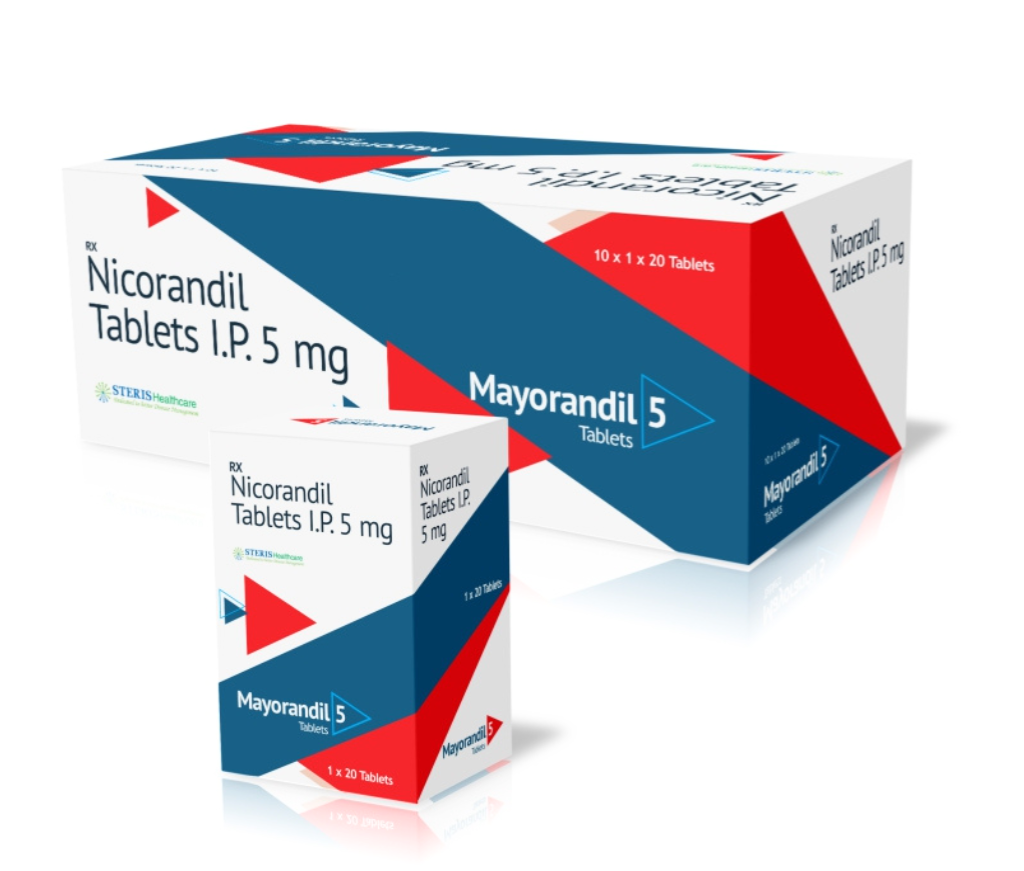
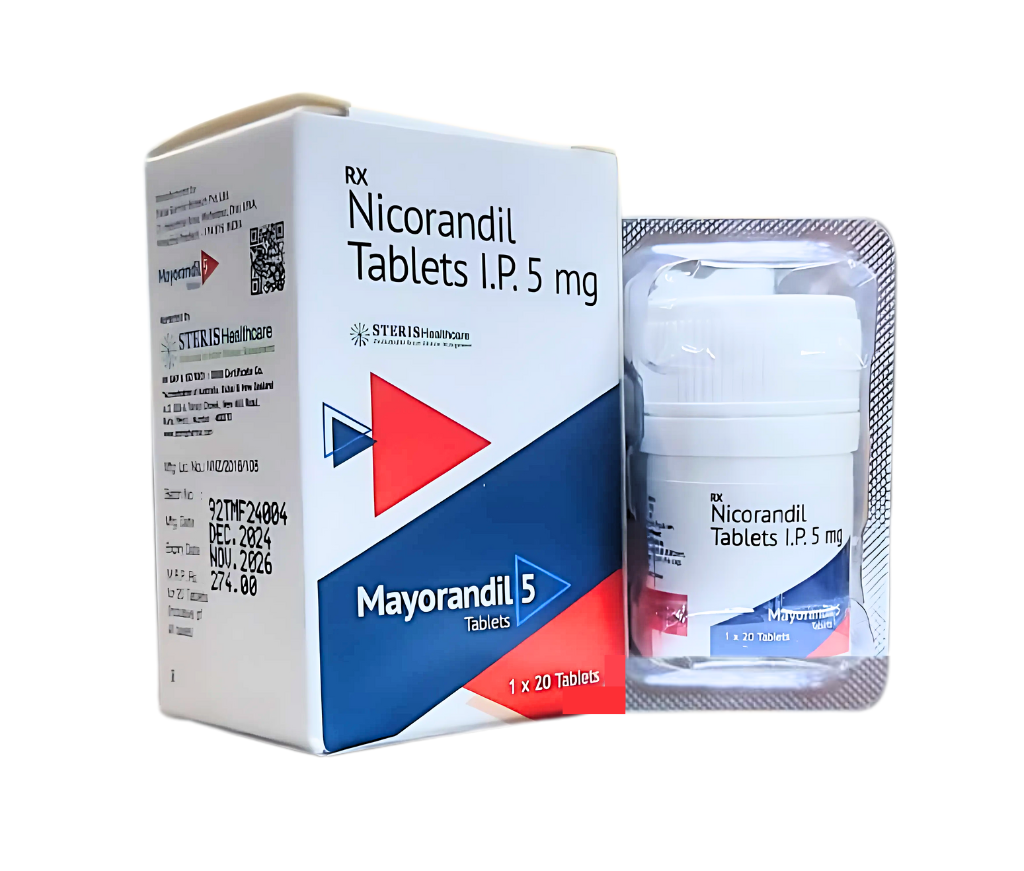


MAYORANDIL 5
 Item requires a valid prescription
Manufactured By Steris Healthcare Pvt Ltd
Composition Nicorandil Tablets 5mg
Rs 100.00
MRP Rs 256.80
(61% OFF)
Includes all taxes
Package SIZE
( For 20 Tablet )

100% Authentic
Products

Free
Shipping*

Products
Return Policy
Description:
Nicorandil tablets 5 mg are prescription heart medicines used to help prevent and manage angina, a type of chest pain caused by reduced blood and oxygen supply to the heart muscle. Nicorandil works mainly by relaxing and widening blood vessels, helping improve blood flow and oxygen delivery to the heart. It may be prescribed when other anti-anginal medicines are not suitable or have not provided adequate control.
Nicorandil belongs to a distinctive group of anti-anginal medicines because it has both potassium-channel-activating and nitrate-like vasodilator activity. This combination helps reduce vascular resistance and improves coronary blood flow.
Because nicorandil is a prescription medicine, the 5 mg strength should be taken only according to the dose prescribed by a doctor or cardiologist. The appropriate dose depends on the patient's symptoms, response to treatment, other medicines, blood pressure, kidney function and risk of adverse effects.
What Are Nicorandil Tablets 5 mg Used For?
The primary use of nicorandil tablets 5 mg is the prevention and long-term management of stable angina. Angina occurs when the heart muscle does not receive enough oxygen-rich blood, commonly because the coronary arteries cannot supply sufficient blood during increased demand.
Nicorandil helps by relaxing blood vessels and increasing blood and oxygen supply to the heart. It is generally used as a preventive treatment rather than as the medicine to rely on for an acute, sudden angina attack.
Doctors may consider nicorandil when commonly used treatments such as beta blockers or calcium-channel blockers are unsuitable, insufficient, or not tolerated. NHS guidance describes nicorandil as a second-line option for some people with angina.
Common therapeutic purpose
Nicorandil may be prescribed to:
-
Help prevent recurrent angina symptoms
-
Reduce the frequency of chest-pain episodes
-
Improve blood flow to the heart
-
Increase oxygen delivery to cardiac muscle
-
Provide longer-term protection against angina symptoms
-
Complement other cardiovascular medicines when prescribed
It is important to understand that nicorandil does not remove the underlying cause of coronary artery disease. It helps control symptoms and is generally part of a broader cardiovascular treatment plan.
How Does Nicorandil 5 mg Work?
Nicorandil has a dual mechanism of action.
First, it activates ATP-sensitive potassium channels in vascular smooth muscle. This causes the muscle surrounding blood vessels to relax, resulting in vasodilation.
Second, nicorandil has a nitrate-like effect that increases cyclic GMP signaling. This further promotes vascular relaxation.
Together, these actions help widen blood vessels, decrease vascular resistance and improve coronary blood flow.
The overall effect is that the heart can receive an improved supply of oxygen while the workload placed on the cardiovascular system may be reduced.
NHS guidance states that nicorandil starts working after approximately one hour, although it can take around four to five days to reach its full effect when taken regularly.
Key Benefits of Nicorandil Tablets 5 mg
1. Helps Prevent Angina
The principal benefit of nicorandil is its ability to help prevent episodes of stable angina. Regular treatment can reduce the likelihood of recurring chest discomfort in appropriately selected patients.
It is intended for ongoing angina prevention, not as a substitute for emergency treatment when sudden severe chest pain occurs.
2. Improves Blood Flow to the Heart
By widening blood vessels, nicorandil helps improve the movement of blood and oxygen toward the heart muscle. This can help reduce the imbalance between the heart's oxygen demand and supply that contributes to angina.
3. Relaxes Blood Vessels
Nicorandil's vasodilator properties reduce resistance within blood vessels. This can make it easier for blood to circulate and may reduce the workload on the heart.
4. Can Be Used When Other Angina Treatments Are Unsuitable
Not every patient responds well to first-line anti-anginal medicines. Nicorandil may be considered when other options do not work adequately or cause troublesome adverse effects.
5. Suitable for Long-Term Angina Management When Prescribed
Nicorandil is commonly used as a long-term medicine. NHS guidance notes that it generally works best when taken regularly over the longer term. Stopping it without medical advice can allow angina symptoms to return.
Why Is Nicorandil Available as 5 mg?
The 5 mg strength can be used as a lower starting dose in some patients, particularly people who are prone to headaches or other adverse reactions.
Importantly, product strengths vary by market. NHS information describes 10 mg tablets that can be divided to provide a 5 mg dose, while Australian prescribing information describes 10 mg and 20 mg tablets and allows a lower 5 mg twice-daily starting regimen for patients prone to headache or other adverse effects. Indian medicine listings also show commercially available 5 mg nicorandil tablets.
Therefore, do not assume that every 5 mg product has the same tablet design, formulation, or storage requirements. Always follow the leaflet supplied with your particular product.
Nicorandil 5 mg Dosage
The correct dose must be determined by a healthcare professional.
Nicorandil dosing can vary according to:
-
Severity and frequency of angina
-
Individual response
-
Tolerance
-
Blood pressure
-
Age
-
Other cardiovascular medicines
-
Kidney and overall health
-
History of headaches or other adverse reactions
Official guidance describes a usual adult therapeutic regimen of 10–20 mg twice daily, with a lower starting dose of 5 mg twice daily sometimes used in patients who are prone to headaches or other adverse reactions.
This does not mean that every person taking a 5 mg tablet should take it twice daily.
Your prescription may differ, and you should never increase or decrease the dose yourself.
How to Take Nicorandil Tablets 5 mg
Take nicorandil exactly as prescribed.
Depending on the product, it can generally be taken with or without food. Swallow the tablet with water unless the product's instructions specifically say otherwise.
For consistent treatment:
-
Take it at approximately the same times each day.
-
Follow the prescribed schedule.
-
Do not take extra tablets if you miss a dose.
-
Do not stop long-term treatment suddenly without medical advice.
-
Keep your medicine in its original packaging and follow the product-specific storage instructions.
If you forget a dose, NHS guidance recommends taking it when remembered unless it is nearly time for the next dose. In that situation, skip the missed dose and continue with the regular schedule. Do not double the next dose.
Common Side Effects of Nicorandil 5 mg
Like all prescription medicines, nicorandil can cause side effects, although not everybody experiences them.
The most frequently reported effects include:
-
Headache
-
Dizziness
-
Weakness
-
Nausea or vomiting
-
Flushing
NHS guidance states that headaches are common and often improve during the first week of treatment. Dizziness can be more noticeable when starting treatment or after an increase in dose.
If dizziness occurs, sit or lie down until you feel better. Avoid driving, cycling or operating machinery while you are dizzy.
Serious Side Effects and Important Warnings
Nicorandil has several uncommon but potentially serious adverse effects that patients should know about.
Ulcers
Nicorandil can cause ulcers in areas including:
-
The mouth
-
Stomach or intestines
-
Skin
-
Eyes
-
Anal or genital areas
Persistent abdominal pain, vomiting, loss of appetite, blood in the stool, painful skin sores, or eye symptoms should be medically assessed.
Eye Problems
Red, painful or watery eyes can indicate an eye problem such as conjunctivitis or a corneal ulcer. These symptoms require medical attention.
Low Blood Pressure
Because nicorandil widens blood vessels, it can sometimes lower blood pressure excessively. This may cause:
-
Dizziness
-
Weakness
-
Lightheadedness
-
Fainting
Patients taking other blood-pressure-lowering medicines may require additional monitoring because combinations can increase the risk of hypotension.
Severe Allergic Reaction
Rarely, a serious allergic reaction can occur. Sudden swelling of the lips, mouth, tongue or throat, breathing difficulty or severe dizziness requires emergency medical attention.
Nicorandil and Erectile Dysfunction Medicines
One of the most important safety points is the interaction between nicorandil and phosphodiesterase-5 (PDE-5) inhibitors, which include medicines such as sildenafil and tadalafil.
Combining these medicines can cause a dangerous drop in blood pressure. NHS guidance specifically advises against taking erectile-dysfunction medicines while using nicorandil.
Always tell your doctor and pharmacist about all prescription medicines, over-the-counter products and supplements you use.
Other Nicorandil Drug Interactions
Nicorandil may interact with medicines that lower blood pressure or otherwise affect cardiovascular function.
Particular medicines requiring medical review include:
-
Blood-pressure medicines
-
Certain antidepressants
-
Muscle relaxants
-
Riociguat
-
ACE inhibitors
-
Angiotensin receptor blockers
-
Some Parkinson's medicines
-
PDE-5 inhibitors
-
Regular NSAIDs such as aspirin or ibuprofen
-
Steroid tablets
-
Potassium supplements or potassium-containing products
Some combinations may increase the risk of low blood pressure, while regular NSAID or steroid use can increase the risk of ulcers.
Never assume that an over-the-counter medicine or herbal supplement is automatically safe with nicorandil.
Who Should Take Extra Care With Nicorandil?
Tell your doctor before taking nicorandil if you have:
-
Low blood pressure
-
Kidney problems
-
Recently experienced a heart attack
-
Heart failure
-
Low potassium
-
A history of allergic reactions to medicines
-
Glucose-6-phosphate dehydrogenase deficiency
-
Diverticular disease
-
Other significant cardiovascular conditions
NHS guidance identifies these conditions as reasons a patient may need additional assessment before using nicorandil.
Is Nicorandil 5 mg Used for Sudden Chest Pain?
No. Nicorandil is primarily a preventive treatment for angina, rather than a medicine to rely on for immediate relief of a sudden angina attack.
If you experience sudden, severe, new or worsening chest pain, follow your personal emergency plan and seek urgent medical attention rather than assuming that taking an additional nicorandil tablet will resolve the episode.
Can You Buy Nicorandil Tablets 5 mg Online?
Nicorandil 5 mg tablets are prescription medicines in markets where the 5 mg formulation is available. Current Indian pharmacy listings show 5 mg nicorandil products as prescription medicines.
If purchasing or obtaining the medicine through an online pharmacy, use a licensed and legitimate pharmacy and provide a valid prescription where required. Avoid websites that offer prescription medicines without appropriate medical oversight or make claims about guaranteed cardiovascular results.
The correct product, strength, manufacturer, storage conditions and authenticity should always be verified.
Conclusion: Nicorandil Tablets 5 mg
Nicorandil tablets 5 mg are prescription anti-anginal medicines used to help prevent and manage stable angina. Their principal action is to relax and widen blood vessels, improving blood and oxygen supply to the heart.
A 5 mg dose may be used as a lower starting dose in selected patients, particularly those susceptible to headaches or other adverse reactions, although exact dosing must be individualized by a healthcare professional.
The most common side effects are headache, dizziness, weakness, nausea and flushing. More serious problems—including gastrointestinal, skin or eye ulcers, severe hypotension and allergic reactions—require prompt medical assessment.
For safe use, take nicorandil exactly as prescribed, do not stop it suddenly without medical advice, and tell your healthcare professional about every medicine and supplement you use. In particular, do not combine nicorandil with erectile-dysfunction medicines such as sildenafil or tadalafil unless a qualified healthcare professional specifically determines a safe alternative plan, because the combination can cause a severe fall in blood pressure.
Frequently Asked Questions
1. What are nicorandil tablets 5 mg used for?
Nicorandil 5 mg is used to help prevent and manage stable angina, or chest pain caused by reduced blood flow to the heart.
2. What is nicorandil 5 mg?
Nicorandil 5 mg is a prescription anti-anginal medicine containing 5 mg of nicorandil as the active ingredient.
3. How does nicorandil 5 mg work?
It relaxes and widens blood vessels through potassium-channel activation and nitrate-like activity, helping improve blood and oxygen supply to the heart.
4. Is nicorandil 5 mg a blood thinner?
No. Nicorandil is not an anticoagulant or blood thinner. It is a vasodilating anti-anginal medicine.
5. Is nicorandil 5 mg used for high blood pressure?
Its primary use is angina, not routine treatment of hypertension. Because it widens blood vessels, it can lower blood pressure as an effect of treatment.
6. What are the common side effects of nicorandil 5 mg?
Headache, dizziness, weakness, nausea, vomiting and flushing are among the commonly reported side effects.
7. Does nicorandil cause headaches?
Yes. Headache is a common side effect, particularly when treatment is started. It often improves after the first week.
8. Can nicorandil 5 mg cause dizziness?
Yes. Dizziness can occur because nicorandil relaxes blood vessels and may lower blood pressure. Avoid driving or operating machinery if you feel dizzy.
9. Can I take nicorandil 5 mg with food?
Nicorandil can generally be taken with or without food, although you should follow the instructions supplied with your specific product.
10. How often should I take nicorandil 5 mg?
The frequency depends on your prescription. A lower 5 mg twice-daily starting regimen may be used in selected patients, but your doctor should determine your individual dose.
11. Can I stop taking nicorandil when my chest pain improves?
Do not stop nicorandil without speaking with your doctor. Stopping treatment can cause angina symptoms to return.
12. Can I take sildenafil with nicorandil?
No. Nicorandil should not be combined with medicines such as sildenafil or tadalafil because the combination can cause a serious fall in blood pressure.
13. Can nicorandil cause ulcers?
Yes. Nicorandil can rarely cause serious ulcers affecting the mouth, gastrointestinal tract, skin or eyes. Seek medical advice for unexplained or persistent ulceration.
14. Is nicorandil 5 mg safe for long-term use?
Nicorandil can be used long term when prescribed and monitored appropriately. However, serious adverse effects can occur, so persistent or unusual symptoms should be reported to a healthcare professional.
15. How quickly does nicorandil start working?
Nicorandil begins working after approximately one hour, while its full effect may take around four to five days with regular treatment.
16. What should I do if I miss a nicorandil dose?
Take the missed dose when you remember unless it is nearly time for the next dose. If the next dose is due soon, skip the missed dose. Do not take two doses together.
17. Can nicorandil lower blood pressure?
Yes. Because nicorandil widens blood vessels, it can cause low blood pressure and symptoms such as dizziness or weakness in some people.
18. Can I drink alcohol while taking nicorandil?
Alcohol may worsen dizziness and low-blood-pressure symptoms. Discuss alcohol consumption with your doctor or pharmacist, particularly when starting treatment.
19. Who should not take nicorandil 5 mg?
Nicorandil may not be suitable for people with certain conditions, including significant low blood pressure, some kidney problems, recent heart attack, heart failure, low potassium or a history of certain reactions. Your doctor should assess suitability before prescribing.
20. Is nicorandil 5 mg available online?
In markets where 5 mg tablets are available, nicorandil is sold as a prescription medicine through authorized pharmacies. Use a legitimate pharmacy and a valid prescription where required.
21. Is nicorandil 5 mg the same as a nitrate?
Nicorandil has nitrate-like vasodilator activity, but it is pharmacologically distinct from conventional organic nitrates because it also activates potassium channels.
22. Can nicorandil be taken with aspirin?
The combination may be prescribed in some cardiovascular treatment plans, but regular NSAID use can increase the risk of ulcers with nicorandil. Ask your doctor before taking aspirin or other NSAIDs regularly.
23. What happens if I take too much nicorandil?
An overdose may cause excessive blood-pressure reduction, dizziness, weakness, rapid or irregular heartbeat and other symptoms. Seek urgent medical advice if you take more than prescribed.
24. Is nicorandil 5 mg suitable for children?
Nicorandil is generally not recommended for children because safety and effectiveness have not been established for pediatric use.
25. What should I do if I develop severe chest pain while taking nicorandil?
Do not take additional nicorandil doses unless your doctor has specifically instructed you to do so for that situation. Follow your prescribed emergency angina plan and seek urgent medical attention for severe, new or worsening chest pain.