


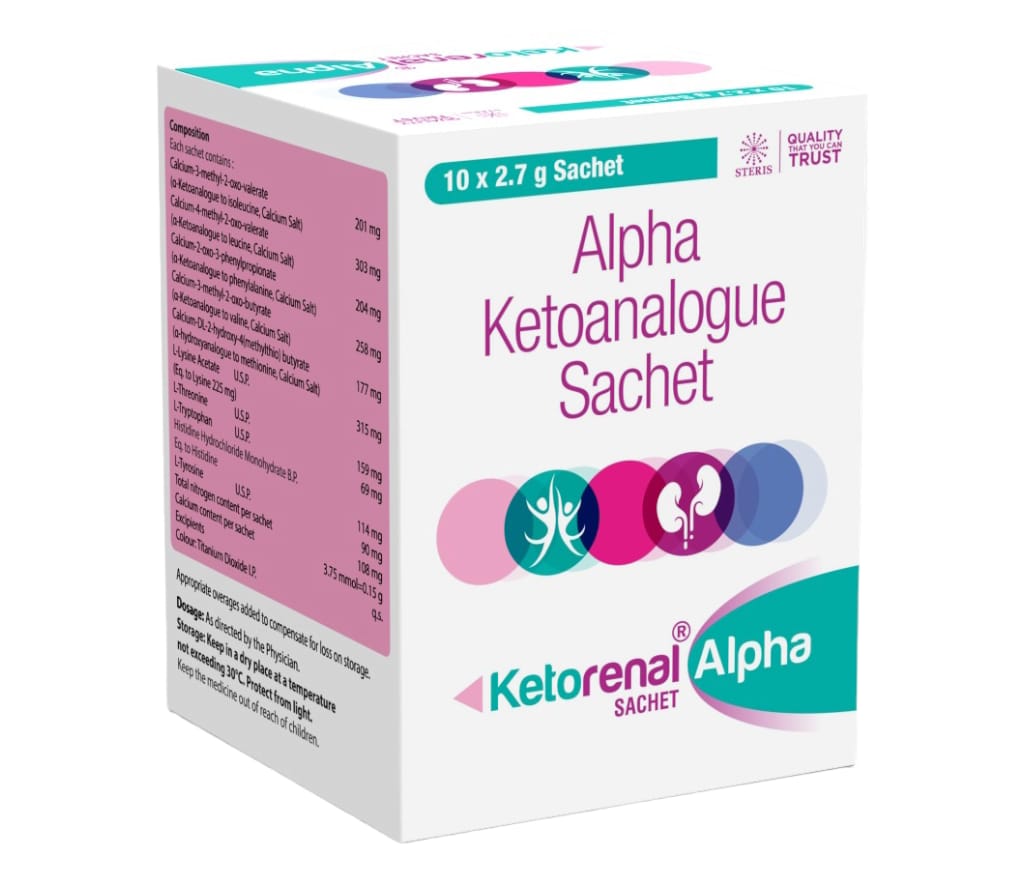
KETORENAL ALPHA SACHET
 Item requires a valid prescription
Manufactured By Steris Healthcare Pvt Ltd
Composition Alpha Ketoanalogue Sachet
Rs 60.00
MRP Rs 118.00
(49% OFF)
Includes all taxes
Package SIZE
( For 10x2.7 gram )

100% Authentic
Products

Free
Shipping*

Products
Return Policy
Description:
Alpha ketoanalogue sachet is a specialized nutritional therapy used under medical supervision for selected people with chronic kidney disease (CKD), particularly those following a prescribed protein-restricted diet. It contains keto or hydroxy analogues of essential amino acids and, depending on the specific product, may also contain essential amino acids and calcium salts.
Unlike an ordinary nutritional supplement, alpha-ketoglutarate therapy is generally used as part of a doctor-supervised renal nutrition plan. Its purpose is to help provide building blocks for protein synthesis while limiting additional nitrogen intake, which can be important when kidney function is significantly reduced.
If you are searching for alpha ketoanalogue sachet uses, benefits, side effects, dosage, price, composition, or how to buy alpha ketoanalogue sachet online in India, this guide explains the key information to consider before purchasing or using the product.
What Is an Alpha Ketoanalogue Sachet?
An alpha ketoanalogue sachet is a nutritional formulation designed to provide nitrogen-free or low-nitrogen precursors related to essential amino acids.
When kidney function is impaired, the body's handling and elimination of nitrogen-containing waste products can become less efficient. Protein restriction may be recommended for certain patients, but restricting protein too much can create a risk of inadequate nutrition.
Keto analogues are designed to help address this nutritional balance. After absorption, ketoanalogues can undergo transamination, using nitrogen from other amino acids to form essential amino acids. This can provide substrates for protein synthesis without introducing the same nitrogen load as directly supplying equivalent amounts of amino acids.
Product formulations vary. For example, some Indian alpha-ketoanalogue formulations contain calcium salts of ketoanalogues along with amino acids such as lysine, threonine, tryptophan, histidine, and tyrosine. Therefore, buyers should always check the exact composition printed on the product packaging rather than assuming that every alpha ketoanalogue sachet has an identical formula.
Alpha Ketoanalogue Sachet Uses
The primary alpha ketoanalogue sachet use is nutritional management in selected patients with chronic kidney disease, especially when a healthcare professional has prescribed a controlled or protein-restricted diet.
It may be recommended to:
- Support nutritional requirements during a prescribed low-protein diet.
- Provide precursors for essential amino acids.
- Help support protein synthesis while limiting nitrogen intake.
- Help reduce the nutritional consequences of inadequate protein intake.
- Support nutritional status in selected patients with advanced kidney impairment.
- Form part of a comprehensive renal nutrition strategy.
Some clinical product references describe alpha ketoanalogue therapy for patients with advanced CKD and significantly reduced glomerular filtration, but the appropriate patient selection and dietary protein target should be determined individually by the treating clinician.
How Does Alpha Ketoanalogue Work?
The mechanism is based on nitrogen conservation and amino-acid metabolism.
Ketoanalogues are structurally related to essential amino acids but lack the amino group's nitrogen. In the body, they can receive nitrogen through metabolic reactions and be converted into corresponding amino acids.
This mechanism can help the body obtain substrates needed for protein synthesis while potentially generating less additional nitrogenous waste than an equivalent intake of intact amino acids.
For people with reduced kidney function, this nutritional approach may help balance two competing goals:
adequate nutrition and reduced nitrogen burden.
However, alpha ketoanalogue therapy should not be interpreted as a medicine that directly repairs damaged kidneys. It is a nutritional intervention used as part of an overall CKD management plan.
Key Benefits of Alpha Ketoanalogue Sachet
1. Supports nutrition during protein restriction
One of the principal benefits is nutritional support for patients who have been advised to follow a controlled protein intake.
2. Supplies essential amino acid precursors
Ketoanalogues can be converted into essential amino acids through metabolic pathways, helping provide substrates needed for protein metabolism.
3. Helps limit additional nitrogen load
Because ketoanalogues do not contain the amino nitrogen present in conventional amino acids, they can be used in nutritional strategies intended to limit nitrogenous waste production.
4. Helps support protein metabolism
By supplying amino-acid precursors, alpha ketoanalogue therapy may support protein synthesis and help reduce the nutritional consequences of excessive protein restriction.
5. May help support nutritional status in
Maintaining adequate nutrition is important in chronic kidney disease. Alpha ketoanalogue therapy may be used as part of a carefully designed nutritional plan to help reduce the risk of protein-energy wasting.
6. May support conservative CKD management
In appropriately selected patients, ketoanalogue-based nutritional therapy can form part of conservative dietary management intended to preserve nutritional status while managing the metabolic consequences of advanced kidney disease. It should not, however, be promoted as a guaranteed way to prevent dialysis. An Apollo Pharmacy
Alpha Ketoanalogue Sachet Dosage
There is no universal alpha ketoanalogue sachet dosage that is suitable for every patient.
The appropriate amount depends on factors such as
- Kidney function and CKD stage
- Body weight
- Dietary protein intake
- Nutritional status
- Laboratory results
- Calcium levels
- Other medicines and supplements
- The exact formulation of the sachet
Some formulations may be taken during meals or according to a specific schedule, while directions can differ between products. For this reason, patients should follow the dosage instructions printed on their specific product and the recommendation of their doctor or renal dietitian. An Apollo Pharmacy +1
Do not increase the number of sachets simply because you believe more protein support will produce better results.
How to Take Alpha Ketoanalogue Sachet
The exact method depends on the formulation.
For a powder sachet, follow the manufacturer's directions regarding dilution and administration. Some products are designed to be consumed orally after being mixed as directed.
Take the product consistently according to the prescribed schedule and preferably as part of the diet plan provided by your healthcare team.
An important point is that alpha ketoanalogue therapy works in conjunction with appropriate dietary management. Taking the sachet while ignoring a prescribed protein or calorie plan may reduce the intended nutritional benefit.
Alpha Ketoanalogue Sachet Side Effects
Alpha ketoanalogue products are generally intended to be used under medical supervision, but side effects can occur.
Potential side effects include:
- Nausea
- Vomiting
- Abdominal discomfort
- Bloating
- Constipation
- Gastrointestinal upset
- Increased blood calcium levels (hypercalcaemia)
Increased calcium is particularly relevant because many formulations contain calcium salts. Current medicine references identify elevated blood calcium as an important potential adverse effect.
If you experience persistent nausea, vomiting, unusual weakness, confusion, significant abdominal symptoms, or other concerning changes, contact your healthcare professional.
Hypercalcaemia and Alpha-Ketoanalogue Sachet
People taking alpha ketoanalogue formulations should be aware of the possibility of high calcium levels, particularly if the product contains calcium salts or if the person is also taking calcium-containing medicines or supplements.
Symptoms of significantly elevated calcium can include:
- Nausea or vomiting
- Constipation
- Muscle weakness
- Excessive tiredness
- Confusion
- Other metabolic symptoms
Doctors may recommend blood tests to monitor calcium and other relevant laboratory values during therapy, particularly in patients with advanced CKD or those taking other calcium-containing products. An Apollo Pharmacy
Alpha Ketoanalogue Sachet Drug Interactions
Because formulations can contain calcium salts, interactions with certain medicines are possible.
Calcium-containing products may interfere with the absorption of some medicines, including certain antibiotics and mineral preparations. Your doctor or pharmacist may recommend separating administration times when appropriate. An Apollo Pharmacy +1
Before using an alpha-ketoglucoside sachet, tell your healthcare professional about:
- Calcium supplements
- Iron supplements
- Antibiotics
- Phosphate-related medicines
- Vitamin D products
- Other kidney medicines
- Prescription medicines
- OTC medicines
- Herbal or nutritional supplements
Do not assume that a product marketed as a nutritional supplement is automatically free from drug interactions.
Who Should Avoid or Use Caution With Alpha Ketoanalogue?
Medical supervision is particularly important if you have:
- High blood calcium levels
- Kidney disease with complex metabolic abnormalities
- Disorders affecting amino-acid metabolism
- Conditions requiring calcium restriction
- Multiple nutritional supplements or calcium-containing medicines
Pregnant or breastfeeding individuals should discuss use with their healthcare professional before starting treatment.
The exact contraindications and precautions depend on the formulation, so the product label should always be checked.
Buying Alpha Ketoanalogue Sachet Online in India
If your doctor has recommended an alpha ketoanalogue sachet and you are planning to buy it online, verify the product before placing an order.
Buyer checklist
- Check the composition: Different brands can contain different combinations of ketoanalogues and amino acids.
- Confirm the dosage form: Make sure you are buying a sachet rather than a tablet if your prescription specifies a sachet.
- Check the pack size: Price comparisons can be misleading when pack quantities differ.
- Verify manufacturer details: Look for the manufacturer/marketer printed on the package.
- Check batch number and expiry date: Do not use an expired or damaged product.
- Buy from a reputable pharmacy: This helps reduce the risk of receiving improperly stored or counterfeit products.
- Compare like-for-like pricing: Compare the same composition, strength, and number of sachets.
- Follow prescription advice: Your doctor may recommend a specific brand or composition based on your nutritional requirements.
For example, current Indian pharmacy listings show Ketoalfa Sachet 2.7 g as a prescription product marketed by Alniche Life Sciences, illustrating that specific formulations and pack information can vary between products. An Apollo Pharmacy
Some Indian supplier listings also show alpha ketoanalogue sachets at different prices and minimum order quantities, reinforcing the importance of confirming whether a listing is intended for retail consumers or bulk procurement. Tradeindia
Alpha Ketoanalogue Sachet Price in India
The alpha ketoanalogue sachet price is not uniform across India.
Cost can vary depending on:
- Brand
- Composition
- Sachet size
- Pack quantity
- Manufacturer
- Pharmacy
- Discounts
- Location
- Retail versus bulk purchasing
For an accurate comparison, compare the same composition and pack size rather than choosing solely according to the displayed price.
Is Alpha Ketoanalogue Sachet a Kidney Medicine?
Alpha-ketoleucine is better described as a renal nutritional therapy rather than a conventional kidney medicine that directly reverses kidney damage.
It is used in selected CKD patients to support nutritional management, especially alongside controlled protein intake. It should therefore be considered one component of a broader kidney-care plan involving medical treatment, dietary management, blood-pressure control, diabetes management when applicable, laboratory monitoring, and other measures recommended by the healthcare team.
Frequently Asked Questions
1. What is an alpha ketoanalogue sachet used for?
The alpha ketoanalogue sachet is used as nutritional therapy in selected patients with chronic kidney disease, particularly those following a medically prescribed protein-restricted diet. It provides keto/hydroxy analogues that can be converted into essential amino acids while helping limit additional nitrogen intake.
2. What are the main benefits of the alpha ketoanalogue sachet?
The main benefits are supporting protein metabolism, providing essential amino acid precursors, and helping maintain nutritional status during a prescribed low-protein diet. It is used as part of comprehensive CKD nutritional management rather than as a standalone cure for kidney disease.
3. What are the side effects of the alpha-ketoglutarate sachet?
Possible side effects include nausea, vomiting, abdominal discomfort, constipation, and increased blood calcium levels. The risk can depend on the specific formulation and the patient's medical condition.
4. Can an alpha-ketoanalogue sachet help kidney patients?
Yes. It may be prescribed for selected people with chronic kidney disease to support nutritional management, particularly when protein intake has been restricted. It should be used according to an individualized renal diet plan.
5. Can an alpha-ketoanalogue sachet prevent dialysis?
It should not be promoted as a guaranteed way to prevent dialysis. Some patients may use ketoanalogue-based nutritional therapy as part of conservative CKD management, but whether dialysis can be delayed depends on kidney function, disease progression, symptoms, and many other clinical factors.
6. Should an alpha-ketoanalogue sachet be taken with a low-protein diet?
In many clinical uses, yes—the therapy is intended to complement a medically prescribed protein-restricted diet. The appropriate amount of protein restriction should be determined by a nephrologist or renal dietitian because excessively restricting protein can cause malnutrition.
7. Can an alpha-ketoanalogue sachet increase calcium levels?
Yes. Some formulations contain calcium salts, and hypercalcaemia is a recognized potential adverse effect. Patients may need calcium monitoring, especially if they also take calcium or vitamin-D products.
8. Can I buy an alpha-ketoanalogue sachet online?
Yes, alpha ketoanalogue sachet products are listed by Indian online pharmacies and suppliers. Product availability, composition, pack size, and pricing vary. Check the exact formulation and purchase from a reliable source. An Apollo Pharmacy +1
9. Is an alpha-ketoanalogue sachet the same as an ordinary protein supplement?
No. Alpha ketoanalogue therapy is specifically formulated for nutritional management in selected kidney patients and works differently from conventional protein supplements. It should be used according to a renal diet plan rather than as a general bodybuilding or protein supplement.
10. Can I take calcium supplements with an alpha-ketoglutarate sachet?
Do not add calcium supplements without discussing them with your doctor. Some alpha ketoanalogue formulations already contain calcium salts, and additional calcium may increase the risk of high blood calcium levels. An Apollo Pharmacy
Conclusion
An alpha-ketoglutarate sachet is a specialized renal nutritional therapy used for selected patients with chronic kidney disease, particularly when a healthcare professional has prescribed a controlled protein intake. Its key nutritional role is to provide keto/hydroxy analogues that can participate in essential amino-acid production while helping limit additional nitrogen intake.
The potential benefits include supporting protein metabolism, maintaining nutritional status, and helping patients follow an appropriate low-protein renal diet. However, an alpha-ketoglutarate sachet is not a replacement for medical CKD treatment and should not be marketed as a guaranteed cure or a guaranteed method of avoiding dialysis.

