


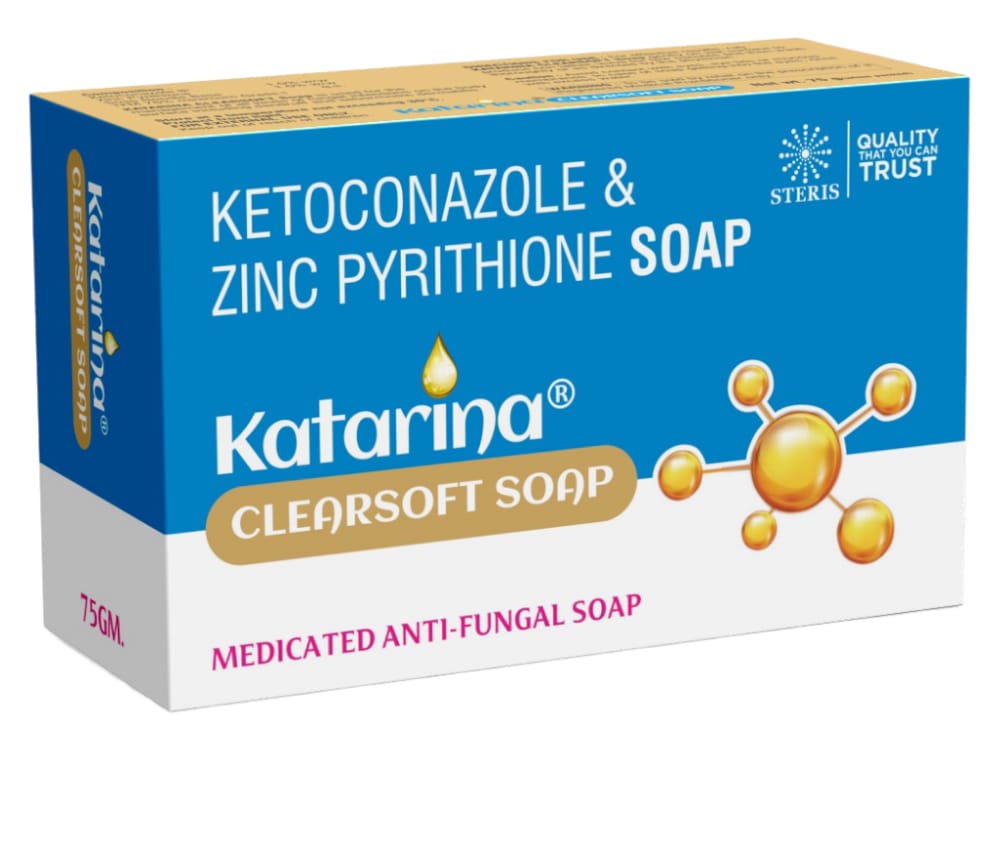
KATARINA CLEARSOFT SOAP
 Item requires a valid prescription
Manufactured By Steris Healthcare Pvt Ltd
Composition Ketoconazole and Zinc Pyrithione soap
Rs 59.19
MRP Rs 84.55
(30% OFF)
Includes all taxes
Package SIZE
( For 75 gm )

100% Authentic
Products

Free
Shipping*

Products
Return Policy
Description:
Ketoconazole and Zinc Pyrithione Soap is a medicated topical cleansing product that combines two active ingredients commonly used to manage fungal and dandruff-related skin conditions. Depending on the specific product, formulations may contain ketoconazole with zinc pyrithione at different strengths, so consumers should check the product label and follow the directions provided by a healthcare professional or manufacturer. Current Indian product listings include combinations such as ketoconazole 1% with zinc pyrithione 1% and ketoconazole 2% with zinc pyrithione 1%.
Ketoconazole is an antifungal medicine that works by slowing the growth of fungi. Topical ketoconazole is used for several fungal skin infections and is also used in some formulations for dandruff and seborrheic dermatitis. Zinc pyrithione is an established anti-dandruff active ingredient; U.S. regulations recognize pyrithione zinc at specified concentrations for products intended to control dandruff.
For shoppers, the key question is not simply whether a Ketoconazole and Zinc Pyrithione Soap is available online, but whether the product is appropriate for the particular skin problem. Persistent, severe, spreading, painful, or recurrent rashes should be evaluated by a dermatologist because not every itchy or scaly rash is fungal.
What Is Ketoconazole and Zinc Pyrithione Soap?
Ketoconazole and Zinc Pyrithione Soap is a topical medicated soap containing two active ingredients with antifungal or anti-dandruff properties.
Ketoconazole belongs to the imidazole class of antifungal medicines. It works by slowing the growth of fungi responsible for certain infections. Topical ketoconazole is used for conditions such as ringworm, athlete's foot, jock itch, tinea versicolor, and certain yeast-related skin infections, depending on the formulation.
Zinc pyrithione is commonly used in anti-dandruff and seborrheic-dermatitis products. Current DailyMed labeling for a zinc pyrithione shampoo lists it as an active ingredient for relieving scalp itching, irritation, flaking, and redness associated with dandruff.
Together, these ingredients are used in some medicated cleansing products marketed for fungal skin problems, dandruff, and related symptoms. However, the approved or labeled uses can vary by country and individual product, so consumers should read the packaging rather than assuming every combination soap treats every fungal condition.
What Is Ketoconazole and Zinc Pyrithione Soap Used For?
The combination may be recommended for certain fungal skin infections and dandruff-related conditions, depending on the formulation and medical advice.
Potential uses can include:
-
Fungal skin infections
-
Dandruff-related symptoms
-
Seborrheic dermatitis-related scaling
-
Itching associated with certain fungal conditions
-
Flaking and irritation associated with dandruff
-
Some superficial yeast-related skin problems
Topical ketoconazole has established uses against several fungal infections, while zinc pyrithione is used in anti-dandruff products.
Importantly, not every rash is caused by fungus. Eczema, psoriasis, bacterial infections, contact dermatitis, folliculitis, and other skin disorders can produce similar symptoms. Using an antifungal soap for the wrong condition may delay the correct diagnosis.
How Does Ketoconazole and Zinc Pyrithione Soap Work?
The two active ingredients serve complementary purposes.
Ketoconazole
Ketoconazole is an antifungal agent that interferes with fungal growth. MedlinePlus explains that ketoconazole belongs to the imidazole antifungal class and works by slowing the growth of fungi that cause infection.
Zinc Pyrithione
Zinc pyrithione is used in topical anti-dandruff products to help control symptoms such as flaking, itching, irritation, and redness associated with dandruff. A current DailyMed label for a 1% zinc pyrithione shampoo identifies these purposes and directs users to avoid eye contact.
The combination therefore provides an antifungal-focused cleansing approach while also targeting dandruff-associated symptoms in products specifically formulated for those purposes.
Key Benefits of Ketoconazole and Zinc Pyrithione Soap
1. Combines Two Active Ingredients
One potential advantage is the combination of ketoconazole and zinc pyrithione in a single topical product. Instead of using separate products, a combination soap can provide both active ingredients during the same cleansing routine.
2. Supports Fungal Skin Care
Ketoconazole is an established topical antifungal. It can help manage susceptible fungal infections when used in an appropriate formulation and according to professional or label directions.
3. Helps Manage Dandruff-Related Symptoms
Zinc pyrithione is used in anti-dandruff products to relieve symptoms including scalp flaking, itching, irritation, and redness.
4. Convenient Topical Application
A medicated soap can be convenient for people who need a wash-off topical product for affected areas. However, convenience should not replace correct diagnosis or proper use.
5. May Help Reduce Itching Associated With the Underlying Condition
When itching is caused by a susceptible fungal or dandruff-related condition, controlling the underlying problem may reduce associated discomfort. Itching itself, however, does not prove that a fungal infection is present.
How to Use Ketoconazole and Zinc Pyrithione Soap
Always follow the specific instructions on the product packaging or the directions provided by your healthcare professional. Different formulations may have different concentrations, contact times, and recommended frequencies.
A typical topical cleansing routine may involve:
-
Wetting the affected area.
-
Applying the medicated soap as directed.
-
Gently creating a lather without aggressively scrubbing the skin.
-
Following the product's specified contact time, if applicable.
-
Rinsing thoroughly with clean water.
-
Drying the skin gently.
-
Washing hands after use unless the hands themselves are the treatment area.
Do not use more frequently than recommended simply because symptoms are severe. More product does not necessarily mean faster improvement and may increase irritation.
For topical ketoconazole products, MedlinePlus advises using the medicine exactly as directed and avoiding contact with the eyes and mouth.
Ketoconazole and Zinc Pyrithione Soap Side Effects
Most people can use topical products without major problems when they are appropriate for their condition, but irritation can occur.
Potential side effects may include:
-
Dryness
-
Itching
-
Burning or stinging
-
Redness
-
Skin irritation
-
Increased sensitivity at the application site
-
Rash or other local reactions
MedlinePlus lists dry skin, itching, irritation, and stinging at the application site among possible adverse effects associated with topical ketoconazole.
A zinc pyrithione product can also cause local irritation in some users. The product label should be checked for its specific warnings.
When Should You Stop Using It?
Stop using the product and seek medical advice if you develop a severe reaction, significant swelling, widespread rash, hives, breathing difficulty, or other symptoms suggesting an allergic reaction.
Also consult a healthcare professional if the skin condition becomes worse or fails to improve as expected. Current zinc pyrithione labeling specifically advises users to stop and ask a doctor if the condition worsens or does not improve with regular use as directed.
Who Should Be Careful With This Soap?
Extra care may be appropriate if you have:
-
Very sensitive or damaged skin
-
Open wounds or broken skin
-
A history of allergy to either active ingredient
-
A persistent or unexplained rash
-
Severe inflammation
-
A skin condition diagnosed as something other than a fungal infection
Avoid getting the soap into the eyes, mouth, or other sensitive areas unless the product is specifically designed for that area. If accidental eye exposure occurs, rinse thoroughly with water.
Children, pregnant individuals, and people who are breastfeeding should ask a healthcare professional whether the particular product is appropriate before use.
Is Ketoconazole and Zinc Pyrithione Soap Good for Fungal Infections?
It can be appropriate for certain fungal skin conditions when the formulation is intended for that use and the diagnosis is correct.
Ketoconazole has established topical antifungal applications, including certain dermatophyte and yeast infections.
However, the phrase “fungal infection” covers many different conditions, and treatment varies according to the organism, location, severity, and patient's circumstances.
For example, a persistent ring-shaped rash may require a different treatment approach from seborrheic dermatitis. A rash that resembles a fungal infection may instead be eczema or another dermatological condition.
If symptoms persist despite appropriate use, professional assessment is more useful than repeatedly switching medicated soaps.
Is It Suitable for Dandruff?
Zinc pyrithione is an established anti-dandruff active ingredient. Current DailyMed information for a 1% zinc pyrithione shampoo describes its use for symptoms associated with dandruff, including itching, irritation, flaking, and redness.
Ketoconazole is also used in certain anti-dandruff and seborrheic dermatitis formulations. MedlinePlus notes that topical ketoconazole products may be used for dandruff and seborrheic dermatitis in some circumstances.
However, a soap is not necessarily interchangeable with a medicated shampoo. The scalp may require a formulation specifically designed for scalp application and appropriate contact time.
Buying Ketoconazole and Zinc Pyrithione Soap Online
If you are searching for Ketoconazole and Zinc Pyrithione Soap online, compare the actual product label rather than relying only on the product name.
Before purchasing, check:
-
Ketoconazole concentration
-
Zinc pyrithione concentration
-
Product size
-
Manufacturer or marketer
-
Batch and expiry information
-
Storage instructions
-
Prescription status where applicable
-
Intended use
-
Directions and warnings
-
Seller or pharmacy authenticity
Current Indian listings demonstrate why checking the concentration matters: some combination soaps are listed as ketoconazole 1% plus zinc pyrithione 1%, while others contain ketoconazole 2% plus zinc pyrithione 1%.
Do not assume that two products with similar names have identical strengths.
What Is the Difference Between Ketoconazole Soap and Ketoconazole + Zinc Pyrithione Soap?
A ketoconazole-only soap contains one principal antifungal active ingredient. A combination soap contains ketoconazole plus zinc pyrithione.
The combination may be attractive when the intended treatment involves both fungal control and dandruff-related symptoms. However, more active ingredients do not automatically make a product better for every person or every skin condition.
The appropriate product depends on the diagnosis and the specific formulation.
Can Ketoconazole and Zinc Pyrithione Soap Be Used Every Day?
Not necessarily.
The correct frequency depends on the exact formulation, concentration, condition being treated, and product instructions. Using a medicated soap more often than recommended can increase dryness or irritation without improving results.
Follow the label or your healthcare professional's instructions rather than creating an independent long-term schedule.
Frequently Asked Questions
1. What is Ketoconazole and Zinc Pyrithione Soap used for?
It is a medicated topical cleansing product used in some formulations for fungal skin conditions and dandruff-related symptoms.
2. What are the main benefits of Ketoconazole and Zinc Pyrithione Soap?
The main potential benefits are antifungal activity from ketoconazole and dandruff-related symptom control associated with zinc pyrithione.
3. Does Ketoconazole and Zinc Pyrithione Soap treat fungal infections?
It may help treat susceptible fungal skin infections when the specific product is indicated for that condition and used correctly.
4. Is Ketoconazole and Zinc Pyrithione Soap good for dandruff?
Products containing zinc pyrithione are used to control dandruff symptoms, while ketoconazole is also used in certain dandruff and seborrheic dermatitis treatments.
5. Can I use Ketoconazole and Zinc Pyrithione Soap on my face?
Only use it on the face if the product label or a healthcare professional specifically recommends facial use. Facial skin can be more sensitive and may become irritated.
6. Can Ketoconazole and Zinc Pyrithione Soap be used on the scalp?
A product specifically formulated for scalp use may be appropriate, but a medicated soap should not automatically be substituted for a ketoconazole shampoo.
7. How often should I use Ketoconazole and Zinc Pyrithione Soap?
Use it according to the specific product instructions or your healthcare professional's recommendation. Different formulations can have different directions.
8. Does Ketoconazole and Zinc Pyrithione Soap stop itching?
It may reduce itching when the underlying cause is a susceptible fungal or dandruff-related condition, but itching from other causes may require different treatment.
9. What are the side effects of Ketoconazole and Zinc Pyrithione Soap?
Possible local reactions include dryness, itching, burning, stinging, redness, and irritation. Topical ketoconazole is known to cause these types of application-site effects in some users.
10. Can Ketoconazole and Zinc Pyrithione Soap cause dry skin?
Yes. Medicated cleansing products can cause dryness or irritation, particularly when overused or applied to sensitive skin.
11. Can I use it on broken skin?
Do not apply it to broken, severely irritated, or damaged skin unless specifically instructed by a healthcare professional.
12. Can I use Ketoconazole and Zinc Pyrithione Soap every day?
Do not assume daily use is appropriate. Follow the directions for your particular formulation.
13. How long does Ketoconazole and Zinc Pyrithione Soap take to work?
The time varies according to the condition, severity, formulation, and individual response. If symptoms do not improve within the period specified on the product label, seek medical advice.
14. Can I use this soap for ringworm?
Ketoconazole is used topically for certain fungal infections such as ringworm, but the specific soap must be appropriate for that indication.
15. Can Ketoconazole and Zinc Pyrithione Soap treat seborrheic dermatitis?
Ketoconazole is used in some treatments for seborrheic dermatitis, while zinc pyrithione is used in anti-dandruff products. The suitability of a particular soap depends on its formulation and intended use.
16. Is Ketoconazole and Zinc Pyrithione Soap safe?
It can be safe when an appropriate product is used correctly, but topical irritation and allergic reactions are possible. Always follow the product directions.
17. Can pregnant women use Ketoconazole and Zinc Pyrithione Soap?
Pregnant or breastfeeding individuals should check with a healthcare professional before using a medicated product, particularly when the formulation and treatment area have not been evaluated for their specific situation.
18. Can children use Ketoconazole and Zinc Pyrithione Soap?
Do not assume that an adult medicated soap is suitable for children. Check the product's age restrictions and ask a pediatrician or pharmacist when appropriate.
19. What should I do if the soap gets into my eyes?
Rinse the eyes thoroughly with clean water. Seek medical advice if irritation persists or significant symptoms develop. Product labeling for topical antifungal and zinc pyrithione products advises avoiding eye contact.
20. Can I buy Ketoconazole and Zinc Pyrithione Soap online?
Availability depends on the country, product, and prescription regulations. When buying online, verify the formulation, manufacturer, expiry information, seller authenticity, and whether a prescription is required.
21. Is Ketoconazole 2% plus Zinc Pyrithione 1% stronger than Ketoconazole 1% plus Zinc Pyrithione 1%?
The ketoconazole concentration is higher, but “stronger” does not mean automatically better or more suitable. The correct concentration depends on the product, condition, and professional advice.
22. Can I use another antifungal cream with this soap?
Do not automatically combine multiple antifungal treatments. Ask a pharmacist or healthcare professional whether combination treatment is appropriate for your specific condition.
23. What if my rash gets worse after using the soap?
Stop using the product and seek medical advice, particularly if you develop severe irritation, swelling, hives, blistering, or breathing difficulty.
24. Can this soap prevent fungal infections?
It should not be treated as a guaranteed preventive product. Good hygiene, keeping susceptible areas dry, avoiding shared personal items, and addressing the underlying cause are important for reducing some infection risks.