


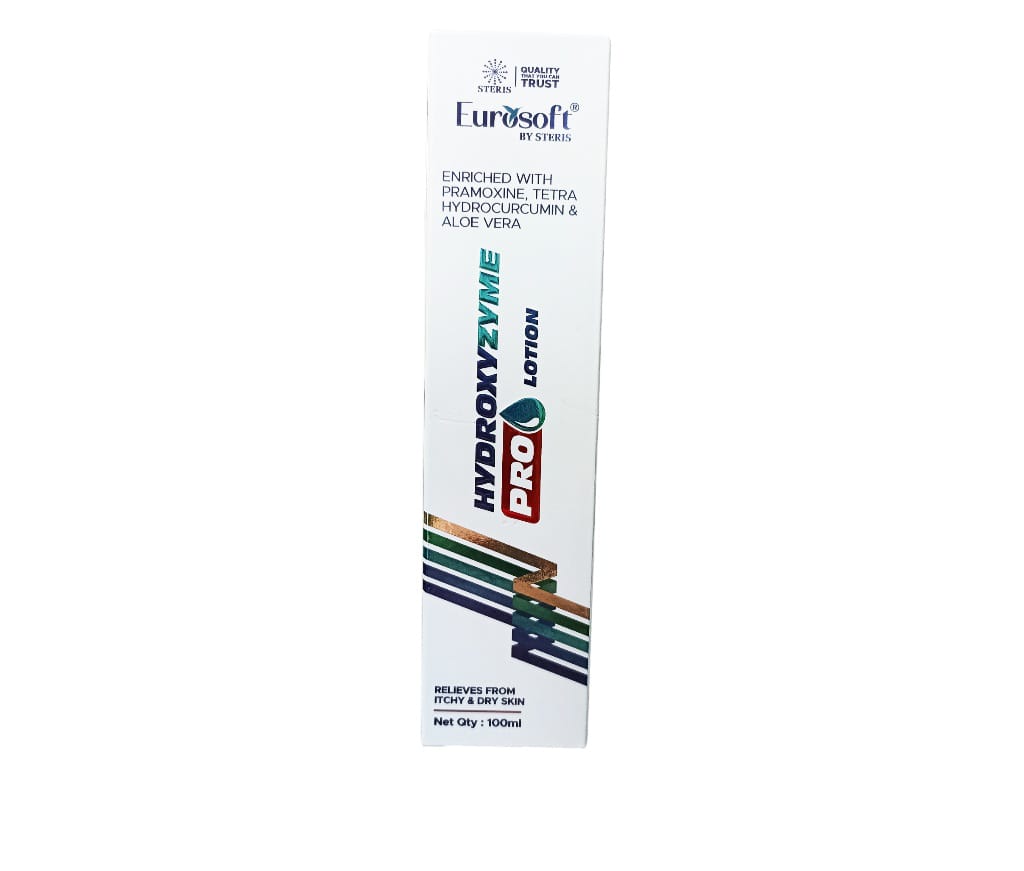
Hydroxyzyme Pro Lotion
 Item requires a valid prescription
Manufactured By Steris Healthcare Pvt Ltd
Composition Aqua / Water/ Equ, LightLiquid Paraffin, Aloevera Extract, Calamine Powder, Propylene Glycol, Glycerin, Polyoxyethylene Fatty Ether, Dimethicone, Steareth-2, Simethicone Emulsion, Pramoxine Hydrochloride, Bentonite, Bronopol, Hydroxypropyl Methylcelluose, Xanthan Gum, Glyceryl Stearate, Citric Acid, Tetra Hydrocurcumin.
Rs 339.50
MRP Rs 485.00
(30% OFF)
Includes all taxes
Package SIZE
( For 100 ml )

100% Authentic
Products

Free
Shipping*

Products
Return Policy
Description:
What Is This Calamine and Pramoxine Skin Cream Used For?
A topical skin formulation containing calamine, pramoxine hydrochloride, aloe vera extract, dimethicone, glycerin, and other supporting ingredients is designed around a simple consumer need: helping provide temporary relief from uncomfortable, irritated, or itchy skin while supporting a soothing, protective skin feel.
The ingredient list provided for this product includes:
-
Aqua / Water / Equ
-
Light Liquid Paraffin
-
Aloe Vera Extract
-
Calamine Powder
-
Propylene Glycol
-
Glycerin
-
Polyoxyethylene Fatty Ether
-
Dimethicone
-
Steareth-2
-
Simethicone Emulsion
-
Pramoxine Hydrochloride
-
Bentonite
-
Bronopol
-
Hydroxypropyl Methylcellulose
-
Xanthan Gum
-
Glyceryl Stearate
-
Citric Acid
-
Tetrahydrocurcumin
The most important ingredient from a symptom-relief perspective is pramoxine hydrochloride, a topical anesthetic. Pramoxine is used for temporary relief of itching and pain associated with minor skin irritation, rashes, insect bites, and other minor skin conditions.
Calamine also has an established role in skin-protectant products. The FDA's OTC skin-protectant monograph includes calamine and dimethicone among recognized skin-protectant active ingredients, while current U.S. OTC labeling for a calamine/pramoxine product identifies calamine as a skin protectant and pramoxine HCl as an external analgesic.
This combination makes the formulation particularly relevant for consumers looking for itch relief, soothing care, and protection of irritated skin.
Key Benefits of This Calamine and Pramoxine Formula
1. Helps Provide Temporary Relief From Itching
One of the primary reasons consumers look for pramoxine-containing skin products is itch relief.
Pramoxine works as a topical anesthetic by reducing the transmission of pain signals from nerves in the treated area. MedlinePlus describes topical pramoxine as being used for temporary relief of itching and pain from minor skin irritation, rashes, insect bites, minor burns, and other minor skin problems.
This makes a pramoxine-containing formulation useful when itching is one of the main symptoms.
However, temporary symptom relief is not the same as treating the underlying cause. Persistent itching may result from eczema, allergy, infection, scabies, medication reactions, or another condition that requires diagnosis.
2. Provides Soothing Skin-Protectant Support
Calamine is another key ingredient in the formula.
Current OTC labeling for calamine/pramoxine lotion lists calamine as a skin protectant and identifies use for temporary relief of pain and itching associated with minor skin irritation and certain rashes.
Calamine is commonly associated with a soothing, protective feel on irritated skin and may help dry oozing or weeping associated with certain minor irritations.
Because formulations differ, consumers should always check the actual product label rather than assuming that every calamine cream has identical indications.
3. Aloe Vera Extract Supports a Soothing Skin Feel
Aloe vera extract is included as a botanical skincare ingredient.
Aloe vera is widely used in topical formulations designed for moisturizing and soothing skin. In this formula, it works alongside ingredients such as glycerin, light liquid paraffin, and dimethicone to create a more comprehensive skin-care base.
Aloe vera should not, however, be interpreted as a cure for dermatitis, burns, infections, or other medical conditions.
4. Helps Reduce Dryness and Supports the Skin Barrier
The formulation contains several ingredients associated with moisturization and skin conditioning.
Glycerin
Glycerin is a humectant that helps attract and retain water in the outer layers of the skin.
Light Liquid Paraffin
Light liquid paraffin is an emollient ingredient that helps soften the skin and reduce the feeling of dryness.
Dimethicone
Dimethicone is a silicone-based skin-conditioning ingredient and is also recognized by the FDA within the skin-protectant category for certain OTC uses.
Together, these ingredients can help make the product more comfortable on dry or irritated skin.
Understanding Every Ingredient in the Formula
One of the best ways to evaluate a topical product before buying it is to understand why each ingredient is present.
Aqua / Water / Equ
Water is commonly used as the primary vehicle or solvent in topical creams and lotions.
It provides the aqueous phase of the formulation and allows water-soluble ingredients to be incorporated into the product.
Light Liquid Paraffin
Light liquid paraffin is a mineral-oil-derived emollient.
Its primary cosmetic role is to help soften the skin and reduce the dry or rough feeling associated with moisture loss.
For consumers with dry skin, an emollient-containing formulation can feel more comfortable than a product designed solely for short-term itch relief.
Aloe Vera Extract
Aloe vera extract is a botanical ingredient commonly used in skincare formulations.
It is included here primarily as a soothing and conditioning component. Consumers should remember that "natural" does not automatically mean that an ingredient cannot cause irritation or allergy.
Calamine Powder
Calamine is one of the formula's key skin-protectant ingredients.
It is commonly used in topical preparations for irritated, itchy skin and certain minor rashes. FDA's skin-protectant framework includes calamine among recognized active ingredients for specified OTC uses.
Propylene Glycol
Propylene glycol can serve several formulation functions, including acting as a solvent and humectant.
It can help maintain the consistency and performance of a topical preparation.
Some people with particularly sensitive skin can experience irritation from propylene glycol-containing products, so discontinue use if significant irritation develops.
Glycerin
Glycerin is a well-known humectant.
It helps attract water and contributes to a softer, more hydrated skin feel. In an anti-itch formulation, this can be useful when dryness is contributing to discomfort.
Polyoxyethylene Fatty Ether
This type of ingredient generally functions as an emulsifying or surfactant component.
It helps different phases of a cream or lotion remain properly dispersed, supporting a consistent texture and stable formulation.
Dimethicone
Dimethicone is a silicone-based skin-conditioning ingredient.
It contributes to a smooth application and can help form a protective film on the skin. The FDA also lists dimethicone among skin-protectant active ingredients for specified OTC uses.
Steareth-2
Steareth-2 is an emulsifying ingredient.
Its formulation role is primarily to help combine and stabilize ingredients that otherwise do not mix easily, contributing to the cream's texture and consistency.
Simethicone Emulsion
Simethicone is more commonly associated with gastrointestinal products, but in a topical formulation an emulsion may serve a formulation-specific purpose.
The exact role depends on the manufacturer's formulation and concentration, so consumers should not infer a separate therapeutic indication from the presence of simethicone alone.
Pramoxine Hydrochloride
Pramoxine hydrochloride is the most important symptom-relief ingredient in this formulation.
It is a topical anesthetic that temporarily reduces sensations such as itching and minor pain. MedlinePlus states that pramoxine is used for temporary relief of itching and pain associated with minor skin irritation, rashes, insect bites, minor burns, and similar conditions.
Current DailyMed labeling for a pramoxine-containing lotion lists pramoxine HCl 1% as an external analgesic.
The strength of the actual product discussed here should be confirmed from its package label rather than assumed from another pramoxine product.
Bentonite
Bentonite is a mineral clay used in some topical formulations.
It can contribute to the physical properties of a cream, including texture and suspension of certain ingredients.
In calamine-type preparations, clay-based ingredients can also contribute to the product's characteristic feel.
Bronopol
Bronopol is a preservative used to help protect certain formulations against microbial contamination.
Preservatives are particularly important in water-containing creams and lotions because microorganisms can otherwise compromise product quality and safety.
Hydroxypropyl Methylcellulose
Hydroxypropyl methylcellulose, often abbreviated HPMC, is a polymer commonly used as a thickener, film-forming agent, or stabilizer.
In this formulation it helps contribute to the desired consistency and physical stability.
Xanthan Gum
Xanthan gum is a thickening and stabilizing agent.
It helps control viscosity and keeps the formulation physically consistent.
Glyceryl Stearate
Glyceryl stearate is commonly used as an emulsifier and skin-conditioning ingredient.
It contributes to the cream's texture and can help provide a smoother application.
Citric Acid
Citric acid can be used to adjust the formulation's pH.
Maintaining an appropriate pH is important for product stability and skin compatibility.
Tetrahydrocurcumin
Tetrahydrocurcumin is a derivative of curcumin used in some cosmetic and skin-care formulations.
It is of interest in cosmetic research because of antioxidant and skin-conditioning properties reported in laboratory and formulation research. However, consumers should distinguish ingredient-level research from clinical proof that a finished cream treats a specific skin disease.
Therefore, it is more appropriate to describe tetrahydrocurcumin here as a supporting cosmetic ingredient rather than promise a specific medical outcome.
What Skin Problems Can This Product Help With?
A calamine-and-pramoxine topical product may be relevant for temporary relief of itching and discomfort associated with minor skin irritation, depending on the finished product's approved labeling.
Potential consumer use cases can include:
-
Minor itchy skin irritation
-
Minor rashes
-
Insect-bite-related itching
-
Dry, itchy skin
-
Certain minor irritant reactions
-
Minor discomfort associated with superficial skin irritation
Pramoxine is specifically described for temporary relief from itching and pain caused by several minor skin conditions.
A current DailyMed calamine/pramoxine label similarly lists temporary relief of itching and pain associated with minor skin irritation and certain rashes.
Do not assume this product treats infections, fungal disease, scabies, severe eczema, psoriasis, or other chronic conditions unless the official product label specifically says so.
How to Use a Pramoxine and Calamine Skin Product
Always prioritize the instructions printed on the actual package.
For topical pramoxine products, general directions commonly include cleaning and drying the affected area before applying a small amount. MedlinePlus advises following the package directions carefully and not using more, more frequently, or for longer than directed.
A practical approach is
-
Clean the affected area gently.
-
Pat the skin dry.
-
Apply a thin layer as directed on the product label.
-
Wash your hands after application unless the hands are the treatment area.
-
Avoid contact with the eyes.
-
Do not use more frequently than recommended.
Do not cover the treated area with an occlusive bandage unless directed by a healthcare professional or the product label.
Side Effects and Possible Skin Reactions
Like any topical product, this formulation can cause unwanted reactions in some users.
Possible local reactions associated with topical pramoxine include the following:
-
Redness
-
Irritation
-
Swelling
-
Burning
-
Stinging
-
Pain
-
Dryness
MedlinePlus lists these as potential side effects of pramoxine.
A more serious allergic reaction can include the following:
-
Hives
-
Severe rash
-
Severe itching
-
Facial or throat swelling
-
Difficulty breathing or swallowing
These symptoms require prompt medical attention.
When should you stop using it?
Current labeling for a calamine/pramoxine product advises stopping use and asking a doctor if the condition worsens, symptoms persist for more than seven days, or symptoms clear and return within a few days.
This seven-day rule is useful consumer guidance, but the specific label supplied with your product takes priority.
Important Precautions Before Buying or Using
A topical product containing pramoxine should generally be treated as an external-use preparation.
Avoid getting it in the eyes. MedlinePlus specifically advises avoiding the eyes and seeking advice if exposure occurs.
Unless the product label specifically permits it, avoid applying pramoxine products to the following:
-
Deep wounds
-
Large damaged areas
-
Blistered skin
-
Severely broken skin
-
Sensitive mucosal areas
-
The eyes
MedlinePlus advises against applying pramoxine to open or damaged wounds or large areas unless directed by a doctor.
If you have a known allergy to pramoxine or another ingredient, do not use the product without professional advice.
Who Should Consult a Doctor Before Use?
Professional advice is particularly important if:
-
The rash is widespread.
-
The skin is severely damaged.
-
There is pus, significant swelling, or increasing warmth.
-
You have fever or feel unwell.
-
The itching is severe or persistent.
-
The condition repeatedly returns.
-
You are unsure what is causing the rash.
-
You are pregnant or breastfeeding.
-
The product is intended for a child.
-
You are already using several topical medicines.
A topical anti-itch product can reduce symptoms while the underlying condition remains untreated. Persistent or unexplained symptoms deserve proper evaluation.
Is This Product Suitable for Sensitive Skin?
It may be suitable for some people, but no ingredient list can guarantee that a product will suit every sensitive skin type.
This formula contains multiple functional ingredients, including preservatives, solvents, emulsifiers, botanical extracts, and a topical anesthetic. Any of these can potentially cause irritation or sensitivity in an individual user.
If you have highly reactive skin, consider testing a small amount on an appropriate limited area first, provided the product label does not prohibit this approach.
Stop using the product if you develop significant burning, swelling, rash, or worsening symptoms.
How to Choose the Right Calamine and Pramoxine Product Online
If your purchase intent is "buy calamine pramoxine cream," don't choose solely on price.
Check the active ingredients
Look for the exact amount of
-
Calamine
-
Pramoxine hydrochloride
Do not assume two products are equivalent merely because both say "calamine" or "anti-itch."
For example, a current DailyMed product label lists calamine 8% and pramoxine HCl 1%, but this does not mean every product with these ingredient names contains those same concentrations.
Check the complete ingredient list
The formula should clearly identify all ingredients.
For products marketed in India, the Cosmetics Rules, 2020, contain specific labeling requirements, including provisions concerning ingredient listing and warnings where hazards exist.
Verify the manufacturer
Look for:
-
Manufacturer name
-
Manufacturing address
-
Batch number
-
Manufacturing/expiry information
-
Customer support information
-
Clear directions
-
Storage instructions
Avoid exaggerated promises
Be cautious of statements such as the following:
-
"Cures every rash"
-
"Instantly treats eczema"
-
"Permanent itch cure"
-
"100% side-effect free"
-
"Works for all skin diseases"
India's CDSCO states that cosmetics must not make false or misleading claims.
Regulatory and Quality Considerations in India
For Indian buyers, product classification matters.
CDSCO explains that cosmetics manufactured in India are regulated through the applicable licensing system, while imported cosmetics are subject to registration requirements under the Cosmetics Rules, 2020. CDSCO also states that cosmetics must meet applicable quality and safety standards and must not make false or misleading claims.
The Cosmetics Rules, 2020, also specify labeling requirements, including ingredient information and safety directions where relevant.
However, a product containing pramoxine hydrochloride with therapeutic claims may fall under a different regulatory category depending on its formulation, claims, jurisdiction, and intended use. Consumers should therefore rely on the actual regulatory status and label of the product rather than assuming that every calamine/pramoxine preparation is legally identical.
Calamine vs Pramoxine: What Is the Difference?
These ingredients do different jobs.
| Ingredient | Main role |
|---|---|
| Calamine | Skin protectant; helps soothe certain minor irritated or itchy skin |
| Pramoxine hydrochloride | Topical anesthetic: temporarily reduces itching and minor pain |
| Aloe vera extract | Skin-conditioning and soothing support |
| Glycerin | Humectant that helps retain moisture |
| Light liquid paraffin | Emollient for softening skin |
| Dimethicone | Skin-conditioning/protective film-forming ingredient |
| Tetrahydrocurcumin | Supporting cosmetic/antioxidant ingredient |
| Bentonite | Texture and formulation support |
| Xanthan gum/HPMC | Thickening and stabilization |
| Glyceryl stearate | Emulsification and skin conditioning |
This combination explains why a multi-ingredient formulation can feel different from a simple calamine lotion or a standalone pramoxine product.
Frequently Asked Questions
1. What is calamine and pramoxine cream used for?
It is generally used for temporary relief of itching and discomfort associated with minor skin irritation and certain minor rashes, depending on the product's official labeling. Pramoxine provides topical anesthetic action, while calamine acts as a skin protectant.
2. What does pramoxine hydrochloride do for skin?
Pramoxine is a topical anesthetic that temporarily reduces itching and minor pain by reducing nerve signaling from the treated area.
3. What are the benefits of calamine powder in a cream?
Calamine can act as a skin protectant and is commonly used to soothe certain minor irritated or itchy skin conditions.
4. Can this cream be used for insect bites?
Pramoxine is used in topical products for temporary relief of itching and pain associated with insect bites. Whether this particular formulation is appropriate depends on its official label.
5. Can calamine and pramoxine cream stop itching?
It can provide temporary itch relief when used for appropriate minor skin conditions. Pramoxine is specifically used for temporary relief of itching.
6. Is pramoxine a steroid?
No. Pramoxine is a topical anesthetic, not a corticosteroid.
7. Does this product contain aloe vera?
Yes. The supplied ingredient list identifies aloe vera extract as an ingredient.
8. What is the role of glycerin in this cream?
Glycerin is a humectant that helps attract and retain moisture, contributing to a softer skin feel.
9. What does dimethicone do in a skin cream?
Dimethicone is a silicone-based skin-conditioning ingredient that can form a protective film and improve the feel of the formulation. It is also recognized in the FDA's skin-protectant framework for specified OTC uses.
10. Can this cream be used on open wounds?
Do not assume it is suitable for open or deeply damaged skin. MedlinePlus advises against applying pramoxine to open wounds, damaged or blistered areas, deep wounds, or large areas unless directed by a doctor.
11. Can I use pramoxine cream on my face?
Only if the product's label specifically allows facial use and the affected area is appropriate. Avoid the eyes and other sensitive areas.
12. What are the side effects of pramoxine cream?
Possible reactions include redness, irritation, swelling, burning, stinging, pain, and dryness. Rare serious allergic reactions can include hives, severe rash, swelling, or breathing difficulty.
13. How often can I apply pramoxine cream?
Follow the exact directions on the product label. Different pramoxine formulations have different dosing instructions, so do not copy the frequency from another brand.
14. How long can I use calamine and pramoxine cream?
Use it only as directed. Current labeling for a calamine/pramoxine product advises medical consultation if symptoms persist for more than seven days, worsen, or return shortly after clearing.
15. Is this cream safe for sensitive skin?
It may be tolerated by some people with sensitive skin, but individual reactions vary. Stop using it if significant irritation or an allergic reaction occurs.
16. Can this cream treat eczema?
It may temporarily relieve itching associated with some minor irritation, but it should not automatically be considered a treatment for eczema. Persistent eczema requires an appropriate skincare and medical treatment plan.
17. Can calamine and pramoxine cream treat fungal infections?
No assumption should be made that it treats fungal infections. A product designed for itch relief does not necessarily eliminate the underlying fungus.
18. Does aloe vera make the cream more effective?
Aloe vera can provide skin-conditioning and soothing support, but the presence of aloe vera does not prove that the finished product is more effective for a particular medical condition.
19. What is tetrahydrocurcumin used for in skincare?
Tetrahydrocurcumin is a curcumin-derived ingredient used in some cosmetic formulations and is investigated for antioxidant and skin-conditioning properties. Its presence should not be interpreted as proof that the finished product treats a particular disease.
20. Can I buy calamine and pramoxine cream online?
Yes, topical skin products are commonly sold through online pharmacies, retailers, and brand websites. Before buying, verify the exact formulation, active ingredient strengths, manufacturer, batch information, expiry date, and official directions.
21. What should I check before buying this skin cream?
Check the active ingredients and concentrations, complete ingredient list, manufacturer details, expiry date, batch information, directions, warnings, and regulatory labeling. For products marketed in India, relevant Cosmetics Rules, 2020 requirements should also be considered.
22. Is calamine better than pramoxine for itching?
They serve different functions. Calamine acts as a skin protectant, while pramoxine provides topical anesthetic relief from itching and minor pain. A combination may therefore offer a different experience from either ingredient alone.
23. Can I use this cream every day?
Only use it according to the product label. Daily or prolonged use should not be assumed to be appropriate simply because the product is available without a prescription.
24. When should I see a doctor for an itchy rash?
Seek medical advice if the rash is severe, spreading, infected-looking, associated with significant swelling or systemic symptoms, repeatedly returns, or does not improve within the timeframe specified on the product label.
Conclusion
A topical formulation containing aqua/water, light liquid paraffin, aloe vera extract, calamine powder, propylene glycol, glycerin, dimethicone, pramoxine hydrochloride, bentonite, HPMC, xanthan gum, glyceryl stearate, citric acid, and tetrahydrocurcumin combines symptom-relief, skin-protective, and formulation-support ingredients.
The standout ingredient for temporary itch and minor pain relief is pramoxine hydrochloride, while calamine contributes skin-protectant support. Ingredients such as glycerin, light liquid paraffin, aloe vera, and dimethicone support the overall skin feel and conditioning properties.

