


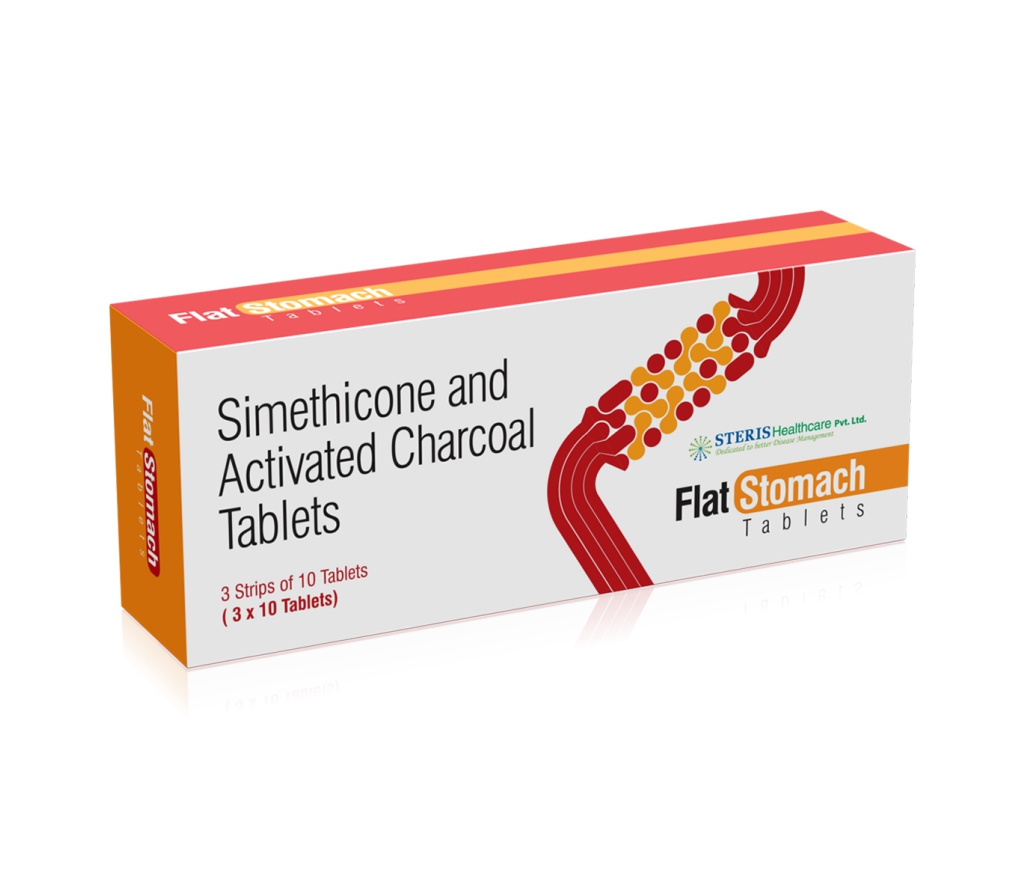
FLATSTOMACH
 Item requires a valid prescription
Manufactured By Steris Healthcare Pvt Ltd
Composition Simethicone and Activated Charcoal Tablets
Rs 63.66
MRP Rs 90.94
(30% OFF)
Includes all taxes
Package SIZE
( For 10 Tablet )

100% Authentic
Products

Free
Shipping*

Products
Return Policy
Description:
Simethicone and Activated Charcoal Tablets are a combination gastrointestinal formulation used for the rapid relief of flatulence, bloating, abdominal distension, and gas-related discomfort. Simethicone acts as an antifoaming agent that breaks down gas bubbles in the gut, while activated charcoal adsorbs intestinal gases, toxins, and irritants. Together, they provide dual-action defoaming and adsorption relief for functional bowel complaints, post-operative gas pain, irritable bowel syndrome (IBS), and dyspepsia.
What is Simethicone and Activated Charcoal Tablet?
Simethicone and Activated Charcoal Tablet is a fixed-dose combination (FDC) gastrointestinal preparation combining two mechanistically distinct anti-gas agents into a single dosage form for synergistic relief of intestinal gas-related symptoms.
Simethicone is a pharmaceutical-grade polydimethylsiloxane — an inert, non-absorbable silicone polymer that acts purely mechanically within the gastrointestinal lumen. It is not absorbed systemically and has no pharmacological activity beyond its local mechanical antifoaming action in the gut. Simethicone works by reducing the surface tension of gas bubbles trapped in the intestinal mucus, causing them to coalesce into larger bubbles that can be more easily expelled through belching or flatulence.
Activated Charcoal (Activated Carbon) is a highly porous form of carbon produced by heating organic material (typically wood, coconut shells, or coal) in the presence of a gas that creates a vast network of pores — giving it an extraordinarily large surface area of 300–2,000 m² per gram. This massive surface area enables activated charcoal to adsorb (not absorb) gases, toxins, chemicals, and microorganisms onto its surface through van der Waals forces, trapping them within the gut lumen and preventing their systemic absorption or further fermentation.
Mechanism of Action — How Does the Combination Work?
| Component | Mechanism | Target | Clinical Effect |
|---|---|---|---|
| Simethicone | Reduces surface tension of gas bubble film | Gas bubbles in intestinal mucus and lumen | Bubble coalescence → easier gas expulsion via belching/flatus |
| Simethicone | Antifoaming — destabilises foam layer in GI tract | Foamy gas trapped in mucus | Reduces frothy stool appearance; defoams enteric gas |
| Activated Charcoal | Physical adsorption (van der Waals forces) | Gas molecules (H₂, CH₄, H₂S, CO₂, N₂) | Traps gas within charcoal pores; reduces luminal gas volume |
| Activated Charcoal | Broad-spectrum toxin adsorption | Bacterial toxins, food chemicals, fermentation byproducts | Reduces toxin-related bloating and cramps |
| Activated Charcoal | Reduces colonic fermentation byproducts | Short-chain fatty acid gases from microbial fermentation | Decreases hydrogen and methane production signals |
| Combined effect | Dual mechanical + adsorptive gas elimination | Total gut gas burden | Rapid, comprehensive relief of bloating and distension |
Why the Combination is Superior to Monotherapy:
Simethicone alone addresses gas already formed as bubbles but does not prevent new gas formation or adsorb dissolved gases. Activated charcoal alone adsorbs gas molecules but does not break down foam or surface-tension-stabilised bubble complexes. The combination addresses the complete spectrum of gas pathophysiology — formation, foaming, and accumulation — making it mechanistically superior to either component alone.
Indications and Clinical Uses
Simethicone and Activated Charcoal Tablets are indicated across a range of gastrointestinal conditions characterised by excess gas production, bloating, and related discomfort:
1. Flatulence and Abdominal Bloating:
Excess intestinal gas — produced by bacterial fermentation of undigested carbohydrates, swallowed air (aerophagia), and chemical reactions between gastric acid and bicarbonate — causes bloating, distension, and crampy discomfort. The combination rapidly defoams and adsorbs accumulated gas, providing symptomatic relief within 30–60 minutes of administration. This is the primary and most common indication for this combination.
2. Irritable Bowel Syndrome (IBS) — Gas-Predominant Type:
IBS affects approximately 10–15% of the global adult population, with bloating and flatulence being among the most distressing and treatment-resistant symptoms. Rome IV criteria recognise abdominal bloating/distension as a core IBS symptom. Simethicone + activated charcoal combination provides meaningful symptomatic relief for gas-predominant IBS patients, particularly in the post-prandial bloating phase. Multiple open-label clinical studies confirm statistically significant reductions in bloating scores with this combination in IBS patients over 4-week treatment periods.
3. Dyspepsia (Functional Indigestion):
Functional dyspepsia — characterised by post-prandial fullness, early satiety, belching, and epigastric discomfort without structural pathology — frequently involves a gas component from accelerated fermentation and impaired gastric emptying. The combination addresses the gas-mediated component of dyspeptic symptoms effectively as adjunctive therapy.
4. Post-Operative Abdominal Distension:
Following abdominal or pelvic surgeries, post-operative ileus and gas retention cause significant patient discomfort. Simethicone and activated charcoal are used as part of bowel recovery protocols to manage gaseous distension and facilitate return of normal bowel function. Studies in post-Caesarean section patients demonstrate earlier return of bowel sounds and reduced time to first flatus with simethicone administration.
5. Endoscopy / Colonoscopy Preparation:
Mucosal bubbles and foamy secretions interfere with endoscopic visualisation of the gastrointestinal mucosa, potentially masking lesions including polyps and early cancers. Pre-procedural administration of simethicone (with or without activated charcoal) significantly improves mucosal visibility scores, polyp detection rates, and overall endoscopic image quality. Many endoscopy units include simethicone in their bowel preparation protocols as standard practice.
6. Aerophagia (Excessive Air Swallowing):
Patients with aerophagia — a functional condition characterised by repetitive, often unconscious air swallowing — accumulate large amounts of gas in the stomach and small intestine, causing painful distension and frequent belching. Simethicone + charcoal combination reduces the symptomatic gas burden while behavioural modification addresses the underlying cause.
7. Food Intolerance-Related Gas:
Lactose intolerance, fructose malabsorption, gluten sensitivity, and high-FODMAP food consumption generate excessive colonic gas through bacterial fermentation of malabsorbed carbohydrates. The combination provides on-demand relief for gas symptoms triggered by dietary indiscretion or food intolerances.
8. Infantile Colic (Simethicone Component — Paediatric Use):
While the adult tablet combination is not indicated for infants, simethicone alone (in drops/suspension form) is widely used for infantile colic with an established safety record. The same antifoaming principle applies.
9. Poisoning / Toxin Ingestion (Activated Charcoal Component):
Activated charcoal alone at higher doses (25–100 g) is a standard emergency treatment for certain oral poisonings. In the combination tablet at standard doses, charcoal provides gut-level toxin adsorption that benefits patients with food poisoning, traveller's diarrhoea with toxic component, or bacterial enterotoxin exposure.
Dosage and Administration
| Indication | Dose | Frequency | Timing | Duration |
|---|---|---|---|---|
| Flatulence / Bloating (acute) | 1–2 tablets | 3–4 times daily | After meals and at bedtime | Until symptoms resolve |
| Functional dyspepsia | 1–2 tablets | 3 times daily | After each main meal | 2–4 weeks |
| IBS (gas-predominant) | 1–2 tablets | 3 times daily | After meals | Ongoing; review monthly |
| Post-operative distension | 1–2 tablets | 3–4 times daily | As directed by surgeon | Until bowel function normalises |
| Endoscopy preparation | 2 tablets | Single dose or as per protocol | 30–60 minutes before procedure | Single-use pre-procedural |
| Food intolerance (on-demand) | 1–2 tablets | As needed | Immediately before or after implicated meal | On demand |
General Administration Instructions:
- Tablets should be chewed thoroughly before swallowing for maximum efficacy — particularly important for simethicone's mechanical action and charcoal's surface contact with gut contents.
- Take preferably after meals and at bedtime.
- Drink adequate water (at least 1 full glass — 250 mL) with each dose, particularly when taking activated charcoal, to prevent constipation.
- Activated charcoal will cause stools to appear black or very dark — patients must be counselled about this expected, harmless colour change to prevent unnecessary alarm or confusion with gastrointestinal bleeding.
Side Effects and Safety Profile
Common Side Effects:
- Black stools: Universally expected with activated charcoal — harmless and reversible on stopping. Patients must be counselled proactively.
- Mild constipation (activated charcoal absorbs water in gut; adequate fluid intake minimises this)
- Nausea (particularly at higher charcoal doses)
- Vomiting (rare at standard tablet doses)
Uncommon Side Effects:
- Abdominal cramping or increased flatulence paradoxically in the first 24 hours (gas redistribution effect)
- Diarrhoea (uncommon; more with sorbitol-containing charcoal preparations)
- Darkening or staining of oral mucosa if tablets are chewed without water
Serious Adverse Effects (Rare):
- Intestinal obstruction — activated charcoal can accumulate and form bezaors in patients with pre-existing bowel motility disorders, particularly at high repeated doses; very unlikely at standard combination tablet doses
- Aspiration pneumonitis — relevant only if vomiting occurs after charcoal ingestion; prevent by not giving in unconscious or obtunded patients (relevant to high-dose poisoning protocols, not standard tablet use)
- Corneal ulceration — only with non-pharmaceutical charcoal; pharmaceutical-grade activated charcoal in tablets is safe
Key Safety Advantage: Both simethicone and activated charcoal are virtually non-absorbed from the gastrointestinal tract. Simethicone is 100% eliminated unchanged in feces. Activated charcoal is not absorbed and exits entirely via feces. This non-systemic profile means no systemic side effects, no organ toxicity, and no systemic drug interactions — making the combination extremely safe for use in elderly patients, patients with renal or hepatic impairment, and in post-surgical settings.
Drug Interactions — Activated Charcoal Adsorption Alert
The most clinically important interaction for this combination is activated charcoal's non-selective adsorptive capacity, which can reduce the absorption of concurrently administered oral medications.
| Interacting Drug/Category | Interaction | Clinical Recommendation |
|---|---|---|
| All oral medications (general) | Activated charcoal adsorbs drug molecules in gut → reduced bioavailability | Separate all other oral medicines by at least 2 hours before or 1 hour after charcoal dose |
| Oral contraceptive pills (OCPs) | Charcoal may adsorb oestrogen/progestogen → reduced contraceptive plasma levels | Take OCP at least 2 hours before or after charcoal; use barrier contraception as backup |
| Digoxin | Charcoal adsorbs digoxin → potential subtherapeutic levels | Strict 2-hour separation; monitor digoxin levels |
| Phenytoin, Carbamazepine | Reduced antiepileptic absorption → seizure risk | 2-hour separation mandatory; monitor drug levels |
| Warfarin / Anticoagulants | Reduced anticoagulant absorption → subtherapeutic anticoagulation | Strict timing separation; INR monitoring |
| Antibiotics (oral) | Reduced antibiotic bioavailability | Separate by 2 hours; do not co-administer |
| Thyroid hormones (Levothyroxine) | Charcoal adsorbs T4 → hypothyroid relapse | Take levothyroxine in early morning, charcoal combination after meals |
| Vitamins and Supplements | Adsorption of fat-soluble vitamins (A, D, E, K) with prolonged use | Avoid long-term high-dose charcoal in patients on nutritional supplements |
| Simethicone (own component) | No interaction — simethicone is not adsorbed by charcoal at standard ratio | No dose adjustment needed within the fixed combination |
Key Patient Counselling Point: The 2-hour separation rule from all other oral medications is the single most important drug interaction instruction for patients taking activated charcoal-containing preparations. This should be printed prominently on dispensing labels.
Contraindications
- Known hypersensitivity to simethicone, activated charcoal, or any tablet excipients
- Intestinal obstruction or suspected bowel obstruction (activated charcoal contraindicated)
- Gastrointestinal perforation or risk of perforation
- Reduced bowel motility conditions (paralytic ileus, severe constipation) — charcoal accumulation risk
- Unconscious or obtunded patients (aspiration risk — oral tablets not applicable but relevant in high-dose poisoning context)
- Do not use as a substitute for emergency activated charcoal in poisoning without medical supervision
- Children below 12 years — adult tablet dose not appropriate; paediatric simethicone formulations (drops/suspension) to be used under paediatric guidance
Key Statistics and Clinical Evidence
- IBS Prevalence in India: Approximately 4–6% of the Indian adult population meets Rome IV IBS criteria, with bloating and flatulence reported by over 70% of IBS patients as their most distressing symptom (Indian Journal of Gastroenterology, 2022).
- Endoscopy Enhancement: Pre-procedural simethicone administration improves mucosal visibility by 35–45% and increases adenoma/polyp detection rates by 15–20% in colonoscopy studies (Gastrointestinal Endoscopy, 2021 meta-analysis).
- Post-CS Gas Relief: Simethicone administration post-Caesarean section reduces time to first flatus by a mean of 6.5 hours compared to placebo (International Journal of Gynecology & Obstetrics, 2019).
- Activated Charcoal Surface Area: Pharmaceutical-grade activated charcoal has a surface area of 900–1,500 m²/g — a single gram can adsorb the equivalent of its own weight or more in intestinal gases and toxins.
- Simethicone Safety: Over 50 years of clinical use with zero documented systemic toxicity, teratogenicity, or carcinogenicity — one of the safest pharmaceutical agents in the GI formulary.
Frequently Asked Questions
Why do stools turn black after taking Simethicone and Activated Charcoal Tablets?
Black or very dark stools are an expected, completely harmless side effect of activated charcoal. Activated charcoal is not absorbed by the body and passes through the entire gastrointestinal tract, staining stool contents black as it exits. This should not be confused with melaena (black tarry stools from gastrointestinal bleeding), which has a distinctly different tarry consistency and foul odour. Charcoal-stained stools are firm to normal in consistency and resolve within 24–48 hours of stopping the medication.
Can Simethicone and Activated Charcoal Tablets be taken daily for IBS?
Yes, the combination can be used regularly for IBS-associated gas and bloating, typically after meals for ongoing symptom management. However, due to activated charcoal's broad adsorptive capacity, long-term daily use at high doses may theoretically reduce absorption of fat-soluble vitamins and some trace minerals. A clinician's guidance is advisable for long-term use. Short-to-medium-term use (weeks to months) at standard doses is well-tolerated in clinical practice.
How long does it take for Simethicone and Activated Charcoal to work?
Relief typically begins within 30–60 minutes of administration for acute gas and bloating. Simethicone acts almost immediately upon contact with gut gas bubbles, while activated charcoal requires 30–60 minutes to adsorb gas molecules across the intestinal contents. Maximum effect is generally experienced within 1–2 hours of dosing.
Can I take my other medicines at the same time as Simethicone and Activated Charcoal Tablets?
No. Due to activated charcoal's non-selective adsorptive properties, it can reduce the absorption of other oral medications taken at the same time. All other oral medicines must be taken at least 2 hours before or 1 hour after activated charcoal-containing preparations. This separation rule is particularly critical for oral contraceptives, antiepileptics, warfarin, digoxin, antibiotics, and thyroid hormones.
Is this tablet safe during pregnancy?
Simethicone is considered safe during pregnancy — it is not absorbed systemically and poses no teratogenic risk. Activated charcoal is also generally considered safe for short-term use in pregnancy for gas relief, as it is not systemically absorbed. However, prolonged use during pregnancy should be supervised by an obstetrician to ensure adequate nutrient and medication absorption is not compromised.
When should Simethicone and Activated Charcoal Tablets be taken?
Simethicone and Activated Charcoal Tablets should ideally be taken after meals and at bedtime for best results. For acute gas and bloating relief, take 1–2 tablets immediately after eating — particularly after heavy, spicy, or gas-producing meals (such as beans, cabbage, dairy, carbonated drinks, and high-FODMAP foods).
How to use simethicon?
Take simethicone after meals and bedtime, following dosage instructions, to relieve gas, bloating, and discomfort effectively.
For Further More Information:
Mail Us: contact@sterispharma.com or info@sterispharma.com
Call Now: +918824175417, +919982524671

