


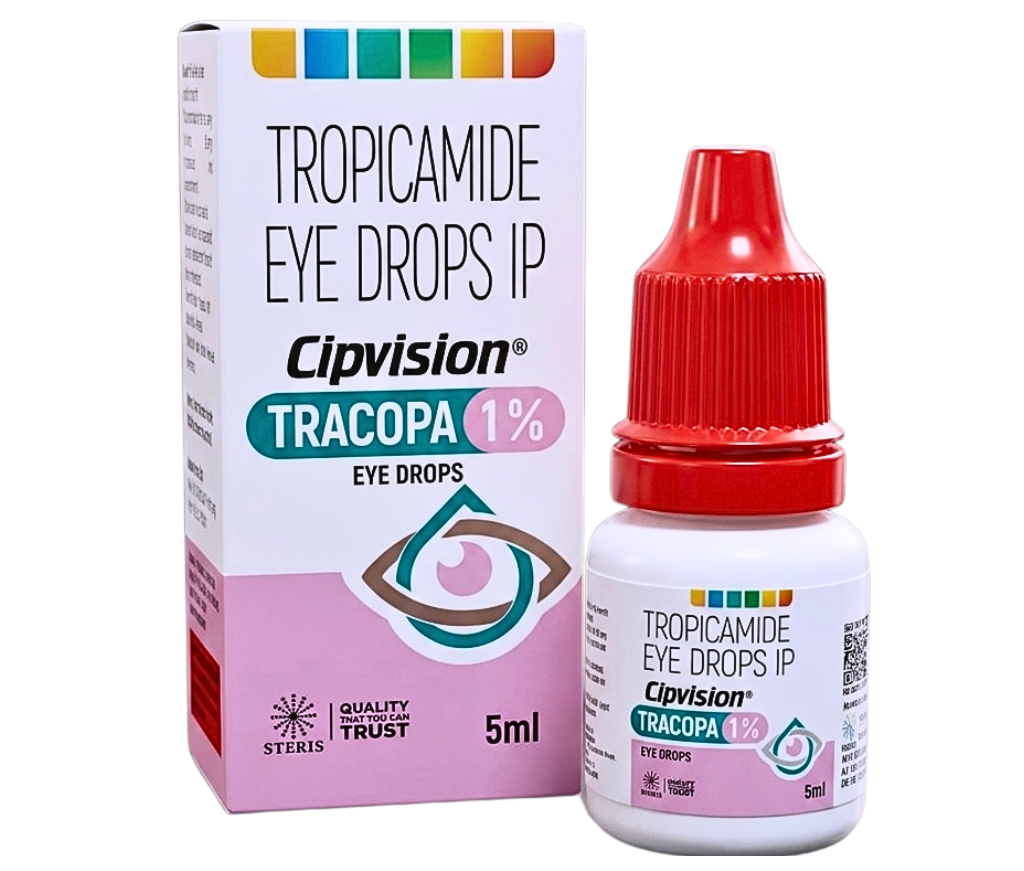
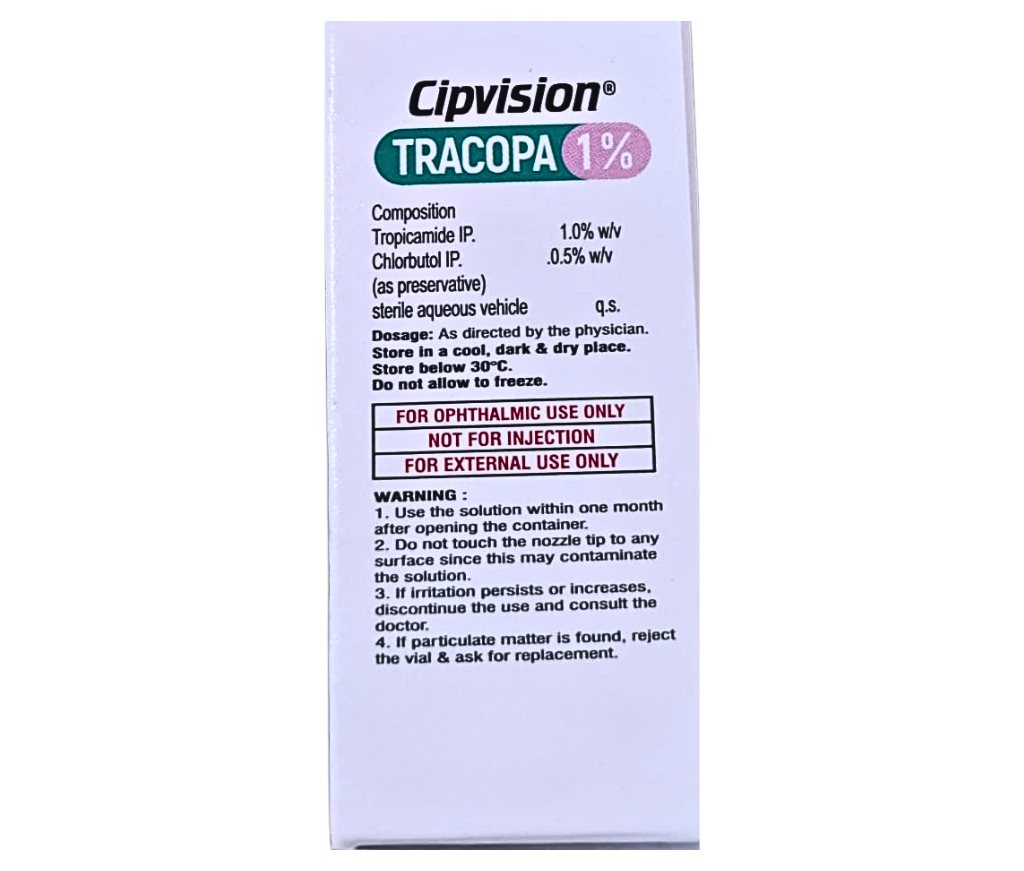

CIPVISION TRACOPA 1%
 Item requires a valid prescription
Manufactured By Steris Healthcare Pvt Ltd
Composition Tropicamide Eye Drops IP
Rs 35.42
MRP Rs 50.60
(30% OFF)
Includes all taxes
Package SIZE
( For 5 ml )

100% Authentic
Products

Free
Shipping*

Products
Return Policy
Description:
Tropicamide eye drops IP are ophthalmic drops used primarily to temporarily dilate the pupil during an eye examination. They help an ophthalmologist obtain a clearer view of the retina and other structures inside the eye. Tropicamide is an anticholinergic medicine and is commonly available in ophthalmic strengths such as 0.5% and 1%. The exact strength, dose and administration schedule should be selected by an eye-care professional.
In India, “IP” refers to the Indian Pharmacopoeia standard associated with the medicine's specified quality requirements. The Indian Pharmacopoeia Commission also lists tropicamide among its reference substances. Pharmacopoeia Commission
What Is Tropicamide Eye Drops IP?
Tropicamide eye drops IP contain tropicamide, a short-acting antimuscarinic medicine that temporarily relaxes muscles involved in pupil constriction and focusing.
When administered to the eye, tropicamide produces mydriasis, meaning enlargement of the pupil. It can also produce a temporary reduction in the eye's ability to focus on near objects, known as cycloplegia.
This action is particularly useful when an eye specialist needs to examine the back of the eye. By enlarging the pupil, the medicine can improve the clinician's view of structures such as the retina and optic nerve.
Indian products containing tropicamide are available from different manufacturers and in different pack sizes and formulations. For example, current Indian pharmacy listings include 1% tropicamide products marketed as prescription medicines.
Tropicamide Eye Drops IP Uses
The most important tropicamide eye drops IP uses relate to diagnostic eye care.
1. Pupil dilation for eye examinations
The principal use is to enlarge the pupil before an ophthalmic examination. A dilated pupil allows the doctor to inspect internal eye structures more effectively.
2. Retinal and fundus examination
Tropicamide can help an ophthalmologist examine the retina, optic disc and other posterior eye structures. This can be important when evaluating eye health or investigating visual symptoms.
3. Cycloplegic refraction
Because tropicamide temporarily interferes with the eye's focusing mechanism, it may be used as part of certain refraction procedures. The exact choice of medicine is particularly important in children, where the ophthalmologist may select a different or additional cycloplegic depending on the examination.
4. Other ophthalmic diagnostic procedures
An eye specialist may use tropicamide when temporary pupil dilation is required for a particular diagnostic procedure.
The specific indication should always come from the treating ophthalmologist rather than from the product label alone.
Key Benefits of Tropicamide Eye Drops IP
The main tropicamide eye drops IP benefits are related to temporary pupil dilation and diagnostic accuracy.
- Effective pupil dilation: Tropicamide relaxes the iris sphincter muscle, allowing the pupil to enlarge.
- Improved visibility: A larger pupil can give the ophthalmologist a better view of internal eye structures.
- Useful for routine examinations: Its relatively short duration makes it practical for many outpatient eye examinations.
- Temporary effect: Unlike longer-acting cycloplegic medicines, tropicamide is generally selected when prolonged pupil dilation is not required.
- Available in different strengths: Ophthalmic formulations may contain different concentrations, allowing the doctor to select an appropriate product for the clinical situation.
The FDA/NIH DailyMed prescribing information describes tropicamide ophthalmic solution as a topical ophthalmic mydriatic and warns that mydriatic medicines can temporarily increase intraocular pressure.
How Do Tropicamide Eye Drops Work?
Tropicamide blocks muscarinic responses in the eye.
Normally, parasympathetic stimulation causes the pupil to constrict and supports accommodation, the process that helps the eye focus on nearby objects. Tropicamide temporarily blocks these responses.
As a result:
- The pupil becomes larger.
- The eye's near-focusing ability is temporarily reduced.
- The doctor obtains improved access to the internal structures of the eye during examination.
The effect eventually wears off as the medicine's activity decreases.
How to Use Tropicamide Eye Drops
Tropicamide should be administered exactly as directed by the ophthalmologist or healthcare professional.
If you are instructed to instill the drops yourself:
- Wash and dry your hands before use.
- Do not allow the dropper tip to touch the eye, eyelids or another surface.
- Instill only the prescribed number of drops.
- Close the eye gently after application.
- Follow the healthcare professional's instructions regarding any repeat dose.
Because tropicamide can temporarily blur vision and increase light sensitivity, do not drive or operate machinery until your vision has returned to normal.
Contact lenses may need to be removed before administration, particularly when the formulation contains a preservative. The official prescribing information specifically advises removing contact lenses before use.
Tropicamide Eye Drops IP Side Effects
Most effects associated with pupil dilation are temporary, but patients should understand what can occur.
Common or expected effects
Possible effects include:
- Temporary blurred vision, particularly for near objects
- Increased sensitivity to light or photophobia
- Temporary stinging or burning after instillation
- Eye irritation
The official U.S. prescribing information reports transient stinging, blurred vision and photophobia among adverse ocular reactions.
Wearing sunglasses after dilation may make bright outdoor light more comfortable.
Less common or potentially important effects
Mydriatic medicines can cause a temporary increase in intraocular pressure. This is particularly relevant for people who have or may be predisposed to narrow-angle glaucoma.
Rare systemic anticholinergic reactions can also occur, and pediatric patients require particular caution because central nervous system reactions have been reported in the prescribing information.
When should you seek urgent medical attention?
Seek immediate medical attention if severe eye pain, significant headache, nausea or vomiting, marked visual deterioration, severe eye redness, facial swelling, difficulty breathing, confusion or unusual behavioral changes occur after administration.
These symptoms should not simply be assumed to be a normal effect of pupil dilation.
Who Should Use Tropicamide With Caution?
Tell your ophthalmologist before receiving tropicamide if you:
- Have glaucoma or have been told you have narrow angles
- Have previously experienced an abnormal reaction to dilating eye drops
- Are pregnant or breastfeeding
- Are taking medicines that may have anticholinergic effects
- Are using contact lenses
- Are giving the medicine to a child
The doctor can determine whether tropicamide is appropriate and whether additional precautions are necessary.
Tropicamide Eye Drops IP Price and Buying Information
The price of tropicamide eye drops IP varies by manufacturer, strength, bottle size, pharmacy and current pricing rules. It is therefore better to compare the exact product name, strength and pack size rather than relying on a generic “tropicamide eye drops price.”
For example, recent Indian online-pharmacy listings show different 1% tropicamide products at different prices, demonstrating that price is product-specific. Current listings also identify these products as prescription medicines.
Before purchasing, check:
- Generic name and strength
- Manufacturer/marketer
- Bottle volume
- Batch number and expiry date
- Prescription requirements
- Storage instructions
- Whether the product is plain tropicamide or a combination containing another medicine
Do not accidentally purchase a phenylephrine + tropicamide combination when your prescription specifically calls for tropicamide alone. These are different formulations with different active ingredients. Current Indian listings include combination products containing phenylephrine and tropicamide.
Storage and Handling
Storage instructions can differ between products, so follow the package label and pharmacist's instructions. Some currently listed Indian tropicamide products specify storage below 30°C.
Keep the bottle closed when not in use and avoid contaminating the dropper tip.
Tropicamide Eye Drops IP: Quick Buyer Checklist
If you are searching for tropicamide eye drops IP online, confirm the following before buying:
- Active ingredient: Tropicamide
- Strength: Check whether your prescription specifies 0.5%, 1% or another concentration
- Formulation: Tropicamide alone versus a combination product
- Pack size: Check the number of millilitres
- Prescription status: Purchase/use according to applicable medical and pharmacy requirements
- Expiry: Never use an expired ophthalmic product
- Manufacturer: Verify the manufacturer and product details
- Purpose: Use only for the indication provided by your eye-care professional
Conclusion
Tropicamide eye drops IP are short-acting ophthalmic drops primarily used to dilate the pupil for eye examinations and selected diagnostic procedures. Their major benefit is that temporary pupil enlargement gives the ophthalmologist a clearer view of internal eye structures. Temporary blurred vision, light sensitivity and mild stinging are among the commonly reported effects, while increased intraocular pressure and rare systemic reactions require appropriate clinical caution.
From a buyer's perspective, the most important point is to match the exact strength, formulation, manufacturer and pack size with the prescription. Do not substitute plain tropicamide with a phenylephrine+tropicamide combination without medical advice.
Frequently Asked Questions
1. What are tropicamide eye drops IP used for?
Tropicamide eye drops IP are mainly used to temporarily dilate the pupil before an eye examination. The dilation helps an ophthalmologist see internal structures of the eye more clearly.
2. Can tropicamide eye drops be used without a doctor's prescription?
Tropicamide is generally supplied as a prescription ophthalmic medicine. It should be used according to an ophthalmologist's or qualified healthcare professional's instructions. Current Indian pharmacy listings identify tropicamide products as prescription medicines.
3. How long does tropicamide eye dilation last?
The duration varies between individuals and depends on the formulation, strength and clinical circumstances. Vision can remain blurred and light sensitivity can continue after the examination, so patients should wait until vision returns to normal before driving.
4. What are the common side effects of tropicamide eye drops IP?
Common effects include temporary blurred vision, increased sensitivity to light and transient stinging or irritation. These effects are generally associated with the temporary pharmacological action of the medicine.
5. Can tropicamide eye drops increase eye pressure?
Yes. Mydriatic medicines such as tropicamide can cause a transient increase in intraocular pressure. People at risk of angle-closure glaucoma require particular caution and should tell their eye doctor about their eye history.
6. Can I drive after using tropicamide eye drops?
You should not drive while your vision is blurred or your ability to focus is impaired. Wait until your vision has returned to normal and your healthcare professional has advised that it is safe to drive.
7. Are tropicamide eye drops the same as tropicamide and phenylephrine eye drops?
No. Plain tropicamide contains tropicamide as the active ingredient, whereas combination products may contain both tropicamide and phenylephrine. Always check the composition before purchasing or using an eye drop.
8. Can children use tropicamide eye drops?
Children may receive tropicamide in appropriate clinical circumstances, but dosing and product selection must be determined by an eye-care professional. The prescribing information includes specific warnings concerning potential central nervous system effects in pediatric patients.
9. Why do my eyes become sensitive to light after tropicamide?
Tropicamide enlarges the pupil. A larger pupil allows more light to enter the eye, which can temporarily cause photophobia or increased sensitivity to bright light. Sunglasses can improve comfort outdoors.
10. What should I check when buying tropicamide eye drops IP?
Check the prescribed strength, active ingredients, manufacturer, bottle size, expiry date and prescription requirements. Also verify that you are purchasing plain tropicamide rather than a combination product unless the combination was specifically prescribed.