


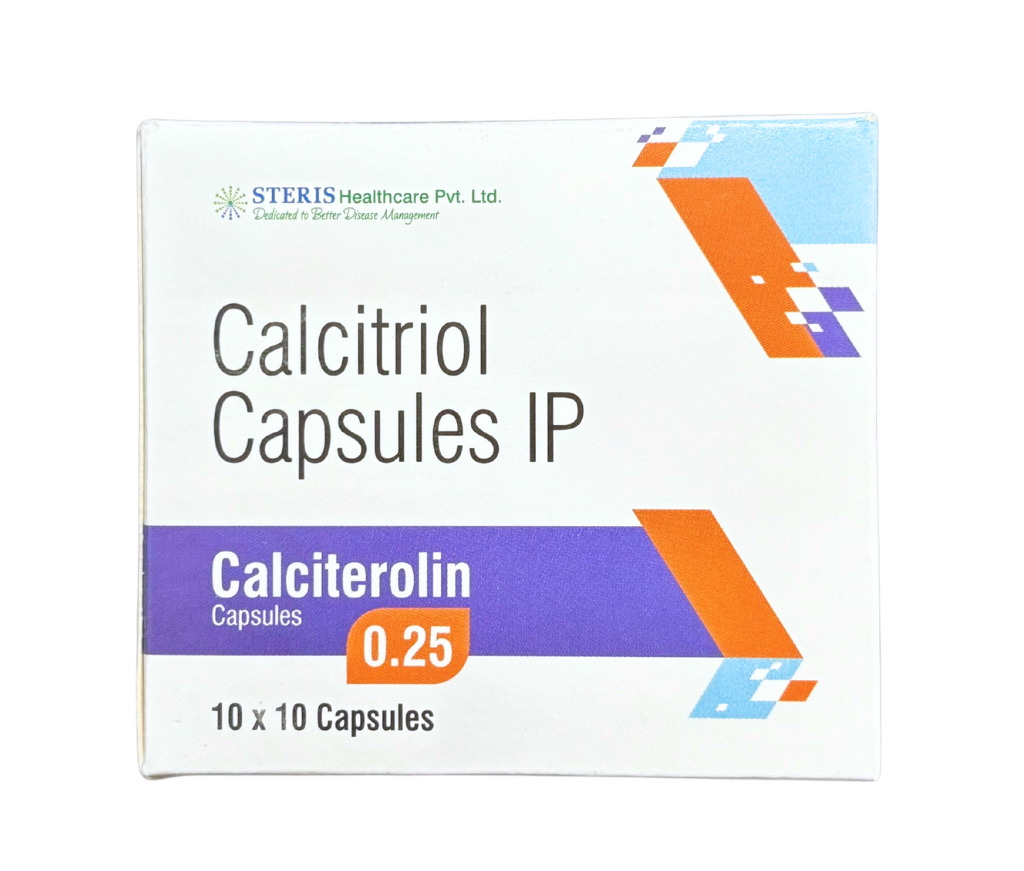
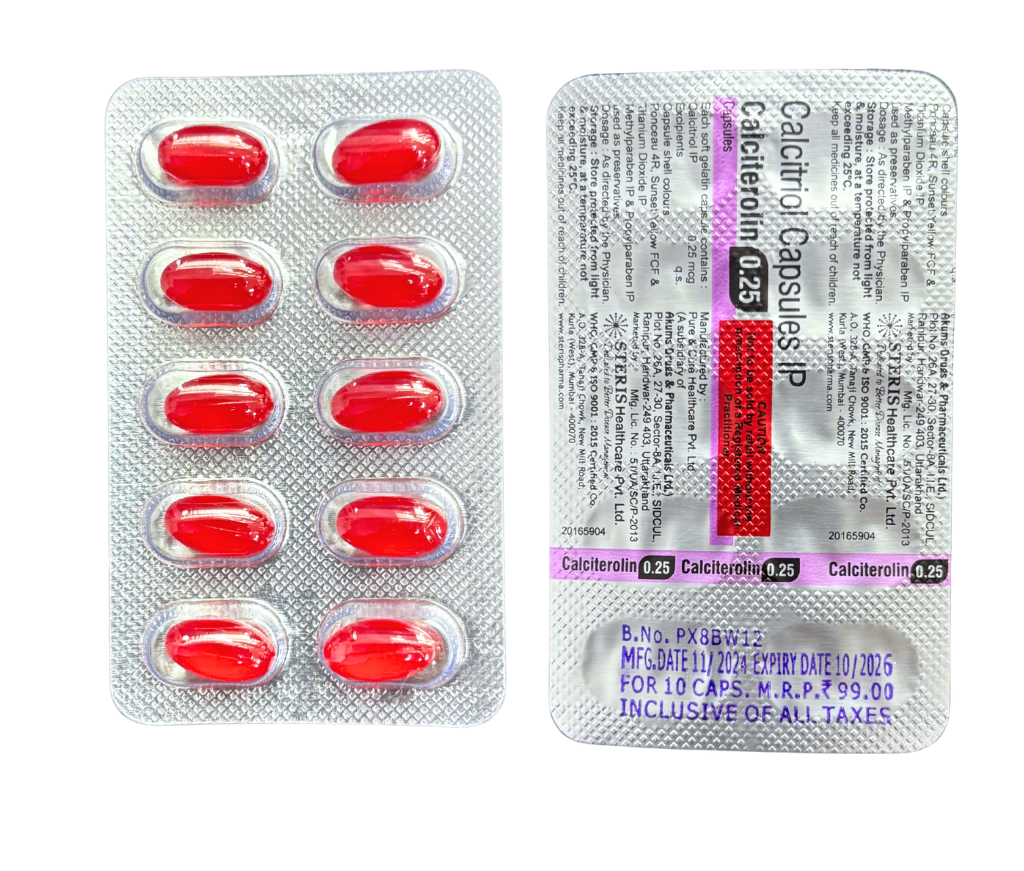
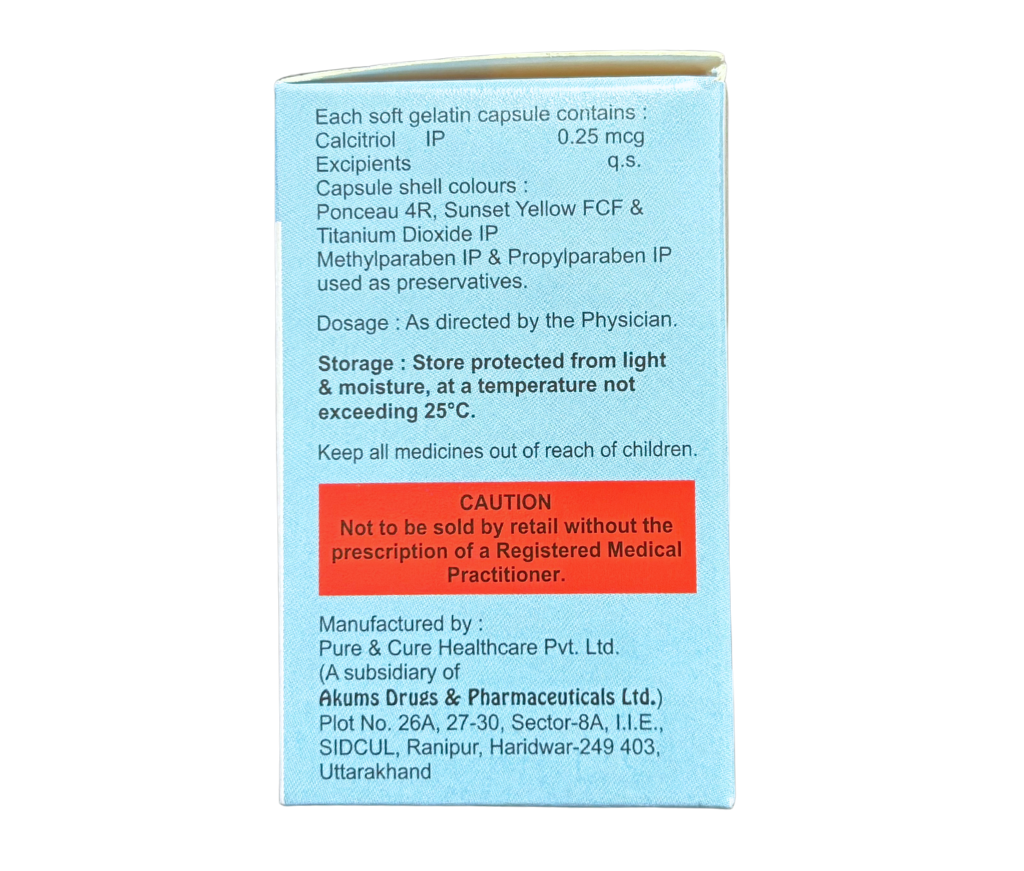
CALCITEROLIN 0.25
 Item requires a valid prescription
Manufactured By Steris Healthcare Pvt Ltd
Composition calcitriol 0.25mg
Rs 90.03
MRP Rs 92.81
(3% OFF)
Includes all taxes
Package SIZE
( For 10 CAPS )

100% Authentic
Products

Free
Shipping*

Products
Return Policy
Description:
Calcitriol 0.25mg is a prescription-strength, biologically active form of Vitamin D3. It's primarily used to correct low calcium levels, prevent bone disease in dialysis patients, and manage parathyroid disorders by enabling efficient calcium absorption in the body. Unlike standard Vitamin D supplements, it does not require kidney activation, making it suitable for patients with impaired renal function.
Brand Name: CALCITEROLIN 0.25 (STERIS HEALTHCARE PVT. LTD.)
Generic Name / Composition: Calcitriol Capsules IP 0.25 mcg
Formulation: Soft Gelatin Capsules
Strength: 0.25 mcg
Pack Size: 10 × 10 Capsules
Marketed By: Steris Healthcare Pvt. Ltd.
Regulatory Standard: WHO-GMP Certified
Schedule: Valid Prescription Required (Prescription Only
What Is Calcitriol 0.25mg Used For?
Calcitriol 0.25mg is the synthetic version of 1,25-dihydroxyvitamin D3, the biologically active metabolite of Vitamin D. It is primarily prescribed to correct low calcium levels (hypocalcemia) in people whose kidneys can no longer convert inactive Vitamin D into its usable form — a common complication in chronic kidney disease (CKD) and dialysis patients. It is also used for managing hypoparathyroidism, renal osteodystrophy, and certain cases of metabolic bone disease.
How Does Calcitriol 0.25mg Work?
Calcitriol works by directly activating Vitamin D receptors (VDR) in the intestine, bone, and kidney without needing further metabolic conversion.
- C – Calcium Absorption: Increases intestinal absorption of dietary calcium and phosphate.
- R – Receptor Activation: Binds directly to Vitamin D receptors, bypassing the need for renal hydroxylation.
- A – Affects Bone Remodeling: Regulates osteoblast and osteoclast activity to maintain healthy bone mineralization.
- S – Suppresses PTH: Reduces excessive parathyroid hormone (PTH) secretion, helping control secondary hyperparathyroidism.
- P – Phosphate Balance: Works alongside calcium regulation to maintain mineral homeostasis essential for bone and cardiovascular health.
Clinical Indications
| Condition | How Calcitriol Helps |
|---|---|
| Chronic Kidney Disease (CKD) related hypocalcemia | Bypasses impaired renal activation of Vitamin D |
| Hypoparathyroidism | Corrects calcium deficiency caused by low PTH activity |
| Renal Osteodystrophy | Supports bone mineralization in dialysis patients |
| Secondary Hyperparathyroidism | Helps suppress elevated PTH levels |
| Postmenopausal Osteoporosis (selected cases) | Supports calcium metabolism for bone density |
Calcitriol 0.25mg Dosage Guide
| Patient Group | Typical Starting Dose | Notes |
|---|---|---|
| Adults with CKD/dialysis | 0.25mcg once daily | May be adjusted based on serum calcium |
| Hypoparathyroidism | 0.25mcg–0.5mcg daily | Titrated under physician supervision |
| Elderly patients | Lower starting dose | Renal function monitored closely |
| Pediatric use | As prescribed by specialist | Weight-based dosing required |
Precautions Before Taking Calcitriol 0.25mg
- Should not be used in patients with hypercalcemia or Vitamin D toxicity.
- Requires regular monitoring of serum calcium and phosphate levels, especially during dose adjustments.
- Caution advised in patients on calcium-containing antacids or supplements, as it increases hypercalcemia risk.
- Not recommended for self-medication; intended for use under direct medical supervision.
- Pregnant or breastfeeding women should use only if clearly prescribed.
Drug Interactions
| Drug/Substance | Interaction Effect |
|---|---|
| Thiazide diuretics | Increased risk of hypercalcemia |
| Digoxin | Hypercalcemia may increase risk of cardiac arrhythmia |
| Magnesium-containing antacids | Risk of hypermagnesemia in dialysis patients |
| Phosphate-binding agents | May require dose coordination |
| Cholestyramine | May reduce calcitriol absorption |
Serious Side Effects to Watch For
While generally well-tolerated at prescribed doses, patients should seek immediate medical attention if they notice:
- Symptoms of hypercalcemia: nausea, vomiting, constipation, confusion, excessive thirst
- Irregular heartbeat
- Unusual fatigue or muscle weakness
- Signs of kidney function decline
Calcitriol vs Other Vitamin D Formulations
| Parameter | Calcitriol | Cholecalciferol (D3) | Alfacalcidol |
|---|---|---|---|
| Activation Required | None (already active) | Requires liver + kidney activation | Requires liver activation only |
| Best Suited For | CKD, dialysis patients | General Vitamin D deficiency | Mild-moderate renal impairment |
| Onset of Action | Fast | Slower | Intermediate |
| Monitoring Needs | High (calcium levels) | Low | Moderate |
Key Statistics & Clinical Insights
| Data Point | Value |
|---|---|
| Prevalence of secondary hyperparathyroidism in CKD Stage 5 | Affects a majority of dialysis patients globally |
| Typical correction time for hypocalcemia | 2–4 weeks with monitored dosing |
| Common monitoring frequency | Serum calcium checked every 2–4 weeks initially |
Frequently Asked Questions
1. What is Calcitriol 0.25mg used for?
Calcitriol 0.25mg is used to treat low calcium levels caused by kidney disease, hypoparathyroidism, or renal osteodystrophy. It helps the body absorb calcium properly when the kidneys cannot activate Vitamin D naturally.
2. Is Calcitriol the same as Vitamin D3?
No. Calcitriol is the already-activated form of Vitamin D, while D3 (cholecalciferol) needs to be converted by the liver and kidneys before it becomes active in the body.
3. Can I take Calcitriol 0.25mg without a prescription?
No. Calcitriol is a Schedule H prescription medicine and must only be taken under the guidance of a registered physician, with regular blood monitoring.
4. What happens if I take too much Calcitriol?
Excess intake can cause hypercalcemia, leading to symptoms like nausea, confusion, and irregular heartbeat. Always follow your doctor's prescribed dosage.
5. How long does it take for Calcitriol to correct calcium levels?
Most patients see measurable improvement in serum calcium within 2 to 4 weeks, though this varies based on the underlying condition and dosage.
6. Can Calcitriol be taken with calcium supplements?
It is often prescribed alongside calcium supplements, but only under medical supervision, since combining both increases the risk of hypercalcemia if not monitored.
7. Is Calcitriol safe for dialysis patients?
Yes, it is commonly prescribed for dialysis patients to manage renal osteodystrophy and secondary hyperparathyroidism, but dosing requires careful monitoring.
Steris Healthcare Pvt. Ltd. WHO-GMP & ISO Certified Pharmaceutical Manufacturer For trade inquiries, contact Steris Healthcare via your registered distributor or visit the official Steris Healthcare contact page.