


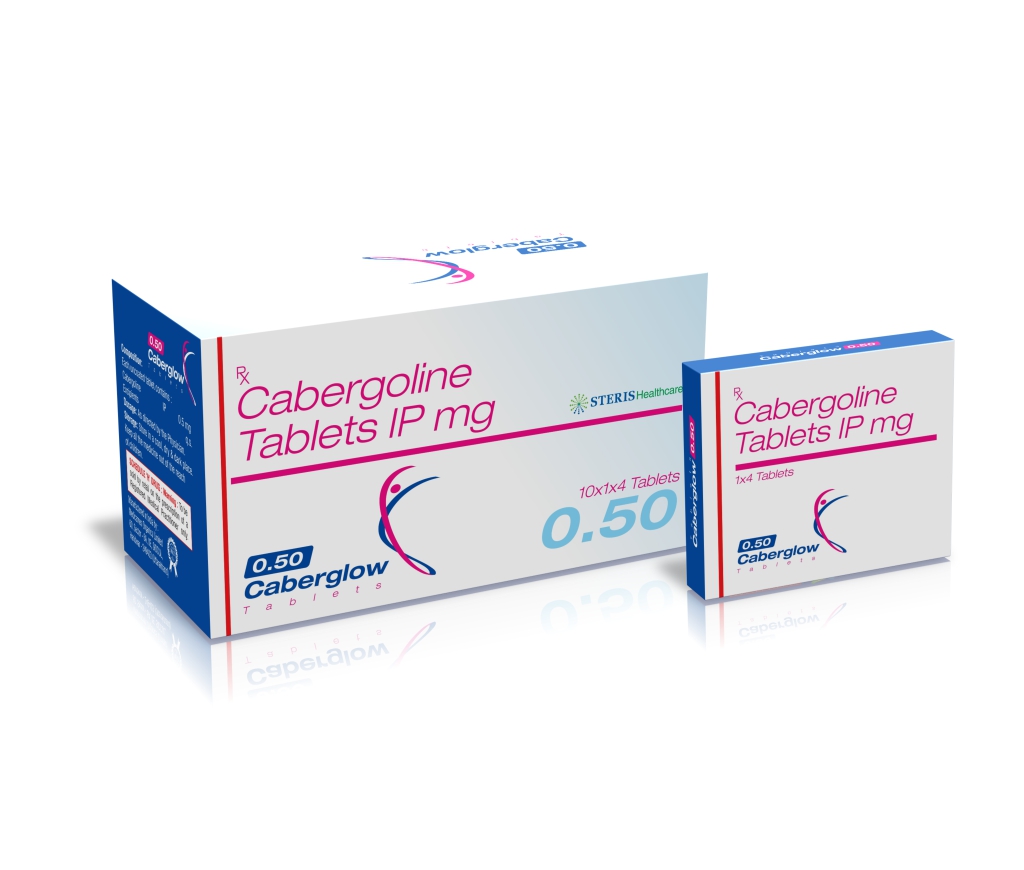
CABERGLOW 0.50
 Item requires a valid prescription
Manufactured By Steris Healthcare Pvt Ltd
Composition Cabergoline IP(0.5mg)
Rs 217.22
MRP Rs 310.31
(30% OFF)
Includes all taxes
Package SIZE
( For 4 Tablets )

100% Authentic
Products

Free
Shipping*

Products
Return Policy
Description:
Cabergoline IP 0.5 mg is a prescription dopamine agonist used to treat hyperprolactinemia — a condition where the body produces abnormally high levels of the hormone prolactin. Manufactured to Indian Pharmacopoeia (IP) standards, it's one of the most widely prescribed and exported hormonal medications in gynecology and endocrinology, valued for its twice-weekly dosing schedule and strong clinical track record since its approval in 1996. Below is a complete breakdown of how it works, its key benefits, dosage guidelines, side effects, and what buyers should verify before sourcing it.
What Is Cabergoline IP 0.5 mg?
Cabergoline is an ergot-derived dopamine receptor (D2) agonist. The "IP" designation means the tablet is manufactured and tested according to Indian Pharmacopoeia standards — covering purity, potency, and dissolution — which is the quality benchmark most Indian manufacturers and exporters use for both domestic and international pharma markets. It's sold under various brand names by GMP-certified Indian manufacturers, typically in 4-tablet or 10-tablet strip packaging.
How Cabergoline IP 0.5 mg Works
Cabergoline binds strongly to dopamine D2 receptors on the pituitary gland's lactotroph cells, directly suppressing the release of prolactin. Because of its high receptor affinity and long half-life, its effect lasts well beyond a single dose — which is why it's dosed twice weekly rather than daily, unlike older agents such as bromocriptine.
Key Uses of Cabergoline IP 0.5 mg
- Hyperprolactinemia — idiopathic, or caused by a pituitary tumor (prolactinoma)
- Infertility linked to high prolactin — used off-label to restore normal ovulation in women and improve reproductive hormone balance
- Menstrual irregularities caused by elevated prolactin
- Lactation-related management in specific clinical scenarios such as stillbirth or miscarriage — though it's important to note regulators advise against routine use for suppressing normal postpartum breastfeeding due to safety concerns, so this use is doctor-directed only
- Parkinsonian syndrome — occasionally used as an adjunct dopaminergic therapy
Key Benefits
- Effective prolactin normalization with a well-documented clinical history
- Twice-weekly dosing — significantly more convenient than daily alternatives
- High receptor selectivity, generally well tolerated when properly monitored
- Long-acting formulation, reducing dosing burden for long-term therapy
- Cost-effective, especially as an IP-grade generic compared to branded international equivalents
Dosage & Administration
Per standard prescribing guidelines, treatment usually starts at 0.25 mg orally twice a week, increased gradually — typically in 0.25 mg increments no more often than every four weeks — until prolactin levels normalize. It's commonly taken with food to reduce nausea, and treatment often continues for six months before reassessment. This dosing information reflects standard clinical guidance and is not a substitute for a doctor's prescription — the right dose depends on individual prolactin levels, cardiac health, and response to therapy, and should only be adjusted by a licensed physician.
Side Effects of Cabergoline IP 0.5 mg
Common side effects (reported in more than 10% of patients):
- Nausea
- Headache
- Dizziness
Other reported effects:
- Fatigue and stomach upset
- Constipation
- Hot flashes or breast tenderness
- Low blood pressure on standing (postural hypotension)
Serious but less common risks:
- Cardiac valvulopathy and fibrotic changes (heart valve, pericardial, pulmonary, or retroperitoneal fibrosis) with prolonged use — this is why an echocardiogram is generally recommended before starting therapy
- Impulse-control changes, such as unusual urges toward gambling or hypersexuality, which have been reported with dopamine agonists as a class
Patients should seek prompt medical attention for shortness of breath, chest pain, persistent cough, or swelling in the limbs.
Precautions & Contraindications
Cabergoline should be avoided in people with uncontrolled high blood pressure, existing valvular heart disease, or fibrotic disorders, and in those allergic to ergot-derived medicines. It requires caution in patients with liver impairment, and anyone who conceives during treatment should discuss continuation with their doctor. Like all prescription hormonal therapies, it should never be self-prescribed or dose-adjusted without medical supervision.
What to Check When Sourcing Cabergoline IP 0.5 mg
For pharmacies, distributors, and healthcare procurement teams evaluating suppliers, a few due-diligence points matter most:
- WHO-GMP and IP certification of the manufacturing facility
- Certificate of Analysis (COA) available for each batch
- Alu-alu blister packaging, which better protects tablet stability during export and storage
- Verified drug manufacturing and export licenses
- Transparent MOQ and wholesale pricing, especially relevant given the price variation seen across Indian exporters for this molecule
Conclusion
Cabergoline IP 0.5 mg remains a first-line, well-established treatment for hyperprolactinemia and related fertility or menstrual issues, prized for its convenient dosing and strong efficacy profile. That said, its rare but serious cardiac and fibrotic risks mean it should always be used under medical supervision with periodic monitoring — never as a self-directed purchase. For businesses sourcing the product, prioritizing WHO-GMP-certified, IP-compliant manufacturers is the safest way to ensure consistent quality and regulatory compliance.
Frequently Asked Questions
1. What is Cabergoline IP 0.5 mg used for?
It's primarily used to treat hyperprolactinemia — abnormally high prolactin hormone levels — which can cause infertility, irregular periods, or unwanted breast milk production.
2. How does Cabergoline IP 0.5 mg work?
It acts as a dopamine D2 receptor agonist, directly suppressing the pituitary gland's release of prolactin into the bloodstream.
3. What is the typical dosage of Cabergoline IP 0.5 mg?
Treatment usually starts at 0.25 mg twice weekly and is adjusted by a doctor based on prolactin blood tests — it's not a fixed, one-size-fits-all dose.
4. What does "IP" mean in Cabergoline IP 0.5 mg?
"IP" stands for Indian Pharmacopoeia, indicating the tablet meets that pharmacopoeia's official quality, purity, and testing standards.
5. What are the most common side effects of Cabergoline IP 0.5 mg?
Nausea, headache, and dizziness are the most frequently reported side effects, especially when starting treatment.
6. Is Cabergoline IP 0.5 mg safe for long-term use?
It can be used long-term under medical supervision, but doctors typically recommend periodic heart valve monitoring (such as an echocardiogram) due to a rare risk of cardiac valve changes.
7. Can Cabergoline IP 0.5 mg be purchased without a prescription?
No — it's a prescription-only medication in most markets and should only be taken under a licensed physician's guidance.

