


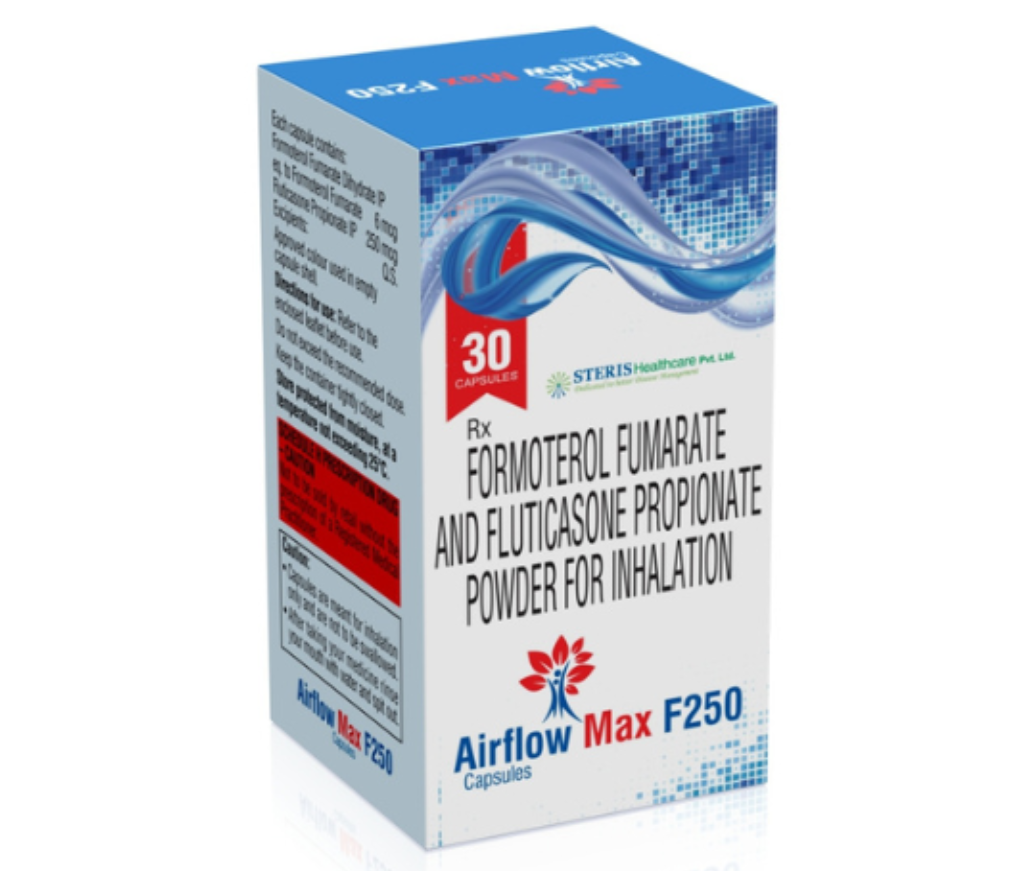
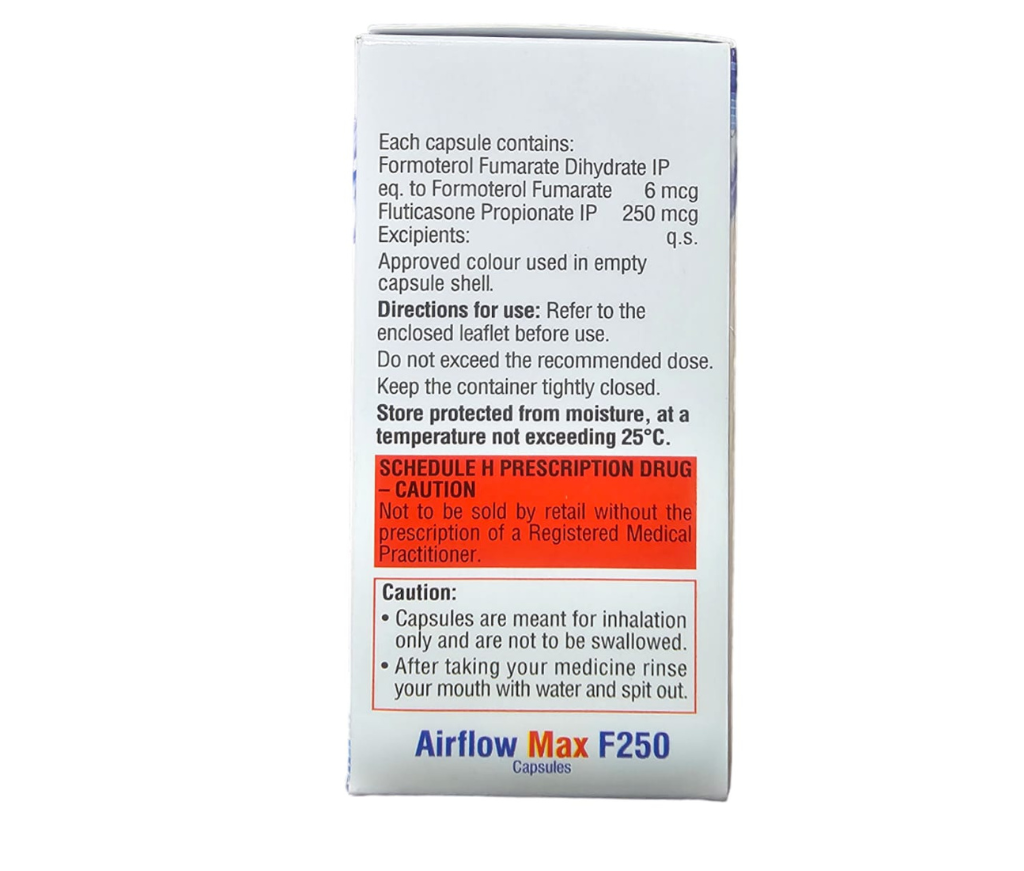
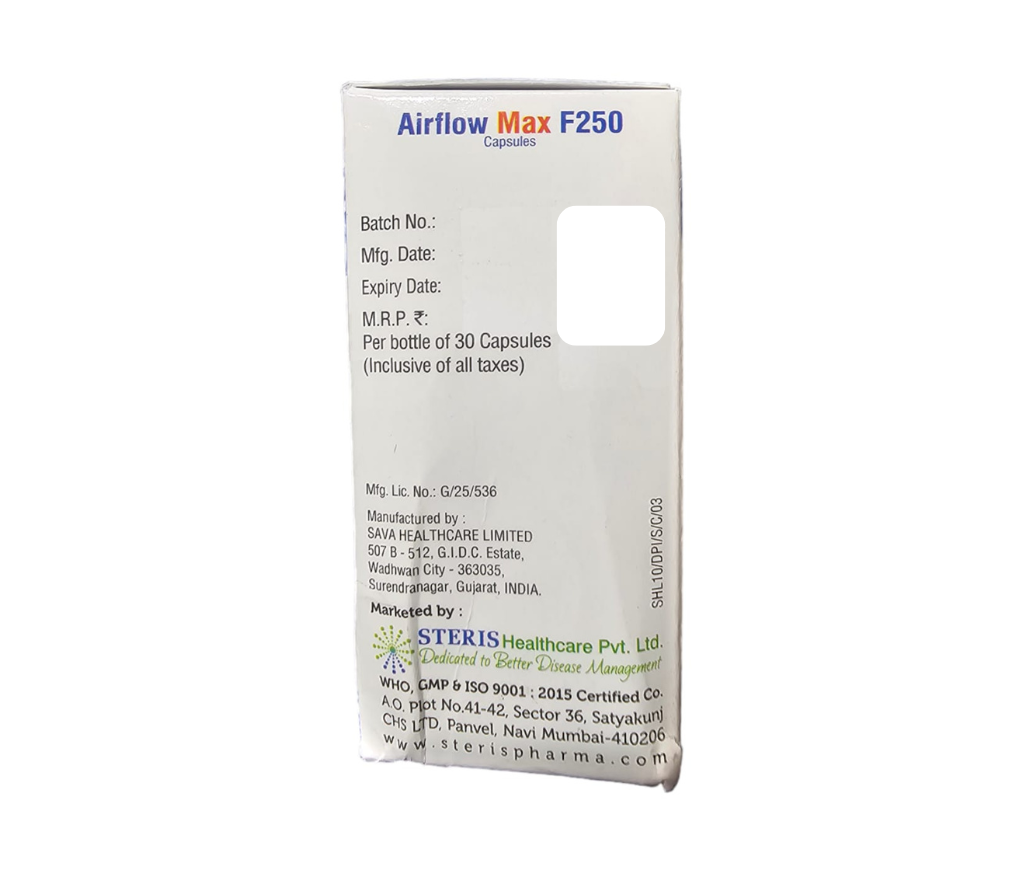
AIRFLOWMAX F250
 Item requires a valid prescription
Manufactured By Steris Healthcare Pvt Ltd
Composition Fluticasone Propionate and Formoterol Fumarate Inhaler
Rs 285.46
MRP Rs 407.81
(30% OFF)
Includes all taxes
Package SIZE
( For 30 Capsules )

100% Authentic
Products

Free
Shipping*

Products
Return Policy
Description:
A fluticasone propionate and formoterol fumarate inhaler is a combination inhaler containing two different medicines that work together to control asthma.
-
Fluticasone propionate is an inhaled corticosteroid (ICS) that reduces inflammation in the airways.
-
Formoterol fumarate is a long-acting beta-2 agonist (LABA) that relaxes airway smooth muscle and produces bronchodilation.
A marketed example is Flutiform, which contains fluticasone propionate and formoterol fumarate dihydrate. Current product information lists strengths of 50 micrograms/5 micrograms, 125 micrograms/5 micrograms and 250 micrograms/10 micrograms per actuation in different markets.
The combination is intended for regular asthma treatment when an inhaled corticosteroid plus a long-acting bronchodilator is clinically appropriate. Current product information describes its use in patients whose asthma is not adequately controlled with an inhaled corticosteroid plus an as-needed short-acting bronchodilator, or in patients already controlled on an inhaled corticosteroid and LABA separately.
This distinction matters for buyers: a combination inhaler is not simply a stronger version of a rescue inhaler. It is a controller/maintenance treatment whose role depends on the particular product and treatment plan.
Fluticasone Propionate and Formoterol Fumarate Inhaler Uses
The primary use of this combination is regular maintenance treatment of asthma when an ICS/LABA combination is appropriate.
The two components address different aspects of asthma:
Fluticasone propionate: controls airway inflammation
Asthma involves chronic airway inflammation, which can contribute to swelling, mucus production and increased airway sensitivity.
Fluticasone propionate is delivered directly into the lungs and has potent local anti-inflammatory activity. Inhaled corticosteroids are the most effective anti-inflammatory medicines for controlling asthma and reducing the risk of exacerbations.
Formoterol fumarate: helps keep airways open
Formoterol is a long-acting selective beta-2 agonist. It relaxes airway smooth muscle, producing bronchodilation and making it easier for air to move through the airways.
For Flutiform specifically, product information reports a rapid onset of bronchodilation—approximately 1–3 minutes—with effects lasting at least 12 hours after a single dose.
Why combine the two medicines?
Asthma is not only an airway-tightening problem. It also involves inflammation.
The combination therefore provides:
anti-inflammatory treatment + long-acting bronchodilation
Clinical trials summarized in the product information found that adding formoterol to fluticasone propionate improved asthma symptoms and lung function and reduced exacerbations compared with fluticasone propionate alone in the studied populations.
Key Benefits of a Fluticasone Propionate and Formoterol Fumarate Inhaler
1. Treats airway inflammation
Fluticasone propionate targets the underlying inflammatory component of asthma.
This is an important advantage over relying solely on a short-acting bronchodilator, because asthma control requires treatment of airway inflammation as well as symptoms.
The 2026 Global Initiative for Asthma (GINA) guidance continues to emphasize the importance of inhaled corticosteroid-containing treatment for people with asthma.
2. Provides long-acting bronchodilation
Formoterol helps relax airway muscles and maintain airway openness.
This can improve symptoms such as:
-
Wheezing
-
Chest tightness
-
Shortness of breath
-
Breathing difficulty
The purpose of regular treatment is to improve asthma control rather than simply provide temporary relief during an acute attack.
3. Can improve lung function
The combination can improve measures of lung function in appropriate patients.
Product information for Flutiform reports clinical-trial evidence that adding formoterol to fluticasone propionate improved lung function and asthma symptoms.
4. Can reduce asthma exacerbations
An important treatment goal is preventing severe asthma flare-ups.
Inhaled corticosteroid-containing therapy reduces the risk of exacerbations, while adding a LABA to an ICS can provide additional improvement when low-dose ICS alone does not adequately control asthma.
5. Combines two medicines in one inhaler
For patients who require both an ICS and LABA, a combination inhaler can simplify treatment compared with using two separate inhalers.
This can also reduce the practical problem of having to coordinate multiple devices.
However, convenience should not replace correct inhaler technique and adherence.
How Does Fluticasone Propionate and Formoterol Fumarate Work?
The combination has complementary mechanisms.
Fluticasone propionate mechanism
Fluticasone propionate is a corticosteroid. Once inhaled, it acts locally in the lungs to reduce inflammatory activity.
Reduced airway inflammation can help decrease:
-
Airway swelling
-
Airway hyperresponsiveness
-
Asthma symptoms
-
Risk of exacerbations
Formoterol fumarate mechanism
Formoterol stimulates beta-2 receptors in airway smooth muscle.
This causes relaxation of the smooth muscle and bronchodilation.
The result is a wider airway and improved airflow.
Combined effect
The overall therapeutic concept is:
Fluticasone propionate → reduces inflammation
Formoterol fumarate → relaxes airway muscles
Combination → addresses both inflammation and bronchoconstriction
This is why an ICS/LABA combination can be more effective for some patients than increasing the ICS dose alone. GINA's asthma guidance recognizes ICS-LABA as a maintenance option when low-dose ICS does not provide adequate control despite correct technique and adherence.
Is Fluticasone Propionate and Formoterol Fumarate Inhaler a Rescue Inhaler?
Not necessarily, and this is an important safety distinction.
Patients should not assume that every formoterol-containing inhaler can be used as an emergency reliever.
The 2026 GINA strategy recommends particular ICS-formoterol products for anti-inflammatory reliever (AIR) or maintenance-and-reliever therapy (MART), but the evidence and labeling depend on the exact ICS-formoterol product. GINA notes that most evidence for AIR/MART comes from specific budesonide-formoterol products, with some evidence for beclometasone-formoterol.
The cited Flutiform product information specifically states that it is for regular asthma treatment and that patients experiencing an asthma attack require a rapid-acting rescue medicine such as salbutamol.
Therefore, do not use a fluticasone propionate/formoterol inhaler as an emergency rescue inhaler unless your specific product labeling and clinician's asthma action plan explicitly instruct you to do so.
If severe breathing difficulty occurs and the prescribed rescue treatment is not working, seek urgent medical care.
Fluticasone Propionate and Formoterol Fumarate Inhaler Dosage
The correct dose depends on the exact product, strength, age and severity of asthma.
Current Flutiform product information lists three strengths in some markets:
| Strength per actuation | Active ingredients |
|---|---|
| 50/5 micrograms | Fluticasone propionate 50 mcg + formoterol fumarate 5 mcg |
| 125/5 micrograms | Fluticasone propionate 125 mcg + formoterol fumarate 5 mcg |
| 250/10 micrograms | Fluticasone propionate 250 mcg + formoterol fumarate 10 mcg |
The approved age ranges differ by strength. For example, current Singapore information lists 50/5 mcg for adults, adolescents and children aged 5 years and above; 125/5 mcg for adults and adolescents aged 12 years and above; and 250/10 mcg for adults only.
Do not select an inhaler strength based solely on your symptoms or online search results.
The goal is to use the lowest effective inhaled corticosteroid dose that maintains asthma control, with treatment periodically reviewed by a healthcare professional.
How to Use a Fluticasone Propionate and Formoterol Fumarate Inhaler
Correct technique is essential because the medicine must reach the lungs.
General metered-dose inhaler technique typically involves:
-
Remove the mouthpiece cap and check that the inhaler is clean.
-
Shake the inhaler as instructed for the specific product.
-
Sit or stand upright.
-
Breathe out comfortably, away from the inhaler.
-
Place the mouthpiece between your teeth and close your lips around it.
-
Start breathing in slowly and deeply while activating the inhaler as instructed.
-
Hold your breath briefly if your product instructions recommend it.
-
Breathe out slowly.
-
If another puff is prescribed, follow the product's recommended interval and repeat the technique.
-
Replace the mouthpiece cover.
A spacer device may be useful with some pressurized metered-dose inhalers, particularly when coordination between pressing the canister and inhaling is difficult.
Your pharmacist, doctor or respiratory educator can demonstrate the exact technique for your device.
Rinse Your Mouth After Using It
Because the inhaler contains an inhaled corticosteroid, it is good practice to rinse your mouth with water and spit it out after use unless your product instructions say otherwise.
This can reduce the risk of local corticosteroid side effects such as:
-
Oral thrush
-
Hoarseness
-
Voice changes
GINA notes that rinsing and spitting after inhaled corticosteroid use reduces candidiasis risk, while a spacer can further reduce local adverse effects with pressurized metered-dose inhalers.
Fluticasone Propionate and Formoterol Fumarate Inhaler Side Effects
Like all medicines, this combination can cause adverse effects.
Potential side effects include:
-
Headache
-
Tremor
-
Palpitations
-
Hoarseness or dysphonia
-
Sore throat
-
Oral or throat fungal infection
-
Cough
-
Nausea
-
Muscle cramps
-
Insomnia
-
Nervousness
-
Increased heart rate
The exact frequency varies according to the formulation and product.
Oral thrush
Inhaled corticosteroids can increase the risk of oral candidiasis, commonly called thrush.
Signs can include white patches or soreness in the mouth or throat.
Rinsing the mouth and spitting out the water after inhalation can reduce this risk.
Hoarseness
Dysphonia or voice changes can occur with inhaled corticosteroids.
Using correct inhaler technique and, where appropriate, a spacer can help reduce local exposure.
Tremor and palpitations
Formoterol can cause beta-2 agonist-related effects such as tremor or a sensation of a faster heartbeat.
These symptoms may be more noticeable after starting treatment or following excessive dosing.
Serious Side Effects and Important Warnings
Most people do not experience serious complications, but certain symptoms require medical attention.
Paradoxical bronchospasm
Rarely, inhaled medicines can cause immediate worsening of wheezing or breathing difficulty after administration.
If breathing suddenly becomes worse immediately after using the inhaler, stop using the medicine and seek urgent medical advice.
Cardiovascular effects
Formoterol can produce cardiovascular effects such as increased heart rate or palpitations.
Tell your healthcare professional if you have:
-
Heart disease
-
High blood pressure
-
Abnormal heart rhythm
-
Thyroid disease
-
Diabetes
Adrenal and systemic corticosteroid effects
At recommended inhaled doses, systemic corticosteroid exposure is much lower than with oral corticosteroids. However, prolonged use of high-dose inhaled corticosteroids can produce systemic effects.
GINA identifies potential long-term effects such as osteoporosis, cataracts, glaucoma and adrenal suppression, particularly with higher doses or relevant interacting medicines.
Who Should Use This Inhaler With Caution?
Tell your doctor if you have:
-
Heart disease
-
High blood pressure
-
Irregular heartbeat
-
Diabetes
-
Hyperthyroidism
-
Low potassium
-
Glaucoma
-
Cataracts
-
Osteoporosis
-
Tuberculosis or another respiratory infection
-
Recurrent oral fungal infections
-
Liver disease
-
Previous allergic reactions to inhaled medicines
Also tell your healthcare professional about all prescription medicines, over-the-counter medicines and supplements.
Certain medicines that inhibit CYP3A4 can increase systemic exposure to fluticasone. GINA specifically highlights medicines such as ketoconazole, itraconazole, ritonavir and some macrolide antibiotics as relevant examples.
Can You Use Fluticasone Propionate and Formoterol for COPD?
Do not assume that an asthma combination inhaler is automatically appropriate for COPD.
The specific Flutiform product information cited here indicates regular treatment of asthma.
COPD treatment follows different diagnostic and therapeutic considerations. Some inhaled corticosteroid/LABA combinations may have COPD indications, but the exact ingredients, strengths and approved indications matter.
If you have COPD rather than asthma, ask your respiratory specialist whether this particular product is appropriate.
Fluticasone Propionate/Formoterol vs. Fluticasone Alone
A combination inhaler adds a long-acting bronchodilator to the corticosteroid.
Fluticasone alone:
-
Treats airway inflammation
-
Does not provide LABA bronchodilation
Fluticasone + formoterol:
-
Treats airway inflammation
-
Provides long-acting bronchodilation
-
May improve symptoms and lung function when ICS alone is insufficient
Product information reports clinical evidence that adding formoterol to fluticasone propionate improved asthma symptoms and lung function and reduced exacerbations in studied patients.
However, more medicine is not automatically better. Treatment should be stepped up or down according to asthma control and medical review.
Fluticasone Propionate and Formoterol Fumarate Inhaler
Current asthma guidance has evolved significantly.
The 2026 GINA strategy continues to favor inhaled corticosteroid-containing treatment and, for adults and adolescents, prefers Track 1 approaches using specific ICS-formoterol products as anti-inflammatory relievers or maintenance-and-reliever therapy where appropriate.
This does not mean that every ICS-formoterol inhaler is interchangeable.
GINA explains that the strongest evidence for AIR/MART comes from particular ICS-formoterol products, and product-specific labeling remains important.
For buyers, this is an important distinction: check the exact active ingredients, strength, device and approved indication instead of assuming all "formoterol inhalers" work the same way.
Buying Fluticasone Propionate and Formoterol Fumarate Inhaler Online
If your search has transactional intent—such as "buy fluticasone propionate and formoterol fumarate inhaler," "fluticasone formoterol inhaler price," "formoterol fluticasone inhaler online," or "fluticasone propionate formoterol inhaler manufacturer"—product verification should come before price comparison.
1. Check the exact strength
Do not purchase based only on the product name.
Confirm whether your prescription calls for:
-
50/5 mcg
-
125/5 mcg
-
250/10 mcg
Availability and approved strengths can differ between countries.
2. Check the dosage form
Some products are pressurized metered-dose inhalers, while other fluticasone/formoterol combinations or related respiratory medicines may use different devices.
The device matters because inhaler technique differs.
3. Verify the active ingredients
Check that the label specifically lists:
fluticasone propionate + formoterol fumarate/fumarate dihydrate
Do not confuse fluticasone propionate with fluticasone furoate, which is a different corticosteroid.
Likewise, do not assume that formoterol-containing combinations with budesonide, beclometasone or another ICS are interchangeable.
4. Check the manufacturer and packaging
Before buying, verify:
-
Manufacturer
-
Batch number
-
Expiry date
-
Registration/authorization where applicable
-
Packaging integrity
-
Storage instructions
-
Number of actuations
-
Strength per actuation
For example, the Australian product information describes Flutiform inhalers as containing 120 actuations and lists three strengths.
5. Purchase through a legitimate pharmacy
Use a reputable, appropriately licensed pharmacy for prescription inhalers.
In India, CDSCO maintains official regulatory and approval information. Its records also demonstrate ongoing regulatory activity concerning inhaled respiratory combinations, emphasizing why buyers should verify the exact product rather than relying on generic online listings.
6. Don't choose purely on price
The lowest advertised price is not necessarily the best purchasing option.
For an inhaler, authenticity, correct strength, storage conditions, device integrity and legitimate supply are critical.
Frequently Asked Questions
1. What is a fluticasone propionate and formoterol fumarate inhaler used for?
A fluticasone propionate and formoterol fumarate inhaler is used for regular treatment of asthma when an inhaled corticosteroid plus a long-acting beta-2 agonist is appropriate. Fluticasone reduces airway inflammation, while formoterol relaxes airway muscles and provides long-acting bronchodilation.
2. What are the main benefits of fluticasone propionate and formoterol fumarate inhaler?
The combination can reduce airway inflammation, improve bronchodilation, improve asthma symptoms and lung function, and reduce asthma exacerbations in appropriate patients.
3. Is fluticasone propionate and formoterol fumarate a rescue inhaler?
Not automatically. The exact product and labeling determine whether it can be used as a reliever. The cited Flutiform product is intended for regular asthma treatment and instructs patients to use a rapid-acting rescue medicine for an asthma attack.
4. What are the side effects of fluticasone propionate and formoterol fumarate inhaler?
Potential side effects include oral thrush, hoarseness, headache, tremor, palpitations, sore throat, cough and muscle cramps. Higher-dose or prolonged inhaled corticosteroid exposure can also produce systemic corticosteroid effects.
5. Should I rinse my mouth after using a fluticasone/formoterol inhaler?
Yes. Rinse your mouth with water and spit it out after using an inhaled corticosteroid-containing inhaler. This helps reduce the risk of oral candidiasis and other local effects.
6. Can fluticasone propionate and formoterol be used for COPD?
Do not assume so. The cited Flutiform product is indicated for asthma. COPD treatment requires a separate clinical assessment and an appropriately approved product.
7. What strengths of fluticasone propionate and formoterol inhaler are available?
Current Flutiform information lists 50/5 micrograms, 125/5 micrograms and 250/10 micrograms per actuation in relevant markets, with different approved age ranges.
8. Can children use a fluticasone propionate/formoterol inhaler?
It depends on the specific product and strength. For example, current information for Flutiform 50/5 mcg includes children aged 5 years and older in certain markets, while higher strengths have older age restrictions.
9. Can I buy fluticasone propionate and formoterol fumarate inhaler online?
You may be able to purchase it through a legitimate online pharmacy where permitted, but it is a prescription medicine in relevant markets. Verify the exact strength, active ingredients, manufacturer, expiry date, packaging and pharmacy credentials before purchasing.
10. Is fluticasone/formoterol better than fluticasone alone?
It can be more effective for patients whose asthma is not adequately controlled with an inhaled corticosteroid alone, because formoterol adds long-acting bronchodilation. Product information reports improved symptoms and lung function when formoterol was added to fluticasone propionate in clinical studies.
Conclusion
A fluticasone propionate and formoterol fumarate inhaler combines an inhaled corticosteroid with a long-acting bronchodilator to address two important components of asthma: airway inflammation and bronchoconstriction.
Fluticasone propionate helps control inflammation, while formoterol provides sustained bronchodilation. For appropriate asthma patients, the combination can improve symptoms and lung function and help reduce exacerbations.
The most important safety point is that not every fluticasone/formoterol inhaler should be used as an emergency reliever. Current 2026 GINA guidance supports specific ICS-formoterol products for anti-inflammatory reliever and maintenance-and-reliever strategies, but product-specific evidence and labeling matter.

