


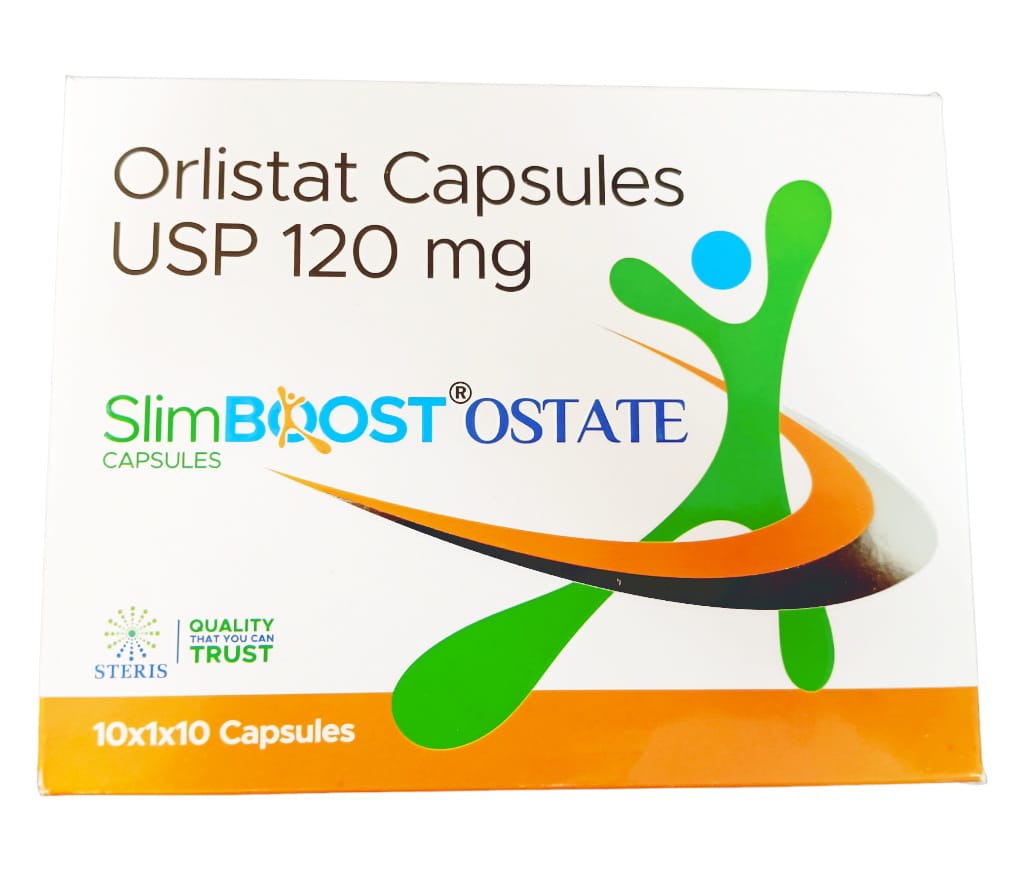
SLIM BOOST OSTATE
 Item requires a valid prescription
Manufactured By Steris Healthcare Pvt Ltd
Composition Orlistat (120mg)
Rs 505.32
MRP Rs 721.88
(30% OFF)
Includes all taxes
Package SIZE
( For 10 Capsules )

100% Authentic
Products

Free
Shipping*

Products
Return Policy
Description:
Orlistat 120 mg is a prescription-strength weight-management medicine used together with a reduced-calorie diet and lifestyle changes to help eligible adults with obesity lose weight and maintain weight loss. The medicine belongs to a class called lipase inhibitors. It works mainly inside the digestive tract rather than by suppressing appetite.
Orlistat blocks some gastrointestinal enzymes called lipases. These enzymes normally break dietary fat into smaller molecules that the body can absorb. By inhibiting some of this activity, orlistat reduces the amount of dietary fat absorbed, with the unabsorbed fat leaving the body in the stool
The 120 mg strength is associated with prescription orlistat products such as Xenical in the United States. In contrast, the U.S. over-the-counter product alli contains 60 mg of orlistat. The FDA's June 2026 safety communication confirms that orlistat 120 mg remains the higher-strength prescription formulation in the United States.
What Is Orlistat 120 mg Used For?
The primary use of orlistat 120 mg is medical weight management in people who meet appropriate criteria for pharmacological treatment of obesity.
Prescription orlistat is indicated for obesity management, including weight loss and weight maintenance, when used alongside a reduced-calorie diet. It can also be used to help reduce the risk of regaining weight after previous weight loss.
In clinical practice, eligibility depends on factors such as BMI, existing weight-related health conditions, previous attempts at weight management, and the individual's overall health. Requirements vary between countries and treatment guidelines.
Orlistat is not a cosmetic slimming pill intended for anyone who wants to lose a few kilograms. It is a medicine intended for appropriately selected patients.
How Does Orlistat 120 mg Work?
The mechanism of action is relatively straightforward:
-
You eat a meal containing dietary fat.
-
Digestive enzymes called lipases normally break down the fat.
-
Orlistat inhibits some of these enzymes in the gastrointestinal tract.
-
A portion of dietary fat is therefore not absorbed.
-
The unabsorbed fat passes out of the body in the stool.
Because its effect depends on dietary fat, eating a high-fat meal while taking orlistat can increase gastrointestinal side effects. The official prescribing information recommends a nutritionally balanced, reduced-calorie diet with approximately 30% of calories from fat.
This also explains why orlistat should be combined with nutrition and physical-activity changes rather than viewed as a stand-alone solution.
Key Benefits of Orlistat 120 mg
When prescribed for an appropriate patient, potential benefits include:
1. Supports medically supervised weight loss
Orlistat can support weight reduction when combined with a reduced-calorie, low-fat eating plan and regular physical activity. It is intended as part of a comprehensive weight-management strategy rather than a replacement for healthy lifestyle habits.
2. Helps reduce dietary fat absorption
Unlike appetite-suppressing medicines, orlistat works by reducing the absorption of some dietary fat in the intestine.
3. Can help with weight maintenance
Prescription orlistat is also indicated for weight maintenance and for reducing the risk of weight regain after previous weight loss.
4. Works locally in the digestive tract
Orlistat primarily acts in the gastrointestinal tract by inhibiting lipases. This is different from medicines whose principal effects involve the central nervous system.
5. May support improvement in weight-related health risks
Weight loss itself can be beneficial for people with obesity-related health concerns. However, individual outcomes vary, and orlistat should be selected based on a person's complete medical profile.
How to Take Orlistat 120 mg
The standard prescription regimen for Xenical is one 120 mg capsule three times daily with each main meal containing fat. The capsule can be taken during the meal or up to one hour afterward.
NHS guidance similarly advises taking orlistat before, with, or up to one hour after a main meal. If a meal is missed or contains no fat, the dose should generally be omitted.
Do not take extra capsules to compensate for a missed dose.
The most important practical point is that orlistat should be synchronized with meals. Taking it when there is no dietary fat to digest does not provide the intended benefit.
What Diet Should You Follow With Orlistat 120 mg?
Diet is a critical part of treatment.
The official prescribing information recommends a nutritionally balanced, reduced-calorie diet containing approximately 30% of calories from fat, distributed across the three main meals.
Eating very large amounts of fat at one meal can make gastrointestinal adverse effects more likely. Common problems include oily stools, oily spotting, urgency and increased bowel movements.
A sensible approach is to distribute dietary fat relatively evenly rather than consuming most of the day's fat in one meal.
Your doctor or registered dietitian can help establish an appropriate calorie target and nutritional plan.
Orlistat 120 mg Side Effects
The most characteristic side effects of orlistat 120 mg involve the digestive system.
Common adverse effects include:
-
Oily or fatty stools
-
Oily spotting
-
Gas with oily discharge
-
Urgent bowel movements
-
Increased frequency of bowel movements
-
Loose stools or diarrhea
-
Difficulty controlling bowel movements
-
Abdominal discomfort
-
Rectal discomfort
These effects are related to the way orlistat prevents some dietary fat from being absorbed. They can be more pronounced after high-fat meals.
NHS guidance also notes that these effects are less likely when patients follow a balanced diet and avoid meals that are particularly high in fat.
Serious side effects
Serious reactions are uncommon, but medical attention is important if concerning symptoms develop.
Potential warning signs include:
-
Severe or persistent abdominal pain
-
Symptoms of acute pancreatitis
-
Symptoms of severe allergic reaction
-
Yellowing of the skin or eyes
-
Dark urine
-
Significant unexplained weakness
-
Symptoms suggesting kidney injury
Rare cases of severe liver injury have been reported, although the relationship between orlistat and some reported liver injuries has not always been established.
The current FDA labeling also highlights oxalate kidney stones and oxalate nephropathy, including kidney failure in susceptible patients. The FDA updated its safety communication in June 2026 to emphasize the risk of acute kidney injury across FDA-approved orlistat products.
Orlistat 120 mg and Vitamins
Because orlistat reduces fat absorption, it can also reduce absorption of some fat-soluble vitamins, particularly vitamins A, D, E and K.
The prescribing information recommends taking a multivitamin containing fat-soluble vitamins while using prescription orlistat. The multivitamin should generally be taken at least 2 hours before or after orlistat, such as at bedtime.
Ask your doctor or pharmacist which supplement is appropriate for you rather than assuming that any multivitamin will provide exactly what you need.
Who Should Avoid Orlistat 120 mg?
Orlistat is not appropriate for everyone.
It should not be used in people with certain conditions, including chronic malabsorption syndrome or cholestasis, according to the prescription labeling.
Tell your healthcare professional if you have:
-
Kidney disease or a history of kidney stones
-
Gallbladder problems
-
Liver disease
-
Digestive or intestinal disorders
-
Diabetes
-
A history of pancreatitis
-
Nutritional deficiencies
-
Problems absorbing vitamins or minerals
The FDA's June 2026 safety communication specifically advises caution in people with a history of kidney disease or kidney stones because of the newly emphasized kidney-injury risk.
Orlistat 120 mg Drug Interactions
Tell your doctor and pharmacist about every medicine, supplement, and vitamin you take.
Particular attention may be needed with medicines such as:
-
Cyclosporine
-
Levothyroxine
-
Certain medicines used for diabetes
-
Warfarin or other medicines requiring careful monitoring
-
Antiepileptic medicines
-
Some medicines affected by changes in vitamin absorption
Orlistat can alter the absorption of some medicines or nutrients. The exact interaction depends on the medicine involved, so professional advice is important before combining treatments.
Orlistat 120 mg During Pregnancy and Breastfeeding
Orlistat is intended for weight management and is not generally recommended during pregnancy for weight-loss purposes.
NHS guidance also states that orlistat is not usually recommended during breastfeeding because it is not known whether the medicine passes into breast milk.
If you are pregnant, planning pregnancy, or breastfeeding, speak with your healthcare professional before using orlistat.
How Long Does Orlistat 120 mg Take to Work?
Orlistat begins affecting fat digestion relatively quickly, but meaningful weight loss takes longer and varies between individuals.
NHS Inform notes that orlistat usually begins affecting fat digestion within approximately one to two days.
The important measure is not whether you notice oily stools after the first dose, but whether the overall treatment program is producing appropriate weight-management results.
Treatment should be reassessed if sufficient weight loss is not achieved. NHS guidance states that continuing orlistat beyond three months is generally not recommended if the person has not lost at least 5% of their body weight.
Buying Orlistat 120 mg Safely
If you are searching online for buy orlistat 120 mg, prioritize safety over price or delivery speed.
Orlistat 120 mg is a prescription-strength medicine in the United States, while availability and prescription requirements differ by country. The FDA specifically identifies Xenical/orlistat 120 mg as the higher-strength prescription product.
Before purchasing:
-
Obtain the medicine through a legitimate, appropriately licensed pharmacy.
-
Use a valid prescription where required.
-
Check the active ingredient and strength.
-
Confirm the packaging is sealed and intact.
-
Check the expiry date and batch information.
-
Avoid websites promising guaranteed or unusually rapid weight loss.
-
Avoid products marketed as “100% side-effect free.”
-
Ask a pharmacist if the product's authenticity or formulation is uncertain.
NHS specifically warns that some websites sell fake weight-loss medicines and recommends purchasing orlistat through a registered pharmacy.
Orlistat 120 mg vs. Orlistat 60 mg
The two strengths should not be treated as interchangeable without professional guidance.
Orlistat 120 mg is the prescription-strength formulation used in products such as Xenical in the United States. Orlistat 60 mg is available over the counter in the United States as alli for eligible adults.
The appropriate strength depends on the product, regulatory requirements, and individual medical circumstances.
Frequently Asked Questions
1. What is orlistat 120 mg used for?
Orlistat 120 mg is used with a reduced-calorie diet and lifestyle changes for medical weight management, including weight loss and weight maintenance in appropriately selected people with obesity.
2. How does orlistat 120 mg work?
It inhibits gastrointestinal lipases, reducing the breakdown and absorption of some dietary fat. The unabsorbed fat passes out in the stool.
3. How should I take orlistat 120 mg?
The standard prescription dose is one 120 mg capsule three times daily with each main meal containing fat, during the meal or within one hour afterward.
4. Can I take orlistat 120 mg without food?
If you skip a meal or the meal contains no fat, the orlistat dose is generally skipped. It is intended to work with dietary fat.
5. What are the most common side effects of orlistat 120 mg?
The most characteristic effects are oily or fatty stools, oily spotting, gas with discharge, bowel urgency, increased bowel movements, loose stools and abdominal discomfort.
6. Does orlistat 120 mg cause diarrhea?
Yes, diarrhea and loose stools can occur. Gastrointestinal side effects tend to be more likely when meals contain excessive amounts of fat.
7. Does orlistat 120 mg cause oily stools?
Yes. Oily or fatty stools and oily spotting are characteristic effects because some dietary fat is not absorbed.
8. Does orlistat 120 mg reduce appetite?
Orlistat does not primarily work by suppressing appetite. Its main action is reducing the intestinal absorption of some dietary fat.
9. How quickly does orlistat 120 mg work?
Orlistat can begin affecting fat digestion within approximately one to two days, but clinically meaningful weight loss develops over time when treatment is combined with dietary and lifestyle changes.
10. How much weight can I lose with orlistat 120 mg?
There is no guaranteed amount of weight loss. Individual results depend on diet, physical activity, adherence, starting weight, medical conditions and other factors. Orlistat is intended to support—not replace—a comprehensive weight-management program.
11. Can I take orlistat 120 mg with a high-fat meal?
You can take the prescribed dose with a meal containing fat, but high-fat meals increase the likelihood of unpleasant gastrointestinal effects. A balanced diet with controlled fat intake is recommended. (
12. Do I need vitamins while taking orlistat 120 mg?
A multivitamin containing fat-soluble vitamins is recommended with prescription orlistat because absorption of vitamins A, D, E and K can be reduced.
13. Can I take a multivitamin with orlistat 120 mg?
Yes, but it should generally be taken at a different time from orlistat. The prescription labeling recommends taking the multivitamin at least two hours before or after orlistat, such as at bedtime.
14. Is orlistat 120 mg safe for everyone?
No. People with certain conditions, including chronic malabsorption syndrome or cholestasis, should not use it. Kidney disease, kidney stones, liver disease and other conditions require discussion with a healthcare professional.
15. Can orlistat 120 mg cause kidney problems?
Rare kidney complications can occur. In June 2026, the FDA highlighted acute kidney injury and updated labeling information for FDA-approved orlistat products, including the risk of oxalate-related kidney injury.
16. Can orlistat 120 mg cause liver problems?
Rare cases of severe liver injury have been reported. Seek medical advice for symptoms such as yellowing of the skin or eyes, dark urine, severe persistent abdominal symptoms, or unexplained weakness.
17. Can I take orlistat 120 mg during pregnancy?
Orlistat is not generally used for weight loss during pregnancy. If you are pregnant or planning pregnancy, discuss your treatment with your healthcare professional.
18. Can I buy orlistat 120 mg online?
Prescription requirements depend on the country. If buying online, use only a legitimate, registered pharmacy and follow applicable prescription rules. Avoid websites selling unverified weight-loss medicines or promising guaranteed results.
19. Is orlistat 120 mg the same as orlistat 60 mg?
No. They contain the same active ingredient but different strengths. In the United States, orlistat 120 mg is the prescription-strength formulation, while 60 mg is available OTC as alli for eligible adults.
20. What happens if I miss an orlistat 120 mg dose?
If more than one hour has passed since the meal, NHS guidance recommends skipping the missed dose and taking the next dose with the next appropriate meal. Do not take two doses together.
21. How long can I take orlistat 120 mg?
Treatment duration depends on your response and medical circumstances. Continued treatment should be reassessed if meaningful weight loss is not occurring. NHS guidance uses a 5% body-weight-loss benchmark at three months when deciding whether treatment should continue.
22. Does orlistat 120 mg work without exercise?
Orlistat is intended to be used as part of a comprehensive weight-management program that includes diet and physical activity. It should not be relied upon as a substitute for lifestyle measures.

